
Nob is a city mentioned in the Bible, notably in 1 Samuel 21-22, where it served as a sanctuary for David and his men. It was known for its priests and the tabernacle, and it became the site of a tragic massacre ordered by King Saul.
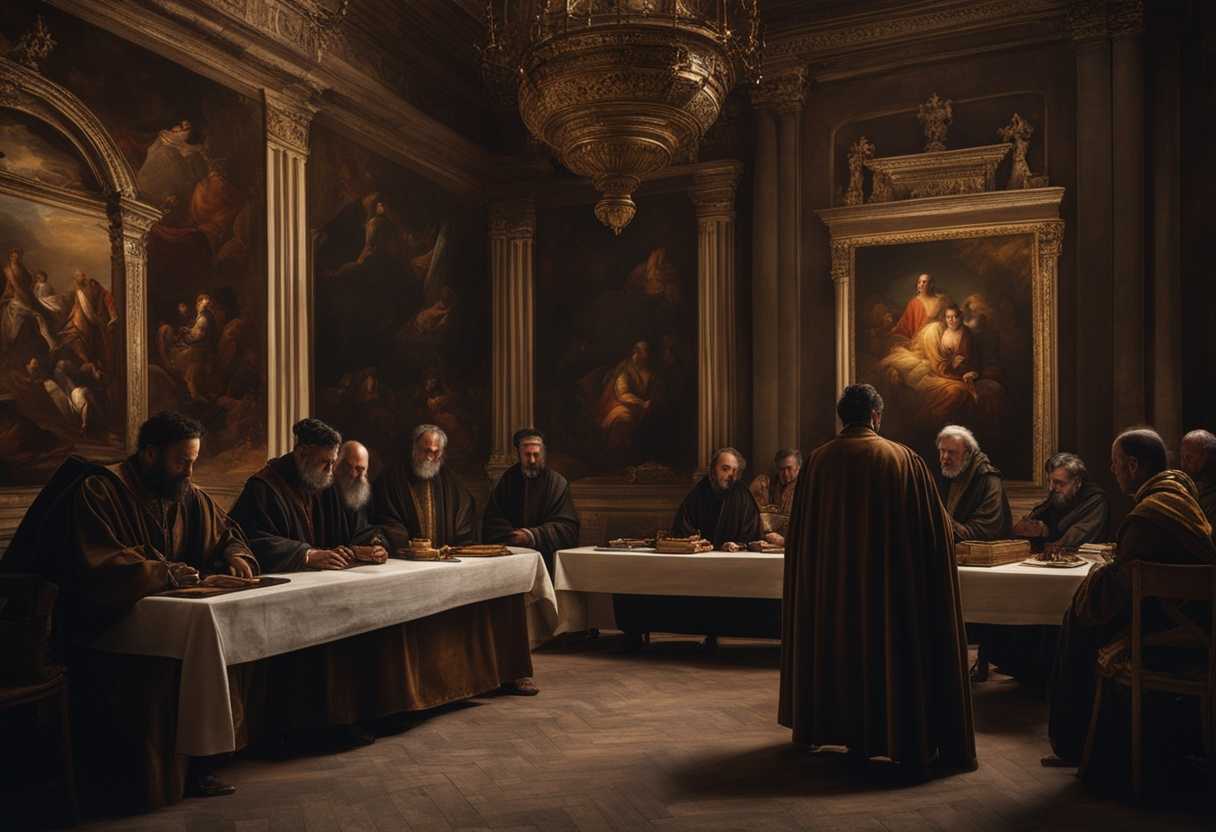
Scripture
1 Then David came to Nob to Ahimelech the priest. And Ahimelech came to meet David trembling and said to him, “Why are you alone, and no one with you?”
2 And David said to Ahimelech the priest, “The king has charged me with a matter and said to me, ‘Let no one know anything of the matter about which I send you, and with which I have charged you.’ I have made an appointment with the young men for such and such a place.
3 Now then, what do you have on hand? Give me five loaves of bread, or whatever is here.”
4 And the priest answered David, “I have no common bread on hand, but there is holy bread—if the young men have kept themselves from women.”
5 And David answered the priest, “Truly women have been kept from us as always when I go on an expedition. The vessels of the young men are holy even when it is an ordinary journey. How much more today will their vessels be holy?”
6 So the priest gave him the holy bread, for there was no bread there but the bread of the Presence, which is removed from before the Lord, to be replaced by hot bread on the day it is taken away.
7 Now a certain man of the servants of Saul was there that day, detained before the Lord. His name was Doeg the Edomite, the chief of Saul’s herdsmen.
8 And David said to Ahimelech, “Is there not here on hand a spear or a sword? For I have brought neither my sword nor my weapons with me, because the king’s business required haste.”
9 And the priest said, “The sword of Goliath the Philistine, whom you struck down in the Valley of Elah, behold, it is here wrapped in a cloth behind the ephod. If you will take that, take it, for there is none but that here.” And David said, “There is none like that; give it to me.”
Meaning of Nob in the Bible
In the biblical narrative, Nob represents a poignant intersection of sanctuary and tragedy, reflecting themes of faith, refuge, and the dire consequences of tyranny. As recounted in 1 Samuel 21-22, David sought refuge in Nob when fleeing from King Saul, indicating the city’s prominent role as a sanctuary for the faithful during times of distress. The priests at Nob provided David with consecrated bread and Goliath’s sword, symbolizing divine provision in moments of need (1 Samuel 21:6-9). However, the narrative quickly turns somber, as Saul, paranoid and vengeful, orders the massacre of Nob’s priests (1 Samuel 22:16-19). This horrific act illustrates the fragility of righteousness in the face of political power that turns violent, serving as a stark warning about the consequences of human corruption and the tragic fate that can befall innocent people amidst conflict.
Moreover, Nob’s significance extends beyond its immediate historical context to offer broader theological reflections on justice, mercy, and the protection of those who embody faithfulness. The massacre at Nob can be seen as a foreshadowing of the oppression that the faithful might face in a world marred by sin and tyranny. In this light, passages like Psalm 34:18, which declares that “the Lord is close to the brokenhearted,” resonate deeply against the backdrop of Nob’s tragedy. Nob thus becomes emblematic of Jesus’ later teachings about caring for the marginalized and oppressed, inviting believers to reflect on their responses to injustice and the call to find refuge in God even amidst life’s sufferings. Through these narratives, Nob invites us to grapple with the complexities of faith, leadership, and the imperative to safeguard the vulnerable within our communities.
The story of Nob not only highlights the grim realities faced by those seeking sanctuary but also raises profound questions about the institutions of faith and justice in a world rife with peril. The actions of the priests who aided David underscore the importance of hospitality and mercy in the face of danger. Their willingness to provide help, even at great risk to themselves, reflects the biblical call to love one’s neighbor and to act justly, illustrating a commitment to God’s covenant amidst chaos. This theme resonates with scriptural teachings on the significance of community and mutual support, particularly during tumultuous times when the lines between safety and peril can blur.
Furthermore, in examining the implications of Nob’s destruction, it becomes apparent that the city serves as a metaphor for the broader tension between divine providence and human agency. The ethical failures of King Saul are juxtaposed against the steadfastness of those who remain loyal to God’s purposes, an ongoing motif throughout biblical history. Nob embodies the perilous positions of those who strive to uphold righteousness, confronting the complexities of moral choice, legacy, and the consequences of unchecked power. The narrative compels readers to reflect on the enduring responsibility to protect the ‘Nobs’ in our society—those who stand at the intersection of vulnerability and faith—and to seek avenues for justice and restoration in places where their safety is threatened. As we consider Nob’s legacy, we are drawn into a dialogue about the essential human call to advocate for the weak and to embody the principles of compassion and righteousness in the face of overwhelming odds.
A Place of Refuge and Provision
Nob is depicted as a location where individuals sought refuge and sustenance during times of distress. It symbolizes the idea of finding safety and support in moments of vulnerability, reflecting the broader biblical theme of God providing for His people in their times of need. This aspect of Nob serves as a reminder of the importance of community and the divine provision that can be found even in unexpected places.
The Consequences of Betrayal
The narrative surrounding Nob also highlights the severe consequences that can arise from betrayal and the misuse of trust. The events that transpired in Nob illustrate the tragic outcomes that can occur when individuals are caught in the crossfire of political and personal conflicts. This serves as a cautionary tale about the fragility of human relationships and the impact of choices made in times of crisis.
A Symbol of Spiritual Conflict
Nob can also be interpreted as a representation of the spiritual conflicts faced by individuals and communities. The events that unfolded in this location reflect the broader struggles between good and evil, faith and fear. Nob serves as a backdrop for the challenges that arise when one is caught between loyalty to God and the pressures of the world, emphasizing the need for discernment and steadfastness in one’s spiritual journey.
How to Embrace Faith in Every Circumstance
Embracing faith in every circumstance can feel daunting, especially when life throws challenges our way, but it’s in these moments that our faith can truly shine. Start by grounding yourself in prayer and scripture; these practices not only strengthen your relationship with God but also provide comfort and guidance. Remember the stories of biblical figures like Job, who maintained his faith amidst suffering, or Paul, who found joy in prison. Reflect on how their unwavering trust in God can inspire you to see trials as opportunities for growth. Surround yourself with a supportive community that encourages you to share your struggles and victories alike. Finally, practice gratitude daily, even for the small things, as this shifts your focus from what’s going wrong to the blessings that remain. By intentionally choosing to trust God in every situation, you’ll find that your faith becomes a steadfast anchor, guiding you through life’s storms.
Bible References to the Meaning of Nob:
1 Samuel 22:9-23: 9 Then answered Doeg the Edomite, who stood by the servants of Saul, “I saw the son of Jesse coming to Nob, to Ahimelech the son of Ahitub,
10 And he inquired of the Lord for him and gave him provisions. He also gave him the sword of Goliath the Philistine.”
11 Then the king sent to summon Ahimelech the priest, the son of Ahitub, and all his father’s house, the priests who were at Nob, and all of them came to the king.
12 And Saul said, “Hear now, son of Ahitub.” And he answered, “Here I am, my lord.”
13 And Saul said to him, “Why have you conspired against me, you and the son of Jesse, in that you have given him bread and a sword and have inquired of God for him, so that he has risen against me, to lie in wait, as at this day?”
14 Then Ahimelech answered the king, “And who among all your servants is so faithful as David, who is the king’s son-in-law, and captain over your bodyguard, and honored in your house?
15 Did I then begin to inquire of God for him? No! Far be it from me. Let not the king impute anything to his servant or to all the house of my father, for your servant has known nothing of all this, much or little.”
16 And the king said, “You shall surely die, Ahimelech, you and all your father’s house.”
17 And the king said to the guard who stood about him, “Turn and kill the priests of the Lord, because their hand also is with David, and they knew that he fled and did not disclose it to me.” But the servants of the king would not put out their hand to strike the priests of the Lord.
18 Then the king said to Doeg, “You turn and strike the priests.” And Doeg the Edomite turned and struck down the priests, and he killed on that day eighty-five persons who wore the linen ephod.
19 And Nob, the city of the priests, he put to the sword; both man and woman, child and infant, ox, donkey, and sheep, he put to the sword.
20 But one of the sons of Ahimelech the son of Ahitub, named Abiathar, escaped and fled after David.
21 And Abiathar told David that Saul had killed the priests of the Lord.
22 And David said to Abiathar, “I knew on that day, when Doeg the Edomite was there, that he would surely tell Saul. I have occasioned the death of all the persons of your father’s house.
23 Stay with me; do not be afraid, for he who seeks my life seeks your life. With me you shall be safe.”
Isaiah 10:28-32: 28 He has come to Aiath; he has passed through Migron; at Michmash he stores his baggage;
29 They have crossed over the pass; at Geba they lodge for the night; Ramah trembles; Gibeah of Saul has fled.
30 Cry aloud, O daughter of Gallim! Give attention, O Laishah! O poor Anathoth!
31 Madmenah is in flight;
the inhabitants of Gebim flee for safety.
32 This very day he will halt at Nob; he will shake his fist at the mount of the daughter of Zion, the hill of Jerusalem.

Reverend Ogunlade is a seasoned Church Minister with over three decades of experience in guiding and nurturing congregations. With profound wisdom and a serene approach, Reverend Ogunlade has carried out various pastoral duties, including delivering uplifting sermons, conducting religious ceremonies, and offering sage counsel to individuals seeking spiritual guidance. Their commitment to fostering harmony and righteousness within their community is exemplified through their compassionate nature, making them a beloved and trusted figure among the congregation.