
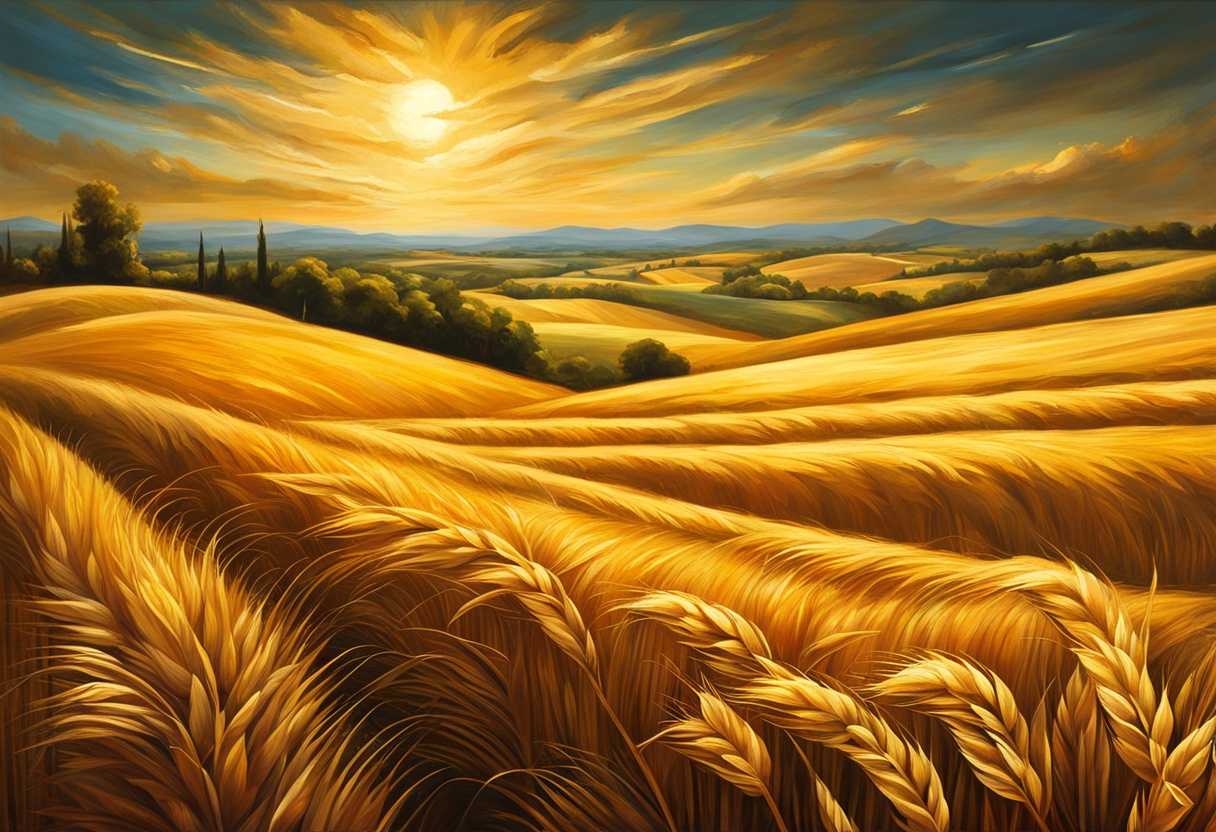
In the Bible, wheat symbolizes abundance, nourishment, and God’s provision, often representing the blessings of harvest and the sustenance necessary for life (Matthew 13:30). It also has spiritual significance, as it can signify the people of God and their growth in faith, as exemplified in the parable of the wheat and tares (Matthew 13:24-30).
Scripture
47 During the seven plentiful years the earth produced abundantly.
48 And he gathered up all the food of the seven years that the land of Egypt produced, and stored up the food in the cities. He put in every city the food from the fields around it.
49 Joseph stored up grain in great abundance, like the sand of the sea, until he ceased to measure it, for it could not be measured.
Biblical Significance of Wheat
Wheat holds profound significance in the Bible, representing not only physical sustenance but also spiritual nourishment and God’s provision for His people. In Matthew 13:30, Jesus speaks of the harvest, signifying a time of gathering both the good wheat (the righteous) and the tares (the unrighteous). This imagery illustrates God’s ultimate plan for His creation, where the faithful are preserved and rewarded. The abundance of wheat is a metaphor for the blessings of life that come from God, seen in scriptures such as Psalm 104:14, where God provides grain for man. The motif of wheat is closely tied to the themes of faith, growth, and eventual judgment, where believers are nourished in their spiritual journey, much like the physical nourishment received from wheat.
Moreover, wheat emphasizes the communal aspect of faith and sustenance, as it’s often linked to community gatherings and celebrations, particularly during harvest times, which are heavily featured in the Jewish festivals such as the Feast of Weeks (Shavuot). In John 12:24, Jesus uses the metaphor of a grain of wheat falling to the ground and dying to produce a rich harvest, symbolizing His impending death and resurrection and demonstrating that through sacrifice comes abundance. Thus, wheat serves as a multifaceted symbol of life, drawing connections not only to God’s bountiful provision and care for His creation but also to the call for believers to bear fruit in their walk of faith, ultimately pointing towards eternal life through Christ.
In addition to its representation of physical nourishment, wheat symbolizes the qualities of faith, resilience, and the transformative power of God’s grace. Throughout biblical texts, wheat is often associated with growth and the Kingdom of God. For instance, the agricultural imagery prevalent in Scripture paints a picture of believers engaged in spiritual cultivation, as they plant seeds of faith that grow and mature into fruitful lives. The parable of the sower (not specifically mentioned here) illustrates how different conditions affect the growth of the seed, reminding us that nurturing a relationship with God can lead to abundant spiritual yields, akin to a field filled with golden wheat ready for harvest.
Wheat’s role extends to the broader theme of sacrifice and redemption, particularly in the context of the Old Testament sacrificial system. During the Feast of Unleavened Bread, which follows Passover, offerings of wheat were presented to God as a form of gratitude for His provisions. This connection reveals a deeper understanding of how life’s necessities are intertwined with spiritual obedience and gratitude. It indicates that the blessings bestowed upon the Israelites came at the cost of their commitment to God. Additionally, wheat fields are often seen as places of abundance and promise, mirroring the biblical portrayal of the Promised Land flowing with milk and honey, which stands as a testament to God’s covenant with His people. Thus, the significance of wheat transcends physical sustenance and serves as a reminder of the faith journey, communal responsibility, and the blessed hope that believers are called to embrace.
Symbol of Abundance and Provision
Wheat is often seen as a symbol of God’s provision and abundance. In agrarian societies, a good harvest of wheat represented not only sustenance for the people but also a sign of divine blessing. The growth and harvest of wheat reflect God’s care for His creation, illustrating the idea that He provides for the needs of His people. This abundance is often linked to the covenant relationship between God and His followers, emphasizing the blessings that come from faithfulness and obedience.
Metaphor for Spiritual Nourishment
Wheat also serves as a metaphor for spiritual nourishment in the Bible. Just as physical bread made from wheat sustains the body, spiritual teachings and the Word of God nourish the soul. This connection highlights the importance of seeking spiritual sustenance through prayer, scripture, and community. The imagery of wheat and bread is frequently used to convey deeper truths about faith, growth, and the transformative power of God’s presence in the lives of believers.
Representation of Growth and Harvest
The life cycle of wheat—from planting to harvesting—symbolizes growth and the process of maturation in the spiritual life. This journey reflects the idea of sowing seeds of faith, enduring trials, and ultimately reaping a harvest of righteousness. The agricultural metaphor emphasizes the importance of patience, perseverance, and the eventual rewards that come from a life dedicated to spiritual cultivation. This theme resonates throughout the biblical narrative, encouraging believers to remain steadfast in their faith as they await the fruits of their labor.
How to Cultivate a Life of Abundance in Faith
Cultivating a life of abundance in faith begins with a heart open to God’s promises and a willingness to trust in His provision. Start each day with gratitude, acknowledging the blessings you already have, no matter how small they may seem. This practice shifts your focus from scarcity to abundance, reminding you that God is always at work in your life. Engage in prayer and scripture reading, allowing His words to fill you with hope and encouragement. Surround yourself with a community of believers who uplift and inspire you, as fellowship can deepen your faith and provide support during challenging times. Finally, remember that abundance isn’t just about material wealth; it’s about the richness of love, joy, and peace that comes from a relationship with Christ. As you cultivate this mindset, you’ll find that your faith flourishes, leading to a life overflowing with blessings that you can share with others.
Bible References to the Significance of Wheat:
Exodus 9:31-32: 31 Now the flax and the barley were struck down, for the barley was in the ear and the flax was in bud.
32 The wheat and the emmer were not struck down, for they are late in coming up.
Leviticus 23:15-17: 15 “You shall count seven full weeks from the day after the Sabbath, from the day that you brought the sheaf of the wave offering.”
16 You shall count fifty days to the day after the seventh Sabbath. Then you shall present a grain offering of new grain to the Lord.
17 You shall bring from your dwelling places two loaves of bread to be waved, made of two tenths of an ephah. They shall be of fine flour, and they shall be baked with leaven, as firstfruits to the Lord.
Deuteronomy 8:7-9: 7 For the Lord your God is bringing you into a good land, a land of brooks of water, of fountains and springs, flowing out in the valleys and hills,
8 a land of wheat and barley, of vines and fig trees and pomegranates, a land of olive trees and honey,
9 a land in which you will eat bread without scarcity, in which you will lack nothing, a land whose stones are iron, and out of whose hills you can dig copper.
Ruth 2:2-3: 2 And Ruth the Moabite said to Naomi, “Let me go to the field and glean among the ears of grain after him in whose sight I shall find favor.” And she said to her, “Go, my daughter.”
3 So she set out and went and gleaned in the field after the reapers, and she happened to come to the part of the field belonging to Boaz, who was of the clan of Elimelech.
2 Samuel 17:27-29: 27 When David came to Mahanaim, Shobi the son of Nahash from Rabbah of the Ammonites, and Machir the son of Ammiel from Lo-debar, and Barzillai the Gileadite from Rogelim,
28 brought beds, basins, and earthen vessels, wheat, barley, flour, parched grain, beans and lentils,
29 honey, curds, sheep, and cheese from the herd, for David and the people with him to eat, for they said, “The people are hungry and weary and thirsty in the wilderness.”
1 Kings 5:10-11: 10 So Hiram supplied Solomon with all the timber of cedar and cypress that he desired,
11 Solomon also gave Hiram twenty thousand cors of wheat as food for his household, and twenty thousand cors of beaten oil. Solomon gave this to Hiram year by year.
2 Chronicles 2:15-16: 15 Now therefore the wheat and barley, oil and wine, of which my lord has spoken, let him send to his servants.
16 And we will cut whatever timber you need from Lebanon and bring it to you in rafts by sea to Joppa, so that you may take it up to Jerusalem.”
Job 31:38-40: 38 “If my land has cried out against me and its furrows have wept together,”
39 if I have eaten its yield without payment
and made its owners breathe their last,
40 let thorns grow instead of wheat,
and foul weeds instead of barley.”
Psalm 81:13-16: 13 Oh, that my people would listen to me, that Israel would walk in my ways!
14 I would soon subdue their enemies and turn my hand against their foes.
15 Those who hate the Lord would cringe toward him, and their fate would last forever.
16 But he would feed you with the finest of the wheat, and with honey from the rock I would satisfy you.
Isaiah 28:23-29: 23 Give ear, and hear my voice;
give attention, and hear my speech.
24 Does he not work by measure? Does he not plow in sowing time and harrow the land?
25 When he has leveled its surface,
does he not scatter dill, sow cumin,
and put in wheat in rows
and barley in its proper place,
and emmer as the border?
26 For he dill his God instructs him and teaches him.
27 Dill is not threshed with a threshing sledge, nor is a cart wheel rolled over cumin, but dill is beaten out with a stick, and cumin with a rod.
28 When one prepares a fine flour, will he not sift it with a sieve before mixing it with oil?
29 This also comes from the Lord of hosts; he is wonderful in counsel and excellent in wisdom.
Jeremiah 12:13: 13 They have sown wheat and have reaped thorns; they have tired themselves out but profit nothing. They shall be ashamed of their harvests because of the fierce anger of the Lord.”
Ezekiel 4:9-12: 9 “And you, take wheat and barley, beans and lentils, millet and emmer, and put them into a single vessel and make your bread from them.
10 And your food that you eat shall be by weight, twenty shekels a day; from day to day you shall eat it.
11 You shall drink water by measure, the sixth part of a hin; you shall drink at fixed times.
12 And you shall eat it as a barley cake, baking it in their sight on human dung.”
Hosea 2:21-23: 21 “And in that day I will answer, declares the Lord,
I will answer the heavens,
and they shall answer the earth,”
22 and the earth shall answer the grain, the wine, and the oil, and they shall answer Jezreel,
23 And I will have mercy on No Mercy, and I will say to Not My People, ‘You are my people’; and he shall say, ‘You are my God.’”
Joel 1:10-12: 10 The fields are destroyed, the ground mourns, because the grain is destroyed, the wine dries up, the oil languishes.
11 Be ashamed, O tillers of the soil; wail, O vinedressers, for the wheat and the barley, because the harvest of the field has perished.
12 The vine dries up; the fig tree languishes. The pomegranate, palm, and apple, all the trees of the field are dried up, and gladness dries up from the children of man.
Amos 8:4-6: 4 Hear this, you who trample on the needy and bring the poor of the land to an end,
5 saying, “When will the new moon be over, that we may sell grain? And the Sabbath, that we may offer wheat for sale, that we may make the ephah small and the shekel great and deal deceitfully with false balances,
6 that we may buy the poor for silver
and the needy for a pair of sandals
and sell the chaff of the wheat?”
Matthew 3:11-12: 11 “I baptize you with water for repentance, but he who is coming after me is mightier than I, whose sandals I am not worthy to carry. He will baptize you with the Holy Spirit and fire.”
12 His winnowing fork is in his hand, and he will clear his threshing floor and gather his wheat into the barn, but the chaff he will burn with unquenchable fire.
Matthew 13:24-30: 24 He put another parable before them, saying, “The kingdom of heaven may be compared to a man who sowed good seed in his field,
25 but while his men were sleeping, his enemy came and sowed weeds among the wheat and went away.
26 But when the plants sprouted and bore grain, then the weeds appeared also.
27 And the servants of the master of the house came and said to him, ‘Master, did you not sow good seed in your field? How then does it have weeds?’
28 He said to them, ‘An enemy has done this.’ So the servants said to him, ‘Then do you want us to go and gather them?’
29 But he said, ‘No, lest in gathering the weeds you root up the wheat along with them.
30 Let both grow together until the harvest, and at harvest time I will tell the reapers, “Gather the weeds first and bind them in bundles to be burned, but gather the wheat into my barn.”
Luke 3:16-17: 16 John answered them all, saying, “I baptize you with water, but he who is mightier than I is coming, the strap of whose sandals I am not worthy to untie. He will baptize you with the Holy Spirit and fire.
17 His winnowing fork is in his hand, to clear his threshing floor and to gather the wheat into his barn, but the chaff he will burn with unquenchable fire.
John 12:23-24: 23 And Jesus answered them, “The hour has come for the Son of Man to be glorified.
24 Truly, truly, I say to you, unless a grain of wheat falls into the earth and dies, it remains alone; but if it dies, it bears much fruit.
1 Corinthians 15:36-38: You foolish person! What you sow does not come to life unless it dies.
37 And what you sow is not the body that is to be, but a bare kernel, perhaps of wheat or of some other grain.
38 But God gives it a body as he has chosen, and to each kind of seed its own body.
Revelation 6:5-6: 5 When he opened the third seal, I heard the third living creature say, “Come!” And I looked, and behold, a black horse! And its rider had a pair of scales in his hand.
6 And I heard what seemed to be a voice in the midst of the four living creatures, saying, “A quart of wheat for a denarius, and three quarts of barley for a denarius, and do not harm the oil and wine!”

Rev. François Dupont is a dedicated church minister with a wealth of experience in serving spiritual communities. With a calm and serene demeanor, he has been devoted to sharing the message of love, compassion, and tolerance for over two decades. Through his thoughtful sermons, compassionate counseling, and unwavering support, Rev. Dupont has touched the lives of countless individuals, allowing them to find solace and strength during difficult times. His serene presence and deep understanding of the human condition make him a trusted guide for those seeking spiritual nourishment and guidance.