
1 On the third day there was a wedding at Cana in Galilee, and the mother of Jesus was there.
2 Jesus also was invited to the wedding with his disciples.
3 When the wine ran out, the mother of Jesus said to him, “They have no wine.”
4 And Jesus said to her, “Woman, what does this have to do with me? My hour has not yet come.”
5 His mother said to the servants, “Do whatever he tells you.”
6 Now there were six stone water jars there for the Jewish rites of purification, each holding twenty or thirty gallons.
7 Jesus said to the servants, “Fill the jars with water.” And they filled them up to the brim.
8 And he said to them, “Now draw some out and take it to the master of the feast.” So they took it.
9 When the master of the feast tasted the water now become wine, and did not know where it came from (though the servants who had drawn the water knew), the master of the feast called the bridegroom.
10 and said to him, “Everyone serves the good wine first, and when people have drunk freely, then the poor wine. But you have kept the good wine until now.”
11 This, the first of his signs, Jesus did at Cana in Galilee, and manifested his glory. And his disciples believed in him.
12 After this he went down to Capernaum, with his mother and his brothers and his disciples, and they stayed there for a few days.
13 The Passover of the Jews was at hand, and Jesus went up to Jerusalem.
14 In the temple he found those who were selling oxen and sheep and pigeons, and the money-changers sitting there.
15 And making a whip of cords, he drove them all out of the temple, with the sheep and oxen. And he poured out the coins of the money-changers and overturned their tables.
16 And he told those who sold the pigeons, “Take these things away; do not make my Father’s house a house of trade.”
17 His disciples remembered that it was written, “Zeal for your house will consume me.”
18 So the Jews said to him, “What sign do you show us for doing these things?”
19 Jesus answered them, “Destroy this temple, and in three days I will raise it up.”
20 The Jews then said, “It has taken forty-six years to build this temple, and will you raise it up in three days?”
21 But he was speaking about the temple of his body.
22 When therefore he was raised from the dead, his disciples remembered that he had said this, and they believed the Scripture and the word that Jesus had spoken.
23 Now when he was in Jerusalem at the Passover Feast, many believed in his name when they saw the signs that he was doing.
24 But Jesus on his part did not entrust himself to them, because he knew all people
25 and needed no one to bear witness about man, for he himself knew what was in man.
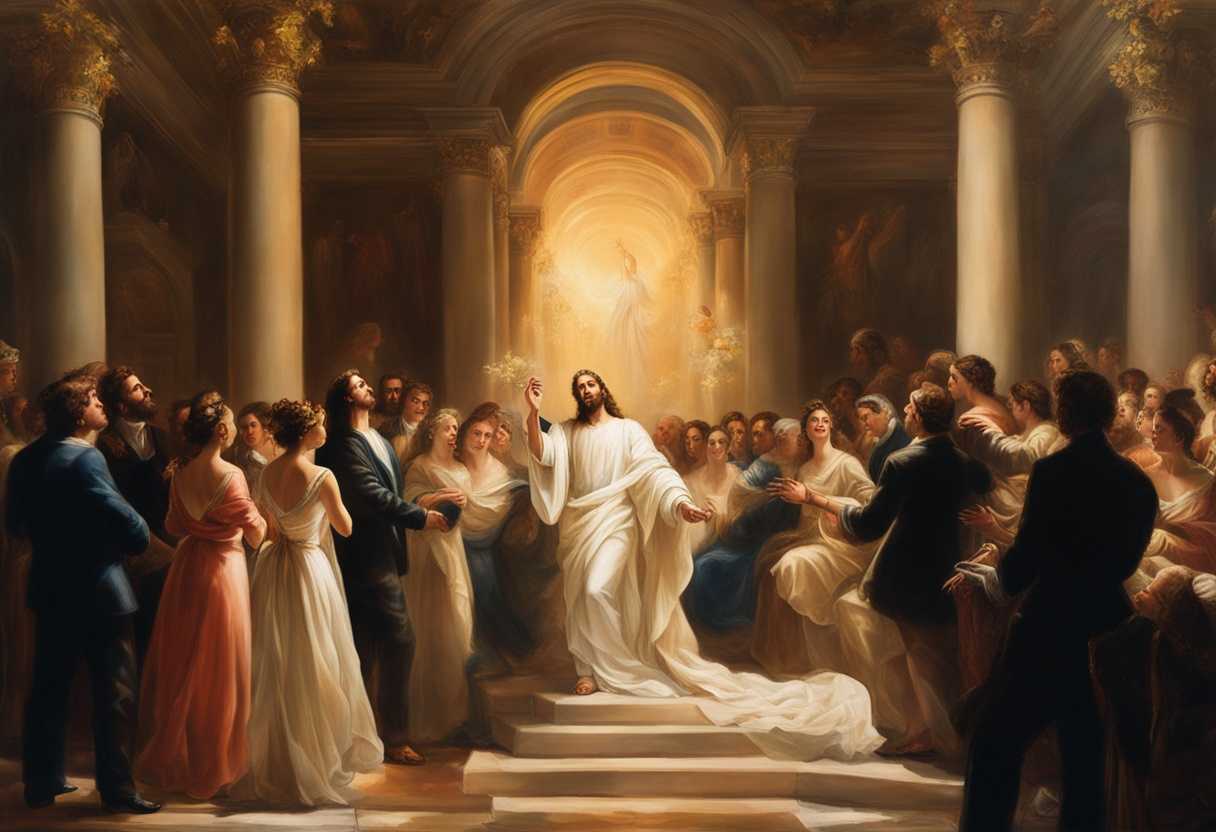
The True Meaning of John 2
This passage from the Gospel of John provides an account of some of the early events in the ministry of Jesus Christ. The author, John, was one of the twelve disciples of Jesus and a close companion. He offers a unique perspective on the life and teachings of the Savior. Jesus performs his first recorded miracle in this chapter, foreshadowing the incredible power and authority he will demonstrate throughout his earthly ministry. We also see Jesus asserting his divine role as the Messiah, challenging the religious establishment, and drawing his first followers. These events set the stage for the profound impact Jesus will have on the world.
The chapter opens with Jesus attending a wedding celebration in Cana, where he miraculously transforms water into wine, displaying his mastery over the natural world. This miracle not only demonstrates Jesus’ supernatural abilities but also his compassion and concern for the well-being of those around him. Throughout the Gospels, we will see that Jesus is not merely a teacher or prophet, but the long-awaited Messiah, the Son of God.
John 2:1-5
Jesus performs his first public miracle by turning water into wine in the passage about the wedding at Cana in John 2:1-5. Let’s break this down into sections.
Verse 1: “On the third day a wedding took place at Cana in Galilee. Jesus’ mother was there,”
Here, the mention of the setting being on the third day signifies a new beginning or a fresh start. The wedding at Cana is symbolic of the union between Christ and his followers, which is often depicted as a metaphorical marriage in the Bible. Jesus’ mother being present is noteworthy because it signifies her faith and belief in her son’s abilities even before his public ministry begins.
Verse 2: “and Jesus and his disciples had also been invited to the wedding. Jesus and his disciples actively participate in the celebrations and events of everyday life by being invited to the wedding. This highlights the humanity of Jesus and his willingness to engage with people in their joys and festivities.
Verse 3: “When the wine was gone, Jesus’ mother said to him, “They have no more wine.””
Mary, the mother of Jesus, plays a unique role in this narrative. She demonstrates her trust in Jesus’s ability to solve problems by bringing the issue of the wine shortage to him. This shows Mary’s faith in her son’s divinity and authority. Mary’s words also echo her concern for the hosts of the wedding, showing her compassion for others.
Verse 4: “Woman, why do you involve me?” Jesus replied. “My hour has not yet come.”
Jesus’ response to Mary is intriguing. Referring to Mary as “woman” may seem curt to us, but in biblical times, it was a respectful term. Jesus is also drawing attention to the fact that his actions are in accordance with a divine timetable, signaling that his miracles will be aligned with God’s plan and timing. This dialogue highlights Jesus’ obedience to God the Father and his awareness of the timing of his ministry.
Verse 5: His mother said to the servants, “Do whatever he tells you.”
Mary’s wise words to the servants are a powerful declaration of faith and obedience. She trusts Jesus implicitly and encourages the servants to follow Jesus’ instructions. This statement embodies a crucial message for all believers: to trust in Jesus completely and follow his guidance without hesitation. Mary’s faith and submission to Jesus serve as an example for Christians to follow. This passage from John 2:1-5 not only narrates the miraculous event of turning water into wine but also conveys essential lessons about faith, obedience, and the divine timing of Jesus’ ministry. Mary’s pivotal role in this event showcases her faith, trust, and understanding of Jesus as the promised Messiah. This miracle at the wedding at Cana marks the beginning of Jesus’ public ministry and points to his divine authority over nature and his ability to bring abundance out of scarcity. This miracle also sets the stage for the reveal of Jesus’ glory, as stated in John 2:11, which strengthens the faith of his disciples and affirms his divine identity.
John 2:6-11
The passage in John 2:6-11 describes the scene at the wedding in Cana where Jesus performed his first miracle. Let’s break this down into important sections:
-
“Now there were six stone water jars set there for the Jewish custom of purification, containing twenty or thirty gallons each.” – This sets the stage for the miracle that is about to take place. The water jars were used for ceremonial washing, emphasizing the importance of purification in Jewish tradition. The fact that these jars were empty would have been significant to the guests at the wedding, as it would have symbolized that the purification process was incomplete.
-
“Jesus said to the servants, ‘Fill the jars with water.’ And they filled them up to the brim.” – Here, Jesus instructs the servants to fill the jars with water. This seemingly simple command leads to a profound display of his divinity. The obedience of the servants echoes themes of faith and submission to God’s will.
-
“Now draw some out and take it to the master of the feast.” – After the water had been turned into wine, the master of the feast, who was responsible for ensuring the smooth running of the event and the quality of the wine, unknowingly tasted the transformed water. His reaction reveals the superiority of the wine that Jesus had miraculously created, as he commends the groom for saving the best wine for last.
-
“This, the first of his signs, Jesus did at Cana in Galilee, and manifested his glory. And his disciples believed in him.” – This miracle at the wedding in Cana was not just about providing wine; it was a sign of Jesus’ divinity and power. This event served as a confirmation of Jesus’ identity and his mission on earth. The belief of his disciples was strengthened, laying the foundation for their future ministry.
The significance of this passage goes beyond a mere demonstration of Jesus’ miraculous abilities. It shows Jesus’ care for the small details of our lives, as he stepped in to prevent a potentially embarrassing situation for the wedding hosts. The transformation of water into wine symbolizes the abundance and joy that Jesus brings into our lives when we invite him in. This event also foreshadows the theme of new beginnings and the transformation of the old into something new, which is central to Jesus’ ministry. The miracle is reminiscent of the theme of God’s abundance and provision, as seen in the feeding of the 5,000 (Matthew 14:13-21). Just as Jesus multiplied the loaves and fish to feed the hungry crowd, he transformed water into wine to bring joy to the wedding celebration. This event also aligns with the concept of Jesus being the source of living water (John 4:14), symbolizing spiritual nourishment and eternal life. The wedding at Cana serves as a powerful testimony to Jesus’ authority, his compassion for people’s needs, and his ability to bring about transformation in the lives of those who believe in him. This miraculous event marks the beginning of Jesus’ public ministry and sets the stage for the signs and wonders that would follow, all pointing to his identity as the Son of God and the Savior of the world.
John 2:12-17
Several important sections in John 2:12-17 require breakdown to extract deeper meanings and understand the significance within the context of the Bible and the story of Jesus. The passage details Jesus’s cleansing of the temple in Jerusalem:
-
Verse 12 begins by stating that after the wedding in Cana where Jesus performed his first public miracle by turning water into wine, he went down to Capernaum with his mother, brothers, and disciples. This sets the scene for the subsequent events and emphasizes the familial and communal relationships that Jesus had with those around him.
-
Verses 13-16 describe Jesus entering the temple courts in Jerusalem and finding merchants selling cattle, sheep, and doves, as well as money changers. It narrates Jesus making a whip from cords and driving out the animals and people from the temple, overturning the tables of the money changers. He tells those selling doves to take them out of the temple courts, declaring, “Stop turning my Father’s house into a market!” This account showcases Jesus’s righteous anger at the desecration of a place meant for worship and prayer, highlighting his authority as the Son of God to cleanse and restore what is holy.
-
Verse 17 concludes with Jesus’s disciples remembering the prophecy from the Psalms that says, “Zeal for your house will consume me.” This passage reinforces the idea that Jesus’s actions in the temple were in accordance with the Scriptures and fulfill the prophecies that foretold his coming and ministry.
The significance of this event lies in Jesus’s display of righteous anger and his assertion of the sanctity of the temple as a house of prayer. Jesus symbolically purifies and renews the place of worship by cleansing the temple, emphasizing the importance of true devotion and reverence in the worship of God. It serves as a reminder that external practices and rituals should not overshadow the true spirit of worship and faith.
This episode also foreshadows Jesus’s ultimate sacrifice and the establishment of a new covenant. Jesus’s reference to “destroy this temple, and I will raise it again in three days” in John 2:19 alludes to his death and resurrection, pointing towards the foundation of Christianity where belief in Jesus’s sacrificial death and resurrection is central to salvation.
Additionally, the temple cleansing highlights Jesus’s role as a disruptor of the status quo and his challenge to the religious authorities of the time. It underscores his authority, not only in matters of spirituality but also in matters of tradition and religious practices. This event sets the tone for Jesus’s ministry as one that challenges hypocrisy and emphasizes the importance of sincere faith. Jesus’s cleansing of the temple echoes the prophetic tradition of Old Testament figures like Jeremiah and Malachi, who also criticized the corruption and rituals devoid of true devotion in the temple when connecting this event to other verses in the Bible (Jeremiah 7:11, Malachi 3:1-3). It underscores the continuity of God’s message throughout history and reinforces the need for continual reflection on the purity of our worship and relationship with God.
John 2:18-22
The Jews said to him in John 2:18-22, “What sign do you show us for doing these things?”‘ Jesus answered them, ‘Destroy this temple, and in three days I will raise it up.’ The Jews then said, ‘It has taken forty-six years to build this temple, and will you raise it up in three days?’ But he was speaking about the temple of his body. When therefore he was raised from the dead, his disciples remembered that he had said this, and they believed the Scripture and the word that Jesus had spoken. Jesus confronts the Jews regarding His authority and actions carried out in the temple in this passage. The Jews, questioning Jesus, ask for a sign to prove His authority for cleansing the temple. Jesus responds enigmatically by saying, “Destroy this temple, and in three days I will raise it up.” The Jews misunderstand Jesus, thinking He is referring to the physical temple in Jerusalem. However, Jesus is speaking metaphorically about His own body and the resurrection that will take place after His crucifixion.
One of the key aspects of this passage is the theme of Jesus as the ultimate temple. The temple in the Old Testament was the place where God’s presence dwelt among His people. However, with Jesus’ arrival, He becomes the new temple, the ultimate connection between God and humanity. His death and resurrection would symbolize the destruction and rebuilding of this new temple, signifying a new era in which access to God is through faith in Jesus Christ alone.
This passage also points to Jesus’ divine nature and foreknowledge of His death and resurrection. Jesus demonstrates His authority over death and fulfills the prophecies of the Scriptures by predicting His resurrection. The disciples, upon witnessing His resurrection, come to realize the significance of His words and believe in Him as the Messiah foretold in the Scriptures.
The symbolism present in this passage echoes throughout the New Testament, emphasizing the centrality of Christ in the Christian faith. Paul further elaborates on the concept of believers as temples of the Holy Spirit in 1 Corinthians 6:19, highlighting the personal and spiritual connection believers have with Christ. The events and dialogue in John 2:18-22 serve as a foundation for understanding the profound truths about Jesus’ identity, His sacrificial death, and His ultimate victory over sin and death.
John 2:23-25
The verses in John 2:23-25 highlight the response of the people to Jesus after witnessing the signs He performed. Let’s break down this passage to understand its significance.
-
Verse 23: Recognition of Jesus’ Signs
When Jesus was in Jerusalem for the Passover feast, many observed the signs He was performing. These signs were miracles that displayed His divine power and authority. The people could see that there was something extraordinary about Jesus, something beyond the ordinary. It’s essential to note that these signs were not meaningless displays of power but rather demonstrations of Jesus’ compassion, love, and the message He brought to humanity. -
Verse 24: Jesus’ Discernment of Hearts
Despite the people’s recognition of His signs, Jesus did not entrust Himself to them. This signifies that Jesus was aware of the superficial level of belief present among the crowd. Their acknowledgment of His miracles did not necessarily indicate genuine faith or understanding of who He truly was. Jesus saw beyond the external actions and into the depths of their hearts. This serves as a critical reminder for us not to be swayed by superficial displays of faith or mere admiration of miracles but to seek a genuine relationship with Christ grounded in faith and understanding. -
Verse 25: Jesus’ Knowledge of Human Nature
The last verse of this passage provides insight into Jesus’ knowledge of human nature. He did not need anyone to testify about mankind because He knew what was in each person. This highlights the omniscience of Jesus, His deep understanding of humanity, and the innermost thoughts and intentions of individuals. It is a reminder that we cannot hide our true selves from God; He sees beyond our actions to our hearts and minds. This knowledge showcases Jesus’ divine nature and reminds us of the importance of sincerity and truthfulness in our relationship with Him.
Taking a broader view, these verses in John 2:23-25 set the stage for Jesus’ ministry and the interactions He would have with people throughout the Gospels. The signs performed by Jesus were not merely displays of power but invitations to deeper faith and belief in Him as the Son of God. The passage also foreshadows the varying responses Jesus would receive from people – from superficial belief to genuine faith, and even disbelief and rejection. It underscores the importance of true faith and understanding in our relationship with Christ, encouraging us to move beyond surface-level acknowledgment of His power to a genuine, heartfelt faith that transforms our lives. These verses echo themes found throughout Scripture in the broader context of the Bible. For instance, in 1 Samuel 16:7, God reminds Samuel that while humans look at the outward appearance, God looks at the heart. This concept is mirrored in Jesus’ discernment of the people’s hearts in John 2. Additionally, throughout the Bible, God’s omniscience and understanding of human nature are emphasized, highlighting His divine attributes and the importance of genuine faith and relationship with Him. John 2:23-25 serves as a foundational passage that sets the tone for Jesus’ ministry, emphasizes the importance of true faith over superficial belief, and showcases Jesus’ divine knowledge and understanding of humanity. It challenges us to examine our own hearts, motivations, and level of faith in our relationship with Christ, urging us to go beyond outward displays of belief to a deep, authentic connection with the Son of God.
After John 2
Jesus performed the first miracle in this chapter by turning water into wine at a wedding in Cana. This miraculous event not only displayed Jesus’ divine power but also revealed his compassion and care for the needs of others. Through this miracle, Jesus showed that he is the true source of joy and abundance in our lives. Jesus is always present in our lives, ready to work miracles and bring blessings beyond our imagination as we reflect on this incredible display of his power and love. Let us trust in his ability to transform the ordinary into the extraordinary and have faith in his provision for our every need. We should carry this lesson in our hearts as we move forward and be open to experiencing the wonders that Jesus has in store for us in the chapters to come.

Reverend Michael Johnson is an experienced Church Minister with a profound expertise in spirituality and guidance. With a serene presence and a compassionate heart, he has faithfully served his congregation for over 20 years, leading them on a spiritual journey towards inner peace and enlightenment. Reverend Johnson’s extensive knowledge of religious philosophies and profound understanding of human nature have made him a trusted confidant and mentor to many, as he seamlessly weaves his profound wisdom into life teachings. Reverend Johnson’s calming demeanor and empathetic nature continue to uplift and heal souls, nurturing a sense of unity and tranquility within his community.