
1 Soon afterward he went on through cities and villages, proclaiming and bringing the good news of the kingdom of God. And the twelve were with him,
2 and also some women who had been healed of evil spirits and infirmities: Mary, called Magdalene, from whom seven demons had gone out,
3 Joanna, the wife of Chuza, Herod’s household manager, and Susanna, and many others, who provided for them out of their means.
4 And when a great crowd was gathering and people from town after town came to him, he said in a parable:
5 “A sower went out to sow his seed. And as he sowed, some fell along the path and was trampled underfoot, and the birds of the air devoured it.”
6 And some fell on the rock, and as it grew up, it withered away, because it had no moisture.
7 And some fell among thorns, and the thorns grew up with it and choked it.
8 And some fell into good soil and grew and yielded a hundredfold.” As he said these things, he called out, “He who has ears to hear, let him hear.”
9 And when his disciples asked him what this parable meant,
10 He said, “To you it has been given to know the secrets of the kingdom of God, but for others they are in parables, so that ‘seeing they may not see, and hearing they may not understand.’
11 Now the parable is this: The seed is the word of God.
12 The ones along the path are those who have heard; then the devil comes and takes away the word from their hearts, so that they may not believe and be saved.
13 And the ones on the rock are those who, when they hear the word, receive it with joy. But these have no root; they believe for a while, and in time of testing fall away.
14 And as for what fell among the thorns, they are those who hear, but as they go on their way they are choked by the cares and riches and pleasures of life, and their fruit does not mature.
15 As for that in the good soil, they are those who, hearing the word, hold it fast in an honest and good heart, and bear fruit with patience.
16 “No one after lighting a lamp covers it with a jar or puts it under a bed, but puts it on a stand, so that those who enter may see the light.”
17 For nothing is hidden that will not be made manifest, nor is anything secret that will not be known and come to light.
18 Take care then how you hear, for to the one who has, more will be given, and from the one who has not, even what he thinks that he has will be taken away.”
19 Then his mother and his brothers came to him, but they could not reach him because of the crowd.
20 And he was told, “Your mother and your brothers are standing outside, desiring to see you.”
21 But he answered them, “My mother and my brothers are those who hear the word of God and do it.”
22 One day he got into a boat with his disciples, and he said to them, “Let us go across to the other side of the lake.” So they set out,
23 And as they sailed he fell asleep. And a windstorm came down on the lake, and they were filling with water and were in danger.
24 And they went and woke him, saying, “Master, Master, we are perishing!” And he awoke and rebuked the wind and the raging waves, and they ceased, and there was a calm.
25 He said to them, “Where is your faith?” And they were afraid, and they marveled, saying to one another, “Who then is this, that he commands even winds and water, and they obey him?”
26 Then they sailed to the country of the Gerasenes, which is opposite Galilee.
27 When Jesus had stepped out on land, there met him a man from the city who had demons.
28 When he saw Jesus, he cried out and fell down before him and said with a loud voice, “What have you to do with me, Jesus, Son of the Most High God? I beg you, do not torment me.”
29 For he had commanded the unclean spirit to come out of the man. (For many a time it had seized him. He was kept under guard and bound with chains and shackles, but he would break the bonds and be driven by the demon into the desert.)
30 Jesus then asked him, “What is your name?” And he said, “Legion,” for many demons had entered him.
31 And they begged him not to command them to depart into the abyss.
32 Now a large herd of pigs was feeding there on the hillside, and they begged him to let them enter these. So he gave them permission.
33 Then the demons came out of the man and entered the pigs, and the herd rushed down the steep bank into the lake and drowned.
34 When the herdsmen saw what had happened, they fled and told it in the city and in the country.
35 Then people went out to see what had happened, and they came to Jesus and found the man from whom the demons had gone, sitting at the feet of Jesus, clothed and in his right mind, and they were afraid.
36 Then those who had seen it told them how the demon-possessed man had been healed.
37 Then all the people of the surrounding country of the Gerasenes asked him to depart from them, for they were seized with great fear. So he got into the boat and returned.
38 The man from whom the demons had gone begged that he might be with him, but Jesus sent him away, saying,
39 “Return to your home, and declare how much God has done for you.” And he went away, proclaiming throughout the whole city how much Jesus had done for him.
40 Now when Jesus returned, the crowd welcomed him, for they were all waiting for him.
41 And there came a man named Jairus, who was a ruler of the synagogue. And falling at Jesus’ feet, he implored him to come to his house,
42 for he had an only daughter, about twelve years of age, and she was dying.
43 And there was a woman who had had a discharge of blood for twelve years, and though she had spent all her living on physicians, she could not be healed by anyone.
44 She came up behind him and touched the fringe of his garment, and immediately her discharge of blood ceased.
45 And Jesus said, “Who was it that touched me?” When all denied it, Peter said, “Master, the crowds surround you and are pressing in on you!”
46 But Jesus said, “Someone touched me, for I perceive that power has gone out from me.”
47 And when the woman saw that she was not hidden, she came trembling, and falling down before him declared in the presence of all the people why she had touched him, and how she had been immediately healed.
48 And he said to her, “Daughter, your faith has made you well; go in peace.”
49 While he was still speaking, someone from the ruler’s house came and said, “Your daughter is dead; do not trouble the Teacher any more.”
50 But Jesus on hearing this answered him, “Do not fear; only believe, and she will be well.”
51 And when he came to the house, he allowed no one to enter with him, except Peter and John and James, and the father and mother of the child.
52 And all were weeping and mourning for her, but he said, “Do not weep, for she is not dead but sleeping.”
53 And they laughed at him, knowing that she was dead.
54 But taking her by the hand he called, saying, “Child, arise.”
55 But Jesus on hearing this answered him, “Do not fear; only believe, and she will be well.”
56 And her parents were amazed, but he charged them to tell no one what had happened.
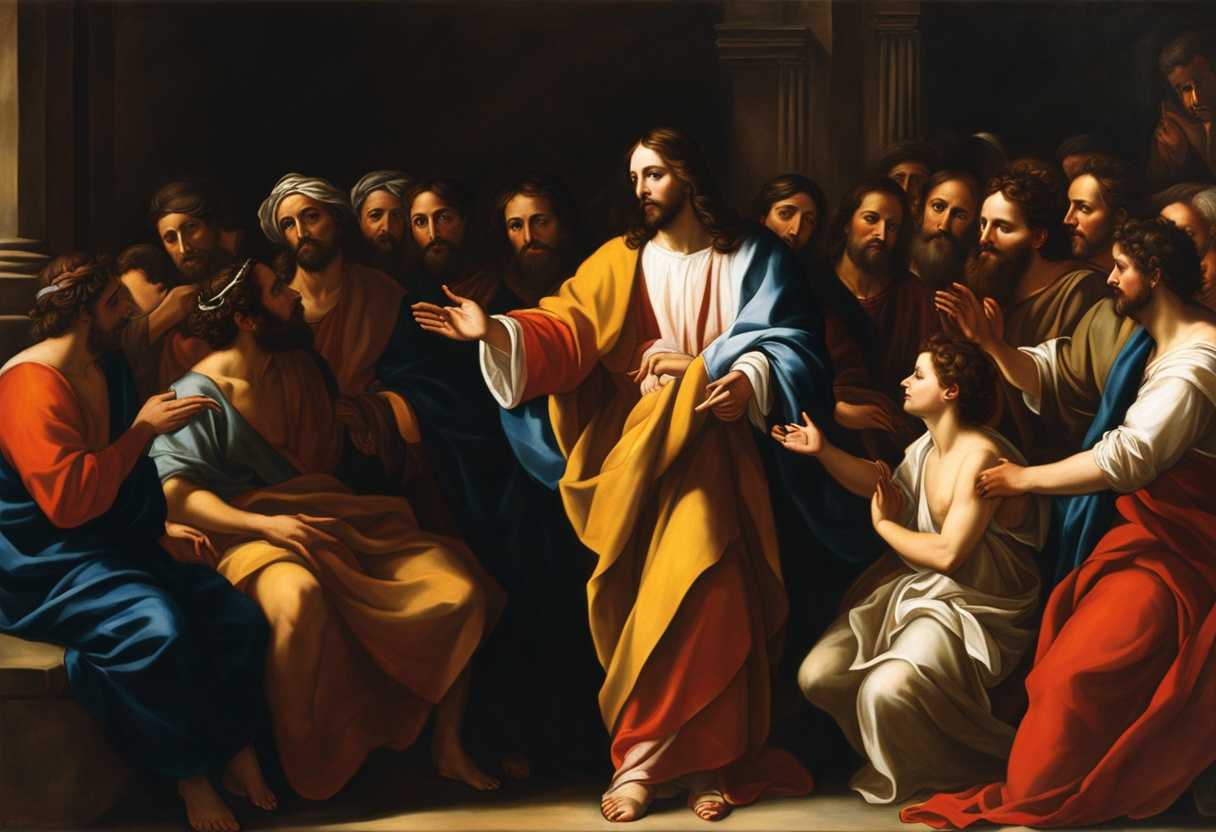
The True Meaning of Luke 8
The Gospel of Luke was written by Luke, a physician and companion of the Apostle Paul. Luke, a Gentile convert to Christianity, provides a unique perspective on the life and ministry of Jesus Christ. Jesus demonstrates his divine nature through various miracles and teachings in this chapter.
The chapter begins with Jesus preaching the parable of the sower, highlighting the different responses people have to the word of God. We then see Jesus calming the storm, showcasing his mastery over the natural world. This is followed by the healing of the demon-possessed man, a powerful display of Jesus’ authority over the spiritual realm. These events foreshadow the growing opposition Jesus will face from the religious authorities, as well as the ultimate triumph of his message and mission.
Throughout the chapter, Luke draws connections to other important biblical figures and events. For instance, the healing of the demon-possessed man echoes the deliverance of the Israelites from the plagues in Exodus (Exodus 7-12). These parallels serve to reinforce the idea that Jesus is the long-awaited Messiah, the fulfillment of God’s promises to his people.
Luke 8:1-3
Jesus travels from town to town proclaiming the good news of the Kingdom of God in a pivotal moment in His ministry as we encounter in Luke 8:1-3. This passage serves as a transition from the parables Jesus shared with the crowds in Luke 8:4-18 to the miracles He performed in the subsequent verses. Let’s break down these verses to understand their significance.
Firstly, in verse 1, we are informed that Jesus traveled from one town and village to another, accompanied by His twelve disciples. This emphasizes the itinerant nature of Jesus’ ministry as He moved around, spreading His message to different places. The fact that He was accompanied by His disciples highlights the importance of community and discipleship in the spreading of the Gospel. A group of women who had been cured of evil spirits and diseases are introduced in verse 2. One of these women is Mary Magdalene, who is mentioned by name. Mary Magdalene holds a significant place in the Gospels as a faithful follower of Jesus. She was the first person to witness the resurrected Christ and played a crucial role in proclaiming the good news of His resurrection to the apostles (John 20:11-18). The mention of these women highlights Jesus’ care and compassion for all, including those who were marginalized or possessed by evil spirits. These women supported Jesus and his disciples out of their own means in verse 3. Their financial support enabled Jesus and His disciples to continue their ministry without being burdened by material concerns. This act of support also underscores the importance of generosity and contributing to the work of God. Proverbs 19:17 states, “Whoever is kind to the poor lends to the Lord, and he will reward them for what they have done. These verses in Luke 8:1-3 emphasize the communal nature of Jesus’ ministry, the significant role of women in His circle of followers, and the importance of supporting God’s work through contributions and generosity. It teaches us about the value of community, discipleship, compassion, and financial support in sharing the message of the Kingdom of God. Through the examples of Jesus and these women, we are reminded of the timeless message of love, generosity, and inclusivity that are central to the Christian faith.
Luke 8:4-8
The well-known parable of the sower is seen in Luke 8:4-8. This section can be divided into two main parts: the sower going out to sow the seed and the different types of soil the seed falls on. The sower represents anyone sharing the message of the Gospel, the seed is the word of God, and the soil represents the hearts of people receiving the message. The seed falls along the path where it is trampled and eaten by birds, symbolizing those who hear the word but don’t understand it, allowing the devil to snatch it away. This reflects the importance of having an open heart and a willingness to receive and understand the teachings of Christ. Without a receptive heart, the word of God cannot take root and grow.
Other seed falls on rocky soil, sprouts quickly, but withers because it lacks moisture. This represents those who initially receive the word with joy but have no root and fall away when faced with difficulty or persecution. This speaks to the idea of having a shallow faith that does not withstand trials. We, as Christians, are called to build our foundation on the rock that is Christ (Matthew 7:24-27) so that our faith remains firm in all situations.
Some seed falls among thorns, grows, but is choked by the thorns and does not bear fruit. This represents those who hear the word but are distracted by the worries, riches, and pleasures of this life, preventing them from fully committing to Christ. It serves as a reminder to prioritize our relationship with God above worldly desires and distractions. Jesus warns about the deceitfulness of wealth and the worries of this life in the parable of the sower, emphasizing the importance of keeping our focus on Him (Matthew 6:19-21).
Lastly, some seed falls on good soil, grows, and produces a crop a hundred times more than was sown. This represents those who hear the word, understand it, and apply it in their lives, bearing much fruit for the Kingdom of God. This highlights the importance of not only hearing the word but also living it out in our daily lives. Jesus states in Matthew 13:23 that the seed falling on good soil refers to those who hear the word and understand it, producing a crop yielding thirty, sixty, or even a hundred times what was sown. The parable of the sower serves as a timeless message about the condition of our hearts when receiving the word of God. It challenges us to examine our receptiveness, depth of faith, prioritization of God over worldly concerns, and the fruitfulness of our lives in response to His teachings.
Luke 8:9-15
Jesus shares a parable about the sower and the seed in Luke 8:9-10. This parable is one of the most well-known teachings of Jesus and carries a profound message about the different responses people have to the Word of God. The sower represents anyone who shares the message of the Gospel, while the seed represents the Word of God. The various types of soil represent the different conditions of people’s hearts. Jesus explains in verses 11-12 that the seed that falls along the path represents those who hear the word but do not understand it, and the devil comes and takes it away from their hearts so that they may not believe and be saved. This highlights the importance of having a receptive heart and an open mind to truly understand and accept God’s word. It also serves as a cautionary tale about the dangers of ignoring or dismissing the message of the Gospel. Jesus talks about the seed that falls on rocky ground in verses 13-14, representing those who hear the word and receive it with joy, but their faith does not last because they have no root. When faced with trials or persecution, they quickly fall away. This emphasizes the significance of establishing a strong foundation in one’s faith and deepening one’s relationship with God through prayer, study, and perseverance. It serves as a reminder that true faith requires endurance and steadfastness, especially in the face of challenges. Jesus describes the seed that falls among thorns in verses 15, symbolizing those who hear the word but are choked by the cares, riches, and pleasures of life, and their fruit does not mature. This verse serves as a warning against the distractions and temptations of the world that can hinder one’s spiritual growth and relationship with God. It urges believers to prioritize their faith and guard their hearts against the allure of material possessions and worldly desires.
The final part of the parable in verse 15 talks about the seed that falls on good soil, representing those who hear the word, hold it fast in an honest and good heart, and bear fruit with patience. This serves as a message of hope and encouragement, highlighting the transformative power of God’s Word in those who are receptive and responsive to it. It underscores the importance of cultivating a genuine and sincere faith that bears fruit in one’s life through love, compassion, and service to others.
This parable of the sower and the seed is not only a lesson in faith and perseverance but also a reflection of the diverse responses people have to the message of the Gospel. It challenges believers to examine the condition of their own hearts and to strive to be like the good soil that produces an abundant harvest for the glory of God. It echoes similar themes found in other passages of Scripture, such as Matthew 13:1-23 and Mark 4:1-20, further emphasizing the importance of hearing, understanding, and applying God’s Word in our lives.
Luke 8:16-18
Jesus often speaks in parables, using the imagery of a lamp to convey a deeper spiritual truth, as seen in Luke 8:16-18. Identify the important sections of the verse and delve into their meanings.
Verse 16: “No one lights a lamp and hides it in a clay jar or puts it under a bed. Instead, they put it on a stand, so that those who come in can see the light.”
Here, Jesus is illustrating the importance of shining the light of God’s truth for all to see. Just as a lamp’s purpose is to illuminate its surroundings, believers are called to share the message of salvation openly and boldly. Hiding our faith or keeping it to ourselves serves no purpose in fulfilling God’s plan for spreading His light to others.
This verse draws parallels to other scriptures, such as Matthew 5:14-16 where Jesus describes believers as the light of the world. Christians are to let their light shine before others so that they may see their good works and glorify God. The lamp symbolizes the gospel message, and it is meant to be shared with the world, not hidden away.
Verse 17: “For there is nothing hidden that will not be disclosed, and nothing concealed that will not be known or brought out into the open.”
Jesus emphasizes the idea that nothing can remain hidden forever. God sees all and knows all, and one day, everything hidden will be revealed and brought into the open. This verse serves as a reminder of the importance of honesty, integrity, and living a life that is pleasing to God.
This theme of hidden things being revealed is consistent throughout the Bible. Jesus tells his disciples in Luke 12:2-3 that whatever is said in the dark will be heard in the daylight, and what is whispered in the ear in the inner rooms will be proclaimed from the roofs. This underscores the idea that our actions and intentions will ultimately come to light, revealing who we truly are.
Verse 18: “Therefore consider carefully how you listen. Whoever has will be given more; whoever does not have, even what they think they have will be taken from them.”
Jesus concludes this passage with a call to attentiveness and discernment in listening to His teachings. Those who are receptive to God’s Word and apply it in their lives will be given greater understanding and blessings. Conversely, those who ignore or reject the message will find even the little understanding they have slipping away.
This verse echoes the concept of spiritual receptivity found in other parts of Scripture. Jesus speaks in parables to the crowds in Matthew 13:12, explaining that whoever has will be given more, but whoever does not have, even what they have will be taken away. This principle highlights the importance of actively engaging with God’s Word and allowing it to transform our hearts and minds. Believers should shine the light of God’s truth, live with transparency and integrity, and listen attentively and obediently to the teachings of Jesus as a powerful reminder in Luke 8:16-18. Just as a lamp brightens a room, our lives are meant to illuminate the world around us with the love and truth of Christ.隐藏的事情终将被揭示,这是我们被提醒要诚实和忠诚,并且要过着让上帝喜悦的生活。
Luke 8:19-21
We encounter a crucial interaction between Jesus and his earthly family, particularly his mother and brothers in Luke 8:19-21. This episode takes place after Jesus has been teaching the crowds using parables, including the well-known Parable of the Sower. Jesus’s family tries to reach him but faces difficulty due to the crowds surrounding him as his popularity grows.
Looking closer at this passage, it begins with someone informing Jesus, “Your mother and brothers are standing outside, wanting to see you.” This message on the surface could seem like a simple piece of information, but it carries profound implications. It highlights the tension between the biological family and the spiritual family to which Jesus gives priority. The mention of his mother, Mary, and his brothers implies a link to Jesus’s earthly lineage and family ties. However, Jesus seizes this moment to teach a deeper truth about spiritual kinship and obedience to God.
When Jesus responds, “My mother and brothers are those who hear God’s word and put it into practice,” he elevates the significance of spiritual family over physical relationships. This statement underscores the idea that faith and obedience to God are the true markers of belonging to Jesus’s family. He broadens the definition of family beyond mere blood relations to encompass all who follow God’s will. This ideology is a recurring theme in Jesus’s teachings, emphasizing spiritual connections over earthly ones.
This episode serves as a teaching moment for the audience then and continues to resonate with believers today. It challenges us to reflect on our priorities and asks if we are aligning ourselves with God’s will as members of His spiritual family. It encourages us to deepen our relationship with God through studying His word and applying it in our lives. Jesus’s statement in these verses echoes his earlier teachings, such as in Matthew 12:46-50, where he declares that those who do the will of his Father in heaven are his true family.
Therefore, through these verses in Luke 8:19-21, we are reminded of the transformative power of faith and obedience in shaping our identity and belonging in the family of God. It prompts us to consider the depth of our spiritual relationships and the importance of living out God’s word in our daily lives, just as Jesus emphasized by redefining the concept of family around faith and devotion to the Heavenly Father.
Luke 8:22-25
We witness a powerful display of Jesus’ authority over nature in Luke 8:22-25. The passage begins with Jesus suggesting to his disciples to cross to the other side of the lake. What follows is a significant event that tests the faith of the disciples and demonstrates the divinity of Jesus. A fierce storm descended upon them as they sailed. The waves were crashing into the boat, and the disciples were filled with fear. They woke Jesus up in their distress while he was asleep in the stern of the boat. This scene captures the humanity of Jesus, who was exhausted and needed rest like any other person.
The disciples, in their panic, cried out to Jesus, “Master, Master, we’re going to drown!” This cry reveals their desperation and lack of faith in that moment. Jesus, however, calmly got up and rebuked the wind and the raging waters. The storm ceased, and there was a great calm. Jesus showcases his authority not only over the physical elements of nature but also over the spiritual realm in this miraculous act. It is a direct display of his divinity and power.
This passage serves as a powerful reminder of the importance of faith in the face of adversity. The disciples, who had witnessed Jesus perform miracles and teach with authority, still struggled to trust him during the storm. Their immediate reaction was fear and doubt, despite being in the presence of the Son of God. This reflects the common human tendency to respond with fear and faithlessness when faced with challenging circumstances.
The calming of the storm also draws parallels to other instances in the Bible where God demonstrates His power over nature. God parted the Red Sea for the Israelites to escape from the pursuing Egyptians in the Old Testament (Exodus 14:21-22). Similarly, in the New Testament, Jesus walking on water (Matthew 14:22-33) and calming the storm here in Luke 8 are acts that reveal His divine authority. These events underscore the consistent message throughout the Bible that God is sovereign over all creation, and His power surpasses all earthly limitations. This narrative serves as a profound lesson on trusting in Jesus during life’s storms. Just as the disciples turned to Jesus in their moment of need, we are called to have faith in Him when we face trials and tribulations. The assurance that Jesus is in control and can bring peace to any situation should strengthen our faith and resolve. This story challenges us to surrender our fears and doubts to Jesus, knowing that He has the power to bring calmness and peace amidst life’s tumultuous moments.
Luke 8:26-39
Jesus heals a demon-possessed man in the region of the Gerasenes in Luke 8:26-39. This passage can be broken down into several significant sections that reveal important truths about Jesus’ power, compassion, and authority over evil forces.
The passage begins with Jesus and His disciples crossing the Sea of Galilee and arriving in the region of the Gerasenes, which was predominantly inhabited by Gentiles. Immediately, they are met by a man possessed by a legion of demons. This man had been tormented for a long time, living among the tombs, isolated from society, and often bound with chains and shackles. The man’s condition symbolizes the spiritual bondage and despair that sin and the forces of darkness can bring upon a person.
Upon seeing Jesus, the demons within the possessed man recognized Him as the Son of the Most High God. This acknowledgement is significant as it underscores the authority and power that Jesus holds even over the demonic realm. The demons begged Jesus not to torment them or send them into the abyss, requesting instead to be cast into a nearby herd of pigs. Jesus granted their request, and the demons entered the pigs, causing them to stampede off a cliff and into the sea, where they drowned. This event showcases Jesus’ authority over evil spirits and His ability to deliver individuals from the grip of demonic oppression.
The reaction of the people in the region is noteworthy. Rather than rejoicing over the deliverance of the demon-possessed man, they were overcome with fear and asked Jesus to leave their region. This response reveals their discomfort with Jesus’ power and the disruption it caused to their way of life. It also highlights the contrast between the Gentiles’ response and the faith exhibited by those in Jewish territories.
The healed man, now freed from the demons, wanted to follow Jesus. However, Jesus instructed him to return to his home and declare all that God had done for him. This act of commissioning the man to share his testimony emphasizes the importance of personal evangelism and the transformational power of encountering Jesus. Jesus demonstrates His authority over both physical ailments and spiritual forces of darkness in this passage. The story of the demon-possessed man in the Gerasenes serves as a powerful reminder of Jesus’ compassion for the broken, His ability to set captives free, and the transformative impact of encountering His saving grace. It also challenges us to reflect on our response to Jesus’ authority in our own lives and to consider how we, like the healed man, can share the good news of our own transformation with others.
This narrative echoes themes found throughout the Bible, such as the power of God to deliver His people from bondage, the clash between good and evil, and the call for believers to spread the message of salvation. It also points to Jesus as the ultimate source of liberation and restoration for all who call upon His name.
Luke 8:40-48
The story of a woman who had been bleeding for twelve years and her encounter with Jesus is encountered in Luke 8:40-48. Let’s break down the passage into important sections for a detailed commentary.
-
Jairus, a synagogue leader, approaches Jesus in these verses and pleads with Him to come to his house because his only daughter, who was about twelve years old, was dying. Jairus, a man of high societal standing as a synagogue leader, shows great faith and humility in seeking Jesus’ help for his daughter. This sets the stage for a powerful display of Jesus’ compassion and miraculous power.
-
A large crowd pressed around Jesus as He was on the way to Jairus’ house. The woman who had been subject to bleeding for twelve years was in the midst of this crowd. This woman, suffering from a condition that not only caused physical discomfort but also made her ceremonially unclean according to Jewish law, symbolizes long-standing pain, isolation, and desperation.
-
The woman, in a moment of faith and desperation, reaches out to touch the edge of Jesus’ cloak in these verses, believing that even just touching Him would heal her. Immediately, she is healed, and Jesus stops, asking who had touched Him. Although the disciples are puzzled by this question due to the pressing crowd, Jesus knew that power had gone out from Him. This interaction demonstrates the intimate and personal nature of Jesus’ healing power, as well as the significance of faith in the miracles He performed.
-
Verse 48:
Upon realizing she could not go unnoticed, the woman trembled with fear and fell at Jesus’ feet. She confessed to touching Him and shared her reason for doing so. Jesus responds with compassion, calling her “Daughter” and acknowledging her faith as the reason for her healing. He then reassures her of her complete healing and bids her to go in peace.
The story of the woman with the issue of blood in Luke 8:40-48 carries profound messages that resonate through the pages of the Bible. It highlights the themes of faith, healing, compassion, and restoration in the ministry of Jesus. The woman’s courage, persistence, and unwavering faith in seeking healing from Jesus serve as a powerful example for all believers. Her act of reaching out to touch Jesus in faith demonstrates that even amidst seemingly insurmountable obstacles, the touch of faith can bring about miraculous transformation.
This passage also emphasizes Jesus’ accessibility and responsiveness to those who earnestly seek Him. Regardless of societal status or perceived uncleanness, Jesus offers healing and restoration to all who approach Him in faith. His acknowledgment of the woman’s faith and His proclamation of peace upon her reveal His desire for not only physical healing but also spiritual wholeness for all who come to Him. This encounter reflects the overarching theme of redemption and restoration through Christ in the broader context of the Bible. Just as the woman found healing and a renewed sense of peace in her encounter with Jesus, all who come to Him with faith can experience spiritual healing and reconciliation. This story serves as a poignant reminder of the transformative power of faith and the boundless compassion of Jesus towards those who seek Him. Luke portrays Jesus as the restorer of life and the healer of all ailments, physical, emotional, and spiritual, by intertwining the narratives of Jairus’ daughter and the woman with the issue of blood. Both instances showcase Jesus’ authority over sickness and death, reinforcing His role as the promised Messiah who brings hope and salvation to all who believe in Him.
This passage also resonates with other accounts in the Bible where individuals are healed or restored by their faith in Jesus. For instance, the story of the centurion in Matthew 8:5-13 highlights how faith in Jesus transcends societal boundaries and pleases Him. Jesus commends the centurion for his great faith and heals his servant from a distance. Similarly, the story of the woman with the issue of blood underscores the transformative power of faith when coupled with humility and determination. The story of the woman with the issue of blood in Luke 8:40-48 serves as a profound testament to the limitless power of faith in Jesus Christ. It emphasizes His compassion, accessibility, and desire to bring healing and restoration to all who earnestly seek Him. This passage stands as an enduring reminder of the transformative impact of faith and the boundless love and mercy of our Savior.
Luke 8:49-56
Jairus, a ruler of the synagogue, desperately sought Jesus’ help as his daughter was dying in the unfolding story in Luke 8:49-56. This section of the verse carries a sense of urgency and faith as Jairus falls at Jesus’ feet pleading for Him to come and heal his daughter. Jairus, a prominent and respected figure in the community, humbles himself before Jesus, showing great faith and trust in His ability to heal.
Jesus, amidst the crowd pressing around Him, agrees to go with Jairus to heal his daughter. However, on their way, a woman who had been suffering from a discharge of blood for twelve years reaches out to touch the fringe of Jesus’ garment, believing that even this slight touch would heal her. This woman’s story is one of perseverance and faith as she had sought healing from many physicians without success but believed in the power of Jesus to heal her. When she touched Jesus’ garment, she was healed instantly, and Jesus acknowledged her faith and pronounced her healed.
Meanwhile, messengers arrive from Jairus’ house, informing him that his daughter had died, advising him not to trouble Jesus any further. Despite this heartbreaking news, Jesus encourages Jairus to have faith. When they arrive at Jairus’ house, Jesus declares that the girl is not dead but asleep, showing His power over death. Jesus then takes the girl by the hand and commands her to arise, and she is restored to life. This miraculous event demonstrates Jesus’ authority over death and his ability to bring life even in the face of death.
The intertwining of these two stories in Luke 8:49-56 exemplifies the themes of faith, healing, and the power of Jesus over life and death. Jairus, the religious leader, and the unnamed woman from the crowd both display unwavering faith in Jesus’ ability to heal. Their stories highlight the inclusivity of Jesus’ ministry, reaching out to both the influential and the marginalized, showing that all who come to Him in faith can experience His healing touch.
This passage in Luke 8 echoes the message of hope and restoration found throughout the Bible. It points to Jesus as the ultimate source of healing and salvation, emphasizing the importance of faith in Him. Through these miraculous events, Luke conveys the timeless truth that nothing is impossible with God and that those who put their trust in Him will experience His transformative power in their lives. The stories of Jairus and the woman with the issue of blood serve as a reminder for us today to approach Jesus with unwavering faith, knowing that He has the power to bring life, healing, and restoration in every circumstance.
After Luke 8
Jesus calmed a storm with just a word, healed a demon-possessed man, and raised a young girl from the dead in this chapter. These miracles serve as a reminder of the authority and compassion of our Lord. Let us reflect on these events and be encouraged to trust in Jesus in the midst of life’s storms and have faith in his ability to bring healing and restoration. Our God is capable of achieving the impossible as we prepare to delve into the next chapter. We should approach the challenges and uncertainties of life with confidence, knowing that we serve a God who is able to do exceedingly abundantly above all that we ask or think. May we continue to follow Jesus with unwavering faith, knowing that he is always with us, guiding us through every trial and triumph.

Reverend Michael Johnson is an experienced Church Minister with a profound expertise in spirituality and guidance. With a serene presence and a compassionate heart, he has faithfully served his congregation for over 20 years, leading them on a spiritual journey towards inner peace and enlightenment. Reverend Johnson’s extensive knowledge of religious philosophies and profound understanding of human nature have made him a trusted confidant and mentor to many, as he seamlessly weaves his profound wisdom into life teachings. Reverend Johnson’s calming demeanor and empathetic nature continue to uplift and heal souls, nurturing a sense of unity and tranquility within his community.