
Bible explanations for children involve simplifying complex biblical concepts into relatable and understandable language. This approach often focuses on key themes like love, kindness, and faith, using stories and examples to convey God’s messages in a way that resonates with young hearts and minds.
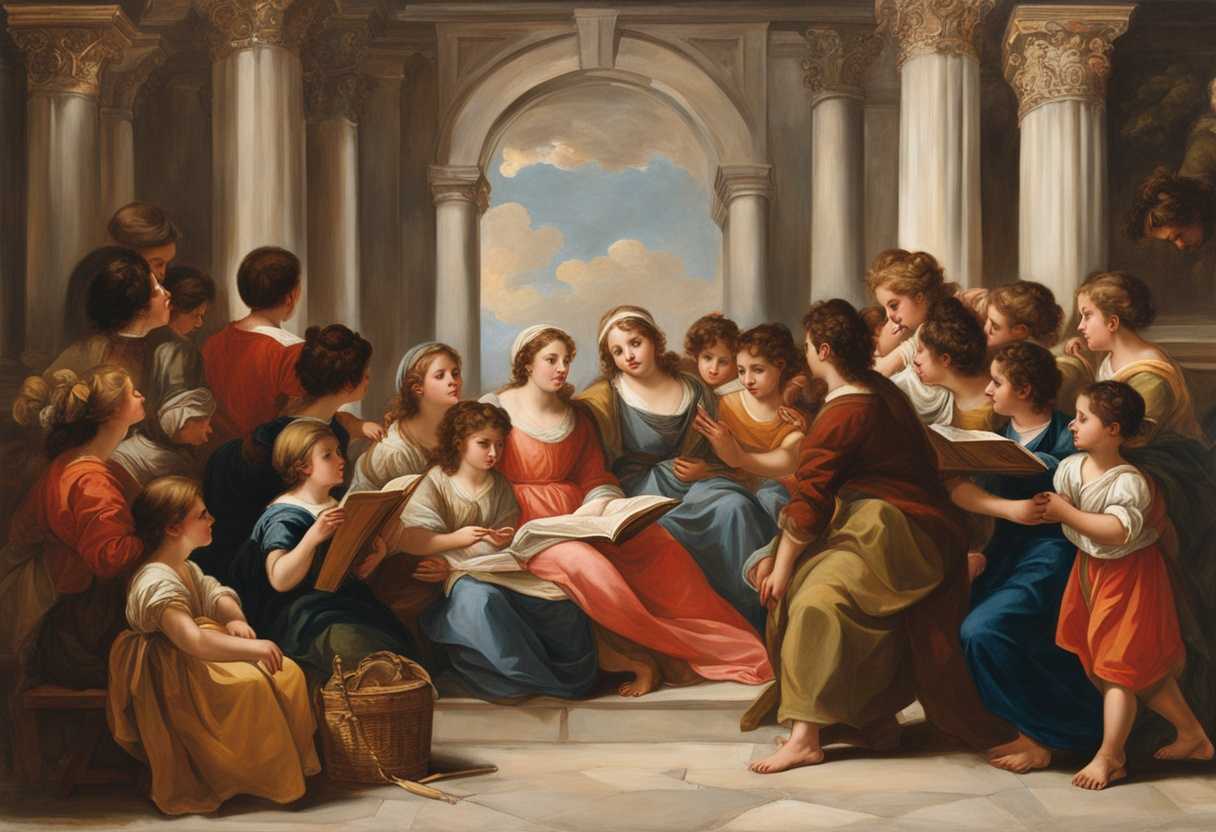
Scripture
6 And these words that I command you today shall be on your heart.
7 You shall teach them diligently to your children, and shall talk of them when you sit in your house, and when you walk by the way, and when you lie down, and when you rise.
8 You shall bind them as a sign on your hand, and they shall be as frontlets between your eyes.
9 You shall write them on the doorposts of your house and on your gates.
Bible Stories Explained for Kids
The idea of Bible explanations for children emphasizes the importance of conveying complex spiritual truths in a manner that young minds can grasp. Jesus himself demonstrated this approach when he taught using parables, like the Parable of the Lost Sheep (Luke 15:1-7), which illustrates God’s immense love and the joy found in repentance. By utilizing relatable stories and simple language, biblical concepts such as love, kindness, and faith become accessible, allowing children to see God’s character and His desire for relationship with humanity. This aligns with the encouragement found in Deuteronomy 6:6-7, where parents are instructed to teach God’s commandments diligently to their children, integrating faith into daily life.
Moreover, conveying biblical lessons to children shapes their foundational understanding of morality and virtue. For instance, the Golden Rule from Matthew 7:12 teaches them the importance of treating others with respect and kindness, encapsulating the essence of Jesus’ teachings. As they learn about figures like David, who demonstrated courage and repentance (1 Samuel 17, Psalm 51), children are inspired to reflect similar values in their lives. This simplified understanding not only nurtures their faith but also equips them with essential life principles, fostering a generation that embodies compassion, humility, and unwavering faith in God. Through these teachings, children are encouraged to develop a personal relationship with God and carry His message of love into the world around them.
The phrase “Bible explanations for children” can be understood in the context of how biblical concepts are communicated in a simplified manner for younger audiences. In Greek, the word “explanation” can be translated as “ἐξήγησις” (exēgēsis), which derives from the verb “ἐξηγέομαι” (exēgeomai), meaning “to lead out” or “to explain.” This term is often used in scholarly discussions about interpreting texts, particularly in the context of biblical hermeneutics.
Etymologically, “ἐξήγησις” is composed of the prefix “ἐξ-” (ex-), meaning “out of” or “from,” and the root “ἡγέομαι” (hēgeomai), which means “to lead” or “to guide.” This reflects the process of drawing out meaning from a text, making it accessible and understandable. Scholars such as John Calvin and more contemporary theologians have emphasized the importance of clear and age-appropriate explanations of scripture, particularly for children, to foster their understanding of faith and moral teachings. By breaking down complex theological concepts into simpler terms, educators can help children grasp the essence of biblical narratives and principles, nurturing their spiritual growth.
Teaching Values Through Stories
The Bible is filled with stories that illustrate important values such as kindness, honesty, and forgiveness. These narratives serve as engaging tools for children to learn about moral principles in a relatable way. By understanding the actions and decisions of biblical characters, children can grasp the significance of making good choices in their own lives.
Building a Relationship with God
The Bible encourages children to develop a personal relationship with God. Through prayer, worship, and understanding God’s love, children can learn about faith and trust. This relationship can provide them with comfort and guidance, helping them navigate life’s challenges with a sense of security and purpose.
Understanding Community and Compassion
Many biblical teachings emphasize the importance of community and helping others. Children can learn about the value of compassion, empathy, and service through the examples set by Jesus and other figures in the Bible. This understanding fosters a sense of responsibility towards others, encouraging children to contribute positively to their communities and support those in need.
How to Deepen Your Faith and Practice Love To Grow
Deepening your faith and practicing love is a beautiful journey that requires intentionality and openness. Start by immersing yourself in Scripture; let the words of the Bible resonate in your heart and guide your actions. Consider setting aside time each day for prayer and reflection, inviting God into your thoughts and decisions. As you grow in your understanding of His love, look for opportunities to express that love to others—whether through acts of kindness, listening to someone in need, or volunteering in your community. Remember, love is not just a feeling but an active choice; it’s in the small, everyday moments that we can truly reflect Christ’s love. Surround yourself with a supportive community of fellow believers who can encourage you and hold you accountable. As you deepen your faith and practice love, you’ll find that your relationship with God flourishes, and you become a beacon of His light in the world.
Bible References to Children’s Understanding:
Proverbs 22:6: 6 Train up a child in the way he should go;
even when he is old he will not depart from it.
Psalm 78:4-7: 4 We will not hide them from their children,
but tell to the coming generation
the glorious deeds of the Lord, and his might,
and the wonders that he has done.
5 He established a testimony in Jacob and appointed a law in Israel, which he commanded our fathers to teach to their children,
6 that the next generation might know them,
the children yet unborn,
and arise and tell them to their children,
7 so that they should set their hope in God and not forget the works of God, but keep his commandments;
Matthew 19:13-15: 13 Then children were brought to him that he might lay his hands on them and pray. The disciples rebuked the people,
14 but Jesus said, “Let the little children come to me and do not hinder them, for to such belongs the kingdom of heaven.”
15 Then were there brought unto him little children, that he should put his hands on them, and pray: and the disciples rebuked them.
Mark 10:13-16: 13 And they were bringing children to him that he might touch them, and the disciples rebuked them.
14 But when Jesus saw it, he was indignant and said to them, “Let the children come to me; do not hinder them, for to such belongs the kingdom of God.
15 Truly, I say to you, whoever does not receive the kingdom of God like a child shall not enter it.
16 And he took them in his arms and blessed them, laying his hands on them.
Luke 18:15-17: 15 Now they were bringing even infants to him that he might touch them. And when the disciples saw it, they rebuked them.
16 But Jesus called them to him, saying, “Let the children come to me, and do not hinder them, for to such belongs the kingdom of God.
17 Truly, I say to you, whoever does not receive the kingdom of God like a child shall not enter it.
Ephesians 6:1-4: 1 Children, obey your parents in the Lord, for this is right.
2 “Honor your father and mother” (this is the first commandment with a promise),
3 “that it may go well with you and that you may live long in the land.”
4 Fathers, do not provoke your children to anger, but bring them up in the discipline and instruction of the Lord.
Colossians 3:20-21: 20 Children, obey your parents in everything, for this pleases the Lord.
21 Fathers, do not provoke your children, lest they become discouraged.
2 Timothy 3:14-15: 14 But as for you, continue in what you have learned and have firmly believed, knowing from whom you learned it,
15 and how from childhood you have been acquainted with the sacred writings, which are able to make you wise for salvation through faith in Christ Jesus.
Deuteronomy 11:18-21: 18 “You shall therefore lay up these words of mine in your heart and in your soul, and you shall bind them as a sign on your hand, and they shall be as frontlets between your eyes.”
19 You shall teach them to your children, talking of them when you are sitting in your house, and when you are walking by the way, and when you lie down, and when you rise.
20 You shall write them on the doorposts of your house and on your gates,
21 that your days and the days of your children may be multiplied in the land that the Lord swore to your fathers to give them, as long as the heavens are above the earth.
Isaiah 54:13: 13 All your children shall be taught by the Lord,
and great shall be the peace of your children.
Proverbs 1:8-9: 8 Hear, my son, your father’s instruction, and forsake not your mother’s teaching,
9 for they will be a graceful garland for your head and pendants for your neck.
Proverbs 4:1-4: 1 Hear, O sons, a father’s instruction,
and be attentive, that you may gain insight,
2 for I give you good precepts;
do not forsake my teaching.
3 For I was my father’s son,
tender and only beloved in the sight of my mother.
4 Let your heart hold fast my words; keep my commandments, and live.
Proverbs 29:15: 15 The rod and reproof give wisdom,
but a child left to himself brings shame to his mother.
Psalm 127:3-5: 3 Behold, children are a heritage from the Lord,
the fruit of the womb a reward.
4 Like arrows in the hand of a warrior are the children of one’s youth.
5 Blessed is the man who fills his quiver with them! He shall not be put to shame when he speaks with his enemies in the gate.
Matthew 18:1-5: 1 At that time the disciples came to Jesus, saying, “Who is the greatest in the kingdom of heaven?”
2 And calling to him a child, he put him in the midst of them
3 and said, “Truly, I say to you, unless you turn and become like children, you will never enter the kingdom of heaven.
4 Whoever humbles himself like this child is the greatest in the kingdom of heaven.
5 “Whoever receives one such child in my name receives me,
1 Samuel 1:27-28: 27 For this child I prayed, and the Lord has granted me my petition that I made to him.
28 Therefore I have lent him to the Lord. As long as he lives, he is lent to the Lord.” And he worshiped the Lord there.
Exodus 20:12: 12 “Honor your father and your mother, that your days may be long in the land that the Lord your God is giving you.
Joshua 4:20-24: 20 And those twelve stones, which they took out of the Jordan, Joshua set up at Gilgal.
21 And he said to the people of Israel, “When your children ask their fathers in times to come, ‘What do these stones mean?’
22 then you shall let your children know, ‘Israel passed over this Jordan on dry ground.’
23 For the Lord your God dried up the waters of the Jordan for you until you passed over, as the Lord your God did to the Red Sea, which he dried up for us until we passed over,
24 so that all the peoples of the earth may know that the hand of the Lord is mighty, that you may fear the Lord your God forever.”
1 Timothy 4:12: 12 Let no one despise you for your youth, but set the believers an example in speech, in conduct, in love, in faith, in purity.

Reverend Ogunlade is a seasoned Church Minister with over three decades of experience in guiding and nurturing congregations. With profound wisdom and a serene approach, Reverend Ogunlade has carried out various pastoral duties, including delivering uplifting sermons, conducting religious ceremonies, and offering sage counsel to individuals seeking spiritual guidance. Their commitment to fostering harmony and righteousness within their community is exemplified through their compassionate nature, making them a beloved and trusted figure among the congregation.