
In the Bible, clergy roles are often associated with individuals set apart for ministry and service, such as priests, elders, and deacons, whose responsibilities include teaching, preaching, and administering sacraments (e.g., 1 Timothy 3:1-13, Hebrews 5:1-4). These roles are characterized by a call to serve God and the community, providing spiritual leadership and guidance (Ephesians 4:11-12).
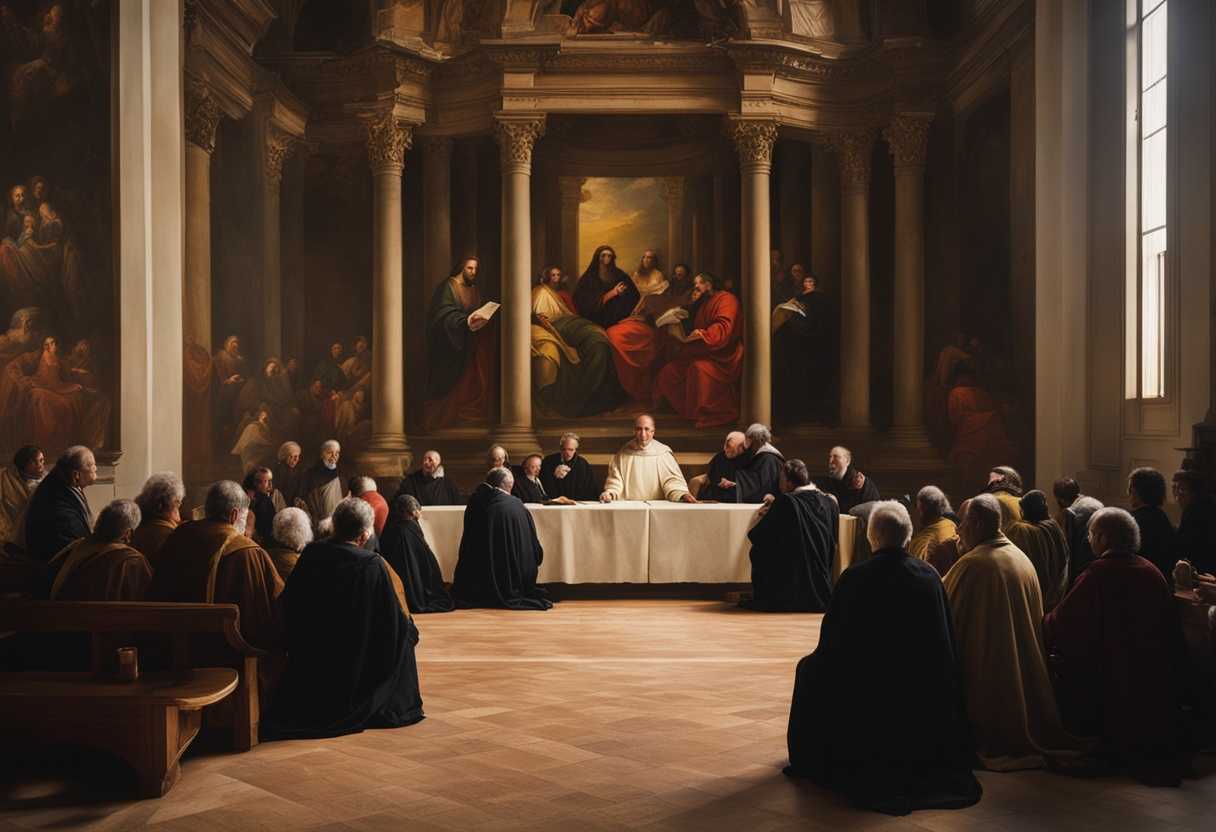
Scripture
1 The saying is trustworthy: If anyone aspires to the office of overseer, he desires a noble task.
2 Therefore an overseer must be above reproach, the husband of one wife, sober-minded, self-controlled, respectable, hospitable, able to teach,
3 not a drunkard, not violent but gentle, not quarrelsome, not a lover of money.
4 He must manage his own household well, with all dignity keeping his children submissive,
5 for if someone does not know how to manage his own household, how will he care for God’s church?
6 He must not be a recent convert, or he may become puffed up with conceit and fall into the condemnation of the devil.
7 Moreover, he must be well thought of by outsiders, so that he may not fall into disgrace, into a snare of the devil.
8 Deacons likewise must be dignified, not double-tongued, not addicted to much wine, not greedy for dishonest gain.
9 They must hold the mystery of the faith with a clear conscience.
10 And let them also be tested first; then let them serve as deacons if they prove themselves blameless.
11 Their wives likewise must be dignified, not slanderers, but sober-minded, faithful in all things.
12 Let deacons each be the husband of one wife, managing their children and their own households well.
13 For those who serve well as deacons gain a good standing for themselves and also great confidence in the faith that is in Christ Jesus.
Biblical Definition of Clergy Roles
The biblical definition of clergy roles is intricately woven into the fabric of community life and spiritual edification within the Christian tradition. In the New Testament, particularly in passages like Ephesians 4:11-12, we see that the church is intended to function as a body, with various members serving distinct purposes to achieve unity and maturity in faith. The roles of clergy—such as pastors, elders, and deacons—not only encompass teaching and preaching but also involve equipping the saints for the work of ministry. This emphasizes the collaborative nature of church life, where clergy act as facilitators of spiritual growth rather than simply hierarchical figures; they are called to shepherd the flock, encouraging active participation among all believers.
Moreover, the calls to holiness and accountability for clergy outlined in passages like 1 Timothy 3:1-13 and Hebrews 5:1-4 highlight the moral and ethical dimensions of these roles. Those who aspire to leadership within the church are expected to demonstrate exemplary character and integrity, signifying the weight of their responsibility to model Christ-like behavior. This notion of being “set apart” underscores not only a vocational aspect but also a spiritual and communal commitment to serve as instruments of God’s grace, reflecting His love and truth. Thus, clergy roles in the Bible invite a holistic understanding of leadership that integrates spiritual maturity, community service, and active engagement in the mission of the church, fostering an environment where faith can thrive collectively.
Additionally, the biblical understanding of clergy roles extends beyond mere responsibilities; it encompasses the ethos of servanthood rooted in the life of Christ. For instance, Jesus Himself models leadership through service, as seen in passages that recount His washing of the disciples’ feet (John 13:1-17). This act is pivotal, highlighting that those who lead must do so with humility and a willingness to serve others, rather than exerting authority for personal gain. Clergy, therefore, are called to embody this servant leadership, prioritizing the needs of their congregations and fostering an attitude of care and compassion. This approach enables them to create a nurturing environment where believers can grow spiritually and relationally.
Furthermore, the role of clergy is marked by a strong emphasis on spiritual guidance and community oversight. In the Book of Acts, we observe the appointment of deacons to ensure that various needs of the church community are met, particularly in the distribution of resources (Acts 6:1-6). This early model reflects an organized church structure that recognizes different callings and functions within the body of Christ, thereby ensuring that diverse needs are addressed. It showcases the collaborative effort among leaders to maintain harmony and demonstrate the love of Christ through practical actions. The clergy’s function in such a context is to uphold the unity of the body while supporting the growth of each member’s personal faith journey. Thus, the biblical definition of clergy roles is deeply relational and multifaceted, encouraging leaders to engage actively and meaningfully within their communities.
The Role of Shepherding in Spiritual Leadership
In the Bible, clergy are often depicted as shepherds, a metaphor that emphasizes their responsibility to guide, protect, and nurture their congregations. This role involves not only teaching and preaching but also providing pastoral care and support to individuals in their spiritual journeys. The shepherd’s duty is to lead the flock towards spiritual growth, ensuring that they are fed with the Word of God and are kept safe from spiritual dangers. This broader meaning highlights the relational aspect of clergy work, where leaders are called to build deep connections with their community, fostering an environment of trust and support.
The Call to Service and Sacrifice
Another significant aspect of the biblical definition of clergy roles is the emphasis on service and sacrifice. Clergy are called to serve others selflessly, often putting the needs of their congregation above their own. This sacrificial nature reflects the teachings of Christ, who exemplified servant leadership. The broader meaning here is that clergy are not merely leaders in a hierarchical sense but are also servants who embody humility and dedication. Their role is to model Christ-like behavior, encouraging their congregations to live out their faith through acts of service and love towards one another and the wider community.
The Importance of Teaching and Discipleship
Clergy roles in the Bible also encompass the vital function of teaching and discipleship. This involves not only the dissemination of biblical knowledge but also the nurturing of faith and spiritual maturity among believers. The broader meaning of this role is the commitment to lifelong learning and growth in faith, both for the clergy themselves and for their congregations. Clergy are tasked with equipping individuals to understand and apply biblical principles in their lives, fostering a culture of discipleship that encourages believers to grow in their relationship with God and to share their faith with others.
How to Cultivate Spiritual Leadership Through Service
Cultivating spiritual leadership through service is a beautiful journey that invites us to embody the teachings of Christ in our daily lives. As we step into the role of a servant leader, we begin to understand that true leadership is not about authority or recognition, but about humility and love for others. Start by seeking opportunities to serve within your community—whether it’s volunteering at a local shelter, mentoring a young person, or simply offering a listening ear to someone in need. Each act of service not only strengthens our connection to others but also deepens our relationship with God, as we reflect His love and grace in tangible ways. Remember, Jesus Himself washed the feet of His disciples, teaching us that greatness in His kingdom is found in our willingness to serve. As you embrace this mindset, you’ll find that your spiritual leadership will flourish, inspiring those around you to follow in your footsteps.
Bible References to Clergy Roles and Definitions:
Titus 1:5-9: 5 This is why I left you in Crete, so that you might put what remained into order, and appoint elders in every town as I directed you—
6 if anyone is above reproach, the husband of one wife, and his children are believers and not open to the charge of debauchery or insubordination.
7 For an overseer, as God’s steward, must be above reproach. He must not be arrogant or quick-tempered or a drunkard or violent or greedy for gain,
8 but hospitable, a lover of good, self-controlled, upright, holy, and disciplined.
9 He must hold firm to the trustworthy word as taught, so that he may be able to give instruction in sound doctrine and also to rebuke those who contradict it.
1 Peter 5:1-4: 5 So I exhort the elders among you, as a fellow elder and a witness of the sufferings of Christ, as well as a partaker in the glory that is going to be revealed:
2 shepherd the flock of God that is among you, exercising oversight, not under compulsion, but willingly, as God would have you; not for shameful gain, but eagerly;
3 not domineering over those in your charge, but being examples to the flock.
4 And when the chief Shepherd appears, you will receive the unfading crown of glory.
Ephesians 4:11-13: 11 And he gave the apostles, the prophets, the evangelists, the shepherds and teachers,
12 to equip the saints for the work of ministry, for building up the body of Christ,
13 until we all attain to the unity of the faith and of the knowledge of the Son of God, to mature manhood, to the measure of the stature of the fullness of Christ,
Acts 20:17-35: 17 Now from Miletus he sent to Ephesus and called the elders of the church to come to him.
18 And when they came to him, he said to them: “You yourselves know how I lived among you the whole time from the first day that I set foot in Asia,
19 serving the Lord with all humility and with tears and with trials that happened to me through the plots of the Jews;
20 how I did not shrink from declaring to you anything that was profitable, and teaching you in public and from house to house,
21 testifying both to Jews and to Greeks of repentance toward God and of faith in our Lord Jesus Christ.
22 And now, behold, I am going to Jerusalem, constrained by the Spirit, not knowing what will happen to me there,
23 except that the Holy Spirit testifies to me in every city that imprisonment and afflictions await me.
24 But I do not account my life of any value nor as precious to myself, if only I may finish my course and the ministry that I received from the Lord Jesus, to testify to the gospel of the grace of God.
25 And now, behold, I know that none of you among whom I have gone about proclaiming the kingdom will see my face again.
26 Therefore I testify to you this day that I am innocent of the blood of all,
27 for I did not shrink from declaring to you the whole counsel of God.
28 Pay careful attention to yourselves and to all the flock, in which the Holy Spirit has made you overseers, to care for the church of God, which he obtained with his own blood.
29 I know that after my departure fierce wolves will come in among you, not sparing the flock;
30 and from among your own selves will arise men speaking twisted things, to draw away the disciples after them.
31 Therefore be alert, remembering that for three years I did not cease night or day to admonish everyone with tears.
32 And now I commend you to God and to the word of his grace, which is able to build you up and to give you the inheritance among all those who are sanctified.
33 I coveted no one’s silver or gold or apparel.
34 You yourselves know that these hands ministered to my necessities and to those who were with me.
In all things I have shown you that by working hard in this way we must help the weak and remember the words of the Lord Jesus, how he himself said, ‘It is more blessed to give than to receive.’”
1 Corinthians 12:27-31: 27 Now you are the body of Christ and individually members of it.
28 And God has appointed in the church first apostles, second prophets, third teachers, then miracles, then gifts of healing, helping, administrating, and various kinds of tongues.
29 Are all apostles? Are all prophets? Are all teachers? Do all work miracles?
30 Do all possess gifts of healing? Do all speak with tongues? Do all interpret?
But earnestly desire the higher gifts. And I will show you a still more excellent way.
1 Timothy 5:17-22: 17 Let the elders who rule well be considered worthy of double honor, especially those who labor in preaching and teaching.
18 For the Scripture says, “You shall not muzzle an ox when it treads out the grain,” and, “The laborer deserves his wages.”
19 Do not admit a charge against an elder except on the evidence of two or three witnesses.
20 As for those who persist in sin, rebuke them in the presence of all, so that the rest may stand in fear.
21 In the presence of God and of Christ Jesus and of the elect angels I charge you to keep these rules without prejudging, doing nothing from partiality.
22 Do not be hasty in the laying on of hands, nor take part in the sins of others; keep yourself pure.
Hebrews 13:7-17: 17 Obey your leaders and submit to them, for they are keeping watch over your souls, as those who will have to give an account. Let them do this with joy and not with groaning, for that would be of no advantage to you.
8 Jesus Christ is the same yesterday and today and forever.
9 Do not be led away by diverse and strange teachings, for it is good for the heart to be strengthened by grace, not by foods, which have not benefited those devoted to them.
10 We have an altar from which those who serve the tent have no right to eat.
11 For the bodies of those animals whose blood is brought into the holy places by the high priest as a sacrifice for sin are burned outside the camp.
12 So Jesus also suffered outside the gate in order to sanctify the people through his own blood.
13 Therefore let us go to him outside the camp and bear the reproach he endured.
14 For here we have no lasting city, but we seek the city that is to come.
15 Through him then let us continually offer up a sacrifice of praise to God, that is, the fruit of lips that acknowledge his name.
16 Do not neglect to do good and to share what you have, for such sacrifices are pleasing to God.
17 Obey your leaders and submit to them, for they are keeping watch over your souls, as those who will have to give an account. Let them do this with joy and not with groaning, for that would be of no advantage to you.
2 Timothy 2:24-26: 24 And the Lord’s servant must not be quarrelsome but kind to everyone, able to teach, patiently enduring evil,
25 correcting his opponents with gentleness. God may perhaps grant them repentance leading to a knowledge of the truth,
26 and they may come to their senses and escape from the snare of the devil, after being captured by him to do his will.
James 5:14-15: 14 Is anyone among you sick? Let him call for the elders of the church, and let them pray over him, anointing him with oil in the name of the Lord.
15 And the prayer of faith will save the one who is sick, and the Lord will raise him up. And if he has committed sins, he will be forgiven.
1 Thessalonians 5:12-13: 12 We ask you, brothers, to respect those who labor among you and are over you in the Lord and admonish you,
And to esteem them very highly in love because of their work. Be at peace among yourselves.
Romans 12:6-8: 6 Having gifts that differ according to the grace given to us, let us use them: if prophecy, in proportion to our faith;
7 if service, in our serving; the one who teaches, in his teaching;
8 the one who exhorts, in his exhortation; the one who contributes, in generosity; the one who leads, with zeal; the one who does acts of mercy, with cheerfulness.
1 Corinthians 9:13-14: 13 Do you not know that those who are employed in the temple service get their food from the temple, and those who serve at the altar share in the sacrificial offerings?
14 In the same way, the Lord commanded that those who proclaim the gospel should get their living by the gospel.
1 Corinthians 4:1-2: 1 This is how one should regard us, as servants of Christ and stewards of the mysteries of God.
2 Moreover, it is required of stewards that they be found trustworthy.
2 Corinthians 6:3-10: 3 We put no obstacle in anyone’s way, so that no fault may be found with our ministry,
4 but as servants of God we commend ourselves in every way: by great endurance, in afflictions, hardships, calamities,
5 beatings, imprisonments, riots, labors, sleepless nights, hunger;
6 by purity, knowledge, patience, kindness, the Holy Spirit, genuine love;
7 by truthful speech, and the power of God; with the weapons of righteousness for the right hand and for the left;
8 through honor and dishonor, through slander and praise. We are treated as impostors, and yet are true;
9 as unknown, and yet well known; as dying, and behold, we live; as punished, and yet not killed;
10 as sorrowful, yet always rejoicing; as poor, yet making many rich; as having nothing, yet possessing everything.

Rev. François Dupont is a dedicated church minister with a wealth of experience in serving spiritual communities. With a calm and serene demeanor, he has been devoted to sharing the message of love, compassion, and tolerance for over two decades. Through his thoughtful sermons, compassionate counseling, and unwavering support, Rev. Dupont has touched the lives of countless individuals, allowing them to find solace and strength during difficult times. His serene presence and deep understanding of the human condition make him a trusted guide for those seeking spiritual nourishment and guidance.