
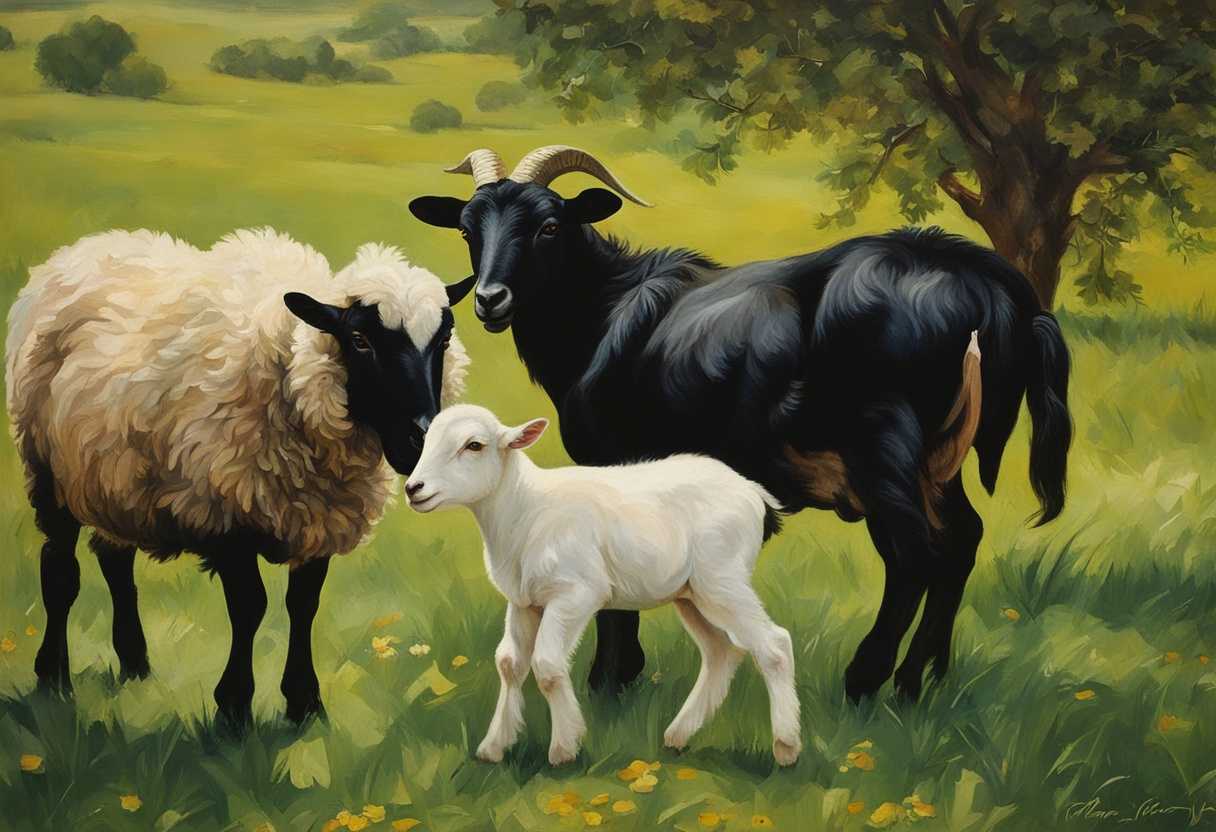
In the Bible, cloven animals refer to those with split hooves, such as sheep and goats, which are considered clean and permissible for consumption according to Levitical law (Leviticus 11:3). This distinction signifies purity and holiness in dietary practices among the Israelites.
Scripture
1 And the Lord spoke to Moses and Aaron, saying to them,
2 “Speak to the people of Israel, saying, These are the living things that you may eat among all the animals that are on the earth.”
3 Whatever parts the hoof and is cloven-footed and chews the cud, among the animals, you may eat.
4 Nevertheless, among those that chew the cud or part the hoof, you shall not eat these: The camel, because it chews the cud but does not part the hoof, is unclean to you.
5 And the rock badger, because it chews the cud but does not part the hoof, is unclean to you.
6 And the hare, because it chews the cud but does not part the hoof, is unclean to you.
7 And the pig, because it parts the hoof and is cloven-footed but does not chew the cud, is unclean to you.
8 You shall not eat any of their flesh, and you shall not touch their carcasses; they are unclean to you.
9 “These you may eat, of all that are in the waters. Everything in the waters that has fins and scales, whether in the seas or in the rivers, you may eat.
10 But anything in the seas or the rivers that has not fins and scales, of the swarming creatures in the waters and of the living creatures that are in the waters, is detestable to you.
11 You shall regard them as detestable; you shall not eat any of their flesh, and you shall detest their carcasses.
12 Everything in the waters that has not fins and scales is detestable to you.
13 “And these you shall detest among the birds; they shall not be eaten; they are detestable: the eagle, the bearded vulture, the black vulture,
14 the kite, the falcon of any kind;
15 Every swarming thing that swarms on the ground is detestable; it shall not be eaten.
16 the ostrich, the nighthawk, the sea gull, the hawk according to its kind,
17 And the little owl and the cormorant and the short-eared owl,
18 the stork, the heron of any kind, the hoopoe, and the bat.
19 the stork, the heron of any kind, the hoopoe, and the bat.
20 “All winged insects that go on all fours are detestable to you.”
21 Yet among the winged insects that go on all fours you may eat those that have jointed legs above their feet, with which to hop on the ground.
22 Of them you may eat: the locust of any kind, the bald locust of any kind, the cricket of any kind, and the grasshopper of any kind.
23 But all other winged insects that have four feet are detestable to you.
24 “And by these you shall become unclean. Whoever touches their carcass shall be unclean until the evening,
25 And whoever carries any part of their carcass shall wash his clothes and be unclean until the evening.
26 Every animal that parts the hoof but is not cloven-footed or does not chew the cud is unclean to you. Everyone who touches them shall be unclean.
27 And among the animals that go on all fours, those that have a true hoof that is completely split open at the bottom, you shall regard as unclean.
28 But the swarming thing that crawls on the ground you shall not eat; they are detestable.
29 “And these are unclean to you among the swarming things that swarm on the ground: the mole rat, the mouse, the great lizard of any kind,
30 the gecko, the monitor lizard, the lizard, the sand lizard, and the chameleon.
31 These are unclean to you among all that swarm. Whoever touches them when they are dead shall be unclean until the evening.
32 And anything on which any of them falls when they are dead shall be unclean, whether it is an article of wood or a garment or a skin or a sack, any article that is used for any purpose. It must be put into water, and it shall be unclean until the evening; then it shall be clean.
33 And if any of them falls into any earthenware vessel, all that is in it shall be unclean, and you shall break it.
34 Any food in it that could be eaten, on which water comes, shall be unclean. And all drink that could be drunk from every such vessel shall be unclean.
35 And everything on which any part of their carcass falls shall be unclean. Whether oven or stove, it shall be broken in pieces. They are unclean and shall remain unclean for you.
36 Nevertheless, a spring or a cistern holding water shall be clean, but whoever touches a carcass in them shall be unclean.
37 If any part of their carcass falls upon any seed grain that is to be sown, it is clean,
38 But if water is put on the seed and any part of their carcass falls on it, it is unclean to you.
39 And if any animal which you may eat dies, whoever touches its carcass shall be unclean until the evening.
40 Whoever eats of its carcass shall wash his clothes and be unclean until the evening.
41 “Every swarming thing that swarms on the ground is detestable; it shall not be eaten.”
42 Whatever goes on its belly, and whatever goes on all fours, or whatever has many feet, any swarming thing that swarms on the ground, you shall not eat, for they are detestable.
43 You shall not make yourselves detestable with any swarming thing that swarms, and you shall not defile yourselves with them, and become unclean through them.
44 For I am the Lord your God. Consecrate yourselves therefore, and be holy, for I am holy. You shall not defile yourselves with any swarming thing that crawls on the ground.
45 For I am the Lord who brought you up out of the land of Egypt to be your God. You shall therefore be holy, for I am holy.”
46 This is the law about beast and bird and every living creature that moves through the waters and every creature that swarms on the ground,
47 to make a distinction between the unclean and the clean and between the living creature that may be eaten and the living creature that may not be eaten.
Biblical Significance of Cloven Animals
The Biblical meaning of cloven animals extends beyond mere dietary regulations to embody deeper theological and spiritual principles. In Leviticus 11:3-4, the distinctions made between clean and unclean animals highlight God’s desire for His people to maintain a state of holiness and purity. Cloven-footed animals, which also chew the cud, symbolize a duality of behavior: they not only partake in what is nourishing (the cud) but also exhibit a separation from the dirt (the split hooves), indicating a life set apart from sin. This dual aspect reflects the call for Israel to engage in a cycle of continuous purification and reflection on their relationship with God, thus maintaining communal and personal holiness.
In broader terms, the concept of cloven animals serves as an illustration of the separation between the holy and the profane, a theme woven throughout the Biblical narrative. For example, in the New Testament, Jesus refers to clean and unclean delineations in Mark 7:15, emphasizing that true purity comes from within a person’s heart rather than merely adhering to external dietary laws. This aligns with the overarching Biblical theme of transformation and sanctification, urging believers to embody a lifestyle that mirrors their inward commitment to God. Thus, cloven animals not only represent physical cleanliness but also invite deeper reflection on spiritual integrity and the importance of being set apart for God’s purpose.
The symbolic significance of cloven animals can further be explored through their connections with notions of sacrifice and redemption in the biblical framework. The act of offering a clean animal, such as those with split hooves and the ability to chew the cud, carries profound implications for the community’s relationship with God. Sacrificial practices involving these animals, prescribed in various parts of the Torah, signify the acknowledgment of sin and the need for atonement. In this context, the attributes of cloven animals—as embodying purity and fitness for sacrifice—reflect a longing for reconciliation with the divine, reinforcing the idea that to approach God, one must be cleansed and set apart from wrongdoing.
Moreover, cloven animals can also symbolize the notion of discernment and separation in the spiritual journey of believers. The physical characteristics that distinguish these creatures serve as metaphors for the spiritual life, encouraging individuals to evaluate what they ingest both physically and spiritually. As followers of the faith are called to consume the Word of God and reflect on their actions, the cloven animal becomes a reminder of the importance of maintaining a healthy spiritual diet—consuming wholesome teachings and practices that lead to righteousness. In this broader theological context, cloven animals stand as a testament to the necessity of balance between faith and practice, urging believers to live lives that are both rooted in spiritual truth and visibly distinct from worldly influences. This understanding fosters a sense of community among believers, reinforcing shared values and the commitment to pursue holiness together.
Symbol of Purity and Separation
Cloven animals, particularly those that chew the cud, are often seen as symbols of purity in the biblical context. Their unique physical characteristics set them apart from other animals, which can represent the idea of being chosen or set apart for a specific purpose. This distinction serves as a metaphor for the spiritual separation that believers are called to maintain from the world, emphasizing the importance of holiness and adherence to divine commandments.
Representation of Abundance and Provision
In biblical narratives, cloven animals can also symbolize abundance and God’s provision. These animals were often associated with agricultural societies, where livestock played a crucial role in sustenance and wealth. The presence of cloven animals in a community could signify God’s blessings and the prosperity that comes from living in accordance with His laws. This connection highlights the relationship between faithfulness to God and the resulting material and spiritual blessings.
Metaphor for Spiritual Discernment
The characteristics of cloven animals can serve as a metaphor for spiritual discernment. Just as these animals are distinguished by their unique traits, believers are called to discern between what is holy and unholy, true and false. This discernment is essential for maintaining a faithful walk with God and understanding His will. The ability to distinguish between different types of spiritual influences mirrors the physical distinction of cloven animals, reinforcing the idea that believers must be vigilant in their spiritual lives.
How to Cultivate Holiness Through Cleanliness and Diet
As you embark on your journey to cultivate holiness through cleanliness and diet, remember that these practices are not just about physical appearance or health, but about honoring God with your body, which is a temple of the Holy Spirit (1 Corinthians 6:19-20). Start by embracing a lifestyle of cleanliness, both in your surroundings and in your personal habits, as this reflects an inner desire for purity and order that God values. Consider your diet as a way to nourish not only your body but also your spirit; choose foods that are wholesome and life-giving, and be mindful of how they affect your energy and mood. In doing so, you create a space for God to work in your life, allowing you to be more present and attuned to His voice. Remember, it’s not about perfection but about intention—each small step you take towards cleanliness and mindful eating can draw you closer to a life that reflects His holiness.
Bible References to Cloven Animals:
Deuteronomy 14:3-21: 3 You shall not eat any abomination.
4 These are the animals you may eat: the ox, the sheep, the goat,
5 the deer, the gazelle, the roebuck, the wild goat, the ibex, the antelope, and the mountain sheep.
6 And every beast that parts the hoof and has the hoof cloven in two and chews the cud, among the animals, you may eat.
7 Yet of those that chew the cud or have the hoof cloven you shall not eat these: the camel, the hare, and the rock badger, because they chew the cud but do not part the hoof, are unclean for you.
8 And the pig, because it parts the hoof and is cloven-footed but does not chew the cud, is unclean to you.
9 “These you may eat of all that are in the waters. Everything in the waters that has fins and scales, whether in the seas or in the rivers, you may eat.
10 but anything that does not have fins and scales you shall not eat; it is unclean for you.
11 You may eat all clean birds.
12 But these are the ones that you shall not eat: the eagle, the bearded vulture, the black vulture,
13 and the glede, the kite, the falcon, all kinds of hawks,
14 And every raven according to its kind,
15 the pig, because it parts the hoof and is cloven-footed but does not chew the cud, is unclean to you.
16 You shall not eat any abomination.
17 the little owl, the cormorant, the short-eared owl,
18 the stork, the heron of any kind, the hoopoe, and the bat.
19 “Every swarming thing that flies is unclean to you; they shall not be eaten.
20 You shall eat it, the clean bird, according to its kind, the clean animal, according to its kind, and everything that creeps on the ground, according to its kind.
21 “You shall not eat anything that has died naturally. You may give it to the sojourner who is within your towns, that he may eat it, or you may sell it to a foreigner. For you are a people holy to the Lord your God. “
Genesis 7:1-3: 1 Then the Lord said to Noah, “Go into the ark, you and all your household, for I have seen that you are righteous before me in this generation.
2 Take with you seven pairs of all clean animals, the male and his mate, and a pair of the animals that are not clean, the male and his mate,
3 and seven pairs of the birds of the heavens also, male and female, to keep their offspring alive on the face of all the earth.
Acts 10:9-16: 9 The next day, as they were on their journey and approaching the city, Peter went up on the housetop about the sixth hour to pray.
10 And he became hungry and wanted something to eat, but while they were preparing it, he fell into a trance.
11 and saw the heavens opened and something like a great sheet descending, being let down by its four corners upon the earth.
12 In it were all kinds of four-footed animals and reptiles and birds of the air.
10 And there came a voice to him: “Rise, Peter; kill and eat.”
14 But Peter said, “By no means, Lord; for I have never eaten anything that is common or unclean.”
15 And the voice came to him again a second time, “What God has made clean, do not call common.”
19 And while Peter was pondering the vision, the Spirit said to him, “Behold, three men are looking for you.
Isaiah 65:1-5: 1 I was ready to be sought by those who did not ask for me; I was ready to be found by those who did not seek me.
2 I spread out my hands all the day to a rebellious people,
who walk in a way that is not good,
following their own devices;
3 a people who provoke me to my face continually,
sacrificing in gardens
and making offerings on bricks;
4 who sit in tombs, and spend the night in secret places; who eat pig’s flesh, and broth of tainted meat is in their vessels;
5 who say, “Keep to yourself, do not come near me, for I am too holy for you.” These are a smoke in my nostrils, a fire that burns all the day.
Romans 14:1-23: As for the one who is weak in faith, welcome him, but not to quarrel over opinions.
2 One person believes he may eat anything, while the weak person eats only vegetables.
3 Let not the one who eats despise the one who abstains, and let not the one who abstains pass judgment on the one who eats, for God has welcomed him.
4 Who are you to pass judgment on the servant of another? It is before his own master that he stands or falls. And he will be upheld, for the Lord is able to make him stand.
5 One person esteems one day as better than another, while another esteems all days alike. Each one should be fully convinced in his own mind.
6 The one who observes the day, observes it in honor of the Lord. The one who eats, eats in honor of the Lord, since he gives thanks to God, while the one who abstains, abstains in honor of the Lord and gives thanks to God.
7 For none of us lives to himself, and none of us dies to himself.
8 For if we live, we live to the Lord, and if we die, we die to the Lord. So then, whether we live or whether we die, we are the Lord’s.
9 For to this end Christ died and lived again, that he might be Lord both of the dead and of the living.
10 Why do you pass judgment on your brother? Or you, why do you despise your brother? For we will all stand before the judgment seat of God;
11 for it is written, “As I live, says the Lord, every knee shall bow to me, and every tongue shall confess to God.”
12 So then each of us will give an account of himself to God.
13 Therefore let us not pass judgment on one another any longer, but rather decide never to put a stumbling block or hindrance in the way of a brother.
14 I know and am persuaded in the Lord Jesus that nothing is unclean in itself, but it is unclean for anyone who thinks it unclean.
15 For if your brother is grieved by what you eat, you are no longer walking in love. By what you eat, do not destroy the one for whom Christ died.
16 So do not let what you regard as good be spoken of as evil.
17 For the kingdom of God is not a matter of eating and drinking but of righteousness and peace and joy in the Holy Spirit.
18 Whoever thus serves Christ is acceptable to God and approved by men.
19 So then let us pursue what makes for peace and for mutual upbuilding.
20 Do not, for the sake of food, destroy the work of God. Everything is indeed clean, but it is wrong for anyone to make another stumble by what he eats.
21 It is good not to eat meat or drink wine or do anything that causes your brother to stumble.
22 The faith that you have, keep between yourself and God. Blessed is the one who has no reason to pass judgment on himself for what he approves.
23 But whoever has doubts is condemned if he eats, because the eating is not from faith. For whatever does not proceed from faith is sin.
1 Timothy 4:1-5: 1 Now the Spirit expressly says that in later times some will depart from the faith by devoting themselves to deceitful spirits and teachings of demons.
2 through the insincerity of liars whose consciences are seared,
3 who forbid marriage and require abstinence from foods that God created to be received with thanksgiving by those who believe and know the truth.
4 For everything created by God is good, and nothing is to be rejected if it is received with thanksgiving,
5 For it is made holy by the word of God and prayer.

Reverend Ogunlade is a seasoned Church Minister with over three decades of experience in guiding and nurturing congregations. With profound wisdom and a serene approach, Reverend Ogunlade has carried out various pastoral duties, including delivering uplifting sermons, conducting religious ceremonies, and offering sage counsel to individuals seeking spiritual guidance. Their commitment to fostering harmony and righteousness within their community is exemplified through their compassionate nature, making them a beloved and trusted figure among the congregation.