
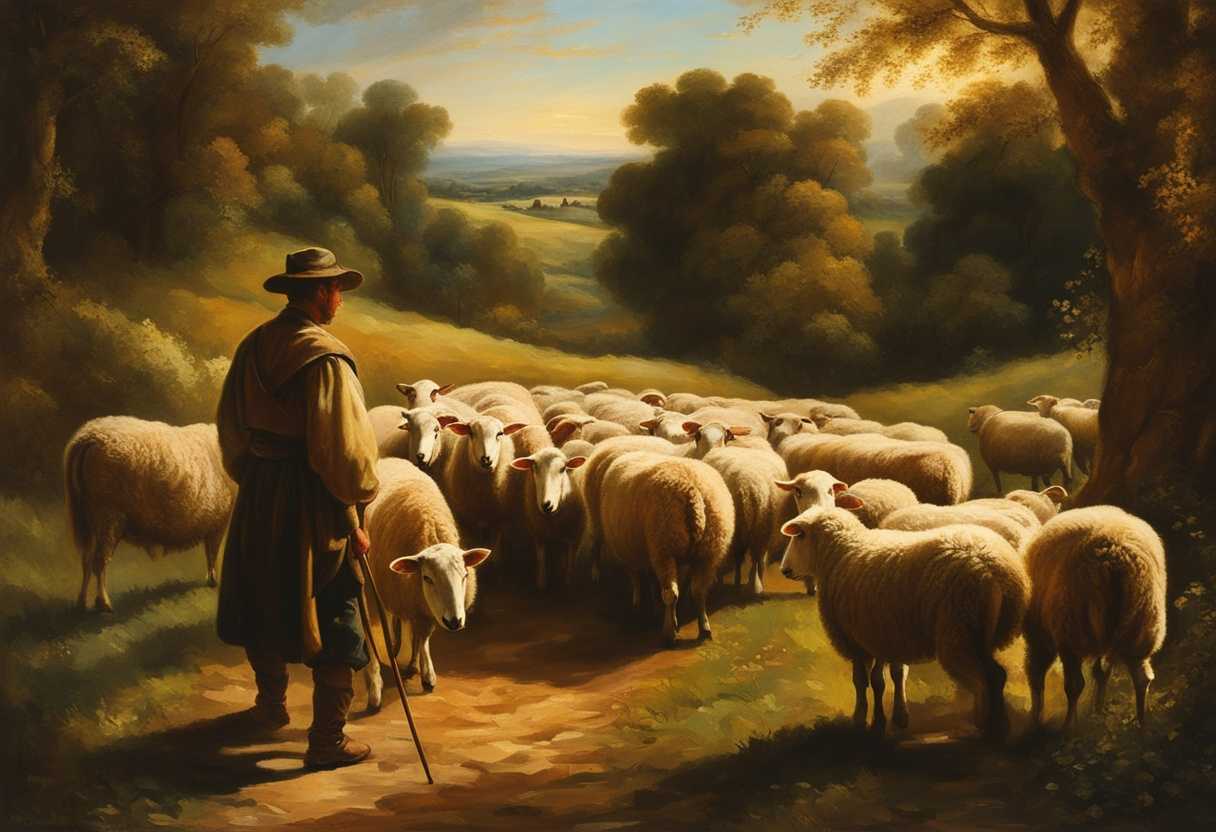
“Feed My Sheep” signifies a call to pastoral responsibility and care for the spiritual well-being of others. This phrase, originating from Jesus’ conversation with Peter in John 21:15-17, emphasizes the importance of nurturing and guiding believers in their faith.
Scripture
15 When they had finished breakfast, Jesus said to Simon Peter, “Simon, son of John, do you love me more than these?” He said to him, “Yes, Lord; you know that I love you.” Jesus said to him, “Feed my lambs.”
16 He said to him a second time, “Simon, son of John, do you love me?” He said to him, “Yes, Lord; you know that I love you.” He said to him, “Tend my sheep.”
17 He said to him the third time, “Simon, son of John, do you love me?” Peter was grieved because he said to him the third time, “Do you love me?” and he said to him, “Lord, you know everything; you know that I love you.” Jesus said to him, “Feed my sheep.
“Feed My Sheep” Biblical Significance
The phrase “Feed My Sheep,” originating from John 21:15-17, carries profound implications for both leadership and community within the Christian faith. After His resurrection, Jesus underscores Peter’s role as a shepherd, entrusting him with the responsibility of nurturing His followers. This interaction is both a commissioning and a reminder of the weight of pastoral duty—administrating spiritual nourishment and guidance. The threefold command to “feed” signifies that this is not merely about physical sustenance but rather a holistic care that includes teaching, preaching, and mentoring believers in their walk with God.
The broader significance of this directive extends beyond pastoral roles to all believers, reflecting a call for mutual accountability and support within the body of Christ. In Acts 20:28, Paul echoes this sentiment, instructing elders to “keep watch over yourselves and all the flock of which the Holy Spirit has made you overseers.” Moreover, the metaphor of sheep emphasizes the vulnerability of individuals within the faith community, highlighting the need for compassion, guidance, and protection. This reaffirms the collective responsibility to promote spiritual growth, reflecting the love and sacrifice of Christ, who is ultimately the Good Shepherd (John 10:11). In layman’s terms, “Feed My Sheep” serves as a foundational principle of Christian discipleship and community life, urging all believers to actively engage in the spiritual nourishment and care of one another.
The theme of “Feed My Sheep” extends into various biblical texts that emphasize the collective responsibility of believers to nurture and guide each other. For instance, throughout the New Testament, the metaphor of the body of Christ illustrates the interconnectedness of all members. Each person plays a vital role in the growth and health of the community, akin to how sheep depend on their shepherd for guidance and sustenance. This interconnected dynamic fosters an environment where believers are called to encourage one another, bearing each other’s burdens and sharing in both joys and challenges. This notion of mutual care strengthens the community and aligns with the concept of discipleship where every member actively participates in contributing to the spiritual well-being of others.
Furthermore, the significance of this phrase can also be traced to the Old Testament, particularly in the prophetic literature, where God often likens His people to sheep and Himself to a shepherd. In passages such as those found in Ezekiel, God speaks of seeking out His lost sheep, restoring them, and bringing them to green pastures. This consistent theme highlights not only divine care but also the expectation that leaders—whether they be prophets, priests, or later church leaders—should embody this nurturing quality. Leaders are called to reflect God’s heart by ensuring that the flock is spiritually well-fed and protected from any harm. Thus, “Feed My Sheep” reverberates throughout Scripture, serving as a timeless reminder of the divine mandate to care for one another, both linked to Christ’s mission and deeply rooted in the shared responsibility of the Christian faith community.
The Call to Spiritual Leadership
The phrase “Feed My Sheep” signifies a divine mandate for spiritual leaders to nurture and guide their communities. This call emphasizes the responsibility of leaders to provide not only physical sustenance but also spiritual nourishment. It highlights the importance of teaching, preaching, and caring for the spiritual well-being of others, ensuring that they grow in faith and understanding. This role is seen as a sacred duty, where leaders are called to be shepherds who protect and lead their flock towards a deeper relationship with God.
The Importance of Community and Care
“Feed My Sheep” also underscores the significance of community within the faith. It reflects the idea that believers are interconnected and have a responsibility to care for one another. This phrase encourages acts of service, compassion, and support among members of the faith community. It serves as a reminder that nurturing one another is essential for spiritual growth and unity, fostering an environment where individuals can thrive in their faith journey together.
The Call to Evangelism and Discipleship
Another broader meaning of “Feed My Sheep” relates to the call for evangelism and discipleship. It emphasizes the importance of sharing the Gospel and making disciples of all nations. This directive encourages believers to actively engage in spreading the message of Christ, teaching others about His love and grace. It highlights the necessity of not only feeding the existing flock but also reaching out to those who have yet to hear the message, thereby expanding the community of faith and fulfilling the Great Commission.
How to Embrace Growth in Faith and Discipleship
Embracing growth in faith and discipleship is a beautiful journey that requires intentionality and openness to God’s leading. Start by immersing yourself in Scripture, allowing the Word to shape your thoughts and actions; consider setting aside time each day for prayer and reflection, inviting the Holy Spirit to guide you in understanding and applying biblical truths. Surround yourself with a community of believers who can encourage and challenge you—whether through a small group, church activities, or fellowship with friends—because growth often flourishes in the context of relationships. Don’t shy away from serving others, as putting your faith into action not only deepens your understanding but also reflects Christ’s love to the world. Remember, growth is a process, and it’s okay to take small steps; be patient with yourself and trust that God is at work in you, shaping you into the person He created you to be.
Bible References to “Feed My Sheep”:
1 Peter 5:1-4: 5 So I exhort the elders among you, as a fellow elder and a witness of the sufferings of Christ, as well as a partaker in the glory that is going to be revealed:
2 shepherd the flock of God that is among you, exercising oversight, not under compulsion, but willingly, as God would have you; not for shameful gain, but eagerly;
3 not domineering over those in your charge, but being examples to the flock.
4 And when the chief Shepherd appears, you will receive the unfading crown of glory.
Acts 20:28-31: 28 Pay careful attention to yourselves and to all the flock, in which the Holy Spirit has made you overseers, to care for the church of God, which he obtained with his own blood.
29 I know that after my departure fierce wolves will come in among you, not sparing the flock;
30 and from among your own selves will arise men speaking twisted things, to draw away the disciples after them.
31 Therefore be alert, remembering that for three years I did not cease night or day to admonish everyone with tears.
Ezekiel 34:1-10: 1 The word of the Lord came to me:
2 “Son of man, prophesy against the shepherds of Israel; prophesy, and say to them, even to the shepherds, Thus says the Lord God: Ah, shepherds of Israel who have been feeding yourselves! Should not shepherds feed the sheep?
3 You eat the fat, you clothe yourselves with the wool, you slaughter the fat ones, but you do not feed the sheep.
4 The weak you have not strengthened, the sick you have not healed, the injured you have not bound up, the strayed you have not brought back, the lost you have not sought, and with force and harshness you have ruled them.
5 So they were scattered, because there was no shepherd, and they became food for all the wild beasts.
6 My sheep were scattered; they wandered over all the mountains and on every high hill. My sheep were scattered over all the face of the earth, with none to search or seek for them.
7 “Therefore, you shepherds, hear the word of the Lord:
8 As I live, declares the Lord God, surely because my sheep have become a prey, and my sheep have become food for all the wild beasts, since there was no shepherd, and because my shepherds have not searched for my sheep, but the shepherds have fed themselves, and have not fed my sheep,
9 Therefore, you shepherds, hear the word of the Lord:
10 Thus says the Lord God, Behold, I am against the shepherds, and I will require my sheep at their hand and put a stop to their feeding the sheep. No longer shall the shepherds feed themselves. I will rescue my sheep from their mouths, that they may not be food for them.
Jeremiah 3:15-16: 15 “‘And I will give you shepherds after my own heart, who will feed you with knowledge and understanding.
16 And when you have multiplied and increased in the land, in those days, declares the Lord, they shall no more say, “The ark of the covenant of the Lord.” It shall not come to mind or be remembered or missed; it shall not be made again.
Matthew 25:31-46: 31 “When the Son of Man comes in his glory, and all the angels with him, then he will sit on his glorious throne.
32 Before him will be gathered all the nations, and he will separate people one from another as a shepherd separates the sheep from the goats.
33 And he will place the sheep on his right, but the goats on the left.
34 Then the King will say to those on his right, ‘Come, you who are blessed by my Father, inherit the kingdom prepared for you from the foundation of the world.
35 For I was hungry and you gave me food, I was thirsty and you gave me drink, I was a stranger and you welcomed me,
36 I was naked and you clothed me, I was sick and you visited me, I was in prison and you came to me.
37 Then the righteous will answer him, saying, ‘Lord, when did we see you hungry and feed you, or thirsty and give you drink?
38 Then the righteous will answer him, saying, ‘Lord, when did we see you hungry and feed you, or thirsty and give you drink?
39 And when did we see you sick or in prison and visit you?
40 And the King will answer them, ‘Truly, I say to you, as you did it to one of the least of these my brothers, you did it to me.’
41 “Then he will say to those on his left, ‘Depart from me, you cursed, into the eternal fire prepared for the devil and his angels.
42 For I was hungry and you gave me no food, I was thirsty and you gave me no drink,
43 I was a stranger and you did not welcome me, naked and you did not clothe me, sick and in prison and you did not visit me.
44 Then they also will answer, saying, ‘Lord, when did we see you hungry or thirsty or a stranger or naked or sick or in prison, and did not minister to you?’
45 Then he will answer them, saying, ‘Truly, I say to you, as you did not do it to one of the least of these, you did not do it to me.’
46 And these will go away into eternal punishment, but the righteous into eternal life.
1 Timothy 4:11-16: 11 Command and teach these things.
12 Let no one despise you for your youth, but set the believers an example in speech, in conduct, in love, in faith, in purity.
13 Until I come, devote yourself to the public reading of Scripture, to exhortation, to teaching.
14 Do not neglect the gift you have, which was given you by prophecy when the council of elders laid their hands on you.
15 Practice these things, immerse yourself in them, so that all may see your progress.
16 Keep a close watch on yourself and on the teaching. Persist in this, for by so doing you will save both yourself and your hearers.
Hebrews 13:20-21: 20 Now may the God of peace who brought again from the dead our Lord Jesus, the great shepherd of the sheep, by the blood of the eternal covenant,
21 equip you with everything good that you may do his will, working in us that which is pleasing in his sight, through Jesus Christ, to whom be glory forever and ever. Amen.
Isaiah 40:10-11: 10 Behold, the Lord God comes with might,
and his arm rules for him;
behold, his reward is with him,
and his recompense before him.
11 He will tend his flock like a shepherd;
he will gather the lambs in his arms;
he will carry them in his bosom,
and gently lead those that are with young.
1 Corinthians 9:7-14: 7 Who serves as a soldier at his own expense? Who plants a vineyard without eating any of its fruit? Or who tends a flock without getting some of the milk?
8 Do I say these things on human authority? Does not the Law say the same?
14 In the same way, the Lord commanded that those who proclaim the gospel should get their living by the gospel.
10 Or is he speaking altogether for our sake? It was written for our sake, because the plowman should plow in hope and the thresher thresh in hope of sharing in the crop.
11 If we have sown spiritual things among you, is it too much if we reap material things from you?
12 If others share this rightful claim on you, do not we even more? Nevertheless, we have not made use of this right, but we endure anything rather than put an obstacle in the way of the gospel of Christ.
13 Do you not know that those who are employed in the temple service get their food from the temple, and those who serve at the altar share in the sacrificial offerings?
14 In the same way, the Lord commanded that those who proclaim the gospel should get their living by the gospel.

Reverend Michael Johnson is an experienced Church Minister with a profound expertise in spirituality and guidance. With a serene presence and a compassionate heart, he has faithfully served his congregation for over 20 years, leading them on a spiritual journey towards inner peace and enlightenment. Reverend Johnson’s extensive knowledge of religious philosophies and profound understanding of human nature have made him a trusted confidant and mentor to many, as he seamlessly weaves his profound wisdom into life teachings. Reverend Johnson’s calming demeanor and empathetic nature continue to uplift and heal souls, nurturing a sense of unity and tranquility within his community.