
Hebrew interpretations of Bible verses often involve analyzing the original Hebrew text to uncover deeper meanings, nuances, and cultural contexts that may not be evident in translations. This approach highlights wordplay, grammatical structures, and historical background, enriching the understanding of scriptural passages.
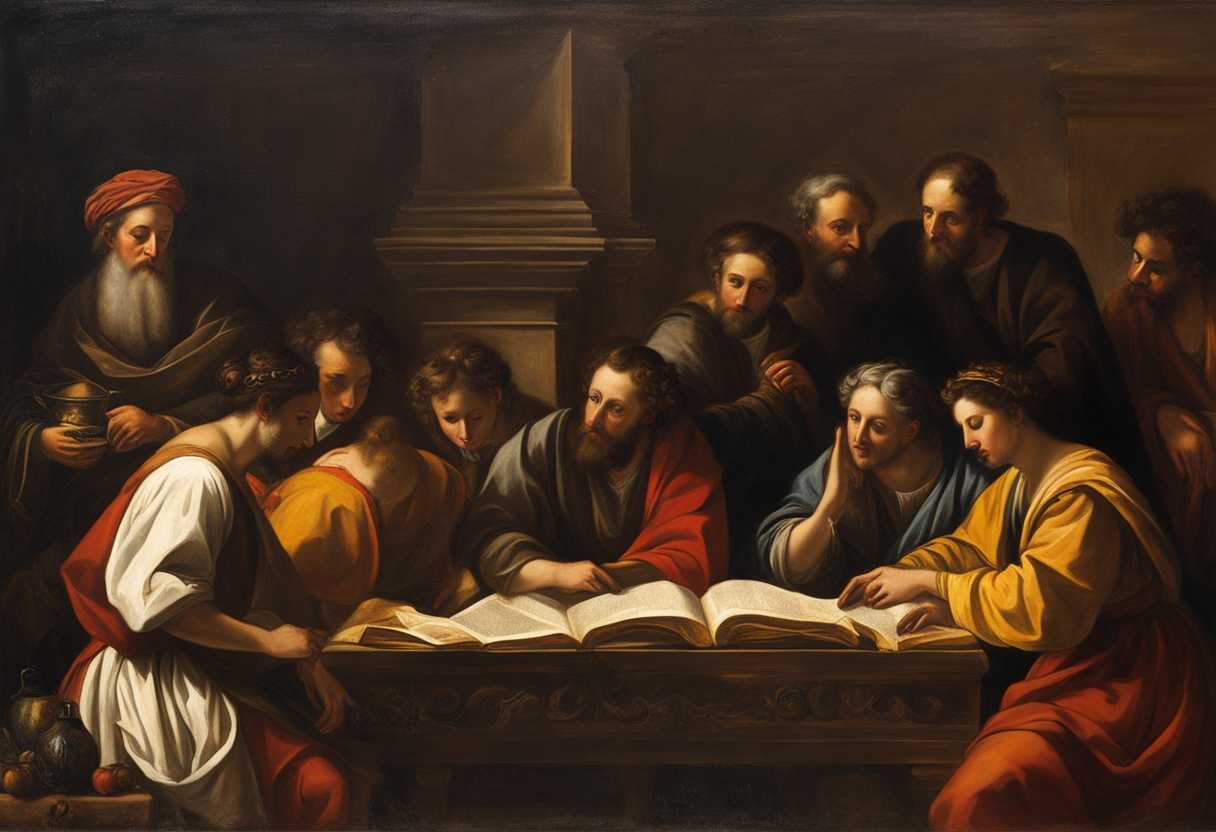
Scripture
1 In the beginning, God created the heavens and the earth.
2 The earth was without form and void, and darkness was over the face of the deep. And the Spirit of God was hovering over the face of the waters.
3 And God said, “Let there be light,” and there was light.
4 And God saw that the light was good.
5 God called the light Day, and the darkness he called Night. And there was evening and there was morning, the first day.
6 And God said, “Let there be an expanse in the midst of the waters, and let it separate the waters from the waters.”
7 And God made the expanse and separated the waters that were under the expanse from the waters that were above the expanse. And it was so.
8 And God called the expanse Heaven. And there was evening and there was morning, the second day.
9 And God said, “Let the waters under the heavens be gathered together into one place, and let the dry land appear.” And it was so.
10 God called the dry land Earth, and the waters that were gathered together he called Seas. And God saw that it was good.
11 And God said, “Let the earth sprout vegetation, plants yielding seed, and fruit trees bearing fruit in which is their seed, each according to its kind, on the earth.” And it was so.
12 The earth brought forth vegetation, plants yielding seed according to their own kinds, and trees bearing fruit in which is their seed, each according to its kind. And God saw that it was good.
13 And there was evening and there was morning, the third day.
14 And God said, “Let there be lights in the expanse of the heavens to separate the day from the night. And let them be for signs and for seasons, and for days and years,
15 and let them be lights in the expanse of the heavens to give light upon the earth.” And it was so.
16 And God made the two great lights—the greater light to rule the day and the lesser light to rule the night—and the stars.
17 And God set them in the expanse of the heavens to give light on the earth,
18 to rule over the day and over the night, and to separate the light from the darkness. And God saw that it was good.
19 And there was evening and there was morning, the fourth day.
20 And God said, “Let the waters swarm with swarms of living creatures, and let birds fly above the earth across the expanse of the heavens.”
21 So God created the great sea creatures and every living creature that moves, with which the waters swarm, according to their kinds, and every winged bird according to its kind. And God saw that it was good.
22 And God blessed them, saying, “Be fruitful and multiply and fill the waters in the seas, and let birds multiply on the earth.”
23 And there was evening and there was morning, the fifth day.
24 And God said, “Let the earth bring forth living creatures according to their kinds—livestock and creeping things and beasts of the earth according to their kinds.” And it was so.
25 And God made the beasts of the earth according to their kinds and the livestock according to their kinds, and everything that creeps on the ground according to its kind. And God saw that it was good.
26 Then God said, “Let us make man in our image, after our likeness. And let them have dominion over the fish of the sea and over the birds of the heavens and over the livestock and over all the earth and over every creeping thing that creeps on the earth.”
27 So God created man in his own image,
in the image of God he created him;
male and female he created them.
28 And God blessed them. And God said to them, “Be fruitful and multiply and fill the earth and subdue it, and have dominion over the fish of the sea and over the birds of the heavens and over every living thing that moves on the earth.”
29 And God said, “Behold, I have given you every plant yielding seed that is on the face of all the earth, and every tree with seed in its fruit. You shall have them for food.
30 And to every beast of the earth and to every bird of the heavens and to everything that creeps on the earth, everything that has the breath of life, I have given every green plant for food.” And it was so.
31 And God saw everything that he had made, and behold, it was very good. And there was evening and there was morning, the sixth day.
Hebrew Interpretations of Biblical Verses
Hebrew interpretations of Bible verses are foundational to understanding the essence and depth of scripture. The original Hebrew text often contains layers of meaning that become obscured in translation. For instance, consider Genesis 1:1, “In the beginning God created the heavens and the earth.” The Hebrew word for “created” (בָּרָא, bara) suggests a divine creation ex nihilo, or creation “out of nothing,” emphasizing God’s sovereignty and intentionality. The nuances of certain terms, such as “heavens” and “earth,” also reflect a holistic understanding of God’s creation, encompassing both the physical universe and the spiritual realm. Emotionally and theologically, this invites readers to reflect not just on the act of creation, but also on the inherent order and purpose behind it, which may be less pronounced in translated texts.
Moreover, Hebrew interpretations often involve examining the interplay of words that suggest deeper moral or philosophical lessons. For example, in Isaiah 40:31, the passage speaks of those who hope in the Lord renewing their strength, but the Hebrew word for “hope” (קָוָה, qavah) implies a tension of waiting and expectation that can yield strength and resilience in trials. This wordplay encourages believers to actively engage with their faith rather than passively waiting for divine intervention. The cultural milieu of ancient Hebrew society, wherein personal, communal, and covenantal relationships were paramount, further deepens the implications of these texts, reminding readers that interpretations should also reflect the communal nature of scriptural engagement, as seen in Exodus 19:6, where Israel is called a “kingdom of priests.” Thus, embracing Hebrew interpretations fosters a dynamic and enriched understanding of scripture that resonates with both ancient and contemporary believers.
The exploration of Hebrew interpretations stretches beyond mere linguistic scrutiny; it delves into the cultural, historical, and theological contexts that shape the understanding of scripture throughout centuries. For instance, when analyzing prophetic literature, one often encounters the term “shofar” (שׁוֹפָר), which denotes a ram’s horn used in religious ceremonies. Its use signifies not just a call to worship or an announcement but also invokes a deeper sense of urgency for communal repentance and spiritual awakening. This understanding is informed by the historical moments in which trumpet calls were employed, often marking significant events or divine interventions, thus tying together communal identity and divine listening within the text.
Additionally, the rich tradition of midrash illustrates how Hebrew scholars employ storytelling and interpretative frameworks to breathe new life into ancient texts. For example, the concept of “chesed” (חֶסֶד), representing loving-kindness, is pivotal in the discussions surrounding the laws of the Torah. Its nuances convey a relational dynamic that is as much about obligation as it is about compassion and creativity in community life. Midrashic interpretations may highlight tales that reflect these themes, revealing how the ancient Israelites understood social justice and ethical behavior as extensions of divine character. This multifaceted approach underscores that Hebrew scripture is not a static set of laws or doctrines but a living dialogue that invites ongoing engagement, personal reflection, and communal discussion. Hence, immersing oneself in the Hebrew tradition enriches the spiritual pilgrimage, allowing believers to draw deeper lessons from their sacred texts.
The Significance of Creation in Hebrew Thought
In Hebrew interpretations, the act of creation is not merely a historical event but a profound theological statement about God’s sovereignty and the inherent goodness of the world. The Hebrew word for “create,” bara, implies a divine initiative that brings order out of chaos. This understanding emphasizes the relationship between God and creation, suggesting that the world is imbued with purpose and intentionality. The Hebrew perspective often sees creation as an ongoing process, where humanity plays a crucial role in maintaining and nurturing the world, reflecting the divine image.
The Concept of Hope and Renewal
Hebrew interpretations often highlight themes of hope and renewal, particularly in the context of suffering and exile. The prophetic literature, for instance, conveys a message of restoration and the promise of a future where justice and peace prevail. This hope is deeply rooted in the covenantal relationship between God and Israel, where faithfulness is met with divine mercy. The cyclical nature of life, as seen in the agricultural rhythms of planting and harvest, reinforces the idea that despair is not the end; rather, it is a precursor to new beginnings and divine intervention.
The Role of Community and Covenant
In Hebrew thought, the concept of community is central to understanding biblical texts. The covenant between God and the people of Israel is not just an individual promise but a collective commitment that shapes the identity and destiny of the community. This interpretation emphasizes the importance of communal responsibility, ethical living, and social justice. The Hebrew Bible often calls for the care of the marginalized and the pursuit of righteousness, reflecting the belief that the well-being of the community is intertwined with the faithfulness of its members to God’s commandments.
How to Deepen Your Faith Through Understanding Scripture
Deepening your faith through understanding Scripture is a transformative journey that invites you to engage with the Word of God on a personal level. Start by setting aside dedicated time each day to read the Bible, allowing its stories and teachings to resonate in your heart. As you read, consider keeping a journal to jot down your thoughts, questions, and insights; this practice not only helps you process what you’re learning but also creates a space for God to speak to you. Don’t hesitate to explore different translations and commentaries, as they can illuminate passages in new ways and deepen your understanding. Remember, prayer is essential—ask the Holy Spirit to guide you in your study, revealing truths that apply to your life. Finally, share your insights with others in your community; discussing Scripture can enrich your understanding and strengthen your faith as you learn from one another. Embrace this journey with an open heart, and watch how your relationship with God flourishes through His Word.
Bible References to Hebrew Interpretations:
Exodus 3:1-22: 1 Now Moses was keeping the flock of his father-in-law, Jethro, the priest of Midian, and he led his flock to the west side of the wilderness and came to Horeb, the mountain of God.
2 And the angel of the Lord appeared to him in a flame of fire out of the midst of a bush. He looked, and behold, the bush was burning, yet it was not consumed.
3 And Moses said, “I will turn aside to see this great sight, why the bush is not burned.”
4 When the Lord saw that he turned aside to see, God called to him out of the bush, “Moses, Moses!” And he said, “Here I am.”
5 Then he said, “Do not come near; take your sandals off your feet, for the place on which you are standing is holy ground.”
6 And he said, “I am the God of your father, the God of Abraham, the God of Isaac, and the God of Jacob.” And Moses hid his face, for he was afraid to look at God.
7 Then the Lord said, “I have surely seen the affliction of my people who are in Egypt and have heard their cry because of their taskmasters. I know their sufferings,
8 and I have come down to deliver them out of the hand of the Egyptians and to bring them up out of that land to a good and broad land, a land flowing with milk and honey, to the place of the Canaanites, the Hittites, the Amorites, the Perizzites, the Hivites, and the Jebusites.
9 And now, behold, the cry of the people of Israel has come to me, and I have also seen the oppression with which the Egyptians oppress them.
10 Come, I will send you to Pharaoh that you may bring my people, the children of Israel, out of Egypt.”
11 But Moses said to God, “Who am I that I should go to Pharaoh and bring the children of Israel out of Egypt?”
12 He said, “But I will be with you, and this shall be the sign for you, that I have sent you: when you have brought the people out of Egypt, you shall serve God on this mountain.”
13 Then Moses said to God, “If I come to the people of Israel and say to them, ‘The God of your fathers has sent me to you,’ and they ask me, ‘What is his name?’ what shall I say to them?”
14 God said to Moses, “I am who I am.” And he said, “Say this to the people of Israel: ‘I am has sent me to you.’”
15 God also said to Moses, “Say this to the people of Israel: ‘The Lord, the God of your fathers, the God of Abraham, the God of Isaac, and the God of Jacob, has sent me to you.’ This is my name forever, and thus I am to be remembered throughout all generations.
16 Go and gather the elders of Israel together and say to them, ‘The Lord, the God of your fathers, the God of Abraham, of Isaac, and of Jacob, has appeared to me, saying, “I have observed you and what has been done to you in Egypt,
17 and I promise that I will bring you up out of the affliction of Egypt to the land of the Canaanites, the Hittites, the Amorites, the Perizzites, the Hivites, and the Jebusites, a land flowing with milk and honey.”
18 And they will listen to your voice, and you and the elders of Israel shall go to the king of Egypt and say to him, ‘The Lord, the God of the Hebrews, has met with us; and now, please let us go a three days’ journey into the wilderness, that we may sacrifice to the Lord our God.’
19 But I know that the king of Egypt will not let you go unless compelled by a mighty hand.
20 So I will stretch out my hand and strike Egypt with all the wonders that I will do in it; after that he will let you go.
21 And I will give this people favor in the sight of the Egyptians; and when you go, you shall not go empty,
22 But each woman shall ask of her neighbor, and any woman who lives in her house, for silver and gold jewelry, and for clothing. You shall put them on your sons and on your daughters. So you shall plunder the Egyptians.”
Leviticus 19:1-37: And the Lord spoke to Moses, saying,
2 “Speak to all the congregation of the people of Israel and say to them, You shall be holy, for I the Lord your God am holy.
3 Every one of you shall revere his mother and his father, and you shall keep my Sabbaths: I am the Lord your God.
4 Do not turn to idols or make for yourselves any gods of cast metal: I am the Lord your God.
5 “When you offer a sacrifice of peace offerings to the Lord, you shall offer it so that you may be accepted.
6 It shall be eaten the same day you offer it or on the day after, and anything left over until the third day shall be burned with fire.
7 You shall not strip your vineyard bare, neither shall you gather the fallen grapes of your vineyard. You shall leave them for the poor and for the sojourner: I am the Lord your God.
8 You shall not eat any flesh with the blood in it. You shall not interpret omens or tell fortunes.
9 “When you reap the harvest of your land, you shall not reap your field right up to its edge, neither shall you gather the gleanings after your harvest.
10 And you shall not strip your vineyard bare, neither shall you gather the fallen grapes of your vineyard. You shall leave them for the poor and for the sojourner: I am the Lord your God.
11 “You shall not steal; you shall not deal falsely; you shall not lie to one another.”
12 You shall not swear by my name falsely, and so profane the name of your God: I am the Lord.
13 “You shall not oppress your neighbor or rob him. The wages of a hired worker shall not remain with you all night until the morning.”
14 You shall not curse the deaf or put a stumbling block before the blind, but you shall fear your God: I am the Lord.
15 “You shall do no injustice in court. You shall not be partial to the poor or defer to the great, but in righteousness shall you judge your neighbor.”
16 You shall not go around as a slanderer among your people, and you shall not stand up against the life of your neighbor: I am the Lord.
17 You shall not hate your brother in your heart, but you shall reason frankly with your neighbor, lest you incur sin because of him.
18 You shall not take vengeance or bear a grudge against the sons of your own people, but you shall love your neighbor as yourself: I am the Lord.
19 “You shall keep my statutes. You shall not let your cattle breed with a different kind. You shall not sow your field with two kinds of seed, nor shall you wear a garment of cloth made of two kinds of material.
20 “If a man lies with a woman who is a slave, assigned to another man and not yet ransomed or given her freedom, a distinction shall be made. They shall not be put to death, because she was not free;
21 But if the man is poor and cannot afford so much, then he shall take one male lamb for a guilt offering to be waved, to make atonement for him, and a tenth of an ephah of fine flour mixed with oil for a grain offering, and a log of oil;
22 And the priest shall make atonement for him with the ram of the guilt offering before the Lord for his sin that he has committed, and he shall be forgiven for the sin that he has committed.
23 “When you come into the land and plant any kind of tree for food, then you shall regard its fruit as forbidden. Three years it shall be forbidden to you; it must not be eaten.”
24 But in the fourth year all its fruit shall be holy, an offering of praise to the Lord.
25 And in the fifth year you shall eat of its fruit, to increase its yield for you: I am the Lord your God.
26 “You shall not eat any flesh with the blood in it. You shall not interpret omens or tell fortunes.
27 You shall not round off the hair on your temples or mar the edges of your beard.
28 You shall not make any cuts on your body for the dead or tattoo yourselves: I am the Lord.
29 “Do not profane your daughter by making her a prostitute, lest the land fall into prostitution and the land become full of depravity.
30 You shall keep my Sabbaths and reverence my sanctuary: I am the Lord.
31 “Do not turn to mediums or necromancers; do not seek them out, and so make yourselves unclean by them: I am the Lord your God.
32 “You shall stand up before the gray head and honor the face of an old man, and you shall fear your God: I am the Lord.
33 “When a stranger sojourns with you in your land, you shall not do him wrong.
34 You shall treat the stranger who sojourns with you as the native among you, and you shall love him as yourself, for you were strangers in the land of Egypt: I am the Lord your God.
35 You shall do no wrong in judgment, in measures of length or weight or quantity.
36 You shall have just balances, just weights, a just ephah, and a just hin: I am the Lord your God, who brought you out of the land of Egypt.
37 You shall observe all my statutes and all my rules, and do them: I am the Lord.”
Deuteronomy 6:1-25: 1 “Now this is the commandment—the statutes and the rules—that the Lord your God commanded me to teach you, that you may do them in the land to which you are going over, to possess it,”
2 that you may fear the Lord your God, you and your son and your son’s son, by keeping all his statutes and his commandments, which I command you, all the days of your life, and that your days may be long.
3 Hear therefore, O Israel, and be careful to do them, that it may go well with you, and that you may multiply greatly, as the Lord, the God of your fathers, has promised you, in a land flowing with milk and honey.
4 “Hear, O Israel: The Lord our God, the Lord is one.
5 You shall love the Lord your God with all your heart and with all your soul and with all your might.
6 And these words that I command you today shall be on your heart.
7 You shall teach them diligently to your children, and shall talk of them when you sit in your house, and when you walk by the way, and when you lie down, and when you rise.
8 You shall bind them as a sign on your hand, and they shall be as frontlets between your eyes.
9 You shall write them on the doorposts of your house and on your gates.
10 “And when the Lord your God brings you into the land that he swore to your fathers, to Abraham, to Isaac, and to Jacob, to give you—with great and good cities that you did not build,
11 and houses full of all good things that you did not fill, and cisterns that you did not dig, and vineyards and olive trees that you did not plant—and when you eat and are full,
12 then take care lest you forget the Lord, who brought you out of the land of Egypt, out of the house of slavery.
13 It is the Lord your God you shall fear. Him you shall serve and by his name you shall swear.
14 You shall not go after other gods, the gods of the peoples who are around you—
15 for the Lord your God in your midst is a jealous God—lest the anger of the Lord your God be kindled against you, and he destroy you from off the face of the earth.
16 “You shall not put the Lord your God to the test, as you tested him at Massah.
17 You shall diligently keep the commandments of the Lord your God, and his testimonies and his statutes, which he has commanded you.
18 And you shall do what is right and good in the sight of the Lord, that it may go well with you, and that you may go in and take possession of the good land that the Lord swore to give to your fathers,
19 to thrust out all your enemies from before you, as the Lord has promised.
20 “When your son asks you in time to come, ‘What is the meaning of the testimonies and the statutes and the rules that the Lord our God has commanded you?’”
21 then you shall say to your son, ‘We were Pharaoh’s slaves in Egypt. And the Lord brought us out of Egypt with a mighty hand.
22 And the Lord showed signs and wonders, great and grievous, against Egypt and against Pharaoh and all his household, before our eyes.
23 And he brought us out from there, that he might bring us in and give us the land that he swore to give to our fathers.
24 And the Lord commanded us to do all these statutes, to fear the Lord our God, for our good always, that he might preserve us alive, as we are this day.
25 And it will be righteousness for us, if we are careful to do all this commandment before the Lord our God, as he has commanded us.’
Isaiah 53:1-12: 1 Who has believed what he has heard from us? And to whom has the arm of the Lord been revealed?
2 For he grew up before him like a young plant, and like a root out of dry ground; he had no form or majesty that we should look at him, and no beauty that we should desire him.
3 He was despised and rejected by men, a man of sorrows and acquainted with grief; and as one from whom men hide their faces he was despised, and we esteemed him not.
4 Surely he has borne our griefs and carried our sorrows; yet we esteemed him stricken, smitten by God, and afflicted.
5 But he was pierced for our transgressions;
he was crushed for our iniquities;
upon him was the chastisement that brought us peace,
and with his wounds we are healed.
6 All we like sheep have gone astray;
we have turned—every one—to his own way;
and the Lord has laid on him
the iniquity of us all.
7 He was oppressed, and he was afflicted,
yet he opened not his mouth;
like a lamb that is led to the slaughter,
and like a sheep that before its shearers is silent,
so he opened not his mouth.
8 By oppression and judgment he was taken away; and as for his generation, who considered that he was cut off out of the land of the living, stricken for the transgression of my people?
9 And they made his grave with the wicked and with a rich man in his death, although he had done no violence, and there was no deceit in his mouth.
10 Yet it was the will of the Lord to crush him; he has put him to grief; when his soul makes an offering for guilt, he shall see his offspring; he shall prolong his days; the will of the Lord shall prosper in his hand.
11 Out of the anguish of his soul he shall see and be satisfied; by his knowledge shall the righteous one, my servant, make many to be accounted righteous, and he shall bear their iniquities.
12 Therefore I will divide him a portion with the many, and he shall divide the spoil with the strong, because he poured out his soul to death and was numbered with the transgressors; yet he bore the sin of many, and makes intercession for the transgressors.
Jeremiah 31:31-34: 31 “Behold, the days are coming, declares the Lord, when I will make a new covenant with the house of Israel and the house of Judah,
32 not like the covenant that I made with their fathers on the day when I took them by the hand to bring them out of the land of Egypt, my covenant that they broke, though I was their husband, declares the Lord.
33 For this is the covenant that I will make with the house of Israel after those days, declares the Lord: I will put my law within them, and I will write it on their hearts. And I will be their God, and they shall be my people.
34 And no longer shall each one teach his neighbor and each his brother, saying, ‘Know the Lord,’ for they shall all know me, from the least of them to the greatest, declares the Lord.
Ezekiel 37:1-28: 1 The hand of the Lord was upon me, and he brought me out in the Spirit of the Lord and set me down in the middle of the valley; it was full of bones.
2 And he led me around among them, and behold, there were very many on the surface of the valley, and behold, they were very dry.
3 And he said to me, “Son of man, can these bones live?” And I answered, “O Lord God, you know.”
4 Then he said to me, “Prophesy over these bones, and say to them, O dry bones, hear the word of the Lord.”
5 Thus says the Lord God to these bones: Behold, I will cause breath to enter you, and you shall live.
6 And I will lay sinews upon you, and will cause flesh to come upon you, and cover you with skin, and put breath in you, and you shall live, and you shall know that I am the Lord.
7 So I prophesied as I was commanded. And as I prophesied, there was a sound, and behold, a rattling, and the bones came together, bone to its bone.
8 And I looked, and behold, there were sinews on them, and flesh had come upon them, and skin had covered them. But there was no breath in them.
9 Then he said to me, “Prophesy to the breath; prophesy, son of man, and say to the breath, Thus says the Lord God: Come from the four winds, O breath, and breathe on these slain, that they may live.”
10 So I prophesied as he commanded me, and the breath came into them, and they lived and stood on their feet, an exceedingly great army.
11 Then he said to me, “Son of man, these bones are the whole house of Israel. Behold, they say, ‘Our bones are dried up, and our hope is lost; we are indeed cut off.’
12 Therefore prophesy, and say to them, Thus says the Lord God: Behold, I will open your graves and raise you from your graves, O my people. And I will bring you into the land of Israel.
13 And you shall know that I am the Lord, when I open your graves, and raise you from your graves, O my people.
13 And you shall know that I am the Lord, when I open your graves, and raise you from your graves, O my people.
37 The word of the Lord came to me:
16 “And you, son of man, take a stick and write on it, ‘For Judah, and the people of Israel associated with him’; then take another stick and write on it, ‘For Joseph (the stick of Ephraim) and all the house of Israel associated with him.’”
17 And join them one to another into one stick, that they may become one in your hand.
18 And when your people say to you, ‘Will you not tell us what you mean by these?’
19 say to them, Thus says the Lord God: Behold, I am about to take the stick of Joseph (that is in the hand of Ephraim) and the tribes of Israel associated with him.
20 The sticks on which you write shall be in your hand before their eyes.
21 then say to them, Thus says the Lord God: Behold, I will take the people of Israel from the nations among which they have gone, and will gather them from all around, and bring them to their own land.
22 And I will make them one nation in the land, on the mountains of Israel. And one king shall be king over them all, and they shall be no longer two nations, and no longer divided into two kingdoms.
23 They shall not defile themselves anymore with their idols and their detestable things, or with any of their transgressions.
24 “My servant David shall be king over them, and they shall all have one shepherd. They shall walk in my rules and be careful to obey my statutes.”
25 They shall dwell in the land that I gave to my servant Jacob, where your fathers lived. They and their children and their children’s children shall dwell there forever, and David my servant shall be their prince forever.
26 I will make a covenant of peace with them. It shall be an everlasting covenant with them. And I will set them in their land and multiply them, and will set my sanctuary in their midst forevermore.
27 My dwelling place shall be with them, and I will be their God, and they shall be my people.
28 Then the nations will know that I am the Lord who sanctifies Israel, when my sanctuary is in their midst forevermore.
Daniel 9:24-27: 24 “Seventy weeks are decreed about your people and your holy city, to finish the transgression, to put an end to sin, and to atone for iniquity, to bring in everlasting righteousness, to seal both vision and prophet, and to anoint a most holy place.”
25 Know therefore and understand that from the going out of the word to restore and build Jerusalem to the coming of an anointed one, a prince, there shall be seven weeks.
26 And after the sixty-two weeks, an anointed one shall be cut off and shall have nothing. And the people of the prince who is to come shall destroy the city and the sanctuary. Its end shall come with a flood, and to the end there shall be war. Desolations are decreed.
27 And he shall make a strong covenant with many for one week, and for half of the week he shall put an end to sacrifice and offering. And on the wing of abominations shall come one who makes desolate, until the decreed end is poured out on the desolator.
Hosea 11:1-11: 1 When Israel was a child, I loved him,
and out of Egypt I called my son.
2 The more they were called, the more they went away; they kept sacrificing to the Baals and burning offerings to idols.
3 Yet it was I who taught Ephraim to walk; I took them up by their arms, but they did not know that I healed them.
4 I led them with cords of kindness,
with the bands of love,
and I became to them as one who eases the yoke on their jaws,
and I bent down to them and fed them.
5 They shall not return to the land of Egypt,
but Assyria shall be their king,
because they have refused to return to me.
6 The sword shall rage against their cities,
consume the bars of their gates,
and devour them because of their own counsels.
7 My people are bent on turning away from me,
and though they call out to the Most High,
he shall not raise them up at all.
8 How can I give you up, O Ephraim?
How can I hand you over, O Israel?
How can I make you like Admah?
How can I treat you like Zeboiim?
My heart recoils within me;
my compassion grows warm and tender.
9 I will not execute my burning anger;
I will not again destroy Ephraim;
for I am God and not a man,
the Holy One in your midst,
and I will not come in wrath.
10 They shall go after the Lord; he will roar like a lion; when he roars, his children shall come trembling from the west;
11 They shall come trembling like birds from Egypt,
and like doves from the land of Assyria,
and I will return them to their homes, declares the Lord.
Amos 5:21-24: 21 “I hate, I despise your feasts, and I take no delight in your solemn assemblies.”
22 Even though you offer me your burnt offerings and grain offerings, I will not accept them; and the peace offerings of your fattened animals, I will not look upon them.
23 Take away from me the noise of your songs; to the melody of your harps I will not listen.
24 But let justice roll down like waters, and righteousness like an ever-flowing stream.
Micah 6:6-8: 6 “With what shall I come before the Lord, and bow myself before God on high? Shall I come before him with burnt offerings, with calves a year old?”
7 Will the Lord be pleased with thousands of rams,
with ten thousands of rivers of oil?
Shall I give my firstborn for my transgression,
the fruit of my body for the sin of my soul?”
8 He has told you, O man, what is good; and what does the Lord require of you but to do justice, and to love kindness, and to walk humbly with your God?
Zechariah 12:10-14: 10 “And I will pour out on the house of David and the inhabitants of Jerusalem a spirit of grace and pleas for mercy, so that, when they look on me, on him whom they have pierced, they shall mourn for him, as one mourns for an only child, and weep bitterly over him, as one weeps over a firstborn.”
11 On that day the mourning in Jerusalem will be as great as the mourning for Hadad-rimmon in the plain of Megiddo.
12 The land shall mourn, each family by itself: the family of the house of David by itself, and their wives by themselves; the family of the house of Nathan by itself, and their wives by themselves;
13 “On that day there shall be a great mourning in Jerusalem, like the mourning of Hadadrimmon in the plain of Megiddo.”
14 The families of the house of David separate themselves, and their wives separate themselves; the family of the house of Nathan separate themselves, and their wives separate themselves;
Malachi 3:1-12: 1 “Behold, I send my messenger, and he will prepare the way before me. And the Lord whom you seek will suddenly come to his temple; and the messenger of the covenant in whom you delight, behold, he is coming, says the Lord of hosts.”
2 But who can endure the day of his coming, and who can stand when he appears? For he is like a refiner’s fire and like fullers’ soap.
3 He will sit as a refiner and purifier of silver, and he will purify the sons of Levi and refine them like gold and silver, and they will bring offerings in righteousness to the Lord.
4 Then the offering of Judah and Jerusalem will be pleasing to the Lord as in the days of old and as in former years.
5 “Then I will draw near to you for judgment. I will be a swift witness against the sorcerers, against the adulterers, against those who swear falsely, against those who oppress the hired worker in his wages, the widow and the fatherless, against those who thrust aside the sojourner, and do not fear me, says the Lord of hosts.”
6 “For I the Lord do not change; therefore you, O children of Jacob, are not consumed.
7 From the days of your fathers you have turned aside from my statutes and have not kept them. Return to me, and I will return to you, says the Lord of hosts. But you say, ‘How shall we return?’
8 Will man rob God? Yet you are robbing me. But you say, ‘How have we robbed you?’ In your tithes and contributions.
9 You are cursed with a curse, for you are robbing me, the whole nation of you.
10 Bring the full tithe into the storehouse, that there may be food in my house. And thereby put me to the test, says the Lord of hosts, if I will not open the windows of heaven for you and pour down for you a blessing until there is no more need.
11 I will rebuke the devourer for you, so that it will not destroy the fruits of your soil, and your vine in the field shall not fail to bear, says the Lord of hosts.
12 Then all nations will call you blessed, for you will be a land of delight, says the Lord of hosts.
Psalms 22:1-31: 1 My God, my God, why have you forsaken me?
Why are you so far from saving me, from the words of my groaning?
2 O my God, I cry by day, but you do not answer,
and by night, but I find no rest.
3 Yet you are holy,
enthroned on the praises of Israel.
4 In you our fathers trusted;
they trusted, and you delivered them.
5 To you they cried and were rescued;
in you they trusted and were not put to shame.
6 But I am a worm and not a man,
scorned by mankind and despised by the people.
7 All who see me mock me;
they make mouths at me;
they wag their heads;
8 “He trusts in the Lord; let him deliver him; let him rescue him, for he delights in him!”
9 Yet you are he who took me from the womb; you made me trust you at my mother’s breasts.
10 I was cast upon you from my birth,
and since my mother bore me you have been my God.
11 Be not far from me,
for trouble is near,
and there is none to help.
12 Many bulls encompass me;
strong bulls of Bashan surround me;
13 They open wide their mouths at me,
like a ravening and roaring lion.
14 I am poured out like water,
and all my bones are out of joint;
my heart is like wax;
it is melted within my breast;
15 my strength is dried up like a potsherd, and my tongue sticks to my jaws; you lay me in the dust of death.
16 For dogs encompass me; a company of evildoers encircles me; they have pierced my hands and feet—
17 I can count all my bones—
they stare and gloat over me;
18 they divide my garments among them,
and for my clothing they cast lots.
19 But you, O Lord, do not be far off!
O you my help, come quickly to my aid!
20 Deliver my soul from the sword,
my precious life from the power of the dog!
21 Save me from the mouth of the lion!
22 I will tell of your name to my brothers; in the midst of the congregation I will praise you:
23 You who fear the Lord, praise him!
All you offspring of Jacob, glorify him,
and stand in awe of him, all you offspring of Israel!
24 For he has not despised or abhorred
the affliction of the afflicted,
and he has not hidden his face from him,
but has heard, when he cried to him.
25 From you comes my praise in the great congregation; my vows I will perform before those who fear him.
26 The afflicted shall eat and be satisfied;
those who seek him shall praise the Lord!
May your hearts live forever!
27 All the ends of the earth shall remember and turn to the Lord,
and all the families of the nations
shall worship before you.
28 For kingship belongs to the Lord,
and he rules over the nations.
29 All the prosperous of the earth eat and worship;
before him shall bow all who go down to the dust,
even the one who could not keep himself alive.
30 Posterity shall serve him; it shall be told of the Lord to the coming generation;
31 they shall come and proclaim his righteousness to a people yet unborn, that he has done it.
Proverbs 3:1-35: 1 My son, do not forget my teaching,
but let your heart keep my commandments,
2 for length of days and years of life
and peace they will add to you.
3 Let not steadfast love and faithfulness forsake you; bind them around your neck; write them on the tablet of your heart.
4 So you will find favor and good success
in the sight of God and man.
5 Trust in the Lord with all your heart,
and do not lean on your own understanding.
6 In all your ways acknowledge him, and he will make straight your paths.
7 Be not wise in your own eyes;
fear the Lord, and turn away from evil.
8 It will be healing to your flesh and refreshment to your bones.
9 Honor the Lord with your wealth
and with the firstfruits of all your produce;
10 then your barns will be filled with plenty, and your vats will be bursting with wine.
11 My son, do not despise the Lord’s discipline
or be weary of his reproof,
12 for the Lord reproves him whom he loves,
as a father the son in whom he delights.
13 Blessed is the one who finds wisdom,
and the one who gets understanding,
14 for the gain from her is better than gain from silver
and her profit better than gold.
15 She is more precious than jewels, and nothing you desire can compare with her.
16 Long life is in her right hand;
in her left hand are riches and honor.
17 Her ways are ways of pleasantness,
and all her paths are peace.
18 She is a tree of life to those who lay hold of her; those who hold her fast are called blessed.
19 The Lord by wisdom founded the earth;
by understanding he established the heavens;
20 by his knowledge the deeps broke open, and the clouds drop down the dew.
21 My son, do not lose sight of these—
keep sound wisdom and discretion,
22 So they will be life to your soul
and adornment to your neck.
23 Then you will walk on your way securely, and your foot will not stumble.
24 If you lie down, you will not be afraid;
when you lie down, your sleep will be sweet.
25 Do not be afraid of sudden terror
or of the ruin of the wicked, when it comes,
26 for the Lord will be your confidence
and will keep your foot from being caught.
27 Do not withhold good from those to whom it is due, when it is in your power to do it.
28 Do not say to your neighbor, “Go, and come again, tomorrow I will give it”—when you have it with you.
29 Do not plan evil against your neighbor, who dwells trustingly beside you.
30 Do not contend with a man for no reason,
when he has done you no harm.
31 Do not envy a man of violence
and do not choose any of his ways,
32 for the devious person is an abomination to the Lord,
but the upright are in his confidence.
33 The Lord’s curse is on the house of the wicked,
but he blesses the dwelling of the righteous.
34 Toward the scorners he is scornful,
but to the humble he gives favor.
35 The wise will inherit honor,
but fools get disgrace.
Job 1:1-22: 1 There was a man in the land of Uz whose name was Job, and that man was blameless and upright, one who feared God and turned away from evil.
2 There were born to him seven sons and three daughters.
3 His possessions also were 7,000 sheep, 3,000 camels, 500 yoke of oxen, and 500 female donkeys, and very many servants, so that this man was the greatest of all the people of the east.
4 His sons used to go and hold a feast in the house of each one on his day, and they would send and invite their three sisters to eat and drink with them.
5 And when the days of the feast had run their course, Job would send and consecrate them, and he would rise early in the morning and offer burnt offerings according to the number of them all. For Job said, “It may be that my children have sinned, and cursed God in their hearts.” Thus Job did continually.
6 Now there was a day when the sons of God came to present themselves before the Lord, and Satan also came among them.
7 The Lord said to Satan, “From where have you come?” Satan answered the Lord and said, “From going to and fro on the earth, and from walking up and down on it.”
8 And the Lord said to Satan, “Have you considered my servant Job, that there is none like him on the earth, a blameless and upright man, who fears God and turns away from evil?”
9 Then Satan answered the Lord and said, “Does Job fear God for no reason?
10 Have you not put a hedge around him and his house and all that he has, on every side? You have blessed the work of his hands, and his possessions have increased in the land.
11 But stretch out your hand and touch all that he has, and he will curse you to your face.”
12 And the Lord said to Satan, “Behold, all that he has is in your hand. Only against him do not stretch out your hand.” So Satan went out from the presence of the Lord.
13 Now there was a day when his sons and daughters were eating and drinking wine in their oldest brother’s house,
14 and there came a messenger to Job and said, “The oxen were plowing and the donkeys feeding beside them,
15 and the Sabeans fell upon them and took them and struck down the servants with the edge of the sword, and I alone have escaped to tell you.”
16 While he was yet speaking, there came another and said, “The fire of God fell from heaven and burned up the sheep and the servants and consumed them, and I alone have escaped to tell you.”
17 While he was yet speaking, there came another and said, “The Chaldeans formed three groups and made a raid on the camels and took them and struck down the servants with the edge of the sword, and I alone have escaped to tell you.”
18 While he was yet speaking, there came another and said, “Your sons and daughters were eating and drinking wine in their oldest brother’s house,
19 Behold, a great wind came across the wilderness and struck the four corners of the house, and it fell upon the young people, and they are dead, and I alone have escaped to tell you.”
20 Then Job arose and tore his robe and shaved his head and fell on the ground and worshiped.
21 And he said, “Naked I came from my mother’s womb, and naked shall I return. The Lord gave, and the Lord has taken away; blessed be the name of the Lord.”
22 In all this Job did not sin or charge God with wrong.
Ruth 1:1-22: 1 In the days when the judges ruled there was a famine in the land, and a man of Bethlehem in Judah went to sojourn in the country of Moab, he and his wife and his two sons.
2 The name of the man was Elimelech and the name of his wife Naomi, and the names of his two sons were Mahlon and Chilion. They were Ephrathites from Bethlehem in Judah. They went into the country of Moab and remained there.
3 But Elimelech, the husband of Naomi, died, and she was left with her two sons.
4 They took Moabite wives, the name of the one was Orpah and the name of the other Ruth. They lived there about ten years.
5 Then both Mahlon and Chilion also died, and the woman was left without her two sons and her husband.
6 Then she arose with her daughters-in-law to return from the country of Moab, for she had heard in the fields of Moab that the Lord had visited his people and given them food.
7 So she set out from the place where she was with her two daughters-in-law, and they went on the way to return to the land of Judah.
8 But Naomi said to her two daughters-in-law, “Go, return each of you to her mother’s house. May the Lord deal kindly with you, as you have dealt with the dead and with me.
9 The Lord grant that you may find rest, each of you in the house of her husband!”
10 And they said to her, “No, we will return with you to your people.”
11 But Naomi said, “Turn back, my daughters; why will you go with me? Have I yet sons in my womb that they may become your husbands?
12 Turn back, my daughters; go your way, for I am too old to have a husband. If I should say I have hope, even if I should have a husband this night and should bear sons,
13 would you therefore wait till they were grown? Would you therefore refrain from marrying? No, my daughters, for it is exceedingly bitter to me for your sake that the hand of the Lord has gone out against me.”
14 Then they lifted up their voices and wept again. And Orpah kissed her mother-in-law, but Ruth clung to her.
15 And she said, “See, your sister-in-law has gone back to her people and to her gods; return after your sister-in-law.”
16 But Ruth said, “Do not urge me to leave you or to return from following you. For where you go I will go, and where you lodge I will lodge. Your people shall be my people, and your God my God.
17 Where you die I will die, and there will I be buried. May the Lord do so to me and more also if anything but death parts me from you.”
18 And when Naomi saw that she was determined to go with her, she said no more.
19 So the two of them went on until they came to Bethlehem. And when they came to Bethlehem, the whole town was stirred because of them. And the women said, “Is this Naomi?”
20 She said to them, “Do not call me Naomi; call me Mara, for the Almighty has dealt very bitterly with me.
21 I went away full, and the Lord has brought me back empty. Why call me Naomi, when the Lord has testified against me and the Almighty has brought calamity upon me?
22 So Naomi returned, and Ruth the Moabite her daughter-in-law with her, who returned from the country of Moab. And they came to Bethlehem at the beginning of barley harvest.
Esther 4:1-17: 1 When Mordecai learned all that had been done, Mordecai tore his clothes and put on sackcloth and ashes, and went out into the midst of the city, and he cried out with a loud and bitter cry.
2 And in every province, wherever the king’s command and his decree reached, there was great mourning among the Jews, with fasting and weeping and lamenting, and many of them lay in sackcloth and ashes.
3 And in every province, wherever the king’s command and his decree reached, there was great mourning among the Jews, with fasting and weeping and lamenting, and many of them lay in sackcloth and ashes.
4 When Esther’s young women and her eunuchs came and told her, the queen was deeply distressed. She sent garments to clothe Mordecai, so that he might take off his sackcloth, but he would not accept them.
5 Then Esther called for Hathach, one of the king’s eunuchs, who had been appointed to attend her, and ordered him to go to Mordecai to learn what this was and why it was.
6 And Hathach went and told Esther what Mordecai had said.
7 And Mordecai told him all that had happened to him, and the exact sum of money that Haman had promised to pay into the king’s treasuries for the destruction of the Jews.
8 Mordecai also gave him a copy of the written decree issued in Susa for their destruction, that he might show it to Esther and explain it to her and command her to go to the king to beg his favor and plead with him on behalf of her people.
9 And Hathach went and told Esther what Mordecai had said.
10 Then Esther spoke to Hathach and commanded him to go to Mordecai and say,
11 “All the king’s servants and the people of the king’s provinces know that if any man or woman goes to the king inside the inner court without being called, there is but one law—to be put to death, except the one to whom the king holds out the golden scepter so that he may live. But as for me, I have not been called to come in to the king these thirty days.”
12 And they told Mordecai what Esther had said.
13 Then Mordecai told them to reply to Esther, “Do not think to yourself that in the king’s palace you will escape any more than all the other Jews.
14 For if you keep silent at this time, relief and deliverance will rise for the Jews from another place, but you and your father’s house will perish. And who knows whether you have not come to the kingdom for such a time as this?”
15 Then Esther told them to reply to Mordecai,
16 “Go, gather all the Jews to be found in Susa, and hold a fast on my behalf, and do not eat or drink for three days, night or day. I and my young women will also fast as you do. Then I will go to the king, though it is against the law, and if I perish, I perish.”
17 So Mordecai went away and did everything as Esther had ordered him.
Nehemiah 8:1-18: 1 And all the people gathered as one man into the square before the Water Gate. And they told Ezra the scribe to bring the Book of the Law of Moses that the Lord had commanded Israel.
2 So Ezra the priest brought the Law before the assembly, both men and women and all who could understand what they heard, on the first day of the seventh month.
3 And he read from it facing the square before the Water Gate from early morning until midday, in the presence of the men and the women and those who could understand. And the ears of all the people were attentive to the Book of the Law.
4 And Ezra the scribe stood on a wooden platform that they had made for the purpose.
5 And Ezra opened the book in the sight of all the people, for he was above all the people, and as he opened it all the people stood.
6 And Ezra blessed the Lord, the great God, and all the people answered, “Amen, Amen,” lifting up their hands. And they bowed their heads and worshiped the Lord with their faces to the ground.
7 Also Jeshua, Bani, Sherebiah, Jamin, Akkub, Shabbethai, Hodiah, Maaseiah, Kelita, Azariah, Jozabad, Hanan, Pelaiah, the Levites, helped the people to understand the Law, while the people remained in their places.
8 They read from the book, from the Law of God, clearly, and they gave the sense, so that the people understood the reading.
9 And Nehemiah, who was the governor, and Ezra the priest and scribe, and the Levites who taught the people said to all the people, “This day is holy to the Lord your God; do not mourn or weep.” For all the people wept as they heard the words of the Law.
10 Then he said to them, “Go your way. Eat the fat and drink sweet wine and send portions to anyone who has nothing ready, for this day is holy to our Lord. And do not be grieved, for the joy of the Lord is your strength.”
11 So the Levites calmed all the people, saying, “Be quiet, for this day is holy; do not be grieved.”
12 And all the people went their way to eat and drink and to send portions and to make great rejoicing, because they had understood the words that were declared to them.
13 On the second day the heads of fathers’ houses of all the people, with the priests and the Levites, came together to Ezra the scribe in order to study the words of the Law.
14 And they found it written in the Law that the Lord had commanded by Moses that the people of Israel should dwell in booths during the feast of the seventh month,
15 and that they should proclaim it and publish it in all their towns and in Jerusalem, “Go out to the hills and bring branches of olive, wild olive, myrtle, palm, and other leafy trees to make booths, as it is written.”
16 So the people went out and brought them and made booths for themselves, each on his roof, and in their courts and in the courts of the house of God, and in the square at the Water Gate and in the square at the Gate of Ephraim.
17 And all the assembly of those who had returned from the captivity made booths and lived in the booths, for from the days of Jeshua the son of Nun to that day the people of Israel had not done so. And there was very great rejoicing.
18 And day by day, from the first day to the last day, he read from the Book of the Law of God. They kept the feast seven days, and on the eighth day there was a solemn assembly, according to the rule.

Rev. François Dupont is a dedicated church minister with a wealth of experience in serving spiritual communities. With a calm and serene demeanor, he has been devoted to sharing the message of love, compassion, and tolerance for over two decades. Through his thoughtful sermons, compassionate counseling, and unwavering support, Rev. Dupont has touched the lives of countless individuals, allowing them to find solace and strength during difficult times. His serene presence and deep understanding of the human condition make him a trusted guide for those seeking spiritual nourishment and guidance.