
In the Bible, a “kinsman” refers to a relative or family member, often emphasizing the importance of kinship ties and responsibilities. The concept is especially significant in the context of the Levirate marriage (Deuteronomy 25:5-10) and in the story of Ruth, where Boaz acts as a kinsman-redeemer, highlighting themes of redemption and familial duty.
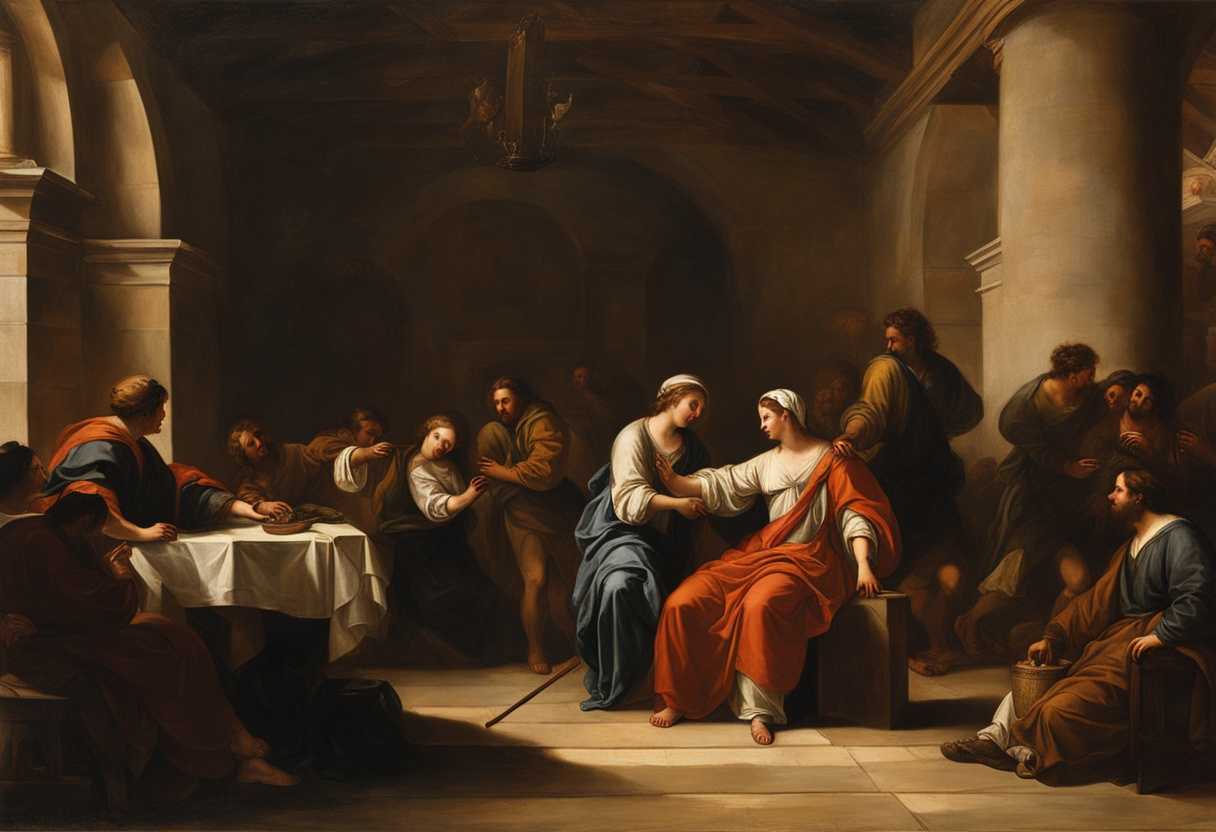
Scripture
1 Now Naomi had a relative of her husband’s, a worthy man of the clan of Elimelech, whose name was Boaz.
2 And Ruth the Moabite said to Naomi, “Let me go to the field and glean among the ears of grain after him in whose sight I shall find favor.” And she said to her, “Go, my daughter.”
3 So she set out and went and gleaned in the field after the reapers, and she happened to come to the part of the field belonging to Boaz, who was of the clan of Elimelech.
4 And behold, Boaz came from Bethlehem. And he said to the reapers, “The Lord be with you!” And they answered, “The Lord bless you.”
5 Then Boaz said to his young man who was in charge of the reapers, “Whose young woman is this?”
6 And the servant who was in charge of the reapers answered, “She is the young Moabite woman, who came back with Naomi from the country of Moab.
7 And she said, ‘Please let me glean and gather among the sheaves after the reapers.’ So she came, and she has continued from early morning until now, except for a short rest.”
8 Then Boaz said to Ruth, “Now, listen, my daughter, do not go to glean in another field or leave this one, but keep close to my young women.
9 Let your eyes be on the field that they are reaping, and go after them. Have I not charged the young men not to touch you? And when you are thirsty, go to the vessels and drink what the young men have drawn.”
10 Then she fell on her face, bowing to the ground, and said to him, “Why have I found favor in your eyes, that you should take notice of me, since I am a foreigner?”
11 But Boaz answered her, “All that you have done for your mother-in-law since the death of your husband has been fully told to me, and how you left your father and mother and your native land and came to a people that you did not know before.
12 The Lord repay you for what you have done, and a full reward be given you by the Lord, the God of Israel, under whose wings you have come to take refuge!
13 Then she said, “Let me find favor in your eyes, my lord, for you have comforted me and spoken kindly to your servant, though I am not one of your servants.”
14 And at mealtime Boaz said to her, “Come here and eat some bread and dip your morsel in the wine.” So she sat beside the reapers, and he passed to her roasted grain. And she ate until she was satisfied, and she had some left over.
15 When she rose to glean, Boaz instructed his young men, saying, “Let her glean even among the sheaves, and do not reproach her.
16 And let fall some of the bundles for her, and leave them for her to glean, and do not rebuke her.”
17 So she gleaned in the field until evening. Then she beat out what she had gleaned, and it was about an ephah of barley.
18 And she took it up and went into the city.
19 And her mother-in-law said to her, “Where did you glean today? And where have you worked? Blessed be the man who took notice of you.” So she told her mother-in-law with whom she had worked and said, “The man’s name with whom I worked today is Boaz.”
20 And Naomi said to her daughter-in-law, “May he be blessed by the Lord, whose kindness has not forsaken the living or the dead!” Naomi also said to her, “The man is a close relative of ours, one of our redeemers.”
21 And Ruth the Moabite said, “Besides, he said to me, ‘You shall keep close by my young men until they have finished all my harvest.’”
22 And Naomi said to Ruth, her daughter-in-law, “It is good, my daughter, that you go out with his young women, lest in another field you be assaulted.”
23 So she kept close to the young women of Boaz, gleaning until the end of the barley and wheat harvests. And she lived with her mother-in-law.
Kinsman: Biblical Meaning and Significance
The concept of a “kinsman” in the Bible extends beyond mere familial relationships; it embodies deep social and moral responsibilities that inform the community’s social fabric. The role of the kinsman is especially significant in the context of Levirate marriage, as illustrated in Deuteronomy 25:5-10, where a man is commanded to marry his deceased brother’s widow to perpetuate the family lineage. This mandate underscores the importance of protecting one’s family line and ensuring that the family name and property remain intact, reflecting a collective responsibility towards kin.
The story of Ruth and Boaz further exemplifies the profound implications of the kinsman concept. In Ruth 3:9, Ruth appeals to Boaz as her kinsman-redeemer, a role that not only entails marrying her to preserve her deceased husband’s lineage but also protecting her and her mother-in-law Naomi. This narrative not only highlights the redemptive quality of familial bonds but also foreshadows the broader biblical theme of redemption through Christ, as seen in Galatians 4:4-5, where Jesus is portrayed as the ultimate redeemer of humanity. Thus, the kinsman concept encapsulates themes of loyalty, protection, and communal identity, reinforcing the belief that relationships and responsibilities to one another are integral to God’s covenant with His people.
The significance of the term “kinsman” can also be seen in its theological implications, particularly within the broader narrative of redemption woven throughout Scripture. This extends to the understanding of God’s covenant with Israel, which reflects a kinship that transcends mere human relationships. The notion of God as Israel’s kinsman can be identified, wherein He not only engages with His people but also bears a deep moral obligation to care for them. This divine kinship emphasizes God’s promises to protect, provide, and rescue His people, similar to the duties expected of a kinsman within the community.
Moreover, the kinsman-redeemer theme resonates profoundly in the prophetic literature, where the longing for restoration and deliverance among the Israelites is often voiced. For instance, when prophets such as Isaiah speak of a coming Messiah, they invoke the idea of a redeemer who will not only save Israel from their oppressors but will also reaffirm their shared heritage and identity. This echoes the role of the kinsman-redeemer — someone who stands up for their kin in times of crisis. As such, the kinsman concept acts as a bridge connecting historical, relational, and spiritual dimensions of redemption, revealing an overarching narrative that encourages believers to embrace their responsibilities towards each other as members of a divine family united through God’s enduring covenant.
The Role of Kinsman in Redemption
In biblical contexts, the term “kinsman” often signifies a family member who has the responsibility to redeem or rescue a relative in need. This concept is deeply rooted in the idea of familial loyalty and obligation, where a kinsman is expected to act on behalf of a relative who may be in distress, such as through financial hardship or loss of land. The kinsman redeemer serves as a protector and restorer, embodying the values of community and support that are central to biblical teachings.
Symbolism of Kinsman in Christ
The concept of a kinsman also carries significant theological implications, particularly in relation to Christ. Jesus is often referred to as our kinsman redeemer, emphasizing His incarnation and connection to humanity. By becoming fully human, He is able to relate to our struggles and ultimately redeem us from sin and death. This relationship highlights the depth of God’s love and the lengths to which He goes to restore His people, illustrating the profound significance of kinship in the divine narrative.
Kinsman as a Reflection of Community
The idea of kinsman extends beyond individual relationships to encompass the broader community. In biblical times, the kinsman was a vital part of the social fabric, ensuring that families remained intact and that the vulnerable were cared for. This reflects the importance of community solidarity and mutual support, which are essential themes throughout the Bible. The kinsman’s role serves as a reminder of the collective responsibility we have towards one another, urging believers to foster relationships that promote love, care, and justice within their communities.
How to Embrace Redemption and Strengthen Family Bonds
Embracing redemption is a transformative journey that can profoundly strengthen your family bonds, and it begins with acknowledging our imperfections and the grace that God offers us. As you reflect on your own experiences of forgiveness—both given and received—consider how these moments can serve as a foundation for deeper connections with your loved ones. Share your stories of redemption with your family, fostering an environment where vulnerability is welcomed and healing can take place. Engage in open conversations about your struggles and triumphs, and encourage each other to seek God’s grace in daily life. Remember, the act of forgiving one another is not just a duty but a beautiful reflection of Christ’s love for us. By prioritizing love, understanding, and compassion within your family, you create a safe space where everyone can grow together in faith, ultimately drawing closer to God and to one another.
Bible References to Kinsman Meaning and Significance:
Ruth 3:1-18: 1 Then Naomi her mother-in-law said to her, “My daughter, should I not seek rest for you, that it may be well with you?
2 And now is not Boaz our relative, with whose young women you were? See, he is winnowing barley tonight at the threshing floor.
3 Wash therefore and anoint yourself, and put on your cloak and go down to the threshing floor, but do not make yourself known to the man until he has finished eating and drinking.
4 And when he lies down, observe the place where he lies. Then go and uncover his feet and lie down, and he will tell you what to do.”
5 And she said to her, “All that you say I will do.”
6 So she went down to the threshing floor and did just as her mother-in-law had commanded her.
7 And when Boaz had eaten and drunk, and his heart was merry, he went to lie down at the end of the heap of grain. Then she came softly and uncovered his feet and lay down.
8 At midnight the man was startled and turned over, and behold, a woman lay at his feet!
9 He said, “Who are you?” And she answered, “I am Ruth, your servant. Spread your wings over your servant, for you are a redeemer.”
10 And he said, “May you be blessed by the Lord, my daughter. You have made this last kindness greater than the first in that you have not gone after young men, whether poor or rich.
11 And now, my daughter, do not fear. I will do for you all that you ask, for all my fellow townsmen know that you are a worthy woman.
12 And now it is true that I am a redeemer.
13 Remain tonight, and in the morning, if he will redeem you, good; let him do it. But if he is not willing to redeem you, then, as the Lord lives, I will redeem you. Lie down until the morning.”
14 So she lay at his feet until the morning, but arose before one could recognize another. And he said, “Let it not be known that the woman came to the threshing floor.”
15 And he said, “Bring the garment you are wearing and hold it out.” So she held it, and he measured out six measures of barley and put it on her. Then she went into the city.
16 And when she came to her mother-in-law, she said, “How did you fare, my daughter?” Then she told her all that the man had done for her,
17 She replied, “These six measures of barley he gave to me, for he said to me, ‘You must not go back empty-handed to your mother-in-law.’”
18 She replied, “Wait, my daughter, until you learn how the matter turns out, for the man will not rest but will settle the matter today.”
Ruth 4:1-22: 1 Now Boaz had gone up to the gate and sat down there. And behold, the redeemer, of whom Boaz had spoken, came by. So Boaz said, “Turn aside, friend; sit down here.” And he turned aside and sat down.
2 And he took ten men of the elders of the city and said, “Sit down here.” So they sat down.
3 Then he said to the redeemer, “Naomi, who has come back from the country of Moab, is selling the parcel of land that belonged to our relative Elimelech.
4 So I thought I would tell you of it and say, ‘Buy it in the presence of those sitting here and in the presence of the elders of my people.’ If you will redeem it, redeem it. But if you will not, tell me, that I may know, for there is no one besides you to redeem it, and I come after you.” And he said, “I will redeem it.”
5 Then Boaz said, “The day you buy the field from the hand of Naomi, you also acquire Ruth the Moabite, the widow of the dead, in order to perpetuate the name of the dead in his inheritance.”
6 Then the redeemer said, “I cannot redeem it for myself, lest I impair my own inheritance. Take my right of redemption yourself, for I cannot redeem it.”
7 Now this was the custom in former times in Israel concerning redeeming and exchanging: to confirm a transaction, the one drew off his sandal and gave it to the other, and this was the manner of attesting in Israel.
8 So when the redeemer said to Boaz, “Buy it for yourself,” he drew off his sandal.
9 Then Boaz said to the elders and all the people, “You are witnesses this day that I have bought from the hand of Naomi all that belonged to Elimelech and all that belonged to Chilion and to Mahlon.
10 Also Ruth the Moabite, the widow of Mahlon, I have bought to be my wife, to perpetuate the name of the dead in his inheritance, that the name of the dead may not be cut off from among his brothers and from the gate of his native place. You are witnesses this day.”
11 Then all the people who were at the gate and the elders said, “We are witnesses. May the Lord make the woman, who is coming into your house, like Rachel and Leah, who together built up the house of Israel. May you act worthily in Ephrathah and be renowned in Bethlehem,
12 and may your house be like the house of Perez, whom Tamar bore to Judah, because of the offspring that the Lord will give you by this young woman.”
13 So Boaz took Ruth, and she became his wife. And he went in to her, and the Lord gave her conception, and she bore a son.
14 Then the women said to Naomi, “Blessed be the Lord, who has not left you this day without a redeemer, and may his name be renowned in Israel!
15 He shall be to you a restorer of life and a nourisher of your old age, for your daughter-in-law who loves you, who is more to you than seven sons, has given birth to him.”
16 Then Naomi took the child and laid him on her lap and became his nurse.
17 And the women of the neighborhood gave him a name, saying, “A son has been born to Naomi.” They named him Obed. He was the father of Jesse, the father of David.
18 Now these are the generations of Perez: Perez fathered Hezron,
19 Hezron fathered Ram, Ram fathered Amminadab,
20 Amminadab fathered Nahshon, Nahshon fathered Salmon,
21 Salmon fathered Boaz, Boaz fathered Obed,
22 Obed fathered Jesse, and Jesse fathered David.
Leviticus 25:23-28: 23 “The land shall not be sold in perpetuity, for the land is mine. For you are strangers and sojourners with me.
24 And in all the country you possess, you shall allow a redemption of the land.
25 If your brother becomes poor and sells part of his property, then his nearest redeemer shall come and redeem what his brother has sold.
26 If a man has no one to redeem it and then himself becomes prosperous and finds sufficient means to redeem it,
27 then let him calculate the years since he sold it and pay back the balance to the man to whom he sold it, and then return to his property.
28 But if he has not sufficient means to recover it, then what he sold shall remain in the hand of the buyer until the year of jubilee.
Leviticus 25:47-55: 47 “If a stranger or sojourner with you becomes rich, and your brother beside him becomes poor and sells himself to the stranger or sojourner with you or to a member of the stranger’s clan,
48 then after he is sold he may be redeemed. One of his brothers may redeem him,
49 or his uncle or his cousin may redeem him or, if he grows rich, he may redeem himself.
50 He shall calculate with his buyer from the year when he sold himself to him until the year of jubilee, and the price of his sale shall vary with the number of years.
51 If there are still many years left, he shall pay proportionately for his redemption some of his sale price.
52 If there remain but a few years until the year of jubilee, he shall calculate and pay for his redemption in proportion to his years.
53 He shall be with him as a yearly hired worker, and he shall not rule ruthlessly over him in your sight.
54 And if he is not redeemed by these means, then he and his children with him shall be released in the year of jubilee.
55 For it is to me that the people of Israel are servants. They are my servants whom I brought out of the land of Egypt: I am the Lord your God.
Deuteronomy 25:5-10: 5 “If brothers dwell together, and one of them dies and has no son, the wife of the dead man shall not be married outside the family to a stranger. Her husband’s brother shall go in to her and take her as his wife and perform the duty of a husband’s brother to her.”
6 And the first son whom she bears shall succeed to the name of his dead brother, that his name may not be blotted out of Israel.
7 And if the man does not wish to take his brother’s wife, then his brother’s wife shall go up to the gate to the elders and say, ‘My husband’s brother refuses to perpetuate his brother’s name in Israel; he will not perform the duty of a husband’s brother to me.’
8 Then the elders of his city shall call him and speak to him, and if he persists, saying, ‘I do not wish to take her,’
9 then his brother’s wife shall go up to him in the presence of the elders, and pull his sandal off his foot and spit in his face. And she shall answer and say, ‘So shall it be done to the man who does not build up his brother’s house.’
10 “If a man dies and has no son, then you shall transfer his inheritance to his daughter.
Numbers 27:8-11: 8 And you shall speak to the people of Israel, saying, If a man dies and has no son, then you shall transfer his inheritance to his daughter.
9 And if he has no daughter, then you shall give his inheritance to his brothers.
10 and if he has no brothers, then you shall give his inheritance to his father’s brothers.
11 “If his father has no brothers, then you shall give his inheritance to the nearest kinsman of his clan, and he shall possess it. And it shall be for the people of Israel a statute and rule, as the Lord commanded Moses.”
Numbers 35:9-34: 9 And the Lord spoke to Moses, saying,
10 “Speak to the people of Israel and say to them, When you cross the Jordan into the land of Canaan,
11 then you shall select cities to be cities of refuge for you, that the manslayer who kills any person without intent may flee there.
12 The cities shall be for you a refuge from the avenger, that the manslayer may not die until he stands before the congregation for judgment.
13 And the cities that you give shall be your six cities of refuge.
14 You shall give three cities beyond the Jordan, and three cities in the land of Canaan, to be cities of refuge.
15 These six cities shall be for refuge for the people of Israel, and for the stranger and for the sojourner among them, that anyone who kills any person without intent may flee there.
16 “But if he struck him down with an iron object, so that he died, he is a murderer. The murderer shall be put to death.
17 And if he struck him down with a stone tool that could cause death, and he died, he is a murderer. The murderer shall be put to death.
18 Or if he struck him down with a wooden object that could cause death, and he died, he is a murderer. The murderer shall be put to death.
19 The avenger of blood shall himself put the murderer to death; when he meets him, he shall put him to death.
20 And if he pushed him out of hatred or hurled something at him, lying in wait, so that he died,
21 or in enmity struck him with his hand so that he died, then he who struck the blow shall be put to death. He is a murderer. The avenger of blood shall put the murderer to death when he meets him.
22 “But if he pushed him suddenly without enmity, or hurled anything on him without lying in wait”
23 or if he struck him down with a stone tool that could cause death, and he died, he is a murderer. The murderer shall be put to death.
24 then the congregation shall judge between the manslayer and the avenger of blood, in accordance with these rules.
25 And the congregation shall rescue the manslayer from the hand of the avenger of blood, and the congregation shall restore him to his city of refuge to which he had fled, and he shall live in it until the death of the high priest who was anointed with the holy oil.
26 But if the manslayer shall at any time go beyond the boundaries of his city of refuge to which he fled,
27 And the avenger of blood finds him outside the boundaries of his city of refuge, and the avenger of blood kills the manslayer, he shall not be guilty of blood.
28 because he should have remained in his city of refuge until the death of the high priest, but after the death of the high priest the manslayer may return to the land of his possession.
29 And these things shall be for a statute and rule for you throughout your generations in all your dwelling places.
30 “If anyone kills a person, the murderer shall be put to death on the evidence of witnesses. But no person shall be put to death on the testimony of one witness.
31 Moreover, you shall accept no ransom for the life of a murderer, who is guilty of death, but he shall be put to death.
32 And you shall accept no ransom for him who has fled to his city of refuge, that he may return to dwell in the land before the death of the high priest.
33 You shall not pollute the land in which you live, for blood pollutes the land, and no atonement can be made for the land for the blood that is shed in it, except by the blood of the one who shed it.
34 You shall not defile the land in which you live, in the midst of which I dwell, for I the Lord dwell in the midst of the people of Israel.”
Isaiah 54:4-8: 4 “Fear not, for you will not be ashamed; be not confounded, for you will not be disgraced; for you will forget the shame of your youth, and the reproach of your widowhood you will remember no more.”
5 For your Maker is your husband,
the Lord of hosts is his name;
and the Holy One of Israel is your Redeemer,
the God of the whole earth he is called.
6 For the Lord has called you
like a wife deserted and grieved in spirit,
like a wife of youth when she is cast off,
says your God.
7 For a brief moment I deserted you,
but with great compassion I will gather you.
8 In overflowing anger for a moment I hid my face from you, but with everlasting love I will have compassion on you,” says the Lord, your Redeemer.
Jeremiah 32:6-15: 6 Jeremiah said, “The word of the Lord came to me:
7 Behold, Hanamel the son of Shallum your uncle will come to you and say, ‘Buy my field that is at Anathoth, for the right of redemption by purchase is yours.’
8 Then Hanamel my cousin came to me in the court of the guard, in accordance with the word of the Lord, and said to me, ‘Buy my field that is at Anathoth in the land of Benjamin, for the right of possession and redemption is yours; buy it for yourself.’ Then I knew that this was the word of the Lord.
9 So I bought the field at Anathoth from Hanamel my cousin, and weighed out the money to him, seventeen shekels of silver.
10 I signed the deed, sealed it, got witnesses, and weighed the money on the scales.
11 Then I took the sealed deed of purchase, containing the terms and conditions and the open copy.
12 And I gave the deed of purchase to Baruch the son of Neriah son of Mahseiah, in the presence of Hanamel my cousin, in the presence of the witnesses who signed the deed of purchase, and in the presence of all the Judeans who were sitting in the court of the guard.
13 And I charged Baruch in their presence, saying,
14 ‘Thus says the Lord of hosts, the God of Israel: Take these deeds, both this sealed deed of purchase and this open deed, and put them in an earthenware vessel, that they may last for a long time.’
15 For thus says the Lord of hosts, the God of Israel: Houses and fields and vineyards shall again be bought in this land.’
Hebrews 2:10-18: 10 For it was fitting that he, for whom and by whom all things exist, in bringing many sons to glory, should make the founder of their salvation perfect through suffering.
11 For he who sanctifies and those who are sanctified all have one source. That is why he is not ashamed to call them brothers,
12 saying, “I will tell of your name to my brothers; in the midst of the congregation I will sing your praise.”
13 And again, “I will put my trust in him.” And again, “Behold, I and the children God has given me.”
14 Since therefore the children share in flesh and blood, he himself likewise partook of the same things, that through death he might destroy the one who has the power of death, that is, the devil,
15 and deliver all those who through fear of death were subject to lifelong slavery.
16 For surely it is not angels that he helps, but he helps the offspring of Abraham.
17 Therefore he had to be made like his brothers in every respect, so that he might become a merciful and faithful high priest in the service of God, to make propitiation for the sins of the people.
18 For because he himself has suffered when tempted, he is able to help those who are being tempted.

Reverend Ogunlade is a seasoned Church Minister with over three decades of experience in guiding and nurturing congregations. With profound wisdom and a serene approach, Reverend Ogunlade has carried out various pastoral duties, including delivering uplifting sermons, conducting religious ceremonies, and offering sage counsel to individuals seeking spiritual guidance. Their commitment to fostering harmony and righteousness within their community is exemplified through their compassionate nature, making them a beloved and trusted figure among the congregation.