
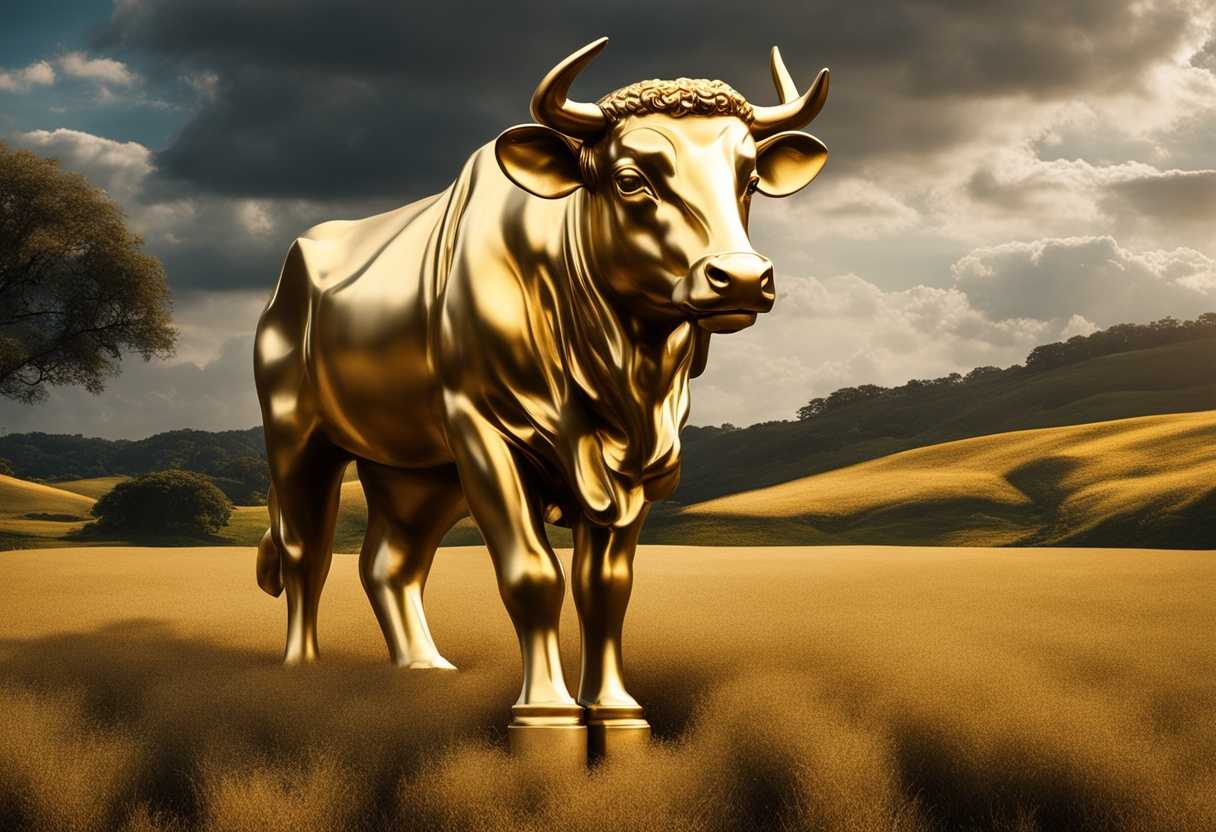
In the Bible, a “calf” often symbolizes prosperity and abundance due to its association with the agricultural lifestyle. It is also significant in the story of the Golden Calf, where the Israelites create an idol in the form of a calf, representing their rebellion against God (Exodus 32:1-35).
Scripture
1 When the people saw that Moses delayed to come down from the mountain, the people gathered themselves together to Aaron and said to him, “Up, make us gods who shall go before us. As for this Moses, the man who brought us up out of the land of Egypt, we do not know what has become of him.”
2 So Aaron said to them, “Take off the rings of gold that are in the ears of your wives, your sons, and your daughters, and bring them to me.”
3 So all the people took off the rings of gold that were in their ears and brought them to Aaron.
4 And he received the gold from their hand and fashioned it with a graving tool and made a golden calf. And they said, “These are your gods, O Israel, who brought you up out of the land of Egypt!”
5 When Aaron saw this, he built an altar before it. And Aaron made a proclamation and said, “Tomorrow shall be a feast to the Lord.”
6 And they rose up early the next day and offered burnt offerings and brought peace offerings. And the people sat down to eat and drink and rose up to play.
7 And the Lord said to Moses, “Go down, for your people, whom you brought up out of the land of Egypt, have corrupted themselves.
8 They have turned aside quickly out of the way that I commanded them.
9 And the Lord said to Moses, “I have seen this people, and behold, it is a stiff-necked people.
10 Now therefore let me alone, that my wrath may burn hot against them and I may consume them, in order that I may make a great nation of you.
11 But Moses implored the Lord his God and said, “O Lord, why does your wrath burn hot against your people, whom you have brought out of the land of Egypt with great power and with a mighty hand?
12 Why should the Egyptians say, ‘With evil intent did he bring them out, to kill them in the mountains and to consume them from the face of the earth’? Turn from your burning anger and relent from this disaster against your people.
13 Remember Abraham, Isaac, and Israel, your servants, to whom you swore by your own self, and said to them, ‘I will multiply your offspring as the stars of heaven, and all this land that I have promised I will give to your offspring, and they shall inherit it forever.’”
14 And the Lord relented from the disaster that he had spoken of bringing on his people.
15 Then Moses turned and went down from the mountain with the two tablets of the testimony in his hand, tablets that were written on both sides; on the front and on the back they were written.
16 The tablets were the work of God, and the writing was the writing of God, engraved on the tablets.
17 Now when Joshua heard the noise of the people as they shouted, he said to Moses, “There is a noise of war in the camp.”
18 But he said, “It is not the sound of shouting for victory, or the sound of the cry of defeat, but the sound of singing that I hear.”
19 And as soon as he came near the camp and saw the calf and the dancing, Moses’ anger burned hot, and he threw the tablets out of his hands and broke them at the foot of the mountain.
20 He took the calf that they had made and burned it with fire and ground it to powder and scattered it on the water and made the people of Israel drink it.
21 And Moses said to Aaron, “What did this people do to you that you have brought such a great sin upon them?”
22 And Aaron said, “Let not the anger of my lord burn hot. You know the people, that they are set on evil.
23 For they said to me, ‘Make us gods who shall go before us. As for this Moses, the man who brought us up out of the land of Egypt, we do not know what has become of him.’
24 So I said to them, ‘Let any who have gold take it off.’ So they gave it to me, and I threw it into the fire, and out came this calf.”
25 And when Moses saw that the people had broken loose (for Aaron had let them break loose, to the derision of their enemies),
26 then Moses stood in the gate of the camp and said, “Who is on the Lord’s side? Come to me.” And all the sons of Levi gathered around him.
27 And he said to them, “Thus says the Lord God of Israel, ‘Put your sword on your side each of you, and go to and fro from gate to gate throughout the camp, and each of you kill his brother and his companion and his neighbor.’”
28 And the sons of Levi did according to the word of Moses. And that day about three thousand men of the people fell.
29 And Moses said, “Today you have been ordained for the service of the Lord, each one at the cost of his son and of his brother, so that he might bestow a blessing upon you this day.”
30 The next day Moses said to the people, “You have sinned a great sin. And now I will go up to the Lord; perhaps I can make atonement for your sin.”
32 Then Moses returned to the Lord, and said, “Alas, this people has sinned a great sin. They have made for themselves gods of gold.
32 But now, if you will forgive their sin—but if not, please blot me out of your book that you have written.”
33 But the Lord said to Moses, “Whoever has sinned against me, I will blot out of my book.
34 But now go, lead the people to the place about which I have spoken to you; behold, my angel shall go before you. But on the day when I visit, I will visit their sin upon them.”
35 Then the Lord sent a plague on the people, because they made the calf, the one that Aaron made.
Meaning of Calf in the Bible
The term “calf” in the Bible carries multifaceted meanings that reflect both agricultural significance and profound spiritual implications. In agrarian societies, a calf symbolizes prosperity and abundance, often representing the fruitfulness of livestock that sustains communities (Deuteronomy 14:4-5). Calves were valuable assets, providing nourishment and serving as a means of trade. In this light, they illustrate God’s provision for His people, embodying blessings like wealth and stability.
However, the most striking biblical reference to the calf is found in Exodus 32, where the Israelites, in their impatience and fear during Moses’ absence, fashioned a golden calf to worship. This act represents a grave rebellion against God, showcasing a profound misunderstanding of divine sovereignty and a longing for tangible, visible deities (Exodus 32:4). The incident emphasizes the dangers of idolatry and the tendency of humans to seek security in physical forms rather than spiritual faith. As a result, the golden calf becomes a symbol of disobedience and a warning against turning away from reliance on God. This duality in the symbolism of the calf highlights the tension between materialism and faithful devotion, illustrating how prosperity, when misdirected, can lead to spiritual downfall.
In addition to its agricultural symbolism and associations with idolatry, the calf also finds significance in various ceremonial and sacrificial contexts throughout the Bible. In Levitical practices, young calves were often selected as offerings in purification rituals or communal sacrifices. These sacrifices were seen as an act of atonement, with the innocent calf representing the innocent suffering in place of the transgressors. This use of the calf not only underscores the concept of substitutionary sacrifice, which is a key theme in the biblical narrative, but it also points to the future sacrificial system that ultimately foreshadows the ultimate sacrifice of Christ.
Moreover, the imagery of the calf is further developed in prophetic literature. For instance, in the book of Hosea, the calf is used metaphorically to illustrate Israel’s reliance on idolatrous practices that lead them away from their covenant relationship with God. As prophets spoke against the worship of these idols, the calf became a symbol of national sin and societal corruption, serving as a reminder of the need for repentance and a return to faithfulness. Thus, the calf encapsulates a spectrum of meanings in the biblical narrative—from a sign of divine provision to a representation of the pitfalls of human unfaithfulness—encouraging profound reflections on the relationship between material wealth, spiritual integrity, and divine forgiveness.
Symbol of Idolatry
In the Bible, the calf often represents idolatry and the worship of false gods. The image of a calf, particularly a golden one, is associated with the rejection of true worship and the turning away from God. This symbolizes humanity’s tendency to create tangible representations of divinity, leading to spiritual corruption and disobedience.
Representation of Sacrifice
The calf also serves as a symbol of sacrifice and atonement in biblical texts. In ancient Israelite culture, calves were often used in sacrificial rituals to seek forgiveness and favor from God. This highlights the importance of sacrifice in the relationship between God and His people, emphasizing themes of redemption and the need for atonement for sins.
Emblem of Abundance and Prosperity
Additionally, the calf can symbolize abundance and prosperity. In agrarian societies, a healthy calf represented wealth and the blessings of God. This association underscores the connection between livestock and the well-being of the community, reflecting God’s provision and the importance of stewardship over His creation.
How to Cultivate Faithfulness and Avoid Idolatry
Cultivating faithfulness while steering clear of idolatry is a journey that requires intentionality and reflection in our daily lives. Start by grounding yourself in prayer and scripture, allowing God’s word to shape your understanding of what it means to be faithful. Consider what occupies your thoughts and affections—are there things, relationships, or ambitions that take precedence over your relationship with God? It’s essential to regularly assess your priorities and make adjustments, ensuring that your heart remains aligned with His will. Surround yourself with a community of believers who encourage and challenge you to stay true to your faith, and engage in acts of service that reflect God’s love. Remember, faithfulness is not just about avoiding sin; it’s about actively pursuing a deeper relationship with God, where He becomes the center of your life, and everything else falls into its rightful place.
Bible References to the Meaning of Calf:
Leviticus 9:1-24: 1 On the eighth day Moses called Aaron and his sons and the elders of Israel,
2 and he said to Aaron, “Take for yourself a bull calf for a sin offering and a ram for a burnt offering, both without blemish, and offer them before the Lord.
3 Then to the people of Israel you shall speak, saying, ‘Take a male goat for a sin offering, and a calf and a lamb, both a year old without blemish, for a burnt offering,
4 And an ox and a ram for peace offerings, to sacrifice before the Lord, and a grain offering mixed with oil, for today the Lord will appear to you.”
5 And they brought what Moses commanded in front of the tent of meeting, and all the congregation drew near and stood before the Lord.
6 And Moses said, “This is the thing that the Lord commanded you to do, that the glory of the Lord may appear to you.”
7 Then Moses said to Aaron, “Draw near to the altar and offer your sin offering and your burnt offering and make atonement for yourself and for the people, and bring the offering of the people and make atonement for them, as the Lord has commanded.”
8 So Aaron drew near to the altar and killed the calf of the sin offering, which was for himself.
9 And the sons of Aaron presented the blood to him, and he dipped his finger in the blood and put it on the horns of the altar and poured out the blood at the base of the altar.
10 But the fat and the kidneys and the long lobe of the liver from the sin offering he burned on the altar, as the Lord commanded Moses.
11 And the flesh and the skin he burned with fire outside the camp.
12 Then he killed the burnt offering, and Aaron’s sons handed him the blood, and he threw it against the sides of the altar.
13 And they handed the burnt offering to him, piece by piece, and the head, and he burned them on the altar.
14 Then he washed the entrails and the legs and burned them with the burnt offering on the altar.
15 Then he presented the people’s offering and took the goat of the sin offering that was for the people and killed it and offered it as a sin offering, like the first one.
16 And he washed the entrails and the legs and burned them with the burnt offering on the altar.
17 Then he presented the grain offering, took a handful of it, and burned it on the altar, besides the burnt offering of the morning.
18 Then he slaughtered the ox and the ram, the sacrifice of peace offerings for the people. And Aaron’s sons handed him the blood, and he threw it against the sides of the altar.
19 And the fat of the bull and of the ram, the fat tail, and that which covers the entrails and the kidneys and the long lobe of the liver.
20 And they put the fat pieces on the breasts, and he burned the fat pieces on the altar,
21 And the breasts and the right thigh Aaron waved for a wave offering before the Lord, as Moses commanded.
22 Then Aaron lifted up his hands toward the people and blessed them, and he came down from offering the sin offering and the burnt offering and the peace offerings.
23 And Moses and Aaron went into the tent of meeting, and when they came out they blessed the people, and the glory of the Lord appeared to all the people.
24 And fire came out from before the Lord and consumed the burnt offering and the pieces of fat on the altar, and when all the people saw it, they shouted and fell on their faces.
Deuteronomy 9:7-21: 7 Remember and do not forget how you provoked the Lord your God to wrath in the wilderness. From the day you came out of the land of Egypt until you came to this place, you have been rebellious against the Lord.
8 Even at Horeb you provoked the Lord to wrath, and the Lord was so angry with you that he was ready to destroy you.
9 When I went up the mountain to receive the tablets of stone, the tablets of the covenant that the Lord made with you, I remained on the mountain forty days and forty nights. I neither ate bread nor drank water.
10 And the Lord gave me the two tablets of stone written with the finger of God, and on them were all the words that the Lord had spoken with you on the mountain out of the midst of the fire on the day of the assembly.
11 And at the end of forty days and forty nights the Lord gave me the two tablets of stone, the tablets of the covenant.
12 Then the Lord said to me, ‘Arise, go down quickly from here, for your people whom you have brought from Egypt have acted corruptly. They have turned aside quickly out of the way that I commanded them; they have made themselves a metal image.’
13 “Furthermore, the Lord said to me, ‘I have seen this people, and behold, it is a stubborn people.”
14 Let me alone, that I may destroy them and blot out their name from under heaven. And I will make of you a nation mightier and greater than they.’
15 “So I turned and came down from the mountain, and the mountain was burning with fire. And the two tablets of the covenant were in my two hands.”
16 And I looked, and behold, you had sinned against the Lord your God. You had made yourselves a golden calf.
17 And I took hold of the two tablets and threw them out of my two hands and broke them before your eyes.
18 Then I lay prostrate before the Lord as before, forty days and forty nights.
19 For I was afraid of the anger and hot displeasure that the Lord bore against you, so that he was ready to destroy you. But the Lord listened to me that time also.
20 And the Lord was so angry with Aaron that he was ready to destroy him. And I prayed for Aaron also at the same time.
21 And I took the sinful thing, the calf that you had made, and burned it with fire and crushed it, grinding it very small, until it was as fine as dust. And I threw the dust of it into the brook that ran down from the mountain.
1 Kings 12:25-33: 25 Then Jeroboam built Shechem in the hill country of Ephraim and lived there. And he went out from there and built Penuel.
26 And Jeroboam said in his heart, “Now the kingdom will turn back to the house of David.
27 If this people go up to offer sacrifices in the temple of the Lord at Jerusalem, then the heart of this people will turn again to their lord, to Rehoboam king of Judah, and they will kill me and return to Rehoboam king of Judah.”
28 So the king took counsel and made two calves of gold. And he said to the people, “You have gone up to Jerusalem long enough. Behold your gods, O Israel, who brought you up out of the land of Egypt.”
29 And he set one in Bethel, and the other he put in Dan.
30 Then this thing became a sin, for the people went as far as Dan to be before one.
31 He also made temples on high places and appointed priests from among all the people, who were not of the Levites.
32 And Jeroboam appointed a feast on the fifteenth day of the eighth month like the feast that was in Judah, and he offered sacrifices on the altar. So he did in Bethel, sacrificing to the calves that he made. And he placed in Bethel the priests of the high places that he had made.
33 He went up to the altar that he had made in Bethel on the fifteenth day in the eighth month, in the month that he had devised from his own heart. And he instituted a feast for the people of Israel and went up to the altar to make offerings.
2 Kings 10:18-29: 18 Then Jehu assembled all the people and said to them, “Ahab served Baal a little, but Jehu will serve him much.
19 Now therefore call to me all the prophets of Baal, all his worshipers, and all his priests. Let none be missing, for I have a great sacrifice to offer to Baal. Whoever is missing shall not live.” But Jehu did it with cunning in order to destroy the worshipers of Baal.
20 And Jehu said, “Sanctify a solemn assembly for Baal.” So they proclaimed it.
21 And Jehu sent throughout all Israel, and all the worshipers of Baal came, so that there was not a man left who did not come. And they entered the house of Baal, and the house of Baal was filled from one end to the other.
22 He said to him who was in charge of the wardrobe, “Bring out the vestments for all the worshipers of Baal.” So he brought out the vestments for them.
23 Then Jehu went into the house of Baal with Jehonadab the son of Rechab, and he said to the worshipers of Baal, “Search, and see that there is no servant of the Lord here among you, but only the worshipers of Baal.”
24 Then they went in to offer sacrifices and burnt offerings. Now Jehu had stationed eighty men outside and said, “The man who allows any of those whom I give into your hands to escape shall forfeit his life.”
25 So as soon as he had made an end of offering the burnt offering, Jehu said to the guard and to the officers, “Go in and strike them down; let not a man escape.” So when they put them to the sword, the guard and the officers cast them out and went into the inner room of the house of Baal.
26 And they brought out the pillar that was in the house of Baal, and burned it.
27 They demolished the pillar of Baal, and demolished the house of Baal, and made it a latrine to this day.
28 Thus Jehu wiped out Baal from Israel.
29 But Jehu did not turn aside from the sins of Jeroboam the son of Nebat, which he made Israel to sin—that is, the golden calves that were in Bethel and in Dan.
Hosea 8:1-14: Set the trumpet to your lips! One like a vulture is over the house of the Lord, because they have transgressed my covenant and rebelled against my law.
2 Israel cries to me, “My God, we—Israel—know you.”
3 Israel has spurned the good; the enemy shall pursue him.
4 They made kings, but not through me.
They set up princes, but I knew it not.
5 He has rejected your calf, O Samaria. My anger burns against them. How long will they be incapable of innocence?
6 For it is from Israel; a craftsman made it; it is not God. The calf of Samaria shall be broken to pieces.
7 For they sow the wind, and they shall reap the whirlwind.
8 Israel is swallowed up; already they are among the nations as a useless vessel.
9 For they have gone up to Assyria, a wild donkey wandering alone; Ephraim has hired lovers.
10 Though they hire allies among the nations,
I will soon gather them up.
And the king and princes shall soon writhe
because of the tribute.
11 Because Ephraim has multiplied altars for sinning,
they have become to him altars for sinning.
12 Were I to write for him my laws by the ten thousands,
they would be regarded as a strange thing.
13 As for my sacrificial offerings, they sacrifice meat and eat it, but the Lord does not accept them. Now he will remember their iniquity and punish their sins; they shall return to Egypt.
14 For Israel has forgotten his Maker and built palaces,
and Judah has multiplied fortified cities;
so I will send a fire upon his cities,
and it shall devour her strongholds.
Hosea 13:1-8: 1 When Ephraim spoke, there was trembling; he was exalted in Israel, but he incurred guilt through Baal and died.
2 And now they sin more and more,
and make for themselves metal images,
idols skillfully made of their silver,
all of them the work of craftsmen.
It is said of them,
“Those who offer human sacrifice kiss calves!”
3 Therefore they shall be like the morning mist
or like the dew that goes early away,
like the chaff that swirls from the threshing floor
or like smoke from a window.
4 But I am the Lord your God from the land of Egypt; you know no God but me, and besides me there is no savior.
5 It was I who knew you in the wilderness,
in the land of drought;
6 but when they had grazed, they became full, they were filled, and their heart was lifted up; therefore they forgot me.
7 So I am to them like a lion; like a leopard I will lurk beside the way.
8 I will fall upon them like a bear robbed of her cubs;
I will tear open their breast,
and there I will devour them like a lion,
as a wild beast would rip them open.
Jeremiah 34:18-20: 18 And the men who transgressed my covenant and did not keep the terms of the covenant that they made before me, I will make them like the calf that they cut in two and passed between its parts—
19 the officials of Judah, the officials of Jerusalem, the eunuchs, the priests, and all the people of the land who passed between the parts of the calf.
20 I will give them into the hand of their enemies and into the hand of those who seek their lives. Their dead bodies shall be food for the birds of the air and the beasts of the earth.
Psalm 106:19-23: 19 They made a calf in Horeb and worshiped a metal image.
20 They exchanged the glory of God for the image of an ox that eats grass.
21 They forgot God, their Savior, who had done great things in Egypt,
22 Wondrous works in the land of Ham, and awesome deeds by the Red Sea.
23 Therefore he said he would destroy them, had not Moses, his chosen one, stood in the breach before him, to turn away his wrath from destroying them.
Acts 7:39-43: 39 Our fathers refused to obey him, but thrust him aside, and in their hearts they turned to Egypt,
40 saying to Aaron, ‘Make for us gods who will go before us. As for this Moses who led us out from the land of Egypt, we do not know what has become of him.’
41 And they made a calf in those days, and offered a sacrifice to the idol and were rejoicing in the works of their hands.
42 But God turned away and gave them over to worship the host of heaven, as it is written in the book of the prophets: “Did you bring to me slain beasts and sacrifices, during the forty years in the wilderness, O house of Israel?
43 You took up the tent of Moloch
and the star of your god Rephan,
the images that you made to worship;
and I will send you into exile beyond Babylon.’

Reverend Michael Johnson is an experienced Church Minister with a profound expertise in spirituality and guidance. With a serene presence and a compassionate heart, he has faithfully served his congregation for over 20 years, leading them on a spiritual journey towards inner peace and enlightenment. Reverend Johnson’s extensive knowledge of religious philosophies and profound understanding of human nature have made him a trusted confidant and mentor to many, as he seamlessly weaves his profound wisdom into life teachings. Reverend Johnson’s calming demeanor and empathetic nature continue to uplift and heal souls, nurturing a sense of unity and tranquility within his community.