
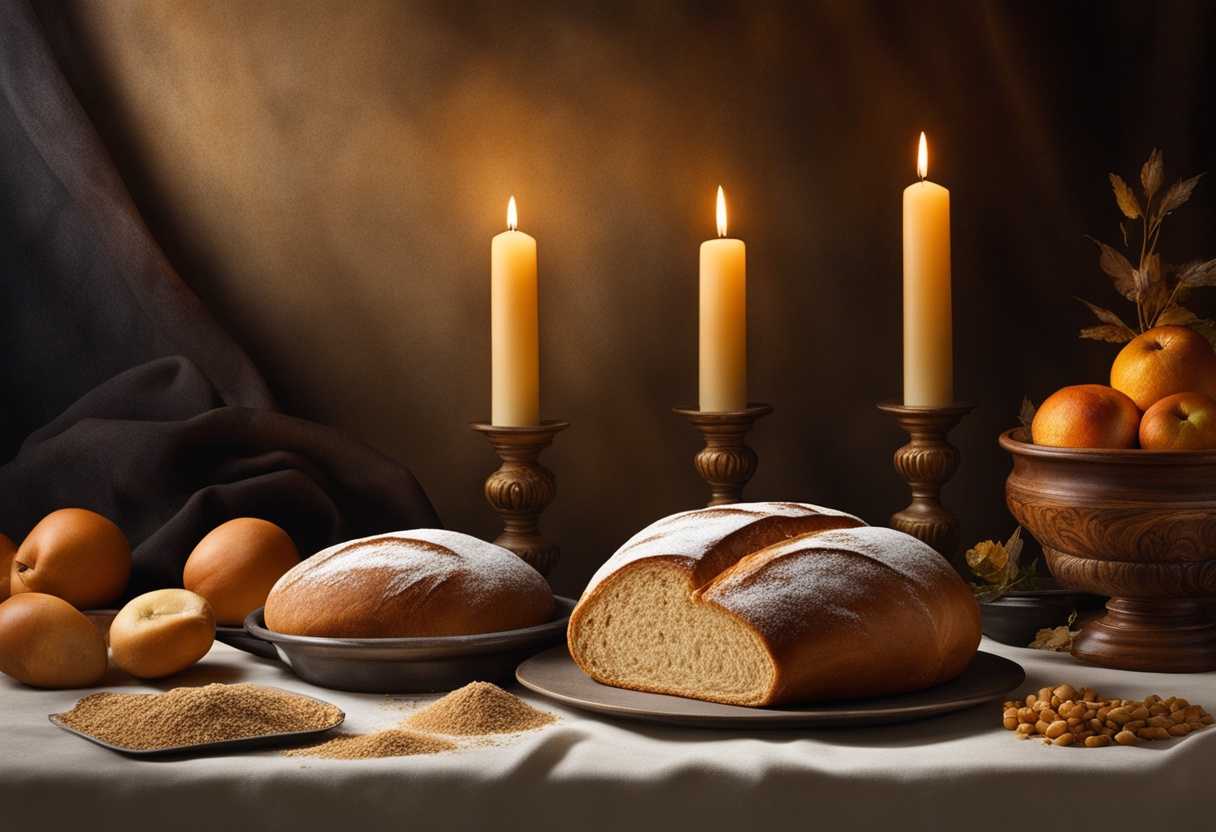
In the Bible, a grain offering is a type of sacrificial gift made to God, consisting of fine flour, baked bread, or grains, signifying thankfulness and devotion. It is described in Leviticus 2 as a voluntary offering that expresses gratitude for God’s provisions and is typically presented alongside animal sacrifices.
Scripture
1 “When anyone brings a grain offering as an offering to the Lord, his offering shall be of fine flour. He shall pour oil on it and put frankincense on it
2 And he shall bring it to Aaron’s sons the priests, and shall take from it a handful of the fine flour and oil, with all of its frankincense, and the priest shall burn this as its memorial portion on the altar, a food offering with a pleasing aroma to the Lord.
3 And the rest of the grain offering shall be for Aaron and his sons; it is a most holy part of the Lord’s food offerings.
4 “When you bring a grain offering baked in the oven as an offering, it shall be unleavened loaves of fine flour mixed with oil or unleavened wafers smeared with oil.
5 And if your offering is a grain offering baked on a griddle, it shall be of fine flour unleavened, mixed with oil.
6 You shall break it in pieces and pour oil on it; it is a grain offering.
7 And if your offering is a grain offering baked in the oven, it shall be unleavened cakes of fine flour mixed with oil, or unleavened wafers smeared with oil.
8 And you shall bring the grain offering that is made of these things to the Lord, and when it is presented to the priest, he shall bring it to the altar.
9 And the priest shall take from the grain offering its memorial portion and burn this on the altar, a food offering with a pleasing aroma to the Lord.
10 But the rest of the grain offering shall be for Aaron and his sons; it is a most holy part of the Lord’s food offerings.
11 You shall not leaven anything that is offered in sacrifice to the Lord.
12 As an offering of firstfruits you may bring them to the Lord, but they shall not be offered on the altar for a pleasing aroma.
13 You shall season all your grain offerings with salt. You shall not let the salt of the covenant with your God be missing from your grain offering; with all your offerings you shall offer salt.
14 And if you offer a grain offering of firstfruits to the Lord, you shall offer for the grain offering of your firstfruits fresh ears, roasted with fire, crushed new grain.
15 You shall put oil on it and lay frankincense on it; it is a grain offering.
16 And the priest shall burn as its memorial portion some of the crushed grain and some of the oil with all of its frankincense; it is a food offering to the Lord.
Meaning of Grain Offering in the Bible
The grain offering, as outlined in Leviticus 2, carries profound theological significance in the biblical narrative, serving as an expression of gratitude and devotion to God. Unlike other offerings that may involve the atonement for sins, the grain offering is fundamentally an acknowledgment of God’s blessings and sustenance. The Israelites would present offerings of fine flour, baked bread, or roasted grains, often accompanied by oil and frankincense, illustrating their gratitude for the harvest and God’s ongoing provision for their daily needs (Leviticus 2:1-2). This highlights the importance of worship that comes from the heart, emphasizing that devotion to God is expressed not just through obligatory rituals, but through acts of thankfulness and recognition of His goodness.
Moreover, the grain offering symbolizes a deeper spiritual truth: that everything we have, including the fruits of our labor, ultimately belongs to God. In offering the grain, the worshipper is signifying their acknowledgment of God as the source of their sustenance and abundance (Deuteronomy 8:10-18). The grain offering also foreshadows the ultimate offering of Christ, who is referred to as the “bread of life” (John 6:35), embodying the intersection of daily nourishment and divine grace. By understanding the grain offering within the broader context of thanksgiving, reliance on God, and spiritual communion, we can appreciate its significance as an invitation for believers to cultivate gratitude in their lives and recognize the sacredness in everyday provisions.
The grain offering further illustrates the holistic relationship that the Israelites were to cultivate with God through their agricultural practices and lifestyle. In ancient Israel, where agrarian life was central, the act of offering grain represented far more than a ritual; it acted as a tangible means of connecting the spiritual with the practical. By bringing their first fruits, individuals expressed their dependence on God as the ultimate provider and affirmed the belief that all creation is a gift from Him. In this way, the grain offering serves as a reminder that the routine of daily life, including farming and labor, is intertwined with the sacred, encouraging adherents to see God’s hand in every aspect of their existence.
Additionally, the communal aspect of the grain offering cannot be overlooked. The presentation of this offering was often accompanied by collective celebrations, reinforcing the importance of shared gratitude within the community of faith. This aspect connects to the broader theme of communal worship throughout the Bible, reminding believers that gratitude and recognition of divine provision should not be limited to individual practice but should foster a collective spirit of thanksgiving among God’s people. When the faithful brought their grain offerings to the temple, they contributed to the spiritual and physical nourishment of the community, reflecting an understanding that God’s blessings are meant to be shared. This emphasis on community reinforces God’s desire for His people to live in unity, recognizing that the gifts of the harvest are to be enjoyed collectively, thereby amplifying the gratitude both to God and to one another.
Symbol of Gratitude and Acknowledgment
The grain offering serves as a profound expression of gratitude towards God. It represents the acknowledgment of God’s provision and sustenance in the lives of the people. By presenting grain, which is a staple food, the offerer recognizes that all blessings, including the fruits of their labor, ultimately come from God. This act of giving back a portion of what one has received reinforces the relationship between the giver and the divine, highlighting the importance of thankfulness in one’s spiritual journey.
Representation of Spiritual Nourishment
In a broader spiritual context, the grain offering symbolizes the nourishment of the soul. Just as physical grain sustains the body, the offering signifies the need for spiritual sustenance through a relationship with God. It reflects the idea that true fulfillment comes not only from material provisions but also from spiritual engagement and devotion. This offering encourages believers to seek a deeper connection with God, emphasizing the importance of spiritual growth and reliance on divine grace.
Community and Fellowship
The grain offering also plays a significant role in fostering community and fellowship among the people of Israel. When offerings were made, they often involved communal meals or shared experiences, reinforcing social bonds and collective worship. This aspect highlights the importance of unity and togetherness in the faith community, as individuals come together to celebrate God’s goodness and share in the blessings received. The act of offering grain thus becomes a communal expression of faith, reinforcing the idea that worship is not just an individual act but a collective journey towards spiritual fulfillment.
How to Cultivate a Deeper Faith Through Worship and Gratitude
Cultivating a deeper faith through worship and gratitude is a transformative journey that can profoundly enrich your spiritual life. Start by setting aside intentional time for worship, whether through singing, prayer, or simply being in nature, allowing yourself to connect with God on a personal level. As you engage in these moments, focus on the attributes of God—His love, mercy, and faithfulness—and let these truths wash over you. Pair your worship with gratitude; keep a journal where you jot down daily blessings, no matter how small. This practice not only shifts your perspective but also deepens your awareness of God’s presence in your life. Remember, faith is not just a feeling but a choice to trust in God’s goodness, and as you express gratitude, you’ll find that your heart opens wider to His grace, leading you to a more profound and resilient faith.
Bible References to Grain Offerings:
Leviticus 6:14-23: 14 “And this is the law of the grain offering. The sons of Aaron shall offer it before the Lord in front of the altar.”
15 And one shall take from it a handful of the fine flour of the grain offering and its oil and all the frankincense that is on the grain offering and burn this as its memorial portion on the altar, a pleasing aroma to the Lord.
16 And the rest of it Aaron and his sons shall eat. It shall be eaten unleavened in a holy place. In the court of the tent of meeting they shall eat it.
17 It shall not be baked with leaven. I have given it as their portion of my food offerings. It is a thing most holy, like the sin offering and the guilt offering.
18 Every male among the children of Aaron may eat of it, as decreed forever throughout your generations, from the Lord’s food offerings. Whatever touches them shall become holy.
19 The Lord spoke to Moses, saying, “This is the offering of Aaron and his sons, which they shall offer to the Lord on the day when he is anointed: a tenth of an ephah of fine flour as a regular grain offering, half of it in the morning and half in the evening.
20 “This is the offering that Aaron and his sons shall offer to the Lord on the day when he is anointed: a tenth of an ephah of fine flour as a regular grain offering, half of it in the morning and half in the evening.”
21 It shall be made with oil on a griddle.
22 And the priest from among Aaron’s sons, who is anointed to succeed him, shall offer it to the Lord as decreed forever. It shall be wholly burned.
23 For every grain offering of the priest shall be wholly burned. It shall not be eaten.”
Numbers 15:1-16: 15 The Lord spoke to Moses, saying,
2 “Speak to the people of Israel and say to them, When you come into the land you are to inhabit, which I am giving you,
3 and you offer to the Lord from the herd or from the flock a food offering or a burnt offering or a sacrifice, to fulfill a vow or as a freewill offering or at your appointed feasts, to make a pleasing aroma to the Lord,
4 then he who brings his offering shall offer to the Lord a grain offering of a tenth of an ephah of fine flour, mixed with a quarter of a hin of oil;
5 And the fourth part of a hin of wine for a drink offering you shall prepare with the burnt offering or the sacrifice, for each lamb.
6 And for a drink offering you shall offer a third of a hin of wine, a pleasing aroma to the Lord.
7 and for the drink offering you shall offer a third of a hin of wine, a pleasing aroma to the Lord.
8 And when you offer a bull as a burnt offering or sacrifice, to fulfill a vow or for peace offerings to the Lord,
9 then two tenths of an ephah of fine flour shall be mixed with a third of a hin of oil.
10 And you shall offer for the drink offering half a hin of wine, as a food offering, a pleasing aroma to the Lord.
11 Thus shall it be done for each bull or ram, or for each lamb or young goat.
12 According to the number that you prepare, so shall you do with each one according to their number.
13 ‘All who are native shall do these things in this way, in offering a food offering, with a pleasing aroma to the Lord.
14 And if a stranger is sojourning with you, or anyone is living permanently among you, and he wishes to offer a food offering, with a pleasing aroma to the Lord, he shall do as you do.
15 For the assembly, there shall be one statute for you and for the stranger who sojourns with you, a statute forever throughout your generations. You and the sojourner shall be alike before the Lord.
16 One law and one rule shall be for you and for the stranger who sojourns with you.
Numbers 28:1-8: 1 The Lord spoke to Moses, saying,
2 “Command the people of Israel and say to them, ‘My offering, my food for my food offerings, my pleasing aroma, you shall be careful to offer to me at its appointed time.’”
3 And you shall say to them, This is the food offering that you shall offer to the Lord: two male lambs a year old without blemish, day by day, as a regular offering.
4 The one lamb you shall offer in the morning, and the other lamb you shall offer at twilight;
5 also a tenth of an ephah of fine flour for a grain offering, mixed with a quarter of a hin of beaten oil.
6 It is a regular burnt offering, which was ordained at Mount Sinai for a pleasing aroma, a food offering to the Lord.
7 “Its drink offering shall be a quarter of a hin for each lamb. In the Holy Place you shall pour out a drink offering of strong drink to the Lord.”
8 The other lamb you shall offer at twilight; as the grain offering of the morning and as its drink offering, you shall offer it, a food offering with a pleasing aroma to the Lord.
Ezekiel 45:13-17: 13 “This is the offering that you shall make: one sixth of an ephah from each homer of wheat, and one sixth of an ephah from each homer of barley,”
14 And the prescribed portion of oil, of the bath of oil, shall be a tenth of a bath from each cor (the cor, like the homer, contains ten baths).
15 And one sheep from every flock of two hundred, from the watering places of Israel for grain offering, burnt offering, and peace offerings, to make atonement for them, declares the Lord God.
16 All the people of the land shall be obliged to give this offering to the prince in Israel.
17 It shall be the prince’s duty to furnish the burnt offerings, grain offerings, and drink offerings, at the feasts, the new moons, and the Sabbaths, all the appointed feasts of the house of Israel: he shall provide the sin offerings, grain offerings, burnt offerings, and peace offerings, to make atonement on behalf of the house of Israel.
Ezekiel 46:11-15: 11 At the feasts and the appointed festivals, the grain offering with a young bull shall be an ephah, and with a ram an ephah, and with the lambs as much as one is able to give, together with a hin of oil to an ephah.
12 When the prince provides a freewill offering, either a burnt offering or peace offerings as a freewill offering to the Lord, the gate facing east shall be opened for him. And he shall offer his burnt offering or his peace offerings as he does on the Sabbath day.
13 “You shall provide a lamb a year old without blemish for a burnt offering to the Lord daily; morning by morning you shall provide it.”
14 And you shall provide a grain offering with it morning by morning, the sixth of an ephah, and the third of a hin of oil to moisten the flour, as a grain offering to the Lord. This is a perpetual statute.
15 Thus the lamb and the meal offering and the oil shall be provided, morning by morning, for a regular burnt offering.
Nehemiah 10:32-39: 32 We also take on ourselves the obligation to give yearly a third part of a shekel for the service of the house of our God:
33 for the showbread, the regular grain offering, the regular burnt offering, the Sabbaths, the new moons, the appointed feasts, the holy things, and the sin offerings to make atonement for Israel, and for all the work of the house of our God.
34 We obligate ourselves to bring the firstfruits of our ground and the firstfruits of all fruit of every tree, year by year, to the house of the Lord;
35 We obligate ourselves to bring the firstfruits of our ground and the firstfruits of all fruit of every tree, year by year, to the house of the Lord;
36 also to bring the first of our dough, and our contributions, the fruit of every tree, the wine and the oil, to the priests, to the chambers of the house of our God; and to bring to the Levites the tithes from our ground, for it is the Levites who collect the tithes in all our towns.
37 and to bring the first of our dough, and our contributions, the fruit of every tree, the wine and the oil, to the priests, to the chambers of the house of our God; and to bring to the Levites the tithes from our ground, for it is the Levites who collect the tithes in all our towns where we labor.
38 And the priest, the son of Aaron, shall be with the Levites when the Levites receive the tithes. And the Levites shall bring up the tithe of the tithes to the house of our God, to the chambers of the storehouse.
39 For the people of Israel and the sons of Levi shall bring the contribution of grain, wine, and oil to the storerooms where the vessels of the sanctuary are, as well as the priests who minister, and the gatekeepers and the singers. We will not neglect the house of our God.”
Malachi 1:6-14: 6 “A son honors his father, and a servant his master. If then I am a father, where is my honor? And if I am a master, where is my fear? declares the Lord of hosts to you, O priests, who despise my name. But you say, ‘How have we despised your name?’
7 By offering polluted food upon my altar. But you say, ‘How have we polluted you?’ By saying that the Lord’s table may be despised.
8 When you offer blind animals in sacrifice, is that not evil? And when you offer those that are lame or sick, is that not evil? Offer that to your governor; will he accept you or show you favor? declares the Lord of hosts.
9 And now entreat the favor of God, that he may be gracious to us. With such a gift from your hand, will he show favor to any of you? Declares the Lord of hosts.
10 Oh that there were one among you who would shut the doors, that you might not kindle fire on my altar in vain! I have no pleasure in you, says the Lord of hosts, and I will not accept an offering from your hand.
11 For from the rising of the sun to its setting my name will be great among the nations, and in every place incense will be offered to my name, and a pure offering. For my name will be great among the nations, says the Lord of hosts.
12 “But you profane it when you say that the Lord’s table is polluted, and its fruit, that is, its food may be despised.”
13 But you say, ‘What a weariness this is,’ and you snort at it, says the Lord of hosts. You bring what has been taken by violence or is lame or sick, and this you bring as your offering! Shall I accept that from your hand? says the Lord.
14 “But cursed be the deceiver who has in his flock a male, and vows it, and yet sacrifices to the Lord what is blemished. For I am a great King, says the Lord of hosts, and my name will be feared among the nations.”

Rev. François Dupont is a dedicated church minister with a wealth of experience in serving spiritual communities. With a calm and serene demeanor, he has been devoted to sharing the message of love, compassion, and tolerance for over two decades. Through his thoughtful sermons, compassionate counseling, and unwavering support, Rev. Dupont has touched the lives of countless individuals, allowing them to find solace and strength during difficult times. His serene presence and deep understanding of the human condition make him a trusted guide for those seeking spiritual nourishment and guidance.