
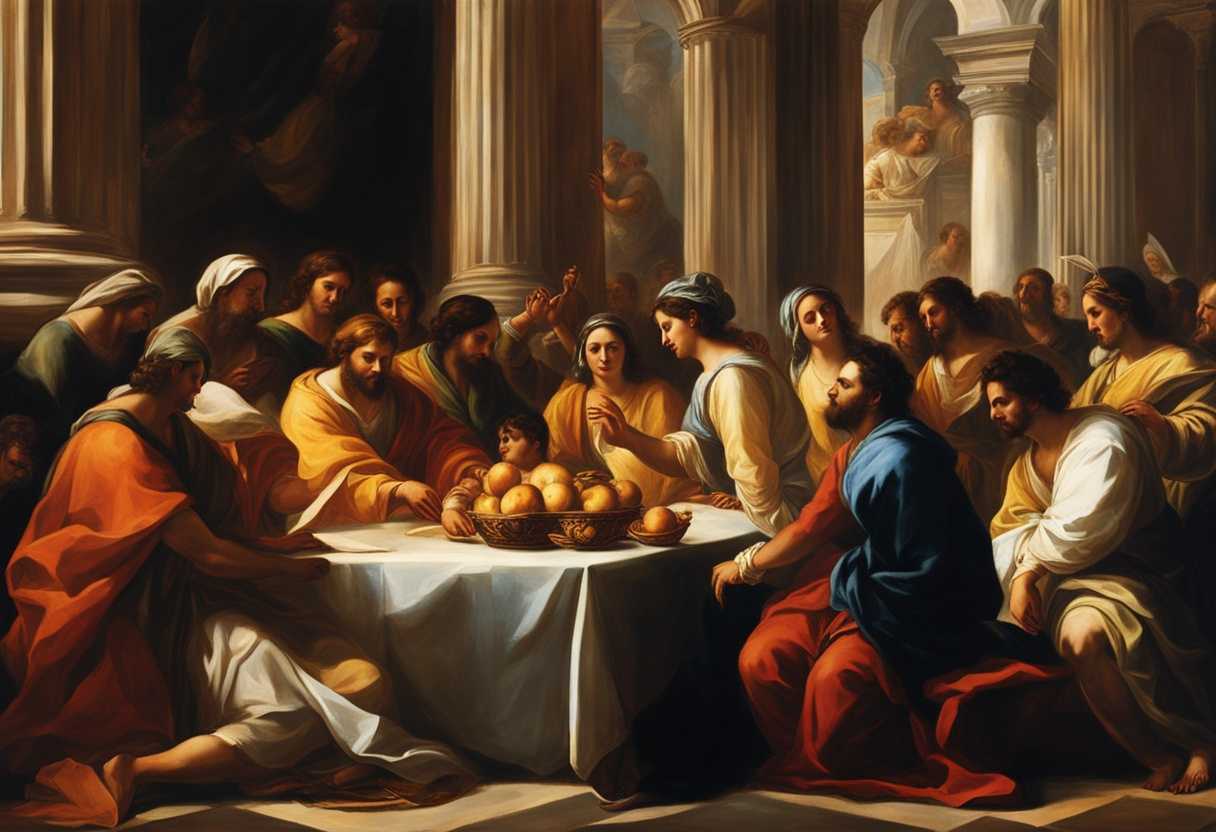
In the Bible, a “holy convocation” refers to a sacred assembly or gathering of people, specifically for worship, prayer, and the celebration of religious festivals as commanded in the Law. It emphasizes communal worship and the collective observance of God’s instructions, often associated with significant events like the Sabbath and various feasts in Israelite tradition (Leviticus 23:2).
Scripture
1 The Lord spoke to Moses, saying,
2 “Speak to the people of Israel and say to them, These are the appointed feasts of the Lord that you shall proclaim as holy convocations; they are my appointed feasts.
3 “Six days shall work be done, but on the seventh day is a Sabbath of solemn rest, a holy convocation. You shall do no work. It is a Sabbath to the Lord in all your dwelling places.
4 “These are the appointed feasts of the Lord, the holy convocations, which you shall proclaim at the time appointed for them.
5 In the first month, on the fourteenth day of the month at twilight, is the Lord’s Passover.
6 And on the fifteenth day of the same month is the Feast of Unleavened Bread to the Lord; for seven days you shall eat unleavened bread.
7 On the first day you shall have a holy convocation; you shall not do any ordinary work.
8 But you shall present a food offering to the Lord for seven days. On the seventh day is a holy convocation; you shall not do any ordinary work.”
9 And the Lord spoke to Moses, saying,
10 “Speak to the people of Israel and say to them, When you come into the land that I give you and reap its harvest, you shall bring the sheaf of the firstfruits of your harvest to the priest.”
11 and he shall wave the sheaf before the Lord, so that you may be accepted. On the day after the Sabbath the priest shall wave it.
12 And on the day when you wave the sheaf, you shall offer a male lamb a year old without blemish as a burnt offering to the Lord.
13 And the grain offering with it shall be two tenths of an ephah of fine flour mixed with oil, a food offering to the Lord with a pleasing aroma, and the drink offering with it shall be of wine, a fourth of a hin.
14 And you shall eat neither bread nor grain parched or fresh until this same day, until you have brought the offering of your God: it is a statute forever throughout your generations in all your dwellings.
15 “You shall count seven full weeks from the day after the Sabbath, from the day that you brought the sheaf of the wave offering.”
16 You shall count fifty days to the day after the seventh Sabbath. Then you shall present a grain offering of new grain to the Lord.
17 You shall bring from your dwelling places two loaves of bread to be waved, made of two tenths of an ephah. They shall be of fine flour, and they shall be baked with leaven, as firstfruits to the Lord.
18 And you shall present with the bread seven lambs a year old without blemish, one bull from the herd and two rams. They shall be a burnt offering to the Lord, with their grain offering and their drink offerings, a food offering with a pleasing aroma to the Lord.
19 You shall offer one male goat for a sin offering, and two male lambs a year old as a sacrifice of peace offerings.
20 And the priest shall wave them with the bread of the firstfruits as a wave offering before the Lord, with the two lambs. They shall be holy to the Lord for the priest.
21 And you shall make proclamation on the same day. You shall hold a holy convocation. You shall not do any ordinary work. It is a statute forever in all your dwelling places throughout your generations.
22 “And when you reap the harvest of your land, you shall not reap your field right up to its edge, nor shall you gather the gleanings after your harvest. You shall leave them for the poor and for the sojourner: I am the Lord your God.”
23 And the Lord spoke to Moses, saying,
24 “Speak to the people of Israel, saying, In the seventh month, on the first day of the month, you shall observe a day of solemn rest, a memorial proclaimed with blast of trumpets, a holy convocation.”
25 You shall not offer the blood of my sacrifice with anything leavened, or let the sacrifice of the Feast of the Passover remain until the morning.
26 And the Lord spoke to Moses, saying,
27 “Now on the tenth day of this seventh month is the Day of Atonement. It shall be for you a time of holy convocation, and you shall afflict yourselves and present a food offering to the Lord.
28 And you shall not do any work on that very day, for it is a Day of Atonement, to make atonement for you before the Lord your God.
29 For whoever does any work on this same day, that person I will destroy from among his people.
30 And whoever does any work on this same day, that person I will destroy from among his people.
31 You shall not do any work. It is a statute forever throughout your generations in all your dwelling places.
32 It shall be to you a Sabbath of solemn rest, and you shall afflict yourselves. On the ninth day of the month beginning at evening, from evening to evening shall you keep your Sabbath.”
33 And the Lord spoke to Moses, saying,
34 Speak to the people of Israel, saying, On the fifteenth day of this seventh month and for seven days is the Feast of Booths to the Lord.
35 On the first day shall be a holy convocation; you shall not do any ordinary work.
36 For seven days you shall present food offerings to the Lord. On the eighth day you shall hold a holy convocation and present a food offering to the Lord. It is a solemn assembly; you shall not do any ordinary work.
37 “These are the appointed feasts of the Lord, which you shall proclaim as times of holy convocation, for presenting to the Lord food offerings, burnt offerings and grain offerings, sacrifices and drink offerings, each on its proper day,
38 besides the Lord’s Sabbaths and besides your gifts and besides all your vow offerings and besides all your freewill offerings, which you give to the Lord.
39 “On the fifteenth day of the seventh month, when you have gathered in the produce of the land, you shall celebrate the feast of the Lord seven days. On the first day shall be a solemn rest, and on the eighth day shall be a solemn rest.
40 And you shall take on the first day the fruit of splendid trees, branches of palm trees and boughs of leafy trees and willows of the brook, and you shall rejoice before the Lord your God seven days.
41 You shall celebrate it as a feast to the Lord for seven days in the year. It is a statute forever throughout your generations; you shall celebrate it in the seventh month.
42 You shall dwell in booths for seven days. All native Israelites shall dwell in booths,
43 that your generations may know that I made the people of Israel dwell in booths when I brought them out of the land of Egypt: I am the Lord your God.”
44 Thus Moses declared to the people of Israel the appointed feasts of the Lord.
Meaning of Holy Convocation in the Bible
The concept of a “holy convocation” in the Bible holds broad significance, emphasizing the importance of communal worship and collective adherence to the teachings of God. Leviticus 23:3 states, “Six days shall work be done: but the seventh day is the sabbath of rest, an holy convocation; ye shall do no work therein: it is the sabbath of the LORD in all your dwellings.” This illustrates not only the sanctity of the Sabbath but also the call for everyone to gather and participate in worship together. Such gatherings serve as vital reminders of the covenant community, fostering unity, accountability, and shared spiritual growth.
Furthermore, holy convocations are often marked by celebrations of significant religious festivals, such as Passover (Exodus 12:16) and the Feast of Weeks (Deuteronomy 16:10), where the people are instructed to come together to remember God’s deeds and express their faith. Through these assemblies, the Israelites would recount their history, share testimonies of God’s faithfulness, and encourage one another in their spiritual journeys. The idea transcends the historical context of ancient Israel, as it underscores the continuous call for believers today to assemble in faith, embracing the biblical principle found in Hebrews 10:24-25, which encourages believers to “not forsake the assembling of ourselves together.” This collective act is essential for nurturing a vibrant, supportive faith community and maintaining devotion to God’s commandments.
Beyond the specific instances mentioned, the notion of a holy convocation reflects a broader theme of communal identity within the biblical narrative. Throughout the Scriptures, gatherings for worship serve as occasions for reaffirming the collective bond among believers, emphasizing that faith is not merely an individual pursuit but a communal one. For example, in the accounts of the early church in the Book of Acts, believers frequently came together for prayer, teaching, and the breaking of bread. These meetings illustrate the New Testament continuation of the holy convocation concept, manifesting in the fellowship of believers as a foundation for spiritual strength and encouragement.
Moreover, the prophetic literature often calls for communal repentance and returning to God, suggesting that gatherings serve a dual purpose: worship and a collective turning towards righteousness. The call to assemble is not just about participating in rituals; it is an invitation to engage in acts of justice, mercy, and community-building. The Minor Prophets, such as Joel and Amos, emphasize that the people should come together not only for feast days but also in times of distress, urging a return to genuine devotion and fellowship. This further supports the idea that holy convocations are central to maintaining a vibrant faith and are crucial for fostering a shared commitment to God’s mission in the world.
Spiritual Gathering and Community Worship
A holy convocation signifies a time set apart for communal worship and spiritual gathering among believers. It emphasizes the importance of coming together as a community to honor God, share in collective prayer, and engage in worship activities. This gathering fosters a sense of unity and belonging, allowing individuals to strengthen their faith through shared experiences and mutual encouragement.
Divine Appointment and Sacred Time
In the biblical context, a holy convocation represents a divinely appointed time for worship and reflection. These occasions are often marked by specific rituals and observances that highlight the sacredness of the moment. They serve as reminders of God’s presence and the importance of dedicating time to spiritual pursuits, reinforcing the idea that certain times are set apart for divine connection and reverence.
Instruction and Spiritual Growth
Holy convocations also serve as opportunities for teaching and spiritual growth. During these gatherings, individuals receive instruction in the faith, learn about God’s commandments, and are encouraged to deepen their understanding of scripture. This aspect underscores the role of communal worship not only as a time for praise but also as a vital space for learning and discipleship within the faith community.
How to Deepen Your Faith Through Community Worship
Deepening your faith through community worship is a beautiful journey that invites you to connect not only with God but also with fellow believers. When you gather with others in worship, you create a space where shared experiences and collective prayers can uplift your spirit and strengthen your resolve. It’s in these moments of singing, praying, and listening to the Word that you can feel the presence of God in a profound way, reminding you that you are part of something much larger than yourself. Engaging in community worship also allows you to learn from others, share your own struggles and victories, and build lasting relationships that encourage you in your faith. So, don’t hesitate to immerse yourself in your church community—attend services regularly, participate in small groups, and volunteer for church activities. Each of these steps will not only deepen your understanding of God’s love but also help you to embody that love in your daily life. Remember, faith is not just a solitary journey; it flourishes in the warmth of community.
Bible References to Holy Convocation Meaning:
Exodus 12:14-20: 14 “This day shall be for you a memorial day, and you shall keep it as a feast to the Lord; throughout your generations, as a statute forever, you shall keep it as a feast.”
15 Seven days you shall eat unleavened bread. On the first day you shall remove leaven out of your houses, for if anyone eats what is leavened, from the first day until the seventh day, that person shall be cut off from Israel.
16 On the first day you shall hold a holy assembly, and on the seventh day a holy assembly. No work shall be done on those days. But what everyone needs to eat, that alone may be prepared by you.
17 And you shall observe the Feast of Unleavened Bread, for on this very day I brought your hosts out of the land of Egypt. Therefore you shall observe this day, throughout your generations, as a statute forever.
18 In the first month, from the fourteenth day of the month at evening, you shall eat unleavened bread until the twenty-first day of the month at evening.
19 For seven days no leaven is to be found in your houses. If anyone eats what is leavened, that person will be cut off from the congregation of Israel, whether he is a sojourner or a native of the land.
20 You shall eat nothing leavened; in all your dwelling places you shall eat unleavened bread.”
Numbers 28:16-25: 16 “On the fourteenth day of the first month is the Lord’s Passover,”
17 and on the fifteenth day of this month is a feast. Seven days shall unleavened bread be eaten.
18 And their drink offerings shall be half a hin of wine, and you shall pour out a drink offering of strong drink to the Lord.
19 but offer a food offering, a burnt offering to the Lord: two bulls from the herd, one ram, and seven male lambs a year old;
20 And their grain offering shall be of fine flour mixed with oil, three tenths of an ephah for the bull, two tenths for the ram,
21 a tenth of an ephah for each of the seven lambs;
22 one male goat for a sin offering, to make atonement for you.
23 “You shall offer these in addition to the burnt offering of the morning, which is for a regular burnt offering.”
24 In this way you shall offer daily, for seven days, the food of the offering made by fire, of a pleasing aroma to the Lord. It shall be offered besides the regular burnt offering and its drink offering.
25 And on the seventh day you shall have a holy convocation. You shall not do any ordinary work.
Numbers 29:1-6: 1 “On the first day of the seventh month you shall have a holy convocation. You shall not do any ordinary work. It is a day for you to blow the trumpets,
2 And you shall offer a burnt offering, a pleasing aroma to the Lord: one bull from the herd, one ram, seven male lambs a year old without blemish;
3 And you shall offer a burnt offering, a pleasing aroma to the Lord: two bulls from the herd, one ram, seven male lambs a year old;
4 And you shall offer a burnt offering to the Lord, a pleasing aroma: one bull from the herd, one ram, seven male lambs a year old without blemish;
5 And one male goat for a sin offering to the Lord; it shall be offered besides the regular burnt offering and its drink offering.
6 besides the burnt offering of the new moon, and its grain offering, and the regular burnt offering and its grain offering, and their drink offering, according to the rule for them, for a pleasing aroma, a food offering to the Lord.
Nehemiah 8:1-12: 1 And all the people gathered as one man into the square before the Water Gate. And they told Ezra the scribe to bring the Book of the Law of Moses that the Lord had commanded Israel.
2 So Ezra the priest brought the Law before the assembly, both men and women and all who could understand what they heard, on the first day of the seventh month.
3 And he read from it facing the square before the Water Gate from early morning until midday, in the presence of the men and the women and those who could understand. And the ears of all the people were attentive to the Book of the Law.
4 And Ezra the scribe stood on a wooden platform that they had made for the purpose.
5 And Ezra opened the book in the sight of all the people, for he was above all the people, and as he opened it all the people stood.
6 And Ezra blessed the Lord, the great God, and all the people answered, “Amen, Amen,” lifting up their hands. And they bowed their heads and worshiped the Lord with their faces to the ground.
7 Also Jeshua, Bani, Sherebiah, Jamin, Akkub, Shabbethai, Hodiah, Maaseiah, Kelita, Azariah, Jozabad, Hanan, Pelaiah, the Levites, helped the people to understand the Law, while the people remained in their places.
8 They read from the book, from the Law of God, clearly, and they gave the sense, so that the people understood the reading.
9 And Nehemiah, who was the governor, and Ezra the priest and scribe, and the Levites who taught the people said to all the people, “This day is holy to the Lord your God; do not mourn or weep.” For all the people wept as they heard the words of the Law.
10 Then he said to them, “Go your way. Eat the fat and drink sweet wine and send portions to anyone who has nothing ready, for this day is holy to our Lord. And do not be grieved, for the joy of the Lord is your strength.”
11 So the Levites calmed all the people, saying, “Be quiet, for this day is holy; do not be grieved.”
12 And all the people went their way to eat and drink and to send portions and to make great rejoicing, because they had understood the words that were declared to them.
Isaiah 1:13-17: 13 Bring no more vain offerings; incense is an abomination to me.
14 Your new moons and your appointed feasts my soul hates; they have become a burden to me; I am weary of bearing them.
15 When you spread out your hands,
I will hide my eyes from you;
even though you make many prayers,
I will not listen;
your hands are full of blood.
16 Wash yourselves; make yourselves clean; remove the evil of your deeds from before my eyes; cease to do evil,
17 learn to do good;
seek justice,
correct oppression;
bring justice to the fatherless,
plead the widow’s cause.
Ezekiel 46:1-12: 1 “Thus says the Lord God: The gate of the inner court that faces east shall be shut on the six working days, but on the Sabbath day it shall be opened, and on the day of the new moon it shall be opened.”
2 The prince shall enter by the vestibule of the gate from outside, and shall take his stand by the post of the gate. The priests shall offer his burnt offering and his peace offerings, and he shall worship at the threshold of the gate.
3 The people of the land shall bow down at the entrance of that gate before the Lord on the Sabbaths and on the new moons.
4 The burnt offering that the prince offers to the Lord on the Sabbath day shall be six lambs without blemish and a ram without blemish.
5 The grain offering with the ram as he shall offer it, and the drink offering with the ram shall be a fourth of a hin, and you shall offer it with the other lamb a fourth of a hin, and a drink offering with it shall be a fourth of a hin.
6 On the day of the new moon he shall offer a bull from the herd without blemish to the Lord.
7 And he shall provide a grain offering, an ephah for the bull and an ephah for the ram, and for the lambs as he is able, together with a hin of oil to an ephah.
8 When the prince enters, he shall enter by the vestibule of the gate, and he shall go out by the same way.
9 “When the people of the land come before the Lord at the appointed feasts, he who enters by the north gate to worship shall go out by the south gate, and he who enters by the south gate shall go out by the north gate. No one shall return by way of the gate by which he entered, but each shall go out straight ahead.”
10 The prince shall enter by the vestibule of the gate from outside, and shall take his stand by the post of the gate. The priests shall offer his burnt offering and his peace offerings, and he shall worship at the threshold of the gate. Then he shall go out, but the gate shall not be shut until evening.
11 At the feasts and the appointed festivals, the grain offering with a young bull shall be an ephah, and with a ram an ephah, and with the lambs as much as one is able to give, together with a hin of oil to an ephah.
12 When the prince provides a freewill offering, either a burnt offering or peace offerings as a freewill offering to the Lord, the gate facing east shall be opened for him. And he shall offer his burnt offering or his peace offerings as he does on the Sabbath day.
Joel 2:15-17: 15 Blow the trumpet in Zion; consecrate a fast; call a solemn assembly;
16 gather the people. Consecrate the congregation; assemble the elders; gather the children, even nursing infants. Let the bridegroom leave his room, and the bride her chamber.
17 Between the vestibule and the altar let the priests, the ministers of the Lord, weep and say, “Spare your people, O Lord, and make not your heritage a reproach, a byword among the nations. Why should they say among the peoples, ‘Where is their God?’”
Hebrews 10:24-25: 24 And let us consider how to stir up one another to love and good works,
25 not neglecting to meet together, as is the habit of some, but encouraging one another, and all the more as you see the Day drawing near.

Rev. François Dupont is a dedicated church minister with a wealth of experience in serving spiritual communities. With a calm and serene demeanor, he has been devoted to sharing the message of love, compassion, and tolerance for over two decades. Through his thoughtful sermons, compassionate counseling, and unwavering support, Rev. Dupont has touched the lives of countless individuals, allowing them to find solace and strength during difficult times. His serene presence and deep understanding of the human condition make him a trusted guide for those seeking spiritual nourishment and guidance.