
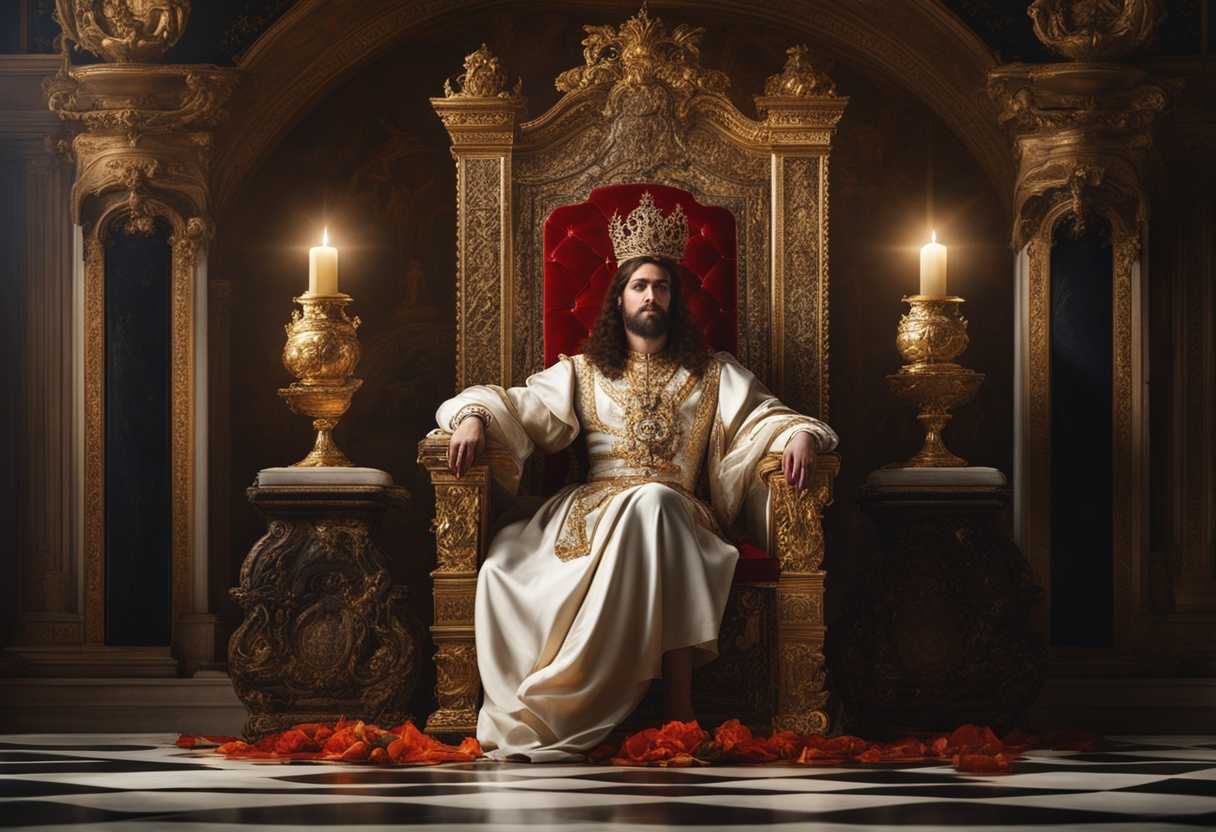
In the Bible, a “potentate” refers to a powerful ruler or sovereign, often indicating someone with significant authority or dominion. The term is used to emphasize the sovereignty and might of earthly rulers or God in contrast to worldly power (e.g., 1 Timothy 6:15).
Scripture
13 I charge you in the presence of God, who gives life to all things, and of Christ Jesus, who in his testimony before Pontius Pilate made the good confession,
14 to keep the commandment unstained and free from reproach until the appearing of our Lord Jesus Christ,
15 which he will display at the proper time—he who is the blessed and only Sovereign, the King of kings and Lord of lords,
16 who alone has immortality, who dwells in unapproachable light, whom no one has ever seen or can see. To him be honor and eternal dominion. Amen.
Potentate in the Bible: Meaning Explained
In the Bible, the term “potentate” conveys the idea of supreme authority and governance, particularly relating to God’s sovereignty over all creation. In 1 Timothy 6:15, Paul refers to Jesus as “the blessed and only Potentate, the King of kings, and Lord of lords,” emphasizing His ultimate power and authority that surpasses all earthly rulers. This designation highlights not only the majesty of Christ but also serves to remind believers that while they may live under various earthly authorities and potentates, it is God alone who wields ultimate power over the universe, determining the course of history and exercising dominion with justice and righteousness.
The biblical portrayal of potentates also serves to contrast the fleeting nature of worldly power with the eternal reign of God. Verses such as Psalm 75:7 declare, “But it is God who judges; He brings one down, He exalts another,” reinforcing the notion that human rulers may rise and fall according to divine will. In this light, the idea of potentates becomes a call to believers to focus their allegiance and trust in God’s everlasting kingdom rather than the temporary and often corrupt systems of human governance. As they endure trials and oppression under earthly potentates, they are assured that ultimate authority rests not with the powerful but with the One who created and sustains the cosmos, fostering a deep sense of hope and resilience in their faith.
Additionally, the concept of potentate in the Bible reflects the broader theme of divine authority contrasted with human authority. In the book of Daniel, kings and empires are depicted as powerful yet transient, showcasing how earthly potentates are mere instruments in God’s sovereign plan. The narrative of Nebuchadnezzar, who ultimately acknowledges God’s supremacy after experiencing divine discipline, illustrates that even the mightiest of rulers must recognize the limits of their authority. This interaction serves as a powerful reminder to both rulers and subjects that no amount of human power can rival the omnipotence of God.
Moreover, the role of potentates in biblical literature often underscores the ethical and moral responsibilities accompanying authority. For instance, leaders in both the Old and New Testaments are frequently called to govern with justice and to serve the people, reflecting God’s character. The warnings against tyranny and corruption in places such as the prophetic books demonstrate that the true essence of a potentate lies not merely in dominance and rule but in serving and protecting the well-being of the community. Therefore, the biblical understanding of potentate extends beyond mere title; it is a profound acknowledgment of the divine accountability that accompanies leadership, urging both believers and leaders to seek wisdom and righteousness in the exercise of their power.
Divine Sovereignty
In the biblical context, the term “potentate” often refers to the ultimate authority and sovereignty of God over all creation. It emphasizes that God is the supreme ruler, possessing power and dominion over the universe. This understanding highlights the belief that earthly rulers and authorities are ultimately subject to God’s will and governance, reinforcing the idea that true power resides with the divine.
Human Authority and Governance
The term “potentate” can also be applied to earthly rulers and leaders, signifying their role as authorities in governance. In this sense, it reflects the biblical perspective on the structure of human authority, where leaders are seen as appointed by God to maintain order and justice. This interpretation encourages a recognition of the responsibilities that come with power, urging leaders to govern with wisdom and integrity in accordance with divine principles.
The Contrast Between Earthly and Heavenly Power
Another broader meaning of “potentate” in the Bible is the contrast between earthly powers and the ultimate power of God. While potentates may wield significant influence and authority in the world, the scriptures often remind believers that such power is temporary and limited. This contrast serves to encourage faith in God’s eternal kingdom, where His reign is unchallenged and everlasting, providing hope and assurance to believers amidst the uncertainties of worldly governance.
How to Embrace God’s Authority in Our Lives
Embracing God’s authority in our lives is a transformative journey that begins with a heart open to His guidance and a willingness to surrender our own desires. It’s about recognizing that His wisdom surpasses our understanding and that His plans for us are rooted in love and purpose. Start by immersing yourself in Scripture, allowing His words to shape your thoughts and actions. Prayer is essential; it’s not just about asking for what we want, but about seeking His will and listening for His voice. Surround yourself with a community of believers who can encourage and challenge you to grow in faith. Remember, embracing God’s authority doesn’t mean losing your freedom; rather, it’s about finding true freedom in living according to His design. As you take these steps, you’ll discover a deeper sense of peace and direction, knowing that you are walking in alignment with the Creator of the universe.
Bible References to the Term “Potentate”:
Revelation 19:11-16: 11 Then I saw heaven opened, and behold, a white horse! The one sitting on it is called Faithful and True, and in righteousness he judges and makes war.
12 His eyes are like a flame of fire, and on his head are many diadems, and he has a name written that no one knows but himself.
13 He is clothed in a robe dipped in blood, and the name by which he is called is The Word of God.
14 And the armies of heaven, arrayed in fine linen, white and pure, were following him on white horses.
15 From his mouth comes a sharp sword with which to strike down the nations, and he will rule them with a rod of iron. He will tread the winepress of the fury of the wrath of God the Almighty.
16 On his robe and on his thigh he has a name written, King of kings and Lord of lords.
Daniel 4:34-37: 34 At the end of the days I, Nebuchadnezzar, lifted my eyes to heaven, and my reason returned to me, and I blessed the Most High, and praised and honored him who lives forever, for his dominion is an everlasting dominion, and his kingdom endures from generation to generation;
35 all the inhabitants of the earth are accounted as nothing, and he does according to his will among the host of heaven and among the inhabitants of the earth; and none can stay his hand or say to him, “What have you done?”
36 At the same time my reason returned to me, and for the glory of my kingdom, my majesty and splendor returned to me. My counselors and my lords sought me, and I was established in my kingdom, and still more greatness was added to me.
37 Now I, Nebuchadnezzar, praise and extol and honor the King of heaven, for all his works are right and his ways are just; and those who walk in pride he is able to humble.
Psalm 47:1-9: 1 Clap your hands, all peoples! Shout to God with loud songs of joy!
2 For the Lord, the Most High, is to be feared, a great king over all the earth.
3 He subdued peoples under us, and nations under our feet.
4 He chose our heritage for us, the pride of Jacob whom he loves. Selah
5 God has gone up with a shout, the Lord with the sound of a trumpet.
6 Sing praises to God, sing praises! Sing praises to our King, sing praises!
7 For God is the King of all the earth; sing praises with a psalm!
8 God reigns over the nations; God sits on his holy throne.
9 The princes of the peoples gather as the people of the God of Abraham. For the shields of the earth belong to God; he is highly exalted!
Isaiah 9:6-7: 6 For to us a child is born,
to us a son is given;
and the government shall be upon his shoulder,
and his name shall be called
Wonderful Counselor, Mighty God,
Everlasting Father, Prince of Peace.
7 Of the increase of his government and of peace there will be no end, on the throne of David and over his kingdom, to establish it and to uphold it with justice and with righteousness from this time forth and forevermore. The zeal of the Lord of hosts will do this.
1 Chronicles 29:10-13: 10 Therefore David blessed the Lord in the presence of all the assembly. And David said: “Blessed are you, O Lord, the God of Israel our father, forever and ever.
11 Yours, O Lord, is the greatness and the power and the glory and the victory and the majesty, for all that is in the heavens and in the earth is yours. Yours is the kingdom, O Lord, and you are exalted as head above all.
12 Both riches and honor come from you, and you rule over all. In your hand are power and might, and in your hand it is to make great and to give strength to all.
13 And now we thank you, our God, and praise your glorious name.
Revelation 17:12-14: 12 And the ten horns that you saw are ten kings who have not yet received royal power, but they are to receive authority as kings for one hour, together with the beast.
13 These are of one mind, and they hand over their power and authority to the beast.
14 They will make war on the Lamb, and the Lamb will conquer them, for he is Lord of lords and King of kings, and those with him are called and chosen and faithful.”
Psalm 2:1-12: 1 Why do the nations rage and the peoples plot in vain?
2 The kings of the earth set themselves, and the rulers take counsel together, against the Lord and against his Anointed, saying,
3 “Let us burst their bonds apart and cast away their cords from us.”
4 He who sits in the heavens laughs; the Lord holds them in derision.
5 Then he will speak to them in his wrath, and terrify them in his fury, saying,
6 As for me, I have set my King on Zion, my holy hill.
7 I will tell of the decree: The LORD said to me, “You are my Son; today I have begotten you.
8 Ask of me, and I will make the nations your heritage, and the ends of the earth your possession.
9 You shall break them with a rod of iron and dash them in pieces like a potter’s vessel.
10 Now therefore, O kings, be wise; be warned, O rulers of the earth.
11 Serve the Lord with fear, and rejoice with trembling.
12 Kiss the Son, lest he be angry, and you perish in the way, for his wrath is quickly kindled. Blessed are all who take refuge in him.
Revelation 1:4-8: 4 John to the seven churches that are in Asia: Grace to you and peace from him who is and who was and who is to come, and from the seven spirits who are before his throne,
5 and from Jesus Christ the faithful witness, the firstborn of the dead, and the ruler of kings on earth. To him who loves us and has freed us from our sins by his blood.
6 and made us a kingdom, priests to his God and Father, to him be glory and dominion forever and ever. Amen.
7 Behold, he is coming with the clouds, and every eye will see him, even those who pierced him, and all tribes of the earth will wail on account of him. Even so. Amen.
8 “I am the Alpha and the Omega,” says the Lord God, “who is and who was and who is to come, the Almighty.”
Philippians 2:9-11: 9 Therefore God has highly exalted him and bestowed on him the name that is above every name,
10 so that at the name of Jesus every knee should bow, in heaven and on earth and under the earth,
11 and every tongue confess that Jesus Christ is Lord, to the glory of God the Father.

Reverend Ogunlade is a seasoned Church Minister with over three decades of experience in guiding and nurturing congregations. With profound wisdom and a serene approach, Reverend Ogunlade has carried out various pastoral duties, including delivering uplifting sermons, conducting religious ceremonies, and offering sage counsel to individuals seeking spiritual guidance. Their commitment to fostering harmony and righteousness within their community is exemplified through their compassionate nature, making them a beloved and trusted figure among the congregation.