
Absalom, in the Bible, means “father of peace” in Hebrew. He is known as the third son of King David, who is remembered for his rebellion against his father and his tragic death during a civil war in Israel, symbolizing the complexities of familial relationships and the consequences of pride and ambition.
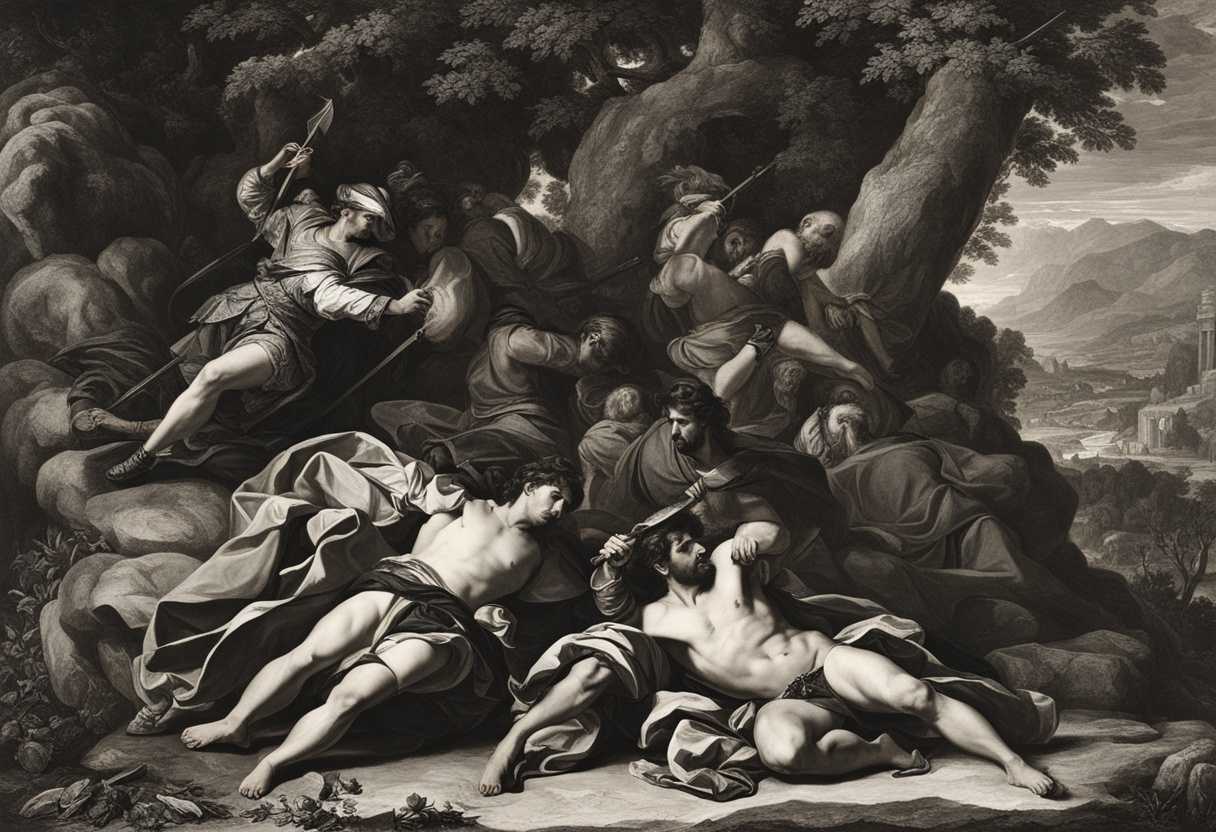
Scripture
1 Now Absalom, David’s son, had a beautiful sister, whose name was Tamar. And after a time Amnon, David’s son, loved her.
2 And Amnon was so tormented that he made himself ill because of his sister Tamar, for she was a virgin, and it seemed impossible to Amnon to do anything to her.
3 But Amnon had a friend, whose name was Jonadab, the son of Shimeah, David’s brother. And Jonadab was a very crafty man.
4 And he said to him, “O son of the king, why are you so haggard morning after morning? Will you not tell me?” Amnon said to him, “I love Tamar, my brother Absalom’s sister.”
5 But Jonadab said to him, “Lie down on your bed and pretend to be ill. And when your father comes to see you, say to him, ‘Let my sister Tamar come and give me bread to eat, and prepare the food in my sight, that I may see it and eat it from her hand.’”
6 So Amnon lay down and pretended to be ill. And when the king came to see him, Amnon said to the king, “Please let my sister Tamar come and make a couple of cakes in my sight, that I may eat from her hand.”
7 Then David sent home to Tamar, saying, “Go to your brother Amnon’s house and prepare food for him.”
8 So Tamar went to her brother Amnon’s house, where he was lying down. And she took dough and kneaded it and made cakes in his sight and baked the cakes.
9 Then she took a pan and baked them before him, and he ate.
10 Then Amnon said to Tamar, “Bring the food into the chamber, that I may eat from your hand.” And Tamar took the cakes she had made and brought them into the chamber to Amnon her brother.
11 But when she brought them near him to eat, he took hold of her and said to her, “Come, lie with me, my sister.”
12 But she said to him, “No, my brother, for this wrong in sending me away is greater than the other that you did to me.” But he would not listen to her.
13 But he would not listen to her, and being stronger than she, he violated her and lay with her.
14 But he would not listen to her, and being stronger than she, he violated her and lay with her.
15 Then Amnon hated her with very great hatred, so that the hatred with which he hated her was greater than the love with which he had loved her. And Amnon said to her, “Get up! Go!”
16 But she said to him, “No, my brother, for this wrong in sending me away is greater than the other that you did to me.” But he would not listen to her.
17 Then he called his young man who served him and said, “Put this woman out of my presence and bolt the door after her.”
18 Now she was wearing a long robe with sleeves, for thus were the virgin daughters of the king dressed. So his servant put her out and bolted the door after her.
19 And Tamar put ashes on her head and tore the long robe that she wore. And she laid her hand on her head and went away, crying aloud as she went.
20 And her brother Absalom said to her, “Has Amnon your brother been with you? Now hold your peace, my sister. He is your brother; do not take this to heart.” So Tamar lived, a desolate woman, in her brother Absalom’s house.
21 But when King David heard of all these things, he was very angry.
22 But Absalom spoke to Amnon neither good nor bad, for Absalom hated Amnon, because he had violated his sister Tamar.
23 After two full years Absalom had sheepshearers at Baal-hazor, which is near Ephraim, and Absalom invited all the king’s sons.
24 And Absalom came to the king and said, “Behold, your servant has sheepshearers. Please let the king and his servants go with your servant.”
25 But the king would not listen to all the people, for it was a turn of affairs brought about by the Lord that he might fulfill his word, which the Lord spoke by Ahijah the Shilonite to Jeroboam the son of Nebat.
26 Then Absalom said, “If not, please let my brother Amnon go with us.” And the king said to him, “Why should he go with you?”
27 But Absalom pressed him until he let Amnon and all the king’s sons go with him.
28 Then Absalom commanded his servants, “Mark when Amnon’s heart is merry with wine, and when I say to you, ‘Strike Amnon,’ then kill him. Fear not; have I not commanded you? Be courageous and be valiant.”
29 And the servants of Absalom did to Amnon as Absalom had commanded. Then all the king’s sons arose, and each mounted his mule and fled.
30 But Absalom had commanded his servants, saying, “Mark when Amnon’s heart is merry with wine, and when I say to you, ‘Strike Amnon,’ then kill him. Do not fear; have I not commanded you? Be courageous and be valiant.”
31 Then the king arose and tore his garments and lay on the earth. And all his servants who were standing by tore their garments.
32 But Jonadab the son of Shimeah, David’s brother, said, “Let not my lord suppose that they have killed all the young men the king’s sons, for Amnon alone is dead.
33 Now therefore let not my lord the king so take it to heart as to suppose that all the king’s sons are dead, for Amnon alone is dead.”
34 But Absalom fled. And the young man who kept the watch lifted up his eyes and looked, and behold, many people were coming from the road behind him by the side of the mountain.
35 And Jonadab said to the king, “Behold, the king’s sons have come; as your servant said, so it has come to pass.”
36 While he was yet speaking, behold, Jonathan the son of Abiathar the priest came. And Adonijah said, “Come in, for you are a worthy man and bring good news.”
37 But Absalom fled and went to Talmai the son of Ammihud, king of Geshur. And David mourned for his son day after day.
38 So Absalom fled and went to Geshur, and was there three years.
39 And the spirit of the king longed to go out to Absalom, because he was comforted about Amnon, since he was dead.
Meaning of Absalom in the Bible
Absalom, whose name means “father of peace,” serves as a poignant symbol of the tumultuous and often contradictory nature of human relationships, especially within a familial context. His story, primarily narrated in 2 Samuel, illustrates a tragic arc of ambition, betrayal, and the quest for personal justice. Absalom’s initial appeal as a charismatic leader who sought to win the hearts of the people (2 Samuel 15:1-6) ultimately leads to a bitter rebellion against King David, his father. This rebellion emphasizes how unresolved issues and the thirst for power can fracture family bonds. Absalom’s desire for recognition and his failure to reconcile with his father represent the overarching theme of pride leading to downfall, encapsulated poignantly in Proverbs 16:18: “Pride goes before destruction, and a haughty spirit before a fall.”
The tragedy of Absalom culminates not just in his death but in the way it impacts David, who is depicted as mourning deeply for his son despite Absalom’s treachery (2 Samuel 18:33). David’s lament, “O my son Absalom, my son, my son Absalom! Would I had died instead of you!” serves as a powerful testament to the enduring pain of lost potential and fractured familial ties (2 Samuel 18:33). Absalom’s narrative invites readers to reflect on the balance of ambition and the consequent familial disruptions, reinforcing that peace—ironically encapsulated in his name—often eludes those who prioritize personal ambition over relational harmony. The story emphasizes that in striving for peace, one must also confront the shadows of pride and the complexities inherent in relationships, reminding us that true peace often comes at a price and requires reconciliation and humility.
In examining the life of Absalom, it is essential to consider how his quest for power not only put him at odds with his father but also fueled a series of events that had profound implications for the entire kingdom of Israel. His rebellion against King David can be seen as a misguided attempt to assert agency in a world dominated by political and familial hierarchies. The narrative prompts readers to question the motivations behind Absalom’s actions, particularly whether his desire for justice, after the tragic assault on his sister Tamar, was genuinely noble or tainted by a thirst for vengeance. The interplay of personal grievance and political ambition in Absalom’s life showcases the ripple effects of unresolved trauma within a family, suggesting that the quest for peace cannot be disassociated from addressing underlying conflicts.
Furthermore, Absalom’s story reveals the catastrophic fallout when familial loyalty is overshadowed by pride and ambition. His hair—a symbol of his vanity—served as both a source of his beauty and, ultimately, his demise. When Absalom was caught by his long hair in the branches of a tree during battle, it metaphorically illustrated how the very qualities that elevated him could also lead to destruction, a reminder of the duality of human experience. Through Absalom’s life and death, the biblical narrative confronts readers with the harsh realities of ambition unchecked by wisdom and the sometimes-painful consequences of choosing power over familial bonds. Absalom’s tale serves as a cautionary parable about the complexities of love, honor, and the cost of discord, urging a deeper contemplation of what it truly means to pursue peace amidst human frailty.
The Complexity of Familial Relationships
Absalom’s story highlights the intricate dynamics of family relationships, particularly the tensions that can arise between parents and children. His rebellion against King David serves as a poignant reminder of how unresolved conflicts and favoritism can lead to estrangement and tragedy within families. The narrative illustrates the consequences of familial discord and the impact it can have on broader societal structures.
The Consequences of Pride and Ambition
Absalom embodies the dangers of unchecked ambition and pride. His desire for power and recognition ultimately leads to his downfall, serving as a cautionary tale about the perils of seeking personal glory at the expense of others. This theme resonates throughout the biblical narrative, emphasizing the importance of humility and the potential consequences of overreaching ambition.
The Quest for Identity and Acceptance
Absalom’s actions can also be interpreted as a quest for identity and acceptance. His desire to win the hearts of the people and establish his own legacy reflects a deep-seated need for validation and belonging. This aspect of his character invites readers to consider the universal human longing for recognition and the lengths to which individuals may go to achieve it, often leading to conflict and strife.
How to Cultivate Inner Peace as a Christian
Cultivating inner peace as a Christian is a beautiful journey that begins with deepening your relationship with God through prayer and scripture. Take time each day to immerse yourself in His Word, allowing the promises and truths found in the Bible to wash over you, reminding you of His love and sovereignty. Practicing gratitude can also transform your perspective; by focusing on the blessings in your life, you can shift your mindset away from anxiety and worry. Additionally, consider incorporating moments of silence and meditation into your routine, where you can listen for God’s voice and feel His presence. Surround yourself with a supportive community of fellow believers who can encourage you and pray with you, as we are reminded in Philippians 4:6-7 to bring our concerns to God, who will guard our hearts and minds. Remember, inner peace is not the absence of trouble but the presence of Christ in your life, so lean into Him, trust His plan, and let His peace fill your heart.
Bible References to the Meaning of Absalom:
2 Samuel 14:1-33: 1 Now Joab the son of Zeruiah knew that the king’s heart went out to Absalom.
2 And Joab sent to Tekoa and brought from there a wise woman and said to her, “Pretend to be a mourner and put on mourning garments. Do not anoint yourself with oil, but behave like a woman who has been mourning many days for the dead.
3 And go to the king and speak thus to him.” So Joab put the words in her mouth.
4 When the woman of Tekoa came to the king, she fell on her face to the ground and paid homage and said, “Save me, O king.”
5 And the king said to her, “What is your trouble?” She answered, “Alas, I am a widow; my husband is dead.
6 Your servant had two sons, and they quarreled with one another in the field. There was no one to separate them, and one struck the other and killed him.
7 And now the king, my lord, the word that I speak to you is in fact: for the king is like an angel of God in discerning good and evil. The Lord your God be with you.”
8 Then the king said to the woman, “Go to your house, and I will give orders concerning you.”
9 And the woman of Tekoa said to the king, “On me be the guilt, my lord the king, and on my father’s house; let the king and his throne be guiltless.”
10 But the king said, “If anyone says anything to you, bring him to me, and he shall never touch you again.”
11 Then she said, “Please let the king invoke the Lord your God, that the avenger of blood kill no more, and my son be not destroyed.” He said, “As the Lord lives, not one hair of your son shall fall to the ground.”
12 But the woman said, “Let your servant speak a word to my lord the king.” And he said, “Speak.”
13 And the woman said, “Why then have you planned such a thing against the people of God? For in giving this decision the king convicts himself, inasmuch as the king does not bring his banished one home again.
14 For we will all die; we are like water spilled on the ground, which cannot be gathered up again. But God will not take away life, and he devises means so that the banished one will not remain an outcast.
15 Now I have come to speak of this matter to my lord the king because the people have made me afraid, and your servant thought, ‘I will speak to the king; it may be that the king will perform the request of his servant.
16 For the king will hear and deliver his servant from the hand of the man who would destroy me and my son together from the heritage of God.
17 Your servant thought, ‘The word of my lord the king will set me at rest,’ for my lord the king is like the angel of God to discern good and evil. The Lord your God be with you!”
18 Then the king answered the woman, “Do not hide from me anything I ask you.” And the woman said, “Let my lord the king speak.”
19 And the king said, “Is the hand of Joab with you in all this?” The woman answered and said, “As surely as you live, my lord the king, one cannot turn to the right hand or to the left from anything that my lord the king has said. It was your servant Joab who commanded me; it was he who put all these words in the mouth of your servant.
20 In order to change the course of things your servant Joab did this. But my lord has wisdom like the wisdom of the angel of God to know all things that are on the earth.”
21 Then the king said to Joab, “Behold now, I grant this; go, bring back the young man Absalom.”
22 Joab fell on his face to the ground and paid homage and blessed the king. And Joab said, “Today your servant knows that I have found favor in your sight, my lord the king, in that the king has granted the request of his servant.”
23 So Joab arose and went to Geshur and brought Absalom to Jerusalem.
24 And the king said, “Let him dwell apart in his own house; he is not to come into my presence.” So Absalom lived apart in his own house and did not come into the king’s presence.
25 Now in all Israel there was no one so much to be praised for his handsome appearance as Absalom. From the sole of his foot to the crown of his head there was no blemish in him.
26 And when he cut the hair of his head (for at the end of every year he used to cut it; when it was heavy on him, he cut it), he weighed the hair of his head, two hundred shekels by the king’s weight.
27 And to Absalom there were born three sons, and one daughter whose name was Tamar. She was a beautiful woman.
28 And Absalom lived two full years in Jerusalem, without coming into the king’s presence.
29 Then Absalom sent for Joab, to send him to the king, but Joab would not come to him. And he sent a second time, but Joab would not come.
30 Then he said to his servants, “See, Joab’s field is next to mine, and he has barley there; go and set it on fire.” So Absalom’s servants set the field on fire.
31 Then Joab arose and went to Absalom at his house and said to him, “Why have your servants set my field on fire?”
32 Absalom answered Joab, “Behold, I sent word to you, ‘Come here, that I may send you to the king, to ask, “Why have I come from Geshur? It would be better for me to be there still.” Now therefore let me go into the presence of the king, and if there is guilt in me, let him put me to death.”
33 Then Joab went to the king and told him, and he summoned Absalom. So he came to the king and bowed himself on his face to the ground before the king, and the king kissed Absalom.
2 Samuel 15:1-37: 1 After this Absalom got himself a chariot and horses, and fifty men to run before him.
2 And Absalom used to rise early and stand beside the way of the gate. And when any man had a dispute to come before the king for judgment, Absalom would call to him and say, “From what city are you?” And when he said, “Your servant is of such and such a tribe in Israel,”
3 And Absalom would say to him, “See, your claims are good and right, but there is no man designated by the king to hear you.”
4 Then Absalom would say, “Oh that I were judge in the land! Then every man with a dispute or cause might come to me, and I would give him justice.”
5 And when anyone came near to pay homage to him, he would put out his hand and take hold of him and kiss him.
6 And on this manner did Absalom to all Israel who came to the king for judgment. So Absalom stole the hearts of the men of Israel.
7 And at the end of four years Absalom said to the king, “Please let me go and pay my vow, which I have vowed to the Lord, in Hebron.
8 For your servant vowed a vow while I lived at Geshur in Aram, saying, ‘If the Lord will indeed bring me back to Jerusalem, then I will offer worship to the Lord.’”
9 And the king said to him, “Go in peace.” So he arose and went to Hebron.
10 But Absalom sent secret messengers throughout all the tribes of Israel, saying, “As soon as you hear the sound of the trumpet, then say, ‘Absalom is king in Hebron.’”
11 With Absalom went two hundred men from Jerusalem who were invited guests, and they went in their innocence and knew nothing.
12 And while Absalom was offering the sacrifices, he sent for Ahithophel the Gilonite, David’s counselor, from his city Giloh. And the conspiracy grew strong, and the people with Absalom kept increasing.
13 And a messenger came to David, saying, “The hearts of the men of Israel have gone after Absalom.”
14 Then David said to all his servants who were with him at Jerusalem, “Arise, and let us flee, or else there will be no escape for us from Absalom. Go quickly, lest he overtake us quickly and bring down ruin on us and strike the city with the edge of the sword.”
15 And the king’s servants said to the king, “Behold, your servants are ready to do whatever my lord the king decides.”
16 And the king went out, and all his household after him. And the king left ten concubines to keep the house.
17 And the king went out, and all the people after him, and they halted at the last house.
18 And all his servants passed by him, and all the Cherethites, and all the Pelethites, and all the six hundred Gittites who had followed him from Gath, passed on before the king.
19 Then the king said to Ittai the Gittite, “Why do you also go with us? Go back and stay with the king, for you are a foreigner and also an exile from your home.
20 You came only yesterday, and shall I today make you wander about with us, since I go I know not where? Go back and take your brothers with you, and may the Lord show steadfast love and faithfulness to you.”
21 But Ittai answered the king, “As the Lord lives, and as my lord the king lives, wherever my lord the king shall be, whether for death or for life, there also will your servant be.”
22 And David said to Ittai, “Go then, pass on.” So Ittai the Gittite passed on with all his men and all the little ones who were with him.
23 And all the land wept aloud as all the people passed by, and the king crossed the brook Kidron, and all the people passed on toward the wilderness.
24 And Abiathar came up, and behold, Zadok came also with all the Levites, bearing the ark of the covenant of God. And they set down the ark of God until the people had all passed out of the city.
25 Then the king said to Zadok, “Carry the ark of God back into the city. If I find favor in the eyes of the Lord, he will bring me back and let me see both it and his dwelling place.
26 But if he says, ‘I have no pleasure in you,’ behold, here I am, let him do to me what seems good to him.”
27 The king also said to Zadok the priest, “Are you not a seer? Go back to the city in peace, with your two sons, Ahimaaz your son, and Jonathan the son of Abiathar.
28 See, I will wait at the fords of the wilderness until word comes from you to inform me.”
29 So Zadok and Abiathar carried the ark of God back to Jerusalem, and they remained there.
30 But David went up the ascent of the Mount of Olives, weeping as he went, barefoot and with his head covered. And all the people who were with him covered their heads, and they went up, weeping as they went.
31 And it was told David, “Ahithophel is among the conspirators with Absalom.” And David said, “O Lord, please turn the counsel of Ahithophel into foolishness.”
32 While David was coming to the summit, where God was worshiped, behold, Hushai the Archite came to meet him with his coat torn and dirt on his head.
33 And David said to him, “If you go on with me, you will be a burden to me.
34 But if you return to the city and say to Absalom, ‘I will be your servant, O king; as I have been your father’s servant in time past, so now I will be your servant,’ then you will defeat for me the counsel of Ahithophel.
35 Are not Zadok and Abiathar the priests with you there? So whatever you hear from the king’s house, tell it to Zadok and Abiathar the priests.
36 Behold, their two sons are with them there, Ahimaaz, Zadok’s son, and Jonathan, Abiathar’s son, and by them you shall send to me everything you hear.”
37 So Hushai, David’s friend, came into the city, just as Absalom was entering Jerusalem.
2 Samuel 16:1-23: 1 When David had passed a little beyond the summit, Ziba the servant of Mephibosheth met him, with a couple of donkeys saddled, bearing two hundred loaves of bread, a hundred bunches of raisins, a hundred of summer fruits, and a skin of wine.
2 And the king said to Ziba, “Why have you brought these?” Ziba answered, “The donkeys are for the king’s household to ride on, the bread and summer fruit for the young men to eat, and the wine for those who faint in the wilderness to drink.”
3 And the king said, “And where is your master’s son?” Ziba said to the king, “Behold, he remains in Jerusalem, for he said, ‘Today the house of Israel will give me back the kingdom of my father.’”
4 Then the king said to Ziba, “Behold, all that belonged to Mephibosheth is now yours.” And Ziba said, “I pay homage; let me ever find favor in your sight, my lord the king.”
5 When King David came to Bahurim, there came out a man of the family of the house of Saul, whose name was Shimei, the son of Gera, and as he came he cursed continually.
6 And he threw stones at David and at all the servants of King David, and all the people and all the mighty men were on his right hand and on his left.
7 And Shimei said as he cursed, “Get out, get out, you man of blood, you worthless man!
8 The Lord has avenged on you all the blood of the house of Saul, in whose place you have reigned, and the Lord has given the kingdom into the hand of your son Absalom. See, your evil is on you, for you are a man of blood.”
9 Then Abishai the son of Zeruiah said to the king, “Why should this dead dog curse my lord the king? Let me go over and take off his head.”
10 But the king said, “What have I to do with you, you sons of Zeruiah? If he is cursing because the Lord has said to him, ‘Curse David,’ who then shall say, ‘Why have you done so?’
11 And David said to Abishai and to all his servants, “Behold, my own son seeks my life; how much more now may this Benjaminite! Leave him alone, and let him curse, for the Lord has told him to.
12 It may be that the Lord will look on the wrong done to me, and that the Lord will repay me with good for his cursing today.”
13 So David and his men went on the road, while Shimei went along on the hillside opposite him and cursed as he went and threw stones at him and flung dust.
14 And the king, and all the people who were with him, arrived weary at the Jordan. And there he refreshed himself.
15 Now Absalom and all the people, the men of Israel, came to Jerusalem, and Ahithophel with him.
16 And when Hushai the Archite, David’s friend, came to Absalom, Hushai said to Absalom, “Long live the king! Long live the king!”
17 And Absalom said to Hushai, “Is this your loyalty to your friend? Why did you not go with your friend?”
18 And Hushai said to Absalom, “No, for whom the Lord and this people and all the men of Israel have chosen, his I will be, and with him I will remain.
19 And again, whom should I serve? Should it not be his son? As I have served your father, so I will serve you.”
20 Then Absalom said to Ahithophel, “Give your counsel. What shall we do?”
21 Ahithophel said to Absalom, “Go in to your father’s concubines, whom he has left to keep the house, and all Israel will hear that you have made yourself a stench to your father, and the hands of all who are with you will be strengthened.”
22 So they pitched a tent for Absalom on the roof. And Absalom went in to his father’s concubines in the sight of all Israel.
23 Now in those days the counsel that Ahithophel gave was as if one consulted the word of God; so was all the counsel of Ahithophel esteemed, both by David and by Absalom.
2 Samuel 17:1-29: 1 Moreover, Ahithophel said to Absalom, “Let me choose twelve thousand men, and I will arise and pursue David tonight.
2 And I will come upon him while he is weary and discouraged and throw him into a panic, and all the people who are with him will flee. I will strike down only the king,
3 And I will bring all the people back to you as a bride comes back to her husband. You seek the life of only one man, and all the people will be at peace.”
4 And the advice seemed right in the eyes of Absalom and all the elders of Israel.
5 Then Absalom said, “Call Hushai the Archite also, and let us hear what he has to say.”
6 So Hushai came to Absalom, and Absalom said to him, “Thus has Ahithophel spoken; shall we do as he says? If not, you speak.”
7 And Hushai said to Absalom, “This time the counsel that Ahithophel has given is not good.”
8 Hushai said, “You know that your father and his men are mighty men, and that they are enraged, like a bear robbed of her cubs in the field. And your father is an expert in war; he will not spend the night with the people.”
9 Behold, even now he has hidden himself in one of the pits or in some other place. And as soon as some of the people fall at the first attack, whoever hears it will say, ‘There has been a slaughter among the people who follow Absalom.’
10 Then even the valiant man, whose heart is like the heart of a lion, will utterly melt with fear, for all Israel knows that your father is a mighty man, and that those who are with him are valiant.
11 But my counsel is that all Israel be gathered to you, from Dan to Beersheba, as the sand by the sea for multitude, and that you go to battle in person.
12 So we shall come upon him in some place where he is found, and we shall light upon him as the dew falls on the ground, and of him and all the men with him not one will be left.
13 Moreover, if he is hidden in a pit or in some other place, and as soon as some of the people fall at the first attack, whoever hears it will say, ‘There has been a slaughter among the people who follow Absalom.’
14 And Absalom and all the men of Israel said, “The counsel of Hushai the Archite is better than the counsel of Ahithophel.” For the Lord had ordained to defeat the good counsel of Ahithophel, so that the Lord might bring harm upon Absalom.
15 Then Hushai said to Zadok and Abiathar the priests, “Thus and so did Ahithophel counsel Absalom and the elders of Israel, and thus and so have I counseled.
16 Now therefore send quickly and tell David, ‘Do not stay tonight at the fords of the wilderness, but by all means pass over, lest the king and all the people who are with him be swallowed up.’”
17 Now Jonathan and Ahimaaz were waiting at En-rogel. A female servant was to go and tell them, and they were to go and tell King David, for they were not to be seen entering the city.
18 But a young man saw them and told Absalom. So both of them went away quickly and came to the house of a man at Bahurim, who had a well in his courtyard. And they went down into it.
19 And the woman took and spread a covering over the well’s mouth and scattered grain on it, and nothing was known of it.
20 When Absalom’s servants came to the woman at the house, they said, “Where are Ahimaaz and Jonathan?” And the woman said to them, “They have gone over the brook of water.” And when they had sought and could not find them, they returned to Jerusalem.
21 After they had gone, the men came up out of the well and went and told King David. They said to David, “Arise, and go quickly over the water, for thus Ahithophel has counseled against you.”
22 Then David arose, and all the people who were with him, and they crossed the Jordan. By daybreak not one was left who had not crossed the Jordan.
23 When Ahithophel saw that his counsel was not followed, he saddled his donkey and went off home to his own city. He set his house in order and hanged himself, and he died and was buried in the tomb of his father.
24 Then David came to Mahanaim. And Absalom crossed the Jordan with all the men of Israel.
25 Now Absalom had set Amasa over the army instead of Joab. Amasa was the son of a man named Ithra the Ishmaelite, who had married Abigal the daughter of Nahash, sister of Zeruiah, Joab’s mother.
26 Israel and Absalom encamped in the land of Gilead.
27 When David came to Mahanaim, Shobi the son of Nahash from Rabbah of the Ammonites, and Machir the son of Ammiel from Lo-debar, and Barzillai the Gileadite from Rogelim,
28 brought beds, basins, and earthen vessels, wheat, barley, flour, parched grain, beans and lentils,
29 honey, curds, sheep, and cheese from the herd, for David and the people with him to eat, for they said, “The people are hungry and weary and thirsty in the wilderness.”
2 Samuel 18:1-33: 1 Then David mustered the men who were with him and set over them commanders of thousands and commanders of hundreds.
2 And David sent out the army, one third under the command of Joab, one third under the command of Abishai the son of Zeruiah, Joab’s brother, and one third under the command of Ittai the Gittite. And the king said to the men, “I myself will also go out with you.”
3 But the men said, “You shall not go out. For if we flee, they will not care about us. If half of us die, they will not care about us. But you are worth ten thousand of us. Therefore it is better that you send us help from the city.”
4 And the king said to them, “Whatever seems best to you I will do.” So the king stood at the side of the gate, while all the army marched out by hundreds and by thousands.
5 And the king ordered Joab and Abishai and Ittai, “Deal gently for my sake with the young man Absalom.” And all the people heard when the king gave orders to all the commanders about Absalom.
6 So the army went out into the field against Israel, and the battle was fought in the forest of Ephraim.
7 And the men of Israel were defeated there by the servants of David, and the loss there was great on that day, twenty thousand men.
8 The men of Israel were defeated there by the servants of David, and the loss there was great on that day, twenty thousand men.
9 And Absalom happened to meet the servants of David. Absalom was riding on his mule, and the mule went under the thick branches of a great oak, and his head caught fast in the oak, and he was suspended between heaven and earth, while the mule that was under him went on.
10 And a certain man saw it and told Joab, “Behold, I saw Absalom hanging in an oak.”
11 And Joab said to the man who told him, “What, you saw him! Why then did you not strike him there to the ground? I would have been glad to give you ten pieces of silver and a belt.”
12 But the man said to Joab, “Even if I felt in my hand the weight of a thousand pieces of silver, I would not reach out my hand against the king’s son, for in our hearing the king commanded you and Abishai and Ittai, ‘For my sake protect the young man Absalom.’
13 And Joab the son of Zeruiah and the servants of David went out and met them at the pool of Gibeon. And they sat down, the one on the one side of the pool, and the other on the other side of the pool.
14 Joab said, “I will not waste time like this with you.” And he took three javelins in his hand and thrust them into the heart of Absalom while he was still alive in the oak.
15 And ten young men, Joab’s armor-bearers, surrounded Absalom and struck him and killed him.
16 Joab blew the trumpet, and the troops came back from pursuing Israel, for Joab restrained them.
17 And they took Absalom and threw him into a great pit in the forest and raised over him a very great heap of stones. And all Israel fled every one to his tent.
18 Now Absalom in his lifetime had taken and set up for himself the pillar that is in the King’s Valley, for he said, “I have no son to keep my name in remembrance.” He called the pillar after his own name, and it is called Absalom’s monument to this day.
19 Then Ahimaaz the son of Zadok said, “Let me run and carry news to the king that the Lord has delivered him from the hand of his enemies.”
20 Then Joab said to him, “You will not carry news today. You may carry news another day, but today you shall carry no news, because the king’s son is dead.”
21 Then Joab said to the Cushite, “Go, tell the king what you have seen.” And the Cushite bowed before Joab and ran.
22 Then Ahimaaz the son of Zadok said, “Let me run and carry news to the king that the Lord has delivered him from the hand of his enemies.”
23 But whatever happens, he said, I will run.
24 Now David was sitting between the two gates, and the watchman went up to the roof of the gate by the wall, and lifted up his eyes and looked, and behold, a man running alone.
25 And the watchman cried out and told the king. And the king said, “If he is alone, there is news in his mouth.” And he drew nearer and nearer.
26 And the watchman saw another man running. And the watchman called to the gate and said, “See, another man running alone!” The king said, “He also brings news.”
27 The watchman said, “I think the running of the first is like the running of Ahimaaz the son of Zadok.”
28 Then Ahimaaz cried out to the king, “All is well.” And he bowed before the king with his face to the earth and said, “Blessed be the Lord your God, who has delivered up the men who raised their hand against my lord the king.”
29 The king said, “Is it well with the young man Absalom?” Ahimaaz answered, “When Joab sent the king’s servant, your servant, I saw a great commotion, but I do not know what it was.”
30 The king said, “Turn aside and stand here.” So he turned aside and stood still.
31 And behold, the Cushite came, and the Cushite said, “Good news for my lord the king! For the Lord has delivered you this day from the hand of all who rose up against you.”
32 The king said to the Cushite, “Is it well with the young man Absalom?” And the Cushite answered, “May the enemies of my lord the king and all who rise up against you for evil be like that young man.”
33 And the king was deeply moved and went up to the chamber over the gate and wept. And as he went, he said, “O my son Absalom, my son, my son Absalom! Would I had died instead of you, O Absalom, my son, my son!”
2 Samuel 19:1-43: 1 It was told Joab, “Behold, the king is weeping and mourning for Absalom.”
2 And the victory that day was turned into mourning for all the people, for the people heard that day, “The king is grieving for his son.”
3 The people stole into the city that day as people steal in who are ashamed when they flee in battle.
4 The king covered his face, and the king cried with a loud voice, “O my son Absalom, O Absalom, my son, my son!”
5 Then Joab came into the house to the king and said, “You have today covered with shame the faces of all your servants, who have this day saved your life and the lives of your sons and your daughters and the lives of your wives and your concubines,
6 You love those who hate you and hate those who love you. For you have made it clear today that commanders and servants are nothing to you, for today I know that if Absalom were alive and all of us were dead today, then you would be pleased.
7 Now therefore arise, go out and speak kindly to your servants, for I swear by the Lord, if you do not go, not a man will stay with you this night, and this will be worse for you than all the evil that has come upon you from your youth until now.”
8 Then the king arose and took his seat in the gate. And the people were all told, “Behold, the king is sitting in the gate.” So all the people came before the king.
9 And all the people were arguing throughout all the tribes of Israel, saying, “The king delivered us from the hand of our enemies and saved us from the hand of the Philistines, and now he has fled out of the land from Absalom.
10 But Absalom, whom we anointed over us, is dead in battle. Now therefore why do you say nothing about bringing the king back?”
11 And King David sent this message to Zadok and Abiathar the priests: “Say to the elders of Judah, ‘Why should you be the last to bring the king back to his house, when the word of all Israel has come to the king?
12 And you are my brothers; you are my bone and my flesh. Why then should you be the last to bring back the king?’
13 And say to Amasa, ‘Are you not my bone and my flesh? God do so to me and more also, if you are not commander of my army from now on in place of Joab.’”
14 And he swayed the heart of all the men of Judah as one man, so that they sent word to the king, “Return, both you and all your servants.”
15 And the king came back to the Jordan, and Judah came to Gilgal to meet the king and to bring the king over the Jordan.
16 And Shimei the son of Gera, the Benjaminite, from Bahurim, hurried to come down with the men of Judah to meet King David.
17 And with him were a thousand men from Benjamin. And Ziba the servant of the house of Saul, with his fifteen sons and his twenty servants, rushed down to the Jordan before the king,
18 And there went over a ferry boat to carry over the king’s household and to do his pleasure.
19 And said to him, “Let not my lord hold me guilty or remember how your servant did wrong on the day my lord the king left Jerusalem. Do not let the king take it to heart.
20 For your servant knows that I have sinned. Therefore, behold, I have come this day, the first of all the house of Joseph to come down to meet my lord the king.”
21 But Abishai the son of Zeruiah answered, “Shall not Shimei be put to death for this, because he cursed the Lord’s anointed?”
22 But David said, “What have I to do with you, you sons of Zeruiah, that you should this day be as an adversary to me? Shall anyone be put to death in Israel this day? For do I not know that I am this day king over Israel?”
23 And the king said to Shimei, “You shall not die.” And the king gave him his oath.
24 And Mephibosheth the son of Saul came down to meet the king. He had neither taken care of his feet nor trimmed his beard nor washed his clothes, from the day the king departed until the day he came back in safety.
25 And when he had come to Jerusalem to meet the king, the king said to him, “Why did you not go with me, Mephibosheth?”
26 And he answered, “My lord, O king, my servant deceived me, for your servant said to him, ‘Saddle a donkey for me, that I may ride on it and go with the king.’ For your servant is lame.
27 And he has slandered your servant to my lord the king. But my lord the king is like the angel of God; do therefore what seems good to you.
28 For all my father’s house were but men doomed to death before my lord the king, but you set your servant among those who eat at your table. What further right have I, then, to cry to the king?”
29 And the king said to him, “Why speak any more of your affairs? I have decided: you and Ziba shall divide the land.”
30 And Mephibosheth said to the king, “Oh, let him take it all, since my lord the king has come safely home.”
31 Barzillai the Gileadite had come down from Rogelim, and he went on with the king to the Jordan, to escort him over the Jordan.
32 Now Barzillai was a very aged man, eighty years old. He had provided the king with food while he stayed at Mahanaim, for he was a very wealthy man.
33 And the king said to Barzillai, “Come over with me, and I will provide for you with me in Jerusalem.”
34 Barzillai said to the king, “How many years have I still to live, that I should go up with the king to Jerusalem?
35 I am this day eighty years old. Can I discern what is pleasant and what is not? Can your servant taste what he eats or what he drinks? Can I still listen to the voice of singing men and singing women? Why then should your servant be an added burden to my lord the king?
36 Your servant will go a little way over the Jordan with the king. Why should the king repay me with such a reward?
37 Please let your servant return, that I may die in my own city near the grave of my father and my mother. But here is your servant Chimham. Let him go over with my lord the king, and do for him whatever seems good to you.
38 And the king answered him, “Chimham shall go over with me, and I will do for him whatever seems good to you, and all that you desire of me I will do for you.”
39 All the people crossed the Jordan, and the king crossed too. And the king kissed Barzillai and blessed him, and he returned to his own home.
40 Then the king went on to Gilgal, and Chimham went on with him. All the people of Judah, and also half the people of Israel, brought the king on his way.
41 Then all the men of Israel came to the king and said to the king, “Why have our brothers the men of Judah stolen you away and brought the king and his household over the Jordan, and all David’s men with him?”
42 Then all the men of Judah answered the men of Israel, “Because the king is our close relative. Why then are you angry over this matter? Have we eaten at all at the king’s expense? Or has he given us any gift?”
43 And the men of Israel answered the men of Judah, “We have ten shares in the king, and in David also we have more than you. Why then did you despise us? Was it not our advice first to bring back our king?” Yet the words of the men of Judah were fiercer than the words of the men of Israel.
2 Samuel 20:1-26: 1 Now there happened to be there a worthless man, whose name was Sheba, the son of Bichri, a Benjaminite. And he blew the trumpet and said, “We have no portion in David, and we have no inheritance in the son of Jesse; every man to his tents, O Israel!”
2 So all the men of Israel withdrew from David and followed Sheba the son of Bichri. But the men of Judah followed their king steadfastly from the Jordan to Jerusalem.
3 And David came to his house at Jerusalem. And the king took the ten concubines whom he had left to care for the house and put them in a house under guard and provided for them, but did not go in to them. So they were shut up until the day of their death, living as if in widowhood.
4 Then the king said to Amasa, “Call the men of Judah together to me within three days, and be here yourself.”
5 Amasa went to summon Judah, but he delayed beyond the set time that had been appointed him.
6 And David said to Abishai, “Now Sheba the son of Bichri will do us more harm than Absalom. Take your lord’s servants and pursue him, lest he get himself to fortified cities and escape from us.”
7 And Joab’s men went out after him, along with the Cherethites and the Pelethites, and all the mighty men. They went out from Jerusalem to pursue Sheba the son of Bichri.
8 When they were at the great stone that is in Gibeon, Amasa came to meet them. Now Joab was wearing a soldier’s garment, and over it was a belt with a sword in its sheath fastened on his thigh, and as he went forward it fell out.
9 And Joab said to Amasa, “Is it well with you, my brother?” And Joab took Amasa by the beard with his right hand to kiss him.
10 But Amasa did not observe the sword that was in Joab’s hand. So Joab struck him with it in the stomach and spilled his entrails to the ground without striking a second blow, and he died. Then Joab and Abishai his brother pursued Sheba the son of Bichri.
11 And one of Joab’s young men took his stand by Amasa and said, “Whoever favors Joab, and whoever is for David, let him follow Joab.”
12 And Amasa lay wallowing in his blood in the highway. And anyone who came by, seeing him, stopped. And when the man saw that all the people stopped, he carried Amasa out of the highway and into the field and threw a garment over him.
13 And when he was removed from the highway, all the men passed on after Joab to pursue Sheba the son of Bichri.
14 And Sheba passed through all the tribes of Israel to Abel of Beth-maacah, and all the Bichrites assembled and followed him in.
15 And all the men who were with Joab came and besieged him in Abel of Beth-maacah. They cast up a mound against the city, and it stood against the rampart, and they were battering the wall to throw it down.
16 Then a wise woman called from the city, “Listen! Listen! Tell Joab, ‘Come here, that I may speak to you.’”
17 And when he came near her, the woman said, “Are you Joab?” He answered, “I am.” Then she said to him, “Listen to the words of your servant.”
18 Then she said, “They used to say in former times, ‘Let them but ask counsel at Abel,’ and so they settled a matter.
19 I am one of those who are peaceable and faithful in Israel. You seek to destroy a city that is a mother in Israel. Why will you swallow up the heritage of the Lord?”
20 Joab answered, “Far be it from me, far be it, that I should swallow up or destroy!
21 That is not true. But a man of the hill country of Ephraim, called Sheba the son of Bichri, has lifted up his hand against King David. Give up him alone, and I will withdraw from the city.” And the woman said to Joab, “Behold, his head shall be thrown to you over the wall.”
22 Then the woman went to all the people in her wisdom. And they cut off the head of Sheba the son of Bichri and threw it out to Joab. So he blew the trumpet, and they dispersed from the city, every man to his home. And Joab returned to Jerusalem to the king.
23 Now Joab was in command of all the army of Israel; and Benaiah the son of Jehoiada was in command of the Cherethites and the Pelethites;
24 And Adoram was in charge of the forced labor, and Jehoshaphat the son of Ahilud was the recorder,
25 and Sheva was secretary; and Zadok and Abiathar were priests;
26 and Ira the Jairite was also David’s priest.
1 Kings 1:5-10: 5 Now Adonijah the son of Haggith exalted himself, saying, “I will be king.” And he prepared for himself chariots and horsemen, and fifty men to run before him.
6 His father had never at any time displeased him by asking, “Why have you done thus and so?”
7 He conferred with Joab the son of Zeruiah and with Abiathar the priest. And they followed Adonijah and helped him.
8 But Zadok the priest and Benaiah the son of Jehoiada and Nathan the prophet and Shimei and Rei and David’s mighty men were not with Adonijah.
9 Adonijah sacrificed sheep, oxen, and fattened cattle by the Serpent’s Stone, which is beside En-rogel, and he invited all his brothers, the king’s sons, and all the royal officials of Judah.
10 But he did not invite Nathan the prophet or Benaiah or the mighty men or Solomon his brother.
1 Chronicles 3:1-9: 1 These are the sons of David who were born to him in Hebron: the firstborn, Amnon, by Ahinoam the Jezreelite; the second, Daniel, by Abigail the Carmelite;
2 the third, Absalom the son of Maacah, the daughter of Talmai, king of Geshur; the fourth, Adonijah the son of Haggith;
3 The fifth, Shephatiah, of Abital; the sixth, Ithream, by his wife Eglah;
4 These six were born to him in Hebron, where he reigned for seven years and six months. And he reigned thirty-three years in Jerusalem.
5 and these were born to him in Jerusalem: Shimea, Shobab, Nathan, and Solomon, four by Bath-shua, the daughter of Ammiel;
6 Ibhar, Elishama, Eliphelet,
7 Nogah, Nepheg, Japhia,
8 Elishama, Beeliada, and Eliphelet.
9 All these were the sons of David, besides the sons of the concubines, and Tamar was their sister.

Rev. François Dupont is a dedicated church minister with a wealth of experience in serving spiritual communities. With a calm and serene demeanor, he has been devoted to sharing the message of love, compassion, and tolerance for over two decades. Through his thoughtful sermons, compassionate counseling, and unwavering support, Rev. Dupont has touched the lives of countless individuals, allowing them to find solace and strength during difficult times. His serene presence and deep understanding of the human condition make him a trusted guide for those seeking spiritual nourishment and guidance.