
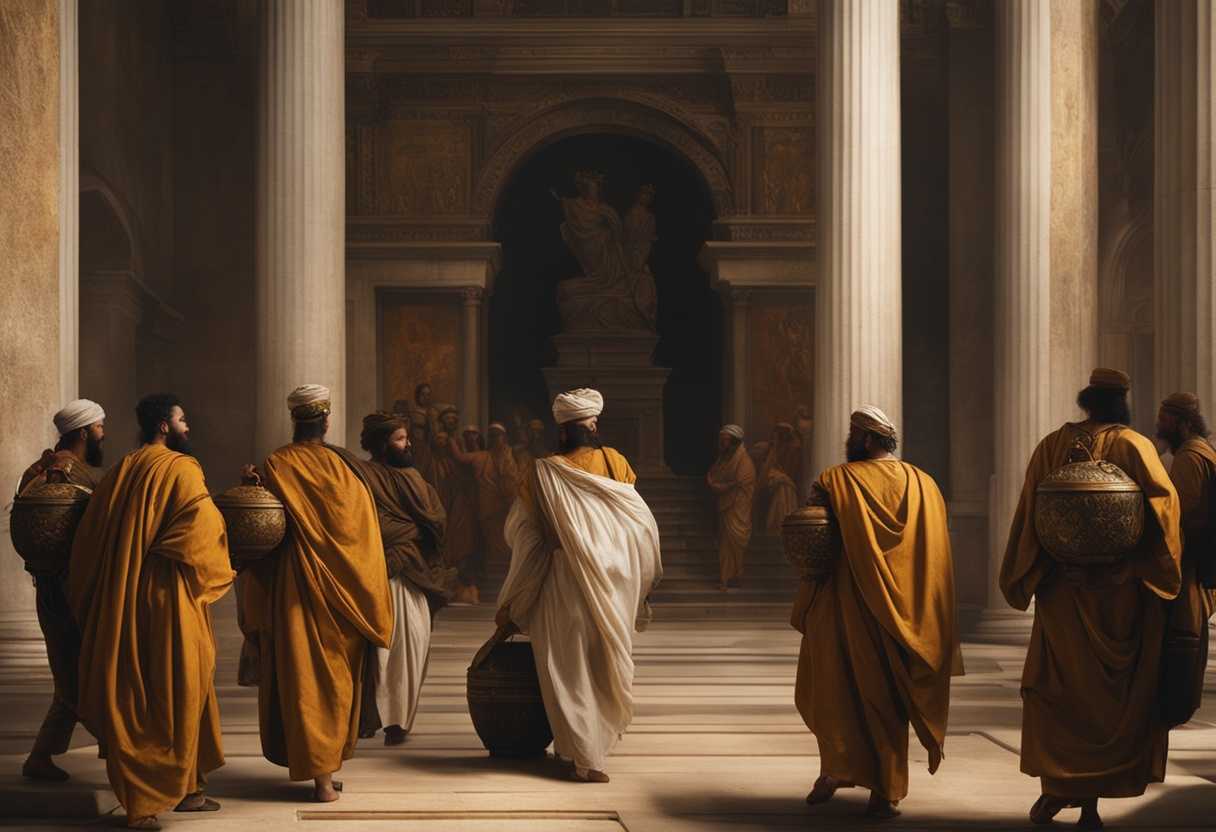
Kohath, in the Bible, refers to a son of Levi and the ancestor of the Kohathites, a group responsible for carrying the sacred objects of the tabernacle. The name Kohath means “assembly” or “congregation,” reflecting his lineage’s significant role in Israel’s worship and priestly duties.
Scripture
27 And of Kohath was the clan of the Amramites and the clan of the Izharites and the clan of the Hebronites and the clan of the Uzzielites.
28 According to the number of all the males, from a month old and upward, there were 8,600.
29 The clans of the sons of Kohath were to camp on the south side of the tabernacle,
30 with Elizaphan the son of Uzziel as chief of the fathers’ house of the clans of the Kohathites.
31 Their guard duty involved the ark, the table, the lampstand, the altars, the vessels of the sanctuary with which they minister, and the screen; all the service connected with these.
32 and Eleazar the son of Aaron the priest shall be chief over the chiefs of the Levites, and have oversight of those who keep guard of the sanctuary.
Meaning of Kohath in the Bible
Kohath, as a pivotal figure in the Levitical lineage, encapsulates significant theological and relational themes within the broader framework of Israel’s worship practices. His descendants, the Kohathites, were entrusted with the sacred objects of the tabernacle, including the Ark of the Covenant, the table of showbread, and the lampstand (Numbers 3:31). This responsibility underscored the notion of holiness and the importance of reverence in approaching God. By carrying these sacred items, the Kohathites symbolized the congregation’s communal worship and the intricate relationship between the divine and the Israelites. As reflected in Numbers 4:5-15, the process of moving the tabernacle and its contents demonstrates the seriousness of worship and the divine instructions essential for maintaining the sanctity of their community.
Furthermore, the meaning of Kohath serves as a reminder of unity and the collective nature of faith. The term “assembly” or “congregation” points to the necessity of coming together as a people of God, which is echoed in passages like Hebrews 10:24-25 urging believers not to forsake gathering together. This highlights the ongoing relational dynamic that transcends time—where every member of the faith community plays a vital role in worship, service, and the preservation of sacred traditions. In an era when individualism often prevails, Kohath’s legacy encourages a return to communal values, reminding believers of their interconnected responsibilities in the body of Christ, akin to the ancient Israelites’ commitment to their covenant with God.
The significance of Kohath is further illuminated when considering the implications of his family’s role in the spiritual life of Israel. The Kohathites were charged with the most sacred duties concerning the tabernacle, indicating that proximity to God requires a deep understanding of holiness and obedience to divine orders. This could be seen as a foreshadowing of pastoral roles in later religious frameworks, where a select group is still entrusted with guiding the faithful in their worship and understanding of God’s law. The gravity of their responsibility serves as a reminder that service to God often comes with intricate guidelines that reflect the larger narrative of God’s holiness and the communal needs of His people.
Moreover, the Kohathites’ task of carrying the ark and other sacred vessels symbolizes the idea of mediators between the divine and humanity, encapsulating the priestly function that becomes more pronounced in later biblical literature. In the New Testament, this mediatorial theme continues to resonate through Jesus Christ, who is often identified as the ultimate high priest. Just as the Kohathites were charged with protecting and honoring the sacred, the New Testament community also inherits the call to uphold the teachings and actions of Christ in their own lives. Thus, Kohath’s legacy serves as an enduring principle that emphasizes the intertwining of holiness, responsibility, and community worship—principles that remain vital as believers strive to live out their faith in both personal and communal dimensions.
The Legacy of Service and Responsibility
Kohath, as a member of the Levite tribe, symbolizes the importance of service and responsibility within the community of Israel. His descendants were entrusted with the care of the most sacred objects of the Tabernacle, highlighting the significance of dedication and the weight of responsibility that comes with serving God. This legacy emphasizes that true service requires commitment and reverence, reflecting the broader theme of stewardship in the biblical narrative.
The Role of Preservation and Protection
Kohath’s lineage was tasked with preserving and protecting the holy items of worship, which signifies a deeper meaning of safeguarding spiritual heritage. This role underscores the importance of maintaining the integrity of faith practices and traditions across generations. The Kohathites’ responsibility serves as a reminder of the need to honor and protect the sacred aspects of one’s faith, ensuring that they are passed down with respect and care.
The Call to Holiness and Separation
The Kohathites were set apart for a specific purpose, illustrating the biblical theme of holiness and separation for divine service. Their unique calling reflects the idea that certain individuals or groups are chosen for particular roles in God’s plan, emphasizing the need for purity and dedication in fulfilling these roles. This notion of being set apart resonates throughout the Bible, encouraging believers to live lives that reflect their commitment to God and His purposes.
How to Embrace Your Heritage for Spiritual Growth
Embracing your heritage can be a profound way to deepen your spiritual journey as a Christian. Each of us carries a unique tapestry of cultural and familial stories that shape our understanding of faith and community. Take time to explore the traditions, values, and teachings passed down through generations in your family or culture. Reflect on how these elements align with biblical principles and how they can enrich your relationship with God. For instance, if your heritage emphasizes hospitality, consider how you can embody that in your daily life, welcoming others as Christ welcomed us. Engaging with your roots not only fosters a sense of belonging but also opens up avenues for understanding God’s diverse creation. Remember, your heritage is not just a backdrop; it’s a vibrant part of your spiritual identity that can lead you to a deeper appreciation of God’s love and purpose for you.
Bible References to the Meaning of Kohath:
Numbers 4:1-20: 1 The Lord spoke to Moses and Aaron, saying,
2 “Take a census of the sons of Kohath from among the sons of Levi, by their clans and their fathers’ houses,
3 from thirty years old up to fifty years old, all who can come on duty, to do the work in the tent of meeting.
4 This is the service of the sons of Kohath in the tent of meeting: the most holy things.
5 When the camp is to set out, Aaron and his sons shall go in and take down the veil of the screen and cover the ark of the testimony with it.
6 Then they shall put on it a covering of goatskin and spread on top of that a cloth all of blue, and shall put in its poles.
7 And over the table of the bread of the Presence they shall spread a cloth of blue and put on it the plates, the dishes for incense, the bowls, and the flagons for the drink offering; the regular showbread also shall be on it.
8 And they shall spread a cloth of blue and cover the lampstand of the light, with its lamps, its tongs, its trays, and all the vessels for oil with which it is supplied.
9 Then they shall take a blue cloth and cover the lampstand for the light, with its lamps, its tongs, its trays, and all the vessels for oil with which it is supplied.
10 And they shall put it with all the utensils of the altar, and they shall spread a cloth of blue over it, and shall put on it the poles.
11 Over the golden altar they shall spread a cloth of blue and cover it with a covering of goatskin and shall put in its poles.
12 And they shall take all the vessels of ministry used for the service in the tabernacle, and they shall put them in a cloth of blue and cover them with a covering of goatskin and put them on the carrying frame.
13 and they shall take away the ashes from the altar and spread a purple cloth over it.
14 And they shall put on it all the utensils of the altar, which are used for the service there, the fire pans, the forks, the shovels, and the basins, all the utensils of the altar; and they shall spread on it a covering of goatskin, and shall put in its poles.
15 And when Aaron and his sons have finished covering the sanctuary and all the furnishings of the sanctuary, as the camp sets out, after that the sons of Kohath shall come to carry these, but they must not touch the holy things, lest they die. These are the things of the tent of meeting that the sons of Kohath are to carry.
16 “And the appointed men shall come and take down the tabernacle of meeting, and they shall cover the ark of the testimony with a veil and put a covering of badger skins on it, and shall insert its poles.”
17 Then the Lord spoke to Moses and to Aaron, saying,
18 But do this to them, that they may live and not die when they come near the most holy things: Aaron and his sons shall go in and appoint them each to his task and to his burden,
19 but deal thus with them, that they may live and not die when they come near to the most holy things: Aaron and his sons shall go in and appoint them each to his task and to his burden,
20 but they shall not go in to look on the holy things even for a moment, lest they die.”
Numbers 7:6-9: 6 So Moses took the wagons and the oxen and gave them to the Levites.
7 Two wagons and four oxen he gave to the sons of Gershon, according to their service,
8 And he gave the two carts and the four oxen to the sons of Gershon, according to their service.
9 But to the sons of Kohath he gave none, because they were charged with the service of the holy things that had to be carried on the shoulder.
Numbers 10:17-21: 17 Then the tabernacle was taken down, and the sons of Gershon and the sons of Merari, who were carrying the tabernacle, set out.
18 And the standard of the camp of Reuben set out by their companies, and over their company was Elizur the son of Shedeur.
19 And the people of Israel set out by stages from the wilderness of Sinai. And the cloud settled down in the wilderness of Paran.
20 And over the company of the tribe of the people of Gad was Eliasaph the son of Deuel.
21 So the Kohathites set out, carrying the holy things, and the tabernacle was set up before their arrival.
1 Chronicles 6:1-2: 1 The sons of Levi: Gershon, Kohath, and Merari.
2 Amram fathered Aaron, and Aaron fathered Nadab, Abihu, Eleazar, and Ithamar.
1 Chronicles 6:16-19: 16 The sons of Levi: Gershom, Kohath, and Merari.
17 These are the names of the sons of Gershom: Libni and Shimei.
18 the sons of Kohath: Amram, Izhar, Hebron, and Uzziel.
19 The sons of Merari: Mahli and Mushi. These are the clans of the Levites according to their fathers.
1 Chronicles 15:5-8: 5 From the sons of Kohath, Uriel the chief, with 120 of his brothers;
6 And David and all Israel went up to Baalah, that is, to Kiriath-jearim that belongs to Judah, to bring up from there the ark of God, which is called by the name of the Lord of hosts who sits enthroned on the cherubim.
7 And the sons of Jeiel, the father of Gibeon, were Eliezer the chief, and 1Chronicles 15:7with his brothers two hundred;
8 And David and all Israel were rejoicing before God with all their might, with song and lyres and harps and tambourines and cymbals and trumpets.
1 Chronicles 23:12-13: 12 The sons of Kohath: Amram, Izhar, Hebron, and Uzziel, four.
13 The sons of Amram: Aaron and Moses. Aaron was set apart to dedicate the most holy things, that he and his sons forever should make offerings before the Lord and minister to him and pronounce blessings in his name forever.
1 Chronicles 23:24-26: 24 These were the sons of Levi by their fathers’ houses, the heads of fathers’ houses as they were listed according to the number of the names of the individuals from twenty years old and upward who were to do the work for the service of the house of the Lord.
25 For David said, “The Lord, the God of Israel, has given rest to his people, and he dwells in Jerusalem forever.
26 So the Levites no longer need to carry the tabernacle or any of the things for its service.”
1 Chronicles 24:20-25: 20 And the rest of the sons of Levi: of the sons of Amram, Shubael; of the sons of Shubael, Jehdeiah.
21 The sons of Merari: Mahli and Mushi. The sons of Mahli: Eleazar and Kish.
22 As for the Izharites: Shelomoth and his sons.
23 As for the rest of the sons of Kohath, their duties involved the care of the sanctuary: they were in charge of the bread of the Presence.
24 These had the sons of Levi: the sons of Gershom, Kohath, and Merari.
25 The brother of Michah, Isshiah; of the sons of Isshiah, Zechariah.
Exodus 6:16-18: 16 These are the names of the sons of Levi according to their generations: Gershon, Kohath, and Merari, the years of the life of Levi being 137 years.
17 The sons of Gershon: Libni and Shimei, by their clans.
18 The sons of Kohath: Amram, Izhar, Hebron, and Uzziel; and the years of the life of Kohath were 133 years.
Exodus 6:24-25: 24 The sons of Korah: Assir, Elkanah, and Abiasaph.
25 Eleazar, Aaron’s son, took as his wife one of the daughters of Putiel, and she bore him Phinehas. These are the heads of the fathers’ houses of the Levites by their clans.
Joshua 21:4-5: 4 And the lot came out for the clans of the Kohathites. So those Levites who were descendants of Aaron the priest received by lot from the tribes of Judah, Simeon, and Benjamin, thirteen cities.
5 And the rest of the Kohathites received by lot from the clans of the tribe of Ephraim, from the tribe of Dan and the half-tribe of Manasseh, ten cities.
Joshua 21:20-26: 20 and out of the tribe of the people of Ephraim, Kibzaim with its pasturelands, the city of refuge for the manslayer, Mahanaim with its pasturelands,
21 Then they gave Hebron to the descendants of Aaron the priest as a city of refuge for the manslayer, Libnah with its pasturelands,
22 And Kibzaim with its pasturelands, Beth-horon with its pasturelands, four cities.
23 Out of the tribe of Dan, Eltekeh with its pasturelands, Gibbethon with its pasturelands,
24 And the leaders of the Levites were Hashabiah the son of Ammihud, Sherebiah the son of Bunni,
25 And from the half-tribe of Manasseh, Taanach with its pasturelands, and Gath-rimmon with its pasturelands—two cities.
26 All that the Levites left in return for their cities was their common land, as the possession of their cities.

Reverend Ogunlade is a seasoned Church Minister with over three decades of experience in guiding and nurturing congregations. With profound wisdom and a serene approach, Reverend Ogunlade has carried out various pastoral duties, including delivering uplifting sermons, conducting religious ceremonies, and offering sage counsel to individuals seeking spiritual guidance. Their commitment to fostering harmony and righteousness within their community is exemplified through their compassionate nature, making them a beloved and trusted figure among the congregation.