
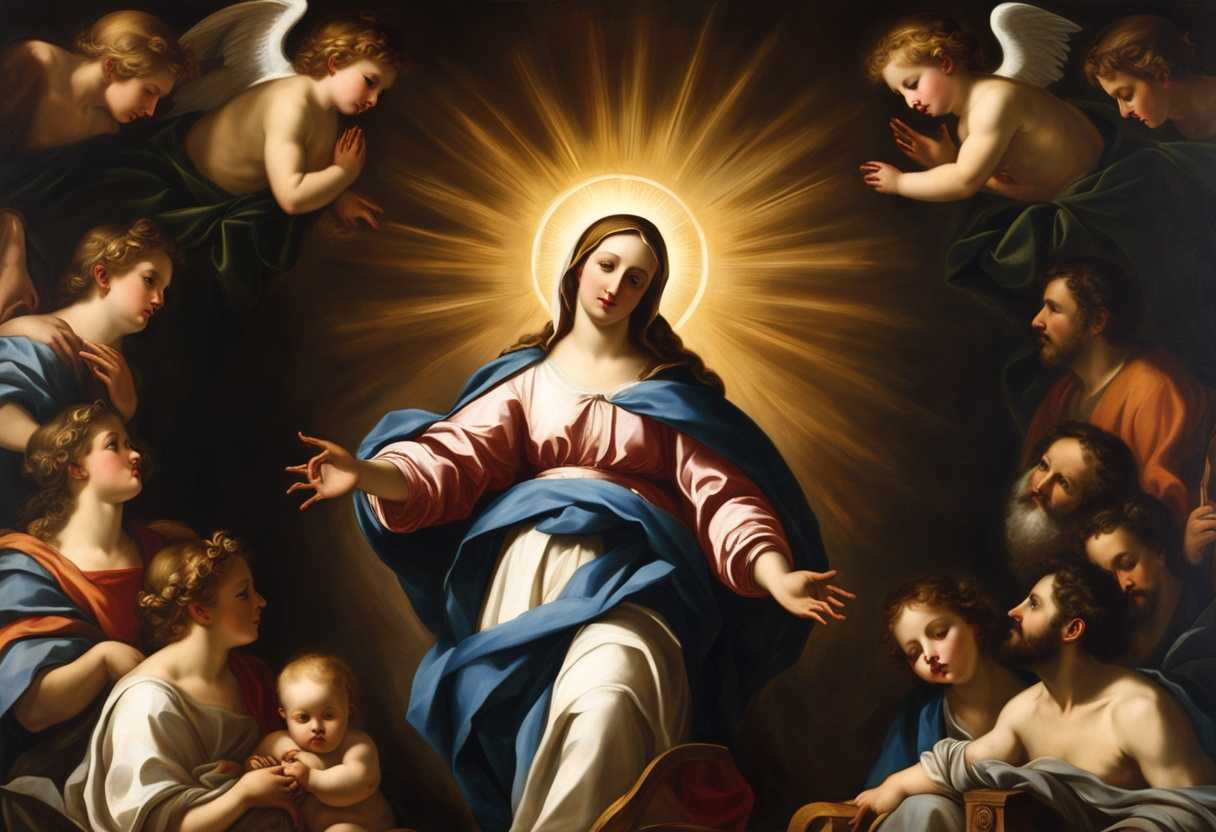
In the Bible, the name Maria is often associated with Mary, the mother of Jesus, whose name means “beloved” or “rebellious.” Mary is revered for her faith and obedience to God, serving as a central figure in the New Testament.
Scripture
18 Now the birth of Jesus Christ took place in this way. When his mother Mary had been betrothed to Joseph, before they came together she was found to be with child from the Holy Spirit.
19 And her husband Joseph, being a just man and unwilling to put her to shame, resolved to divorce her quietly.
20 But as he considered these things, behold, an angel of the Lord appeared to him in a dream, saying, “Joseph, son of David, do not fear to take Mary as your wife, for that which is conceived in her is from the Holy Spirit.
21 She will bear a son, and you shall call his name Jesus, for he will save his people from their sins.
22 All this took place to fulfill what the Lord had spoken by the prophet:
23 “Behold, the virgin shall conceive and bear a son, and they shall call his name Immanuel” (which means, God with us).
24 When Joseph woke from sleep, he did as the angel of the Lord commanded him: he took his wife,
25 but knew her not until she had given birth to a son. And he called his name Jesus.
Meaning of Maria in the Bible
The name Mary, which can also be rendered as Maria in various translations, occupies a significant theological and cultural role in the Bible, particularly in the New Testament. As the mother of Jesus, she embodies the virtues of faith, humility, and obedience to God’s will. Her acceptance of the angel Gabriel’s message in Luke 1:38, where she responds, “I am the Lord’s servant,” highlights her remarkable submission to God’s plan. This moment marks not only the Announcement of Jesus’s birth but also serves as an archetype of how believers are called to respond to divine calling, emphasizing the broader theme of surrender to God and His purposes.
Furthermore, Mary is often interpreted as a symbol of grace and maternal care, acting as a conduit to Jesus and the faith community. Throughout the gospels, her presence at critical moments, such as the wedding at Cana (John 2:1-11) and standing at the foot of the cross (John 19:25-27), underscores her role in the life and ministry of Jesus. The Magnificat (Luke 1:46-55), her song of praise upon visiting her cousin Elizabeth, reveals a deep understanding of God’s mercy and justice, positioning her as a model of justice and care for the marginalized. In essence, the figure of Mary transcends her personal narrative; she represents the ideal of faithfully responding to God’s call and participating in the redemptive story of humanity. Her name, reflecting attributes of being beloved or even rebellious, invites further contemplation on the complexities of faith as it intersects with obedience, love, and divine purpose.
In addition to the New Testament accounts, Mary is often viewed through the lens of the Old Testament, where parallels can be drawn to figures such as Miriam, the sister of Moses, and Hannah, the mother of Samuel. These figures also embody themes of dedication and divine favor. Just as Miriam facilitated the liberation of her people through the Exodus, Mary’s role in the New Testament signifies a pivotal moment in God’s redemptive plan, leading to the liberation of humanity through Christ. Hannah’s heartfelt prayer for a child, followed by her dedication of Samuel to the Lord, echoes in Mary’s own submission to God’s will, illustrating a lineage of faithful women who trust in God’s promise, thus deepening the understanding of women’s vital roles in biblical narratives.
Moreover, the theological implications of Mary extend to discussions about the Incarnation. As the earthly mother of Jesus, her figure invites contemplation about the nature of Jesus—fully divine yet fully human. This unique relationship emphasizes the importance of Mary in the doctrine of the Virgin Birth, affirming Jesus’ divine identity while also honoring His human experience. Mary’s acceptance of this profound responsibility illustrates the interplay between human agency and divine action, showcasing how individuals can be integral to God’s grand narrative. In various Christian traditions, the significance of Mary has evolved, serving as an emblem of intercession and devotion, reflecting the ongoing reverberations of her role within the larger context of faith, grace, and the fulfillment of God’s promises in history.
The Role of Maria as a Symbol of Faith
Maria, often referred to as Mary, embodies unwavering faith and trust in God. Her acceptance of the divine message signifies a profound commitment to God’s will, serving as a model for believers. This aspect of her character encourages individuals to embrace their faith, even in the face of uncertainty or societal challenges.
Maria as a Maternal Figure
In the biblical narrative, Maria represents the archetype of motherhood. Her nurturing qualities and protective instincts highlight the importance of maternal love and care. This maternal aspect extends beyond her biological role, symbolizing the broader concept of compassion and support within the community of believers.
The Significance of Maria in Redemption
Maria’s role in the story of salvation is pivotal. As the mother of Jesus, she is integral to the narrative of redemption, illustrating the connection between humanity and the divine. Her participation in the divine plan emphasizes the theme of grace and the transformative power of accepting one’s purpose in God’s overarching design.
How to Embrace Mary’s Example in Your Faith Journey
Embracing Mary’s example in your faith journey is a beautiful way to deepen your relationship with God and cultivate a spirit of humility and obedience. Mary, the mother of Jesus, exemplified unwavering faith and trust in God’s plan, even when faced with uncertainty and fear. As you navigate your own challenges, take a moment to reflect on her response to the angel Gabriel: “Let it be to me according to your word” (Luke 1:38). This simple yet profound acceptance invites us to surrender our own desires and plans to God’s will. You can incorporate this into your daily life by seeking moments of quiet prayer, asking for guidance, and being open to the unexpected ways God may be calling you. Just as Mary cherished and pondered the mysteries of her faith, allow yourself to embrace the beauty of contemplation, nurturing a heart that is receptive to God’s grace. In doing so, you’ll find that your faith journey becomes richer and more aligned with the divine purpose laid out for you.
Bible References to the Name Maria:
Luke 1:26-38: 26 In the sixth month the angel Gabriel was sent from God to a city of Galilee named Nazareth,
27 to a virgin betrothed to a man whose name was Joseph, of the house of David. And the virgin’s name was Mary.
28 And he came to her and said, “Greetings, O favored one, the Lord is with you!”
29 But she was greatly troubled at the saying, and tried to discern what sort of greeting this might be.
30 And the angel said to her, “Do not be afraid, Mary, for you have found favor with God.
31 And behold, you will conceive in your womb and bear a son, and you shall call his name Jesus.
32 He will be great and will be called the Son of the Most High. And the Lord God will give to him the throne of his father David,
33 and he will reign over the house of Jacob forever, and of his kingdom there will be no end.”
34 And Mary said to the angel, “How will this be, since I am a virgin?”
35 And the angel answered her, “The Holy Spirit will come upon you, and the power of the Most High will overshadow you; therefore the child to be born will be called holy—the Son of God.
36 And behold, your relative Elizabeth in her old age has also conceived a son, and this is the sixth month with her who was called barren.
37 For nothing will be impossible with God.
38 And Mary said, “Behold, I am the servant of the Lord; let it be to me according to your word.” And the angel departed from her.
Luke 1:39-56: 39 In those days Mary arose and went with haste into the hill country, to a town in Judah,
40 and entered the house of Zechariah and greeted Elizabeth.
41 And when Elizabeth heard the greeting of Mary, the baby leaped in her womb. And Elizabeth was filled with the Holy Spirit,
42 and she exclaimed with a loud cry, “Blessed are you among women, and blessed is the fruit of your womb!
43 And why is this granted to me that the mother of my Lord should come to me?
44 For behold, when the sound of your greeting came to my ears, the baby in my womb leaped for joy.
45 And blessed is she who believed that there would be a fulfillment of what was spoken to her from the Lord.”
46 And Mary said, “My soul magnifies the Lord,
47 and my spirit rejoices in God my Savior,
48 for he has looked on the humble estate of his servant.
49 for he who is mighty has done great things for me,
and holy is his name.
50 And his mercy is for those who fear him from generation to generation.
51 He has shown strength with his arm; he has scattered the proud in the thoughts of their hearts.
52 he has brought down the mighty from their thrones
and exalted those of humble estate;
53 he has filled the hungry with good things, and the rich he has sent away empty.
54 He has helped his servant Israel, in remembrance of his mercy,
55 as he spoke to our fathers, to Abraham and to his offspring forever.
56 And Mary remained with her about three months and returned to her home.
Luke 2:1-20: 2 In those days a decree went out from Caesar Augustus that all the world should be registered.
2 This was the first registration when Quirinius was governor of Syria.
3 And all went to be registered, each to his own town.
4 And Joseph also went up from Galilee, from the town of Nazareth, to Judea, to the city of David, which is called Bethlehem, because he was of the house and lineage of David,
5 to be registered with Mary, his betrothed, who was with child.
6 And while they were there, the time came for her to give birth.
7 And she gave birth to her firstborn son and wrapped him in swaddling cloths and laid him in a manger, because there was no place for them in the inn.
8 And in the same region there were shepherds out in the field, keeping watch over their flock by night.
9 And an angel of the Lord appeared to them, and the glory of the Lord shone around them, and they were filled with great fear.
10 And the angel said to them, “Fear not, for behold, I bring you good news of great joy that will be for all the people.
11 For unto you is born this day in the city of David a Savior, who is Christ the Lord.
12 And this will be a sign for you: you will find a baby wrapped in swaddling cloths and lying in a manger.
13 And suddenly there was with the angel a multitude of the heavenly host praising God and saying,
14 “Glory to God in the highest, and on earth peace among those with whom he is pleased!”
15 When the angels went away from them into heaven, the shepherds said to one another, “Let us go over to Bethlehem and see this thing that has happened, which the Lord has made known to us.”
16 And they went with haste and found Mary and Joseph, and the baby lying in a manger.
17 And when they saw it, they made known the saying that had been told them concerning this child.
18 And all who heard it wondered at what the shepherds told them.
19 But Mary treasured up all these things, pondering them in her heart.
20 And the shepherds returned, glorifying and praising God for all they had heard and seen, as it had been told them.
Luke 2:21-40: 21 And at the end of eight days, when he was circumcised, he was called Jesus, the name given by the angel before he was conceived in the womb.
22 And when the time came for their purification according to the Law of Moses, they brought him up to Jerusalem to present him to the Lord.
23 (as it is written in the Law of the Lord, “Every male who first opens the womb shall be called holy to the Lord”)
24 and to offer a sacrifice according to what is said in the Law of the Lord, “a pair of turtledoves, or two young pigeons.”
25 Now there was a man in Jerusalem, whose name was Simeon, and this man was righteous and devout, waiting for the consolation of Israel, and the Holy Spirit was upon him.
26 And it had been revealed to him by the Holy Spirit that he would not see death before he had seen the Lord’s Christ.
27 And he came in the Spirit into the temple, and when the parents brought in the child Jesus, to do for him according to the custom of the Law,
28 he took him up in his arms and blessed God and said,
29 “Lord, now you are letting your servant depart in peace, according to your word;”
30 for my eyes have seen your salvation
31 that you have prepared in the presence of all peoples,
32 a light for revelation to the Gentiles, and for glory to your people Israel.
33 And his father and his mother marveled at what was said about him.
34 And Simeon blessed them and said to Mary his mother, “Behold, this child is appointed for the fall and rising of many in Israel, and for a sign that is opposed.
35 (and a sword will pierce through your own soul also), so that thoughts from many hearts may be revealed.
36 And there was a prophetess, Anna, the daughter of Phanuel, of the tribe of Asher. She was advanced in years, having lived with her husband seven years from when she was a virgin,
37 and then as a widow until she was eighty-four. She did not depart from the temple, worshiping with fasting and prayer night and day.
38 And coming up at that very hour she began to give thanks to God and to speak of him to all who were waiting for the redemption of Jerusalem.
39 And when they had performed everything according to the Law of the Lord, they returned into Galilee, to their own town of Nazareth.
40 And the child grew and became strong, filled with wisdom. And the favor of God was upon him.
John 2:1-12: 1 On the third day there was a wedding at Cana in Galilee, and the mother of Jesus was there.
2 Jesus also was invited to the wedding with his disciples.
3 When the wine ran out, the mother of Jesus said to him, “They have no wine.”
4 And Jesus said to her, “Woman, what does this have to do with me? My hour has not yet come.”
5 His mother said to the servants, “Do whatever he tells you.”
6 Now there were six stone water jars there for the Jewish rites of purification, each holding twenty or thirty gallons.
7 Jesus said to the servants, “Fill the jars with water.” And they filled them up to the brim.
8 And he said to them, “Now draw some out and take it to the master of the feast.” So they took it.
9 When the master of the feast tasted the water now become wine, and did not know where it came from (though the servants who had drawn the water knew), the master of the feast called the bridegroom.
10 and said to him, “Everyone serves the good wine first, and when people have drunk freely, then the poor wine. But you have kept the good wine until now.”
11 This, the first of his signs, Jesus did at Cana in Galilee, and manifested his glory. And his disciples believed in him.
12 After this he went down to Capernaum, with his mother and his brothers and his disciples, and they stayed there for a few days.
John 19:25-27: 25 but standing by the cross of Jesus were his mother and his mother’s sister, Mary the wife of Clopas, and Mary Magdalene.
26 When Jesus saw his mother and the disciple whom he loved standing nearby, he said to his mother, “Woman, behold, your son!”
27 Then he said to the disciple, “Behold, your mother!” And from that hour the disciple took her to his own home.
Acts 1:12-14: 12 Then they returned to Jerusalem from the mount called Olivet, which is near Jerusalem, a Sabbath day’s journey away.
13 And when they had entered, they went up to the upper room, where they were staying, Peter and John and James and Andrew, Philip and Thomas, Bartholomew and Matthew, James the son of Alphaeus and Simon the Zealot and Judas the son of James.
14 All these with one accord were devoting themselves to prayer, together with the women and Mary the mother of Jesus, and his brothers.

Reverend Ogunlade is a seasoned Church Minister with over three decades of experience in guiding and nurturing congregations. With profound wisdom and a serene approach, Reverend Ogunlade has carried out various pastoral duties, including delivering uplifting sermons, conducting religious ceremonies, and offering sage counsel to individuals seeking spiritual guidance. Their commitment to fostering harmony and righteousness within their community is exemplified through their compassionate nature, making them a beloved and trusted figure among the congregation.