
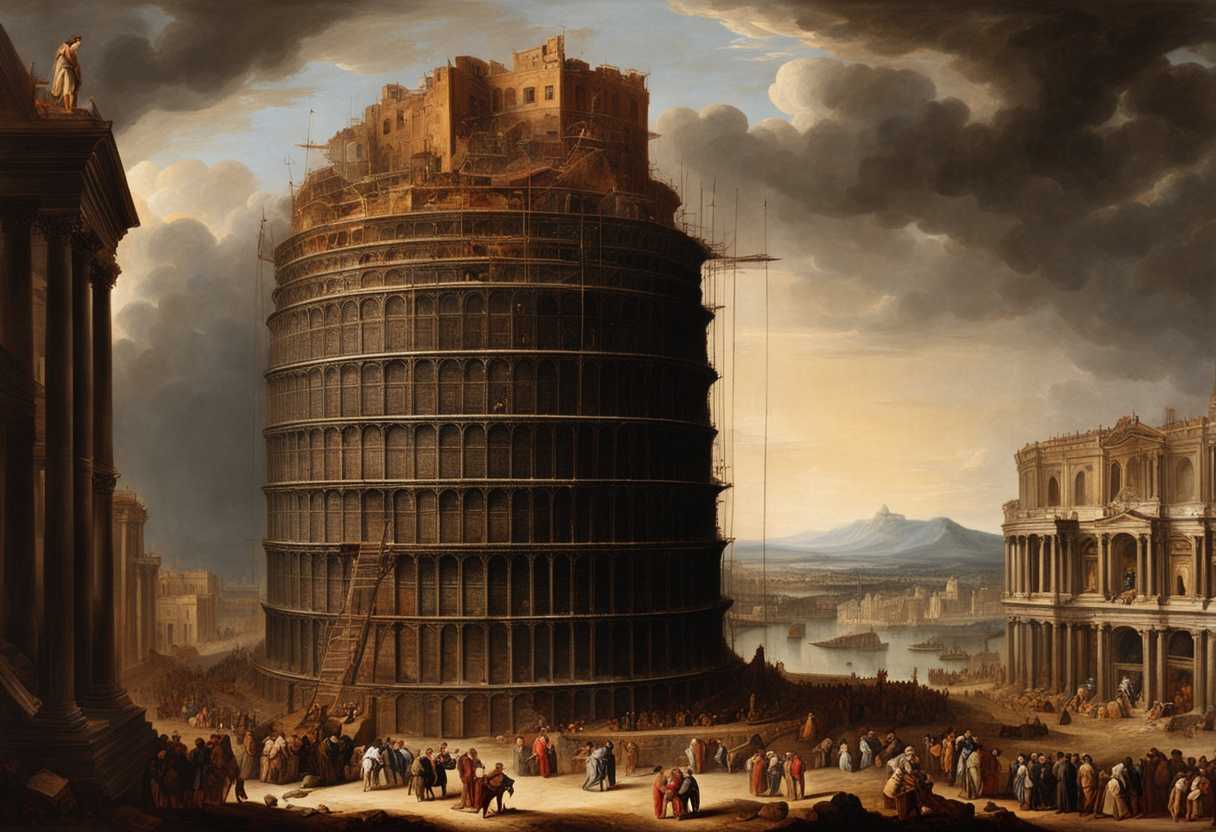
In the Bible, bitumen (or asphalt) is often referenced as a sticky substance used for waterproofing, notably in Genesis 11:3, where it is used in the construction of the Tower of Babel. It symbolizes earthly craftsmanship and can represent human ambition and effort in contrast to divine plans.
Scripture
1 Now the whole earth had one language and the same words.
2 And as people migrated from the east, they found a plain in the land of Shinar and settled there.
3 And they said to one another, “Come, let us make bricks, and burn them thoroughly.” And they had brick for stone, and bitumen for mortar.
4 Then they said, “Come, let us build ourselves a city and a tower with its top in the heavens, and let us make a name for ourselves, lest we be dispersed over the face of the whole earth.”
5 And the Lord came down to see the city and the tower, which the children of man had built.
6 And the Lord said, “Behold, they are one people, and they have all one language, and this is only the beginning of what they will do. And nothing that they propose to do will now be impossible for them.
7 Come, let us go down and there confuse their language, so that they may not understand one another’s speech.
8 So the Lord dispersed them from there over the face of all the earth, and they left off building the city.
9 Therefore its name was called Babel, because there the Lord confused the language of all the earth. And from there the Lord dispersed them over the face of all the earth.
Biblical Significance of Bitumen
In the Bible, bitumen, also often referred to as tar or pitch, carries both practical and symbolic meanings. Its use in Genesis 11:3 during the construction of the Tower of Babel highlights humanity’s ingenuity and determination to build a great city and a tower that reaches the heavens. This act reflects a collective human ambition to create a name for themselves and to prevent their scattering upon the earth. However, the subsequent divine intervention that confounds their language serves as a poignant reminder of the limits of human ability and the ultimate sovereignty of God over human endeavors (Genesis 11:4-9). The materiality of bitumen underscores the tangible human efforts that can lead to overwhelming pride and self-sufficiency.
Additionally, bitumen’s waterproofing qualities can symbolize the protection that God ultimately provides against spiritual floodwaters or chaos. Just as the tar sealed the bricks of Babel, ensuring the integrity of the structure against potential destruction, so too does faith in God serve as a protective seal against the storms of life. This duality emphasizes that while human ambition is a natural inclination, it should always be aligned with divine purposes. The biblical narrative thus encourages believers to reflect on the intentions behind their earthly constructions and aspirations, recognizing that true fulfillment lies in seeking harmony with God’s supernatural plans, as seen in Proverbs 16:3, which advises that we “commit our work to the Lord, and our plans will be established.”
Bitumen also appears in the context of ancient practices surrounding burial and preservation, illustrating its significance as a substance used in the embalming process, most notably in the story of Moses’ death. The Bible notes that he was buried in an undisclosed location, which suggests that the preservation of the body was esteemed, hinting at a reverence for the physical as well as the spiritual. This highlights the value of caring for the physical form, reminding readers of the holistic nature of life, where both body and spirit are important. Furthermore, the association of bitumen with preservation can serve as an allegory for maintaining faith and integrity throughout one’s life journey, echoing a deeper understanding of God’s enduring love and care.
In a metaphorical sense, bitumen can also represent the foundation upon which relationships and communities are built. Just as it bonds materials together effectively, so too does love and faith serve as the binding agent within families and congregations. The idea extends to collective actions that reflect the broader narrative of community reliance on God. The use of bitumen in significant constructs like boats—meant for safety through turbulent waters—mirrors the believers’ understanding of God’s will as the guiding force navigating the challenges of life. In this context, it reinforces the notion that unity and support within a community can be fortified through shared trust in divine guidance, fostering resilience against adversities. Thus, bitumen encapsulates not merely a physical element but serves as a rich symbol within the narrative of human existence and divine interaction.
Symbol of Human Endeavor and Ingenuity
Bitumen, often associated with construction and building materials, can symbolize human effort and ingenuity in the pursuit of progress. In biblical narratives, the use of bitumen in construction reflects humanity’s desire to create and establish lasting structures, which can be seen as a metaphor for human ambition and the drive to leave a mark on the world. This theme resonates with the broader biblical narrative of humanity’s attempts to reach greater heights, both physically and spiritually.
Representation of Unity and Collaboration
The use of bitumen in construction projects, particularly in the context of building structures like cities or towers, can also represent the power of unity and collaboration among people. In biblical contexts, collective efforts often lead to significant achievements, highlighting the importance of working together towards a common goal. This theme underscores the value of community and cooperation in fulfilling shared aspirations, reflecting a deeper spiritual truth about the strength found in unity.
Contrast with Divine Intent
Bitumen can also serve as a contrast to divine intent and purpose. While it represents human efforts to build and create, it can also symbolize the limitations of human ambition when it diverges from divine will. The use of bitumen in constructing grand structures may reflect humanity’s desire to achieve greatness, yet it can also serve as a reminder of the need for humility and alignment with God’s plans. This duality invites reflection on the balance between human initiative and divine guidance in the pursuit of meaningful endeavors.
How to Strengthen Your Faith for a Better Christian Life
Strengthening your faith is a deeply personal journey, and it often begins with cultivating a consistent prayer life. Set aside time each day to talk to God, sharing your thoughts, worries, and gratitude. This intimate dialogue not only deepens your relationship with Him but also opens your heart to His guidance. Additionally, immerse yourself in Scripture; the Bible is a treasure trove of wisdom and encouragement that can illuminate your path and provide comfort during challenging times. Surround yourself with a supportive community of fellow believers, as fellowship can inspire and uplift you in your walk with Christ. Finally, don’t shy away from serving others—acts of kindness and compassion can profoundly reinforce your faith, reminding you of Christ’s love and purpose in your life. Remember, faith is a journey, not a destination, so be patient with yourself as you grow and learn.
Bible References to Bitumen’s Significance:
Exodus 2:1-10: 1 Now a man from the house of Levi went and took as his wife a Levite woman.
2 The woman conceived and bore a son, and when she saw that he was a fine child, she hid him three months.
3 When she could hide him no longer, she took for him a basket made of bulrushes and daubed it with bitumen and pitch. She put the child in it and placed it among the reeds by the river bank.
4 And his sister stood at a distance to know what would be done to him.
5 Now the daughter of Pharaoh came down to bathe at the river, while her young women walked beside the river. She saw the basket among the reeds and sent her servant woman, and she took it.
6 When she opened it, she saw the child, and behold, the baby was crying. She took pity on him and said, “This is one of the Hebrews’ children.”
7 Then his sister said to Pharaoh’s daughter, “Shall I go and call you a nurse from the Hebrew women to nurse the child for you?”
8 Then Pharaoh’s daughter said to her, “Take this child away and nurse him for me, and I will give you your wages.” So the woman took the child and nursed him.
9 She said to Pharaoh’s daughter, “Shall I go and call you a nurse from the Hebrew women to nurse the child for you?”
10 When the child grew older, she brought him to Pharaoh’s daughter, and he became her son. She named him Moses, “Because,” she said, “I drew him out of the water.”
Isaiah 34:8-10: 8 For the Lord has a day of vengeance,
a year of recompense for the cause of Zion.
9 And the streams of Edom shall be turned into pitch,
and her soil into sulfur;
her land shall become burning pitch.
10 Night and day it shall not be quenched; its smoke shall go up forever. From generation to generation it shall lie waste; none shall pass through it forever and ever.
Isaiah 57:20-21: 20 But the wicked are like the tossing sea; for it cannot be quiet, and its waters toss up mire and dirt.
21 There is no peace,” says my God, “for the wicked.”
Jeremiah 13:1-11: 1 Thus says the Lord to me, “Go and buy a linen loincloth and put it around your waist, and do not dip it in water.”
2 So I bought a loincloth according to the word of the Lord, and put it around my waist.
3 Then the word of the Lord came to me:
4 “Take the loincloth that you have bought, which is around your waist, and arise, go to the Euphrates and hide it there in a cleft of the rock.”
5 So I went and hid it by the Euphrates, as the Lord commanded me.
6 “Can the Ethiopian change his skin
or the leopard his spots?
Then also you can do good
who are accustomed to do evil.
7 Then I went to the Euphrates, and dug, and I took the loincloth from the place where I had hidden it. And behold, the loincloth was spoiled; it was good for nothing.
8 Then the word of the Lord came to me:
9 “Thus says the Lord: Even so will I spoil the pride of Judah and the great pride of Jerusalem.”
10 This evil people, who refuse to hear my words, who stubbornly follow their own heart and have gone after other gods to serve them and worship them, shall be like this loincloth, which is good for nothing.
11 For as the loincloth clings to the waist of a man, so I made the whole house of Israel and the whole house of Judah cling to me, declares the Lord, that they might be for me a people, a name, a praise, and a glory, but they would not listen.
Ezekiel 28:11-19: 11 Moreover, the word of the Lord came to me:
12 “Son of man, raise a lamentation over the king of Tyre, and say to him, Thus says the Lord God: “You were the signet of perfection, full of wisdom and perfect in beauty.
13 You were in Eden, the garden of God; every precious stone was your covering, sardius, topaz, and diamond, beryl, onyx, and jasper, sapphire, emerald, and carbuncle; and crafted in gold were your settings and your engravings. On the day that you were created they were prepared.
14 You were an anointed guardian cherub.
15 You were blameless in your ways from the day you were created, till unrighteousness was found in you.
16 In the abundance of your trade you were filled with violence in your midst, and you sinned; so I cast you as a profane thing from the mountain of God, and I destroyed you, O guardian cherub, from the midst of the stones of fire.
17 Your heart was proud because of your beauty;
you corrupted your wisdom for the sake of your splendor.
18 By the multitude of your iniquities, in the unrighteousness of your trade you profaned your sanctuaries; so I brought fire out from your midst; it consumed you, and I turned you to ashes on the earth in the sight of all who saw you.
19 All who know you among the peoples are appalled at you; you have come to a dreadful end and shall be no more forever.”
Ezekiel 32:1-8: 1 In the twelfth year, in the twelfth month, on the first day of the month, the word of the Lord came to me:
2 “Son of man, raise a lamentation over Pharaoh king of Egypt and say to him: “You consider yourself a lion of the nations, but you are like a dragon in the seas; you burst forth in your rivers, trouble the waters with your feet, and foul their rivers.”
3 Thus says the Lord God: I will throw my net over you with a host of many peoples, and they will haul you up in my dragnet.
4 I will cast you on the ground; I will fling you on the open field.
5 I will strew your flesh upon the mountains and fill the valleys with your carcass.
6 I will drench the land even to the mountains with your flowing blood, and the ravines will be full of you.
7 When I blot you out, I will cover the heavens and make their stars dark; I will cover the sun with a cloud, and the moon shall not give its light.
8 All the bright lights of heaven will I make dark over you, and put darkness on your land, declares the Lord God.
Revelation 9:1-11: 1 And the fifth angel blew his trumpet, and I saw a star fallen from heaven to earth, and he was given the key to the shaft of the bottomless pit.
2 He opened the shaft of the bottomless pit, and from the shaft rose smoke like the smoke of a great furnace, and the sun and the air were darkened with the smoke from the shaft.
3 Then from the smoke came locusts on the earth, and they were given power like the power of scorpions of the earth.
4 They were told not to harm the grass of the earth or any green plant or any tree, but only those people who do not have the seal of God on their foreheads.
5 They were allowed to torment them for five months, but not to kill them, and their torment was like the torment of a scorpion when it stings someone.
6 And in those days people will seek death and will not find it. They will long to die, but death will flee from them.
7 In appearance the locusts were like horses prepared for battle: on their heads were what looked like crowns of gold; their faces were like human faces,
8 They had hair like women’s hair, and their teeth were like lions’ teeth.
9 And they had breastplates like breastplates of iron, and the noise of their wings was like the noise of many chariots with horses rushing into battle.
10 They have tails and stings like scorpions, and their power to hurt people for five months is in their tails.
11 They have as king over them the angel of the bottomless pit. His name in Hebrew is Abaddon, and in Greek he is called Apollyon.

Rev. François Dupont is a dedicated church minister with a wealth of experience in serving spiritual communities. With a calm and serene demeanor, he has been devoted to sharing the message of love, compassion, and tolerance for over two decades. Through his thoughtful sermons, compassionate counseling, and unwavering support, Rev. Dupont has touched the lives of countless individuals, allowing them to find solace and strength during difficult times. His serene presence and deep understanding of the human condition make him a trusted guide for those seeking spiritual nourishment and guidance.