
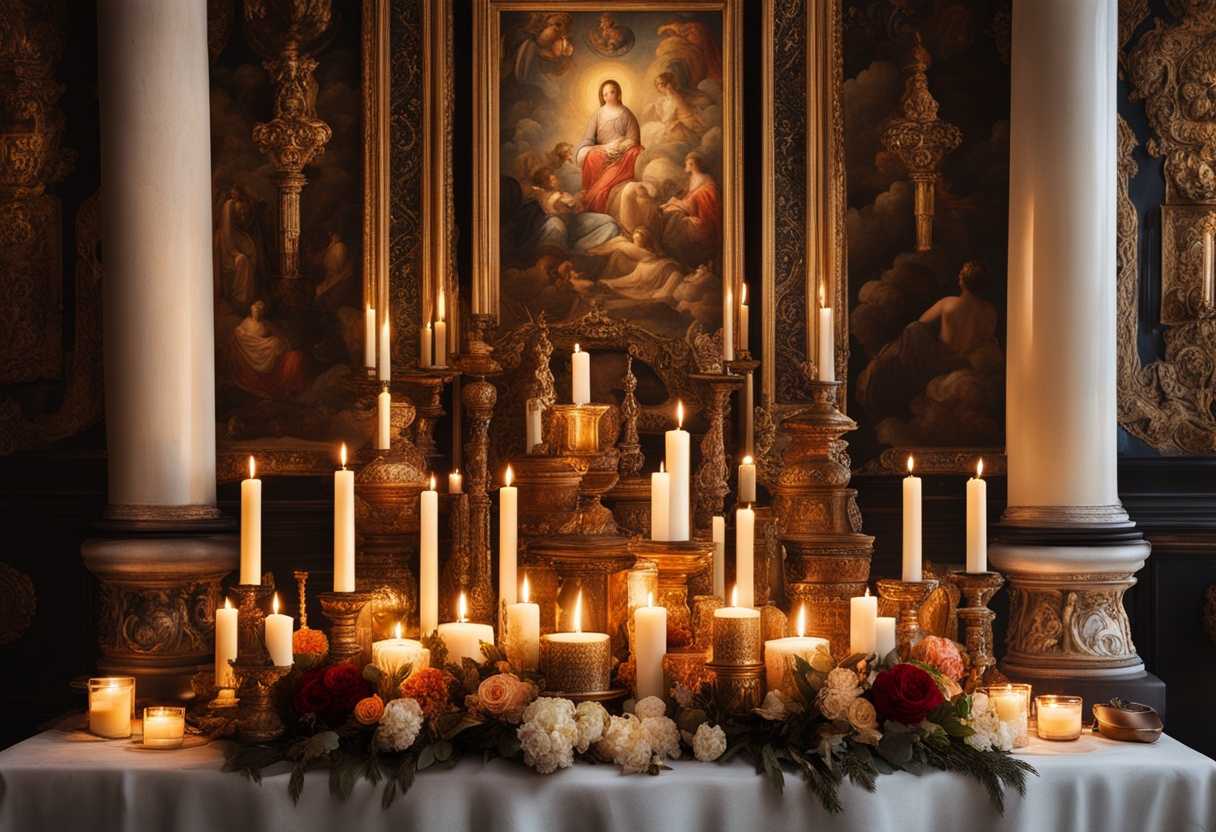
In the Bible, an “altar” is a sacred structure used for worship and sacrifices, symbolizing a place of encounter between God and humanity. It signifies devotion, atonement, and a means of expressing faith through offerings.
Scripture
20 Then Noah built an altar to the Lord and took some of every clean animal and some of every clean bird and offered burnt offerings on the altar.
21 And when the Lord smelled the pleasing aroma, the Lord said in his heart, “I will never again curse the ground because of man, for the intention of man’s heart is evil from his youth. I will never again strike down every living creature as I have done.
22 While the earth remains, seedtime and harvest, cold and heat, summer and winter, day and night, shall not cease.
Biblical Definition of “Altar”
In the Bible, the concept of an “altar” transcends its physical form, embodying a significant spiritual symbolism of communion between God and humanity. Altars were integral to ancient Israelite worship, as seen in passages like Exodus 20:24, where God commands, “Make an altar of earth for me and sacrifice on it your burnt offerings and fellowship offerings.” This establishes the altar as a meeting place for divine and human interaction, facilitating worship and the expression of faith through sacrificial offerings. The act of bringing sacrifices to the altar indicates recognition of sin, the need for atonement, and a desire for reconciliation with God, immersing the altar in the narrative of redemption that permeates biblical texts.
Moreover, the altar represents not only physical sacrifices but also a broader spiritual symbolism in the New Testament, where Jesus becomes the ultimate sacrifice. Hebrews 13:10 highlights this connection: “We have an altar from which those who minister at the tabernacle have no right to eat.” Here, the altar is identified not with a physical structure but with Jesus’ sacrificial work, pointing to the new covenant and access to God without the need for ongoing physical sacrifices. Thus, the altar transcends its terrestrial origins, evolving into a symbol of deep spiritual encounter, atonement, and faith that resonates throughout both the Old and New Testament, ultimately emphasizing God’s desire for relationship and redemption with His creation.
In various passages throughout the Bible, the altar represents not only a place for sacrificial offerings but also symbolizes a pivotal element of faith and worship. For instance, after Noah’s deliverance from the flood, he built an altar to the Lord and offered burnt offerings, demonstrating gratitude and the desire for reconciliation (Genesis 8:20-21). In this context, the altar becomes a physical manifestation of renewal and connection with God, showcasing a fundamental human impulse to respond to divine grace through acts of worship. This moment in the narrative emphasizes that altars are not merely structures but pivotal points for reflection, devotion, and establishing a covenantal relationship with God.
Additionally, the use of altars in the context of personal and communal worship further illustrates their profound significance. In the stories of the patriarchs, such as Abraham, we see a pattern where altars are erected in response to divine encounters, marking sacred moments of promise and revelation (Genesis 12:7-8, 13:18). These altars serve as reminders of God’s faithfulness and are often associated with physical locations in the land promised to Abraham and his descendants. This geographical aspect underscores the altars’ role in the unfolding of God’s redemptive plan and highlights the physical and spiritual intermingling present in the lives of those seeking to follow God. Thus, altars throughout Scripture articulate a continuum of faith, obedience, and a longing for communion with the divine, evolving from rites of sacrifice to the profound recognition of Jesus’ ultimate sacrifice in the New Testament.
Symbol of Sacrifice and Atonement
In the biblical context, an altar serves as a significant symbol of sacrifice and atonement. It is a place where offerings are made to God, representing the act of giving something valuable in exchange for divine favor or forgiveness. This concept underscores the importance of sacrifice in the relationship between humanity and the divine, highlighting themes of repentance and the need for atonement for sins.
Space for Divine Encounter
An altar also represents a sacred space for divine encounter and communion. It is often seen as a threshold where the earthly meets the heavenly, allowing individuals to connect with God through prayer, worship, and ritual. This aspect emphasizes the altar’s role in facilitating a personal relationship with the divine, serving as a focal point for spiritual devotion and connection.
Community and Covenant
Furthermore, altars in the Bible often symbolize community and covenant. They are places where communal worship occurs, reinforcing the bonds among the people of God. Altars can also signify the establishment of covenants between God and His people, marking significant moments in biblical history where commitments are made and promises are fulfilled. This communal aspect highlights the collective nature of faith and the shared responsibility of worship within the community.
How to Cultivate a Heart of Generosity and Service
Cultivating a heart of generosity and service is a beautiful journey that begins with a shift in perspective—seeing others through the lens of love and compassion. Start by reflecting on the countless blessings in your own life, recognizing that everything we have is a gift from God. This gratitude can inspire you to share your time, talents, and resources with those in need. Look for small, everyday opportunities to serve, whether it’s helping a neighbor, volunteering at a local charity, or simply offering a listening ear to a friend. Remember, generosity isn’t just about money; it’s about giving your heart and presence to others. As you practice these acts of kindness, you’ll find that your heart expands, and you’ll experience the joy that comes from living out Christ’s command to love one another. Embrace this journey with an open heart, and watch how it transforms not only those around you but also your own spirit.
Bible References to the Meaning of Altar:
Genesis 12:7-8: 7 Then the Lord appeared to Abram and said, “To your offspring I will give this land.” So he built there an altar to the Lord, who had appeared to him.
8 From there he moved to the hill country on the east of Bethel and pitched his tent, with Bethel on the west and Ai on the east. And there he built an altar to the Lord and called upon the name of the Lord.
Exodus 20:24-26: 24 An altar of earth you shall make for me and sacrifice on it your burnt offerings and your peace offerings, your sheep and your oxen. In every place where I cause my name to be remembered I will come to you and bless you.
25 If you make me an altar of stone, you shall not build it of hewn stones, for if you wield your tool on it, you profane it.
26 And you shall not go up by steps to my altar, that your nakedness be not exposed on it.’
Exodus 27:1-8: 1 “You shall make the altar of acacia wood, five cubits long and five cubits broad. The altar shall be square, and its height shall be three cubits.
2 And you shall make horns for it on its four corners; its horns shall be of one piece with it, and you shall overlay it with bronze.
3 Five cubits shall be the length of the one curtain, and five cubits the breadth of the one curtain for the first set of curtains, and five cubits the length of the one curtain, and five cubits the breadth of the one curtain for the second set of curtains.
4 You shall make for it a grating of network of bronze, and on the net you shall make four bronze rings at its four corners.
5 You shall put it under the ledge of the altar so that the net shall extend halfway down the altar.
6 You shall make poles for the altar, a net of bronze network, to be set halfway up the altar.
7 And you shall put it under the ledge of the altar so that the net shall extend halfway down the altar.
8 It shall be made with cherubim skillfully worked into it.
Leviticus 1:1-9: 1 In the beginning, God created the heavens and the earth.
2 “Speak to the people of Israel and say to them, When any one of you brings an offering to the Lord, you shall bring your offering of livestock from the herd or from the flock.”
3 If his offering is a burnt offering from the herd, he shall offer a male without blemish. He shall bring it to the entrance of the tent of meeting, that he may be accepted before the Lord.
4 He shall lay his hand on the head of the burnt offering, and it shall be accepted for him to make atonement for him.
5 Then he shall kill the bull before the Lord, and Aaron’s sons the priests shall bring the blood and throw the blood against the sides of the altar that is at the entrance of the tent of meeting.
6 And he shall flay the burnt offering and cut it into pieces,
7 The sons of Aaron the priest shall put fire on the altar and arrange wood on the fire.
8 And the priests, Aaron’s sons, shall arrange the pieces, the head, and the fat, on the wood that is on the fire on the altar;
9 but its entrails and its legs he shall wash with water. And the priest shall burn all of it on the altar, as a burnt offering, a food offering with a pleasing aroma to the Lord.
Leviticus 4:7-10: 7 And the priest shall put some of the blood on the horns of the altar of fragrant incense before the Lord that is in the tent of meeting, and all the rest of the blood of the bull he shall pour out at the base of the altar of burnt offering that is at the entrance of the tent of meeting.
8 And he shall take from it all the fat of the bull of the sin offering; the fat that covers the entrails and all the fat that is on the entrails,
9 And the two kidneys with the fat that is on them at the loins, and the long lobe of the liver that he shall remove with the kidneys.
10 But the bull he shall carry outside the camp and burn it up as he burned the first bull; it is the sin offering for the assembly.
Deuteronomy 27:4-8: 4 So when you have crossed over the Jordan, you shall set up these stones, concerning which I command you today, on Mount Ebal, and you shall plaster them with plaster.
5 And there you shall build an altar to the Lord your God, an altar of stones. You shall wield no iron tool on them;
6 You shall build the altar of the Lord your God of uncut stones, and you shall offer burnt offerings on it to the Lord your God.
7 And you shall sacrifice peace offerings and shall eat there, and you shall rejoice before the Lord your God.
8 And you shall write on the stones all the words of this law very plainly.”
Joshua 8:30-31: 30 At that time Joshua built an altar to the Lord, the God of Israel, on Mount Ebal,
31 just as Moses the servant of the Lord had commanded the people of Israel, as it is written in the Book of the Law of Moses, “an altar of uncut stones, upon which no man has wielded an iron tool.” And they offered on it burnt offerings to the Lord and sacrificed peace offerings.
1 Kings 18:30-32: 30 Then Elijah said to all the people, “Come near to me.” And all the people came near to him. And he repaired the altar of the Lord that had been thrown down.
31 Elijah took twelve stones, according to the number of the tribes of the sons of Jacob, to whom the word of the Lord came, saying, “Israel shall be your name,”
32 And with the stones he built an altar in the name of the Lord.
2 Chronicles 4:1-4: 1 He made an altar of bronze, twenty cubits long and twenty cubits wide and ten cubits high.
2 And he cast a round molding, half a cubit high, around the top of it.
3 Now figures like oxen were under it, and all around it. And the second row of oxen was below the first row.
4 He also made a sea of cast metal ten cubits from brim to brim, circular in form, and five cubits high, and a line of thirty cubits measured its circumference.
Ezra 3:2-3: 2 Then Jeshua the son of Jozadak and his fellow priests arose and built the altar of the God of Israel, to offer burnt offerings on it, as it is written in the Law of Moses the man of God.
3 They set the altar in its place, for fear was on them because of the peoples of the lands, and they offered burnt offerings on it to the Lord, burnt offerings morning and evening.
Isaiah 6:6-7: 6 Then one of the seraphim flew to me, having in his hand a burning coal that he had taken with tongs from the altar.
7 And he touched my mouth and said: “Behold, this has touched your lips; your guilt is taken away, and your sin atoned for.”
Ezekiel 43:13-17: 13 And these are the measurements of the altar by cubits (the cubit being a cubit and a handbreadth): its base shall be one cubit high and one cubit broad, with a rim of one span around its edge. And this shall be the height of the altar:
14 And from the base on the ground to the lower ledge, two cubits, with a breadth of one cubit; and from the smaller ledge to the larger ledge, four cubits, with a breadth of one cubit.
15 And the altar hearth shall be four cubits, and from the altar hearth shall project upwards four horns.
16 The altar hearth shall be square, twelve cubits long by twelve broad.
17 The ledge also shall be square, fourteen cubits long by fourteen broad, with a rim all around it of half a cubit, and its base one cubit all around. Its steps shall face east.”
Matthew 5:23-24: 23 So if you are offering your gift at the altar and there remember that your brother has something against you,
24 leave your gift there before the altar and go. First be reconciled to your brother, and then come and offer your gift.
Hebrews 13:10-12: 10 We have an altar from which those who serve the tent have no right to eat.
11 For the bodies of those animals whose blood is brought into the holy places by the high priest as a sacrifice for sin are burned outside the camp.
12 So Jesus also suffered outside the gate in order to sanctify the people through his own blood.
Revelation 6:9-11: 9 When he opened the fifth seal, I saw under the altar the souls of those who had been slain for the word of God and for the witness they had borne.
10 They cried out with a loud voice, “O Sovereign Lord, holy and true, how long before you will judge and avenge our blood on those who dwell on the earth?”
11 Then they were each given a white robe and told to rest a little longer, until the number of their fellow servants and their brothers should be complete, who were to be killed as they themselves had been.

Reverend Ogunlade is a seasoned Church Minister with over three decades of experience in guiding and nurturing congregations. With profound wisdom and a serene approach, Reverend Ogunlade has carried out various pastoral duties, including delivering uplifting sermons, conducting religious ceremonies, and offering sage counsel to individuals seeking spiritual guidance. Their commitment to fostering harmony and righteousness within their community is exemplified through their compassionate nature, making them a beloved and trusted figure among the congregation.