
In the Bible, the story of Jonah and the whale (or great fish) illustrates themes of obedience, mercy, and repentance. Jonah initially flees from God’s command to preach to Nineveh, but after being swallowed by a fish and repenting, he eventually fulfills his mission, demonstrating God’s willingness to forgive those who turn back to Him.
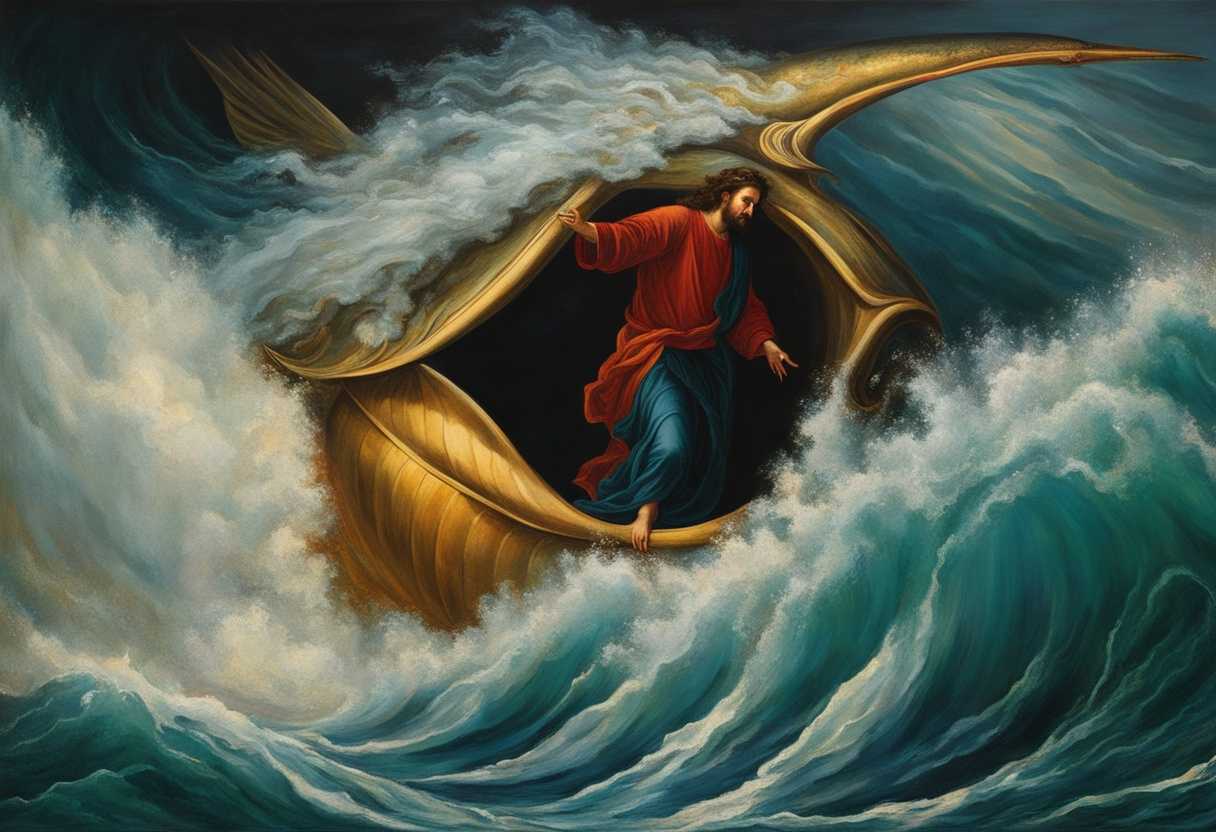
Scripture
1 Now the word of the Lord came to Jonah the son of Amittai, saying,
2 “Arise, go to Nineveh, that great city, and call out against it, for their evil has come up before me.”
3 But Jonah rose to flee to Tarshish from the presence of the Lord. He went down to Joppa and found a ship going to Tarshish. So he paid the fare and went down into it, to go with them to Tarshish, away from the presence of the Lord.
4 But the Lord hurled a great wind upon the sea, and there was a mighty tempest on the sea, so that the ship threatened to break up.
5 Then the mariners were afraid, and each cried out to his god. And they hurled the cargo that was in the ship into the sea to lighten it for them. But Jonah had gone down into the inner part of the ship and had lain down and was fast asleep.
6 So the captain came and said to him, “What do you mean, you sleeper? Arise, call out to your god! Perhaps the god will give a thought to us, that we may not perish.”
7 And they said to one another, “Come, let us cast lots, that we may know on whose account this evil has come upon us.” So they cast lots, and the lot fell on Jonah.
8 Then they said to him, “Tell us on whose account this evil has come upon us. What is your occupation? And where do you come from? What is your country? And of what people are you?”
9 And he said to them, “I am a Hebrew, and I fear the Lord, the God of heaven, who made the sea and the dry land.”
10 Then the men were exceedingly afraid and said to him, “What is this that you have done!” For the men knew that he was fleeing from the presence of the Lord, because he had told them.
11 Then they said to him, “What shall we do to you, that the sea may quiet down for us?” for the sea grew more and more tempestuous.
12 He said to them, “Pick me up and hurl me into the sea; then the sea will quiet down for you, for I know it is because of me that this great tempest has come upon you.”
13 Nevertheless, the men rowed hard to get back to dry land, but they could not, for the sea grew more and more tempestuous against them.
14 Therefore they called out to the Lord, “O Lord, let us not perish for this man’s life, and lay not on us innocent blood, for you, O Lord, have done as it pleased you.”
15 So they picked up Jonah and hurled him into the sea, and the sea ceased from its raging.
16 Then the men feared the Lord exceedingly, and they offered a sacrifice to the Lord and made vows.
17 And the Lord appointed a great fish to swallow up Jonah. And Jonah was in the belly of the fish three days and three nights.
Meaning of Jonah and the Whale
The story of Jonah and the whale serves as a profound metaphor for the struggle between human reluctance and divine purpose. Initially, Jonah’s flight to Tarshish (Jonah 1:3) signifies a common human instinct to evade responsibilities, especially when they involve confronting difficult truths or hostile environments, as was the case with Nineveh, a city renowned for its wickedness. However, God’s intervention—symbolized by Jonah being swallowed by the great fish (Jonah 1:17)—represents the transformational power of divine mercy, which often comes after a period of trial and introspection. While in the belly of the fish, Jonah prays and repents (Jonah 2:1-10), showcasing how even in dire circumstances, individuals can seek God sincerely, and how such turnarounds are met with compassion.
Furthermore, Jonah’s eventual preaching in Nineveh and the city’s subsequent repentance (Jonah 3:4-10) illustrates a broader theological notion regarding God’s desire for all to return to Him. The text emphasizes God’s universal mercy, as He is willing to forgive even the most wayward of hearts, irrespective of their past sins. This theme is echoed in the New Testament, where Jesus References Jonah while emphasizing the importance of repentance (Matthew 12:40-41), thus linking the broader narrative of salvation with the personal and communal aspects of turning to God. Ultimately, Jonah’s story encapsulates the journey from avoidance to acceptance of divine calling, the profound realization of human inadequacies, and the rich promise of grace available through genuine contrition.
The narrative of Jonah also reflects on themes of identity, vocation, and participation in God’s overarching plan. Jonah’s initial reluctance to fulfill his prophetic duty highlights a struggle many face when called to step outside their comfort zones. This reflects a broader biblical motif where individuals, like Moses or Gideon, grapple with self-doubt and fear when tasked with daunting missions. Jonah’s story serves to illustrate that God equips those He calls, even when they resist or question their worthiness. This divine empowerment suggests that true fulfillment comes not from self-direction but from aligning one’s purpose with God’s will, reaffirming the belief that every person has a role to play in the fabric of divine redemption.
Additionally, the account also emphasizes the concept of mercy not being confined to a singular group but instead extending across nations and cultures. The massive repentance of Nineveh after Jonah’s reluctant preaching serves as a testament to the efficacy of God’s message penetrating hardened hearts. This mirrors a larger biblical narrative where the invitation to repent is open to all, as seen in the resounding call of the prophets. The transformation of a city notorious for its wrongdoing accentuates God’s readiness to redeem even those presumed beyond His reach. Thus, the story of Jonah and the whale serves not just as a tale of personal struggle, but as a profound statement about God’s expansive grace and the potential for redemption that lies within every human heart when confronted with the truth of their existence.
The Call to Obedience and Repentance
The story of Jonah and the whale serves as a powerful reminder of the importance of obedience to God’s will. Jonah’s initial refusal to follow God’s command to go to Nineveh highlights the human tendency to resist divine guidance. This narrative illustrates that true repentance is not just about turning away from sin but also about turning towards God’s purpose. The eventual repentance of the people of Nineveh underscores the theme that no one is beyond the reach of God’s mercy, emphasizing the transformative power of repentance.
The Theme of Divine Mercy
Another significant meaning of the Jonah narrative is the theme of divine mercy. Jonah’s journey illustrates that God’s compassion extends even to those whom society may deem unworthy, such as the people of Nineveh. This aspect of the story challenges readers to reconsider their own attitudes towards forgiveness and grace. It emphasizes that God’s love is inclusive and that His desire for repentance and redemption is universal, inviting all to turn back to Him regardless of their past actions.
The Struggle with Personal Bias
The story also delves into the struggle with personal bias and prejudice. Jonah’s reluctance to preach to the Ninevites stems from his disdain for them, reflecting a common human inclination to judge others based on their backgrounds or actions. This narrative encourages self-reflection on how biases can cloud judgment and hinder the fulfillment of God’s mission. It serves as a call to overcome personal prejudices and embrace a broader understanding of community and compassion, reminding believers that they are called to love and serve all people, regardless of their differences.
How to Embrace Obedience and Repentance in Faith
Embracing obedience and repentance in your faith journey is a transformative process that requires both humility and a willingness to grow. Start by recognizing that obedience is not merely about following rules, but about cultivating a heart that desires to align with God’s will. Spend time in prayer and scripture, asking the Holy Spirit to reveal areas in your life where you may be straying from His path. When you stumble—and we all do—don’t shy away from repentance; instead, see it as a beautiful opportunity to reconnect with God. Remember, repentance is not just about feeling sorry for our mistakes, but about turning away from them and moving toward a deeper relationship with Christ. As you practice these principles, you’ll find that obedience becomes a joyful response to God’s love, and repentance becomes a refreshing reminder of His grace. Embrace this journey with an open heart, and watch how it deepens your faith and transforms your life.
Bible References to Jonah and the Whale:
Jonah 2:1-10: 1 Then Jonah prayed to the Lord his God from the belly of the fish,
2 saying, “I called out to the Lord, out of my distress, and he answered me; out of the belly of Sheol I cried, and you heard my voice.
3 For you cast me into the deep,
into the heart of the seas,
and the flood surrounded me;
all your waves and your billows
passed over me.
4 Then I said, ‘I am driven away from your sight; yet I shall again look upon your holy temple.’
5 The waters closed in over me to take my life; the deep surrounded me; weeds were wrapped about my head.
6 I went down to the land whose bars closed upon me forever; yet you brought up my life from the pit, O Lord my God.
7 When my life was fainting away,
I remembered the Lord,
and my prayer came to you,
into your holy temple.
8 Those who pay regard to vain idols forsake their hope of steadfast love.
9 But I with the voice of thanksgiving will sacrifice to you; what I have vowed I will pay. Salvation belongs to the Lord!
10 And the Lord spoke to the fish, and it vomited Jonah out upon the dry land.
Jonah 3:1-10: 1 Then the word of the Lord came to Jonah the second time, saying,
2 “Arise, go to Nineveh, that great city, and call out against it the message that I tell you.”
3 So Jonah arose and went to Nineveh, according to the word of the Lord. Now Nineveh was an exceedingly great city, three days’ journey in breadth.
4 Jonah began to go into the city, going a day’s journey. And he called out, “Yet forty days, and Nineveh shall be overthrown!”
5 And the people of Nineveh believed God. They called for a fast and put on sackcloth, from the greatest of them to the least of them.
6 The word reached the king of Nineveh, and he arose from his throne, removed his robe, covered himself with sackcloth, and sat in ashes.
7 And he issued a proclamation and published through Nineveh, “By the decree of the king and his nobles: Let neither man nor beast, herd nor flock, taste anything. Let them not feed or drink water,
8 but let man and beast be covered with sackcloth, and let them call out mightily to God. Let everyone turn from his evil way and from the violence that is in his hands.
9 Who knows? God may turn and relent and turn from his fierce anger, so that we may not perish.”
10 When God saw what they did, how they turned from their evil way, God relented of the disaster that he had said he would do to them, and he did not do it.
Jonah 4:1-11: 1 But it displeased Jonah exceedingly, and he was angry.
2 And he prayed to the Lord and said, “O Lord, is not this what I said when I was yet in my country? That is why I made haste to flee to Tarshish; for I knew that you are a gracious God and merciful, slow to anger and abounding in steadfast love, and relenting from disaster.
3 Therefore now, O Lord, please take my life from me, for it is better for me to die than to live.”
4 And the Lord said, “Do you do well to be angry?”
5 Jonah went out of the city and sat to the east of the city and made a booth for himself there. He sat under it in the shade, till he should see what would become of the city.
6 Now the Lord God appointed a plant and made it come up over Jonah, that it might be a shade over his head, to save him from his discomfort. So Jonah was exceedingly glad because of the plant.
7 But when dawn came up the next day, God appointed a worm that attacked the plant, so that it withered.
8 When the sun rose, God appointed a scorching east wind, and the sun beat down on the head of Jonah so that he was faint. And he asked that he might die and said, “It is better for me to die than to live.”
9 But God said to Jonah, “Do you do well to be angry for the plant?” And he said, “Yes, I do well to be angry, angry enough to die.”
10 And the Lord said, “You pity the plant, for which you did not labor, nor did you make it grow, which came into being in a night and perished in a night.
11 And should not I pity Nineveh, that great city, in which there are more than 120,000 persons who do not know their right hand from their left, and also much cattle?”
Matthew 12:38-41: 38 Then some of the scribes and Pharisees answered him, saying, “Teacher, we wish to see a sign from you.”
39 But he answered them, “An evil and adulterous generation seeks for a sign, but no sign will be given to it except the sign of the prophet Jonah.
40 For just as Jonah was three days and three nights in the belly of the great fish, so will the Son of Man be three days and three nights in the heart of the earth.
41 The men of Nineveh will rise up at the judgment with this generation and condemn it, for they repented at the preaching of Jonah, and behold, something greater than Jonah is here.
Luke 11:29-32: 29 When the crowds were increasing, he began to say, “This generation is an evil generation. It seeks for a sign, but no sign will be given to it except the sign of Jonah.
30 for as Jonah became a sign to the people of Nineveh, so will the Son of Man be to this generation.
31 The queen of the South will rise up at the judgment with the men of this generation and condemn them, for she came from the ends of the earth to hear the wisdom of Solomon, and behold, something greater than Solomon is here.
32 The men of Nineveh will rise up at the judgment with this generation and condemn it, for they repented at the preaching of Jonah, and behold, something greater than Jonah is here.

Rev. François Dupont is a dedicated church minister with a wealth of experience in serving spiritual communities. With a calm and serene demeanor, he has been devoted to sharing the message of love, compassion, and tolerance for over two decades. Through his thoughtful sermons, compassionate counseling, and unwavering support, Rev. Dupont has touched the lives of countless individuals, allowing them to find solace and strength during difficult times. His serene presence and deep understanding of the human condition make him a trusted guide for those seeking spiritual nourishment and guidance.