
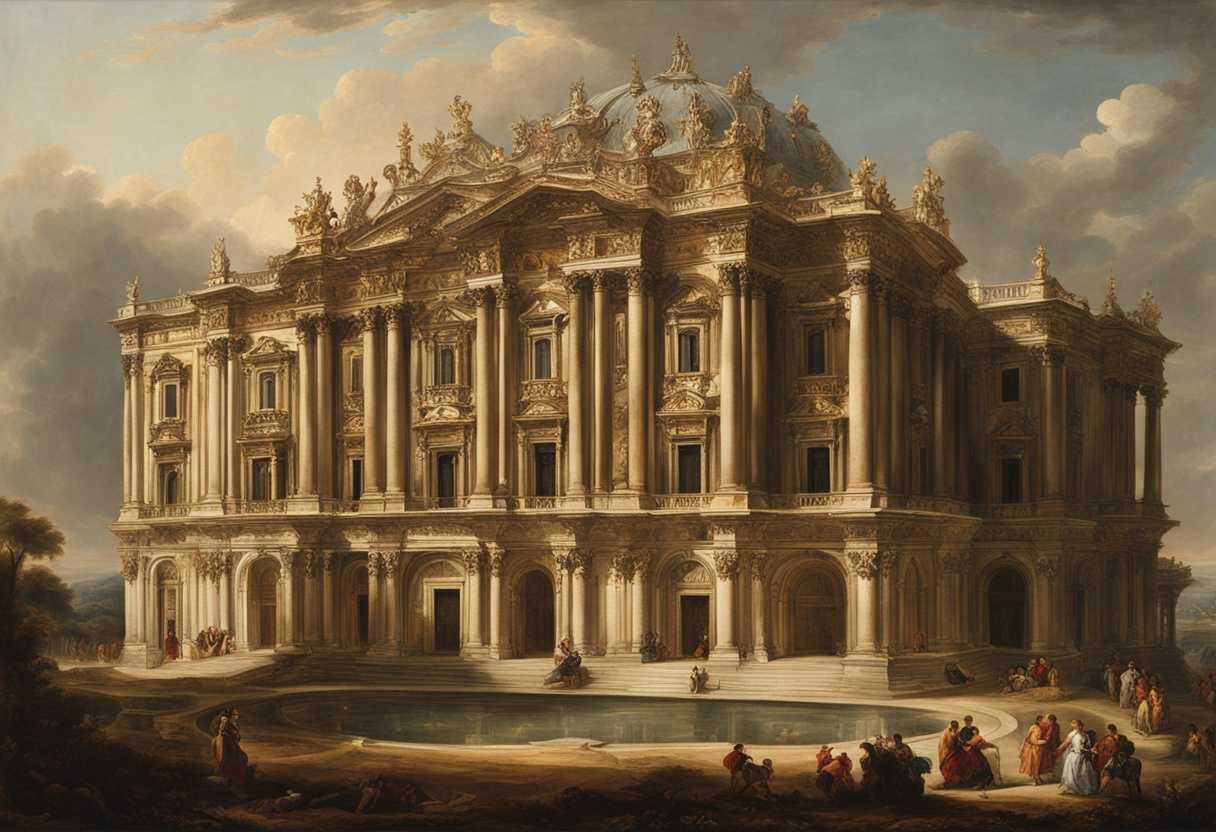
In the Bible, a palace often represents power, authority, and worldly wealth, serving as the residence of kings and the site of governance (e.g., 1 Kings 7:1-12). It can also symbolize human pride and the transient nature of earthly kingdoms (Isaiah 13:19).
Scripture
7 Solomon was building his own house thirteen years, and he finished his entire house.
2 He built the House of the Forest of Lebanon. Its length was a hundred cubits and its breadth fifty cubits and its height thirty cubits, and it was built on four rows of cedar pillars, with cedar beams on the pillars.
3 It was paneled with cedar above the chambers that were on the forty-five pillars, fifteen in each row.
4 There were window frames in three rows, and window opposite window in three tiers.
5 All the doorways and windows had square frames, and window was opposite window in three tiers.
6 He made the Hall of Pillars fifty cubits long and thirty cubits wide, and a porch was in front of them, and a canopy in front of them.
7 And he made the Hall of the Throne where he was to pronounce judgment, even the Hall of Judgment. And it was finished with cedar from floor to rafters.
8 His house where he was to dwell, in the other court back of the hall, was of like workmanship. Solomon also made a house like this hall for Pharaoh’s daughter whom he had taken in marriage.
9 All these were made of costly stones, cut according to measure, sawed with saws, back and front, even from the foundation to the coping, and from the outside to the great court.
10 The foundation was of costly stones, huge stones, stones of eight and ten cubits.
11 Now Hiram made the basins and the shovels and the bowls. So Hiram finished all the work that he did for King Solomon on the house of the Lord:
12 The great court had three courses of cut stone all around, and a course of cedar beams; so had the inner court of the house of the Lord, and the vestibule of the house.
Biblical Significance of a Palace
In the Bible, the concept of a palace often extends beyond its physical structure to symbolize power, authority, and the complexities of human governance. For example, in the story of Solomon, his palace is not just a testament to his wealth and wisdom but also reflects the divine blessing and responsibilities that accompany leadership (1 Kings 10:1-2). Solomon’s palace, described in sumptuous detail, highlights the earthly splendor that can accompany divine favor, yet it also serves as a poignant reminder of the burdens of leadership and the expectations placed upon those in positions of power. The grandeur of such a palace becomes emblematic of Israel’s national identity during its height, contrasting sharply with the eventual decay and downfall that accompanies human pride (Ezekiel 12:13).
Moreover, palaces in biblical narratives frequently serve as symbols of the transient nature of earthly kingdoms. Isaiah 13:19 poignantly articulates this theme by prophesying the fall of Babylon, emphasizing how even the mightiest of palaces will ultimately succumb to divine judgment. The idea that earthly power is fleeting and that human constructs, no matter how grand, are subject to divine authority underscores the broader biblical narrative about the impermanence of worldly riches and the supremacy of God’s eternal kingdom. This duality encapsulates a call for humility and a recognition that true authority and stability rest not in human institutions, but in the divine establishment of God’s kingdom, as seen in Hebrews 12:28, where believers are encouraged to seek a kingdom that cannot be shaken. Thus, palaces in the biblical context illustrate profound spiritual truths regarding the nature of power, responsibility, and the eternal sovereignty of God over all creation.
The biblical significance of palaces can also be explored through the lens of divine justice and the moral responsibilities that accompany positions of power. In the narratives surrounding King Ahab, for instance, the palace represents not only royal authority but also a stronghold of corruption and idolatry. Ahab and Jezebel’s reign is marked by moral decay, as their palace becomes the epicenter of Baal worship and the persecution of prophets (1 Kings 18). This transformation of the palace from a place of governance to one of moral failure illustrates the dangers of misusing authority and the consequences that arise when leaders stray from God’s commandments. The lavishness of the palace in such contexts serves as a stark contrast to the spiritual barrenness that can ensue from turning away from divine principles.
Additionally, palaces are often depicted as venues of divine intervention and prophetic activity. For example, in the account of Esther, the palace of King Xerxes becomes a setting for God’s providential plan to save the Jewish people. Esther’s bold approach to the king within the palace walls not only highlights her courage but also signifies the potential for transformation even in places that may initially seem resistant to God’s purpose. The palace thus stands as a microcosm of the broader struggle between good and evil, where divine providence can penetrate the highest echelons of power to affect change and justice. This signifies that regardless of how earthly realms may be structured, God’s sovereignty ultimately prevails, granting assurance that His plans will be executed even within the palatial confines of worldly authority, reaffirming the biblical theme of hope amid struggles against tyranny and oppression.
Symbol of Authority and Power
In the Bible, palaces often represent the seat of authority and governance. They are places where kings and rulers reside, symbolizing their power and the political structure of society. The grandeur of a palace reflects the wealth and status of its inhabitants, serving as a physical manifestation of their dominion over the land and people. This significance extends to the idea of divine authority, where God’s kingdom is often depicted as a majestic palace, emphasizing His sovereignty over all creation.
A Place of Judgment and Decision-Making
Palaces in the biblical narrative frequently serve as venues for critical decisions and judgments. They are where rulers convene to deliberate on matters of law, justice, and governance. This aspect highlights the moral responsibilities of leadership, as decisions made within these walls can have profound implications for the community. The palace becomes a backdrop for the exercise of wisdom or folly, illustrating the importance of righteous leadership in accordance with divine principles.
Reflection of Spiritual Realities
Beyond their physical and political significance, palaces in the Bible can also symbolize spiritual realities. They may represent the heavenly realm or the presence of God, where divine order and peace reign. The imagery of a palace can evoke thoughts of eternal life and the ultimate fulfillment of God’s promises to His people. This spiritual dimension invites believers to consider their own relationship with God and the hope of dwelling in His presence, akin to residing in a heavenly palace.
How to Embrace Divine Guidance in Daily Living
Embracing divine guidance in our daily lives is a beautiful journey that requires both intention and openness. Start by cultivating a habit of prayer and meditation, allowing yourself to quiet the noise of the world and listen for that still, small voice within. Scripture is a powerful tool; immerse yourself in the Word, letting it illuminate your path and provide wisdom for your decisions. Surround yourself with a community of believers who can offer support and share their own experiences of divine guidance. Remember, it’s not just about seeking answers but also about being receptive to the nudges and signs that God places in your life—whether through circumstances, conversations, or even moments of serendipity. Trust that God is always with you, guiding your steps, and be willing to act on the insights you receive, knowing that each small act of faith can lead to profound transformation.
Bible References to the Significance of Palaces:
2 Chronicles 9:1-12: 1 Now when the queen of Sheba heard of the fame of Solomon, she came to Jerusalem to test him with hard questions, having a very great retinue and camels bearing spices and very much gold and precious stones. And when she came to Solomon, she told him all that was on her mind.
2 And Solomon answered all her questions; there was nothing hidden from Solomon that he could not explain to her.
3 And when the queen of Sheba had seen the wisdom of Solomon, the house that he had built,
4 the food of his table, the seating of his officials, and the attendance of his servants, and their clothing, his cupbearers, and their clothing, and his burnt offerings that he offered at the house of the Lord, there was no more breath in her.
5 And she said to the king, “The report was true that I heard in my own land of your words and of your wisdom,
6 Moreover, the food of his table, the seating of his officials, and the attendance of his servants, and their clothing, his cupbearers, and their clothing, and his burnt offerings that he offered at the house of the Lord, there was no more breath in her.
7 And I did not believe the reports until I came and my own eyes had seen it. And behold, the half of the greatness of your wisdom was not told me; you surpass the report that I heard.
8 Blessed be the Lord your God, who has delighted in you and set you on his throne as king for the Lord your God! Because your God loved Israel and would establish them forever, he has made you king over them, that you may execute justice and righteousness.”
9 Then she gave the king 120 talents of gold, and a very great quantity of spices, and precious stones. Never again came such an abundance of spices as these that the queen of Sheba gave to King Solomon.
10 Moreover, the servants of Hiram and the servants of Solomon, who brought gold from Ophir, brought algum wood and precious stones.
11 Moreover, the fleet of Hiram, which brought gold from Ophir, brought from Ophir a very great amount of almug wood and precious stones.
12 And King Solomon gave to the queen of Sheba all that she desired, whatever she asked besides what she had brought to the king. So she turned and went back to her own land with her servants.
Esther 1:1-9: 1 Now in the days of Ahasuerus, the Ahasuerus who reigned from India to Ethiopia over 127 provinces,
2 in those days when King Ahasuerus sat on his royal throne in Susa, the citadel,
3 in the third year of his reign he gave a feast for all his officials and servants. The army of Persia and Media and the nobles and governors of the provinces were before him,
4 He displayed the riches of his royal glory and the splendor and pomp of his greatness for many days, 180 days.
5 And when these days were completed, the king gave for all the people present in Susa the citadel, both great and small, a feast lasting for seven days in the court of the garden of the king’s palace.
6 There were white cotton curtains and violet hangings fastened with cords of fine linen and purple to silver rods and marble pillars, and also couches of gold and silver on a mosaic pavement of porphyry, marble, mother-of-pearl, and precious stones.
7 Drinks were served in golden vessels, vessels of different kinds, and the royal wine was lavished according to the bounty of the king.
8 By the king’s command they served drinks in golden vessels, each one different from the other, and the royal wine was lavished according to the king’s bounty.
9 Queen Vashti also gave a feast for the women in the palace that belonged to King Ahasuerus.
Nehemiah 2:1-8: 1 In the month of Nisan, in the twentieth year of King Artaxerxes, when wine was before him, I took up the wine and gave it to the king. Now I had not been sad in his presence.
2 And the king said to me, “Why is your face sad, seeing you are not sick? This is nothing but sadness of the heart.”
3 And I said to the king, “Let the king live forever! Why should not my face be sad, when the city, the place of my fathers’ graves, lies in ruins, and its gates have been destroyed by fire?”
4 Then the king said to me, “What are you requesting?” So I prayed to the God of heaven.
5 And I said to the king, “If it pleases the king, and if your servant has found favor in your sight, that you send me to Judah, to the city of my fathers’ graves, that I may rebuild it.”
6 And the king said to me (the queen sitting beside him), “How long will you be gone, and when will you return?” So it pleased the king to send me when I had given him a time.
7 And I said to the king, “If it pleases the king, let letters be given me to the governors of the province Beyond the River, that they may let me pass through until I come to Judah,
8 And the king granted me what I asked, for the good hand of my God was upon me.
Daniel 5:1-31: 1 King Belshazzar made a great feast for a thousand of his lords and drank wine in front of the thousand.
2 Belshazzar, when he tasted the wine, commanded that the vessels of gold and of silver that Nebuchadnezzar his father had taken out of the temple in Jerusalem be brought, that the king and his lords, his wives, and his concubines might drink from them.
3 Then they brought in the golden vessels that had been taken out of the temple, the house of God in Jerusalem, and the king and his lords, his wives, and his concubines drank from them.
4 They drank wine and praised the gods of gold and silver, bronze, iron, wood, and stone.
5 Immediately the fingers of a human hand appeared and wrote on the plaster of the wall of the king’s palace, opposite the lampstand. And the king saw the hand as it wrote.
6 Then the king’s color changed, and his thoughts alarmed him; his limbs gave way, and his knees knocked together.
7 The king called loudly to bring in the enchanters, the Chaldeans, and the astrologers. The king declared to the wise men of Babylon, “Whoever reads this writing, and shows me its interpretation, shall be clothed with purple and have a chain of gold around his neck and shall be the third ruler in the kingdom.”
8 Then all the king’s wise men came in, but they could not read the writing or make known to the king the interpretation.
9 Then King Belshazzar was greatly alarmed, and his color changed, and his lords were perplexed.
10 The queen, because of the words of the king and his lords, came into the banqueting hall, and the queen declared, “O king, live forever! Let not your thoughts alarm you or your color change.
11 There is a man in your kingdom in whom is the spirit of the holy gods. In the days of your father, light and understanding and wisdom like the wisdom of the gods were found in him, and King Nebuchadnezzar, your father—your father the king—made him chief of the magicians, enchanters, Chaldeans, and astrologers,
12 because an excellent spirit, knowledge, and understanding to interpret dreams, explain riddles, and solve problems were found in this Daniel, whom the king named Belteshazzar. Now let Daniel be called, and he will show the interpretation.”
13 Then Daniel was brought in before the king. The king answered and said to Daniel, “You are that Daniel, one of the exiles of Judah, whom the king my father brought from Judah.
14 I have heard of you that the spirit of the gods is in you, and that light and understanding and excellent wisdom are found in you.
15 And now the wise men, the enchanters, have been brought in before me to read this writing and make known to me its interpretation, but they could not show the interpretation of the matter.
16 And I have heard of you, that you can give interpretations and solve problems. Now if you can read the writing and make known to me its interpretation, you shall be clothed in purple and have a chain of gold around your neck and shall be the third ruler in the kingdom.
17 Then Daniel answered and said before the king, “Let your gifts be for yourself, and give your rewards to another. Nevertheless, I will read the writing to the king and make known to him the interpretation.
18 O king, the Most High God gave Nebuchadnezzar your father kingship and greatness and glory and majesty.
19 And because of the greatness that he gave him, all peoples, nations, and languages trembled and feared before him. Whom he would, he killed, and whom he would, he kept alive; whom he would, he raised up, and whom he would, he humbled.
20 But when his heart was lifted up and his spirit was hardened so that he dealt proudly, he was brought down from his kingly throne, and his glory was taken from him.
21 And he was driven from among the children of mankind, and his mind was made like that of a beast, and his dwelling was with the wild donkeys. He was fed grass like an ox, and his body was wet with the dew of heaven, until he knew that the Most High God rules the kingdom of mankind and sets over it whom he will.
22 And you his son, Belshazzar, have not humbled your heart, though you knew all this,
23 but you have lifted up yourself against the Lord of heaven. And the vessels of his house have been brought in before you, and you and your lords, your wives, and your concubines have drunk wine from them. And you have praised the gods of silver and gold, of bronze, iron, wood, and stone, which do not see or hear or know, but the God in whose hand is your breath, and whose are all your ways, you have not honored.
24 “Then from his presence the hand was sent, and this writing was inscribed.”
25 “And this is the writing that was inscribed: Mene, Mene, Tekel, and Parsin.
26 This is the interpretation of the matter: Mene, God has numbered the days of your kingdom and brought it to an end;
27 Tekel, you have been weighed in the balances and found wanting.
28 Peres, your kingdom is divided and given to the Medes and Persians.”
29 Then Belshazzar gave the command, and Daniel was clothed with purple, a chain of gold was put around his neck, and a proclamation was made about him, that he should be the third ruler in the kingdom.
30 That very night Belshazzar the Chaldean king was killed.
31 And Darius the Mede received the kingdom, being about sixty-two years old.
1 Kings 10:1-13: 23 Thus King Solomon excelled all the kings of the earth in riches and in wisdom.
2 She came to Jerusalem with a very great retinue, with camels bearing spices and very much gold and precious stones. And when she came to Solomon, she told him all that was on her mind.
3 And Solomon answered all her questions; there was nothing hidden from the king that he could not explain to her.
4 And when the queen of Sheba had seen all the wisdom of Solomon, the house that he had built,
5 the food of his table, the seating of his officials, and the attendance of his servants, and their clothing, his cupbearers, and his burnt offerings that he offered at the house of the Lord, there was no more breath in her.
6 She said to the king, “The report was true that I heard in my own land of your words and of your wisdom,
7 So I did not believe the reports until I came and my own eyes had seen it. And behold, the half was not told me. Your wisdom and prosperity surpass the report that I heard.
8 Happy are your men! Happy are your servants, who continually stand before you and hear your wisdom!
9 Then she gave the king 120 talents of gold, and a very great quantity of spices and precious stones. Never again came such an abundance of spices as these that the queen of Sheba gave to King Solomon.
10 Then she gave the king 120 talents of gold, and a very great quantity of spices and precious stones. Never again came such an abundance of spices as these that the queen of Sheba gave to King Solomon.
11 Moreover, the fleet of Hiram, which brought gold from Ophir, brought from Ophir a very great amount of almug wood and precious stones.
12 The king also made of the almug wood supports for the house of the Lord and for the king’s house, lyres also and harps for the singers. No such almug wood has come or been seen to this day.
13 King Solomon gave to the queen of Sheba all that she desired, whatever she asked, besides what was given her by the bounty of King Solomon. So she turned and went back to her own land with her servants.
2 Samuel 5:11-12: 11 And Hiram king of Tyre sent messengers to David, and cedar trees, also carpenters and masons who built David a house.
12 And David knew that the Lord had established him king over Israel, and that he had exalted his kingdom for the sake of his people Israel.
1 Kings 9:10-14: 10 At the end of twenty years, in which Solomon had built the two houses, the house of the Lord and the king’s house,
14 Hiram had sent to the king 120 talents of gold.
12 But Solomon gave Hiram twenty cities in the land of Galilee.
13 And King Solomon drafted forced labor out of all Israel, and the draft numbered 30,000 men.
14 And Hiram sent to the king 120 talents of gold.
2 Chronicles 7:11-22: 11 Thus Solomon finished the house of the Lord and the king’s house. All that Solomon had planned to do in the house of the Lord and in his own house he successfully accomplished.
12 Then the Lord appeared to Solomon in the night and said to him: “I have heard your prayer and have chosen this place for myself as a house of sacrifice.
22 And they shall answer, “Because they have forsaken the Lord, the God of their fathers, who brought them out of the land of Egypt, and laid hold on other gods and worshiped them and served them. Therefore he has brought all this disaster on them.”
14 if my people who are called by my name humble themselves, and pray and seek my face and turn from their wicked ways, then I will hear from heaven and will forgive their sin and heal their land.
15 Now my eyes will be open and my ears attentive to the prayer that is made in this place.
16 For now I have chosen and consecrated this house that my name may be there forever. My eyes and my heart will be there for all time.
17 And as for you, if you will walk before me as David your father walked, doing according to all that I have commanded you and keeping my statutes and my rules,
18 then I will establish your royal throne, as I covenanted with David your father, saying, ‘You shall not lack a man to rule Israel.’
19 But if you turn aside and forsake my statutes and my commandments that I have set before you, and go and serve other gods and worship them,
20 then I will pluck you up from my land that I have given you, and this house that I have consecrated for my name, I will cast out of my sight, and I will make it a proverb and a byword among all peoples.
21 And as for this house, which was exalted, everyone passing by will be astonished and say, ‘Why has the Lord done thus to this land and to this house?’
22 And they will say, ‘Because they abandoned the Lord, the God of their fathers who brought them out of the land of Egypt, and laid hold on other gods and worshiped them and served them. Therefore he has brought all this disaster on them.’
Jeremiah 22:1-9: 2 And say, ‘Hear the word of the Lord, O king of Judah, who sits on the throne of David, you, and your servants, and your people who enter these gates.
2 And say, ‘Hear the word of the Lord, O king of Judah, who sits on the throne of David, you, and your servants, and your people who enter these gates.
3 Thus says the Lord: Do justice and righteousness, and deliver from the hand of the oppressor him who has been robbed. And do no wrong or violence to the resident alien, the fatherless, and the widow, nor shed innocent blood in this place.
4 For if you will indeed obey this word, then there shall enter the gates of this house kings who sit on the throne of David, riding in chariots and on horses, they and their servants and their people.
5 But if you will not obey these words, I swear by myself, declares the Lord, that this house shall become a desolation.
6 For thus says the Lord concerning the house of the king of Judah: “‘You are like Gilead to me, like the summit of Lebanon, yet surely I will make you a desert, an uninhabited city.
7 “I will prepare destroyers against you,
each with his weapons,
and they shall cut down your choicest cedars
and cast them into the fire.
8 And many nations will pass by this city, and every man will say to his neighbor, ‘Why has the Lord dealt thus with this great city?’
9 And they will answer, “Because they have forsaken the covenant of the Lord their God and worshiped other gods and served them.”

Rev. François Dupont is a dedicated church minister with a wealth of experience in serving spiritual communities. With a calm and serene demeanor, he has been devoted to sharing the message of love, compassion, and tolerance for over two decades. Through his thoughtful sermons, compassionate counseling, and unwavering support, Rev. Dupont has touched the lives of countless individuals, allowing them to find solace and strength during difficult times. His serene presence and deep understanding of the human condition make him a trusted guide for those seeking spiritual nourishment and guidance.