
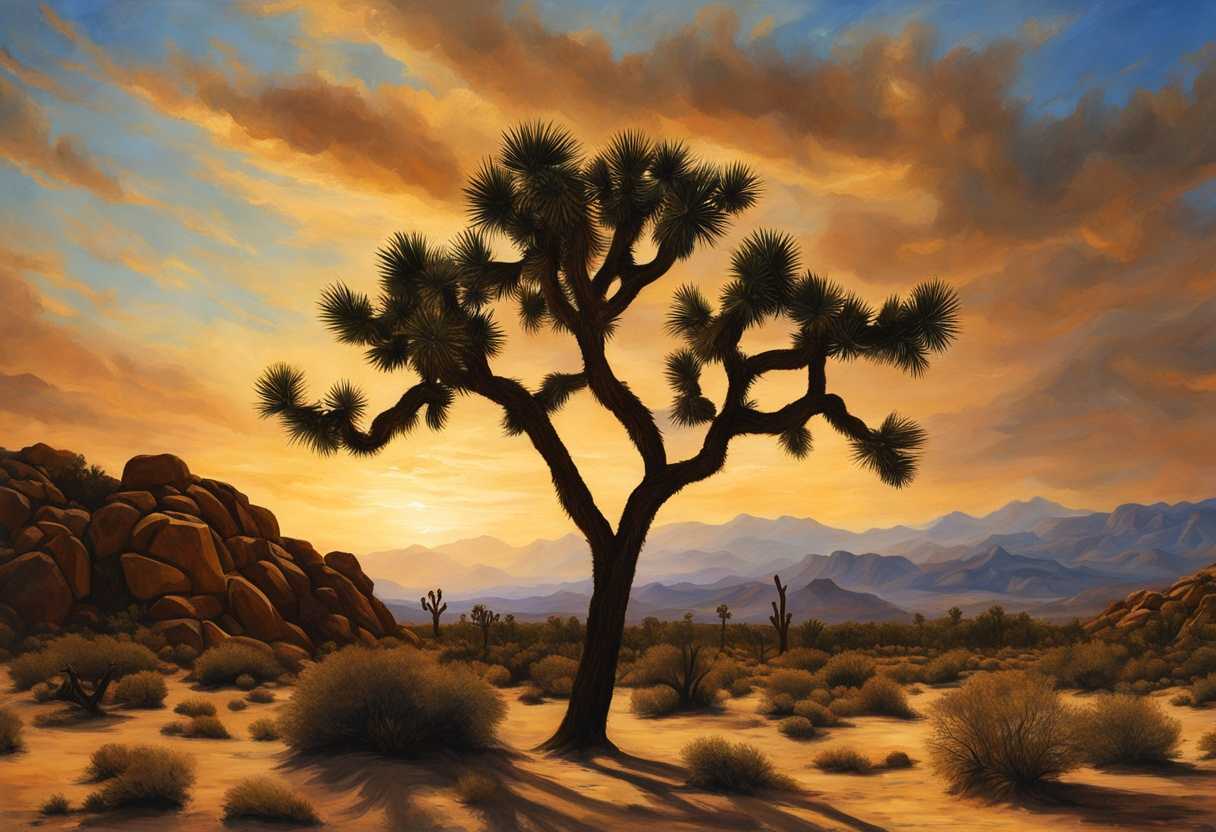
The Joshua Tree is not explicitly mentioned in the Bible, but its name is derived from the biblical figure Joshua. Some interpret the tree’s unusual appearance as symbolic of God’s guidance and presence in the wilderness, akin to how Joshua led the Israelites into the Promised Land.
Scripture
22 Then Moses made Israel set out from the Red Sea, and they went into the wilderness of Shur. And they went three days in the wilderness and found no water.
23 When they came to Marah, they could not drink the water of Marah because it was bitter; therefore it was named Marah.
24 And the people grumbled against Moses, saying, “What shall we drink?”
25 And he cried to the Lord, and the Lord showed him a log, and he threw it into the water, and the water became sweet.
26 saying, “If you will diligently listen to the voice of the Lord your God, and do that which is right in his eyes, and give ear to his commandments and keep all his statutes, I will put none of the diseases on you that I put on the Egyptians, for I am the Lord, your healer.”
27 Then they came to Elim, where there were twelve springs of water and seventy palm trees, and they encamped there by the water.
Biblical Significance of Joshua Tree
While the Joshua Tree is not directly referenced in the Bible, its name pays homage to the biblical figure Joshua, who is emblematic of leadership, faith, and the fulfillment of divine promises. Joshua led the Israelites into the Promised Land, emphasizing God’s unwavering guidance during a transformative journey. This journey is symbolic of the human experience, where believers navigate the wilderness of life seeking purpose and divine direction. In this context, the Joshua Tree, with its distinctive and resilient form, can be seen as a metaphor for the strength and support that believers find in God as they traverse their own wildernesses.
The unusual shape of the Joshua Tree, reaching upwards towards the heavens, also mirrors the call for believers to look toward God and seek His presence in times of uncertainty. This reflects passages such as Psalm 121:1-2, which state, “I lift my eyes to the hills. From where does my help come? My help comes from the Lord, who made heaven and earth.” In recognizing the Joshua Tree as a symbol of divine guidance, believers are reminded of God’s promise found in Isaiah 43:2: “When you pass through the waters, I will be with you; and through the rivers, they shall not overwhelm you.” Thus, the broader meaning of the Joshua Tree in a biblical context encompasses themes of hope, resilience, and the assurance of God’s steadfast presence amid life’s challenges.
Additionally, the story of Moses, who preceded Joshua, illuminates themes of deliverance and transformation that can resonate with the essence of the Joshua Tree. Moses’ mission to lead the Israelites from bondage into freedom echoes the resilience and fortitude displayed by the Joshua Tree itself, which thrives in arid desert conditions. Just as Moses experienced divine encounters in the wilderness—most notably at the burning bush—believers can find inspiration in the way the Joshua Tree stands firm, a testament to the possibility of flourishing even in harsh environments. This resilience invites believers to reflect on their own spiritual journeys, encouraging them to seek strength in the face of adversity, much like the Israelites relied on God’s promises during their desert wanderings.
Furthermore, the Joshua Tree serves as a reminder of God’s creative and sustaining power, evident in the diversity of life found in the desert ecosystem. Just as God fashioned each aspect of creation for a unique purpose, the Joshua Tree connects believers to the larger narrative of creation and providence. As the tree reaches skyward, it calls to mind the biblical principle of bearing fruit and being rooted in one’s faith. For believers, this symbolizes the importance of being anchored in God’s Word and growing spiritually amidst life’s challenges, reflecting the abundant life promised in Scripture. Together, these reflections create a rich tapestry of meaning surrounding the Joshua Tree, presenting it as an emblem of faith, divine assurance, and the hope found in God’s overarching plan for humanity.
Symbol of Resilience and Endurance
The Joshua Tree, with its ability to thrive in harsh desert conditions, serves as a powerful symbol of resilience and endurance. In biblical contexts, this can be interpreted as a representation of faith and perseverance in the face of adversity. Just as the Joshua Tree stands tall against the elements, individuals are encouraged to maintain their faith and strength during challenging times, reflecting the belief that divine support is present even in the most difficult circumstances.
Representation of Divine Guidance
The unique shape and stature of the Joshua Tree can also be seen as a metaphor for divine guidance. In the Bible, trees often symbolize life, growth, and the presence of God. The Joshua Tree, with its upward-reaching branches, may signify the direction towards which believers should aspire—seeking spiritual growth and guidance from a higher power. This imagery encourages individuals to look towards God for direction and support in their spiritual journeys.
Connection to the Promised Land
The Joshua Tree is native to the southwestern United States, particularly in areas that were historically significant to the Israelites. Its presence in the landscape can evoke themes of the Promised Land, a place of hope and fulfillment. In this context, the Joshua Tree may symbolize the journey of faith towards a promised future, reminding believers of the importance of hope and the fulfillment of God’s promises in their lives.
How to Cultivate Faith and Strengthen Your Christian Journey
Cultivating faith and strengthening your Christian journey is a deeply personal and transformative process that requires intentionality and openness. Start by immersing yourself in Scripture; the Bible is not just a book but a living guide that speaks to our hearts and circumstances. Set aside time each day for prayer, allowing it to be a two-way conversation where you not only speak but also listen for God’s gentle whispers. Surround yourself with a community of believers who can encourage and challenge you, as fellowship is vital in our walk of faith. Don’t shy away from sharing your struggles and victories, for vulnerability fosters deeper connections and accountability. Lastly, remember that faith is a journey, not a destination; embrace the ups and downs, knowing that each step brings you closer to understanding God’s love and purpose for your life. Trust in His timing and grace, and watch how your faith flourishes in ways you never imagined.
Bible References to the Joshua Tree Meaning:
Deuteronomy 8:7-10: 7 For the Lord your God is bringing you into a good land, a land of brooks of water, of fountains and springs, flowing out in the valleys and hills,
8 a land of wheat and barley, of vines and fig trees and pomegranates, a land of olive trees and honey,
9 a land in which you will eat bread without scarcity, in which you will lack nothing, a land whose stones are iron, and out of whose hills you can dig copper.
10 And you shall eat and be full, and you shall bless the Lord your God for the good land he has given you.
Isaiah 41:17-20: 17 When the poor and needy seek water, and there is none, and their tongue is parched with thirst, I the Lord will answer them; I the God of Israel will not forsake them.
18 I will open rivers on the bare heights, and fountains in the midst of the valleys. I will make the wilderness a pool of water, and the dry land springs of water.
19 I will put in the wilderness the cedar, the acacia, the myrtle, and the olive. I will set in the desert the cypress, the plane and the pine together,
20 that they may see and know,
may consider and understand together,
that the hand of the Lord has done this,
the Holy One of Israel has created it.
Jeremiah 17:7-8: 7 “Blessed is the man who trusts in the Lord,
whose trust is the Lord.
8 He is like a tree planted by water, that sends out its roots by the stream, and does not fear when heat comes, for its leaves remain green, and is not anxious in the year of drought, for it does not cease to bear fruit.
Ezekiel 47:1-12: 1 Then he brought me back to the door of the temple, and behold, water was issuing from below the threshold of the temple toward the east (for the temple faced east). The water was flowing down from below the south end of the threshold of the temple, south of the altar.
2 Then he brought me out by way of the north gate and led me around on the outside to the outer gate that faces towards the east, and behold, the water was trickling out on the south side.
3 Going on eastward with a measuring line in his hand, the man measured a thousand cubits, and then led me through the water, and it was ankle-deep.
4 Again he measured a thousand, and led me through the water, and it was knee-deep.
5 Again he measured a thousand, and it was a river that I could not pass through, for the water had risen. It was deep enough to swim in, a river that could not be passed through.
6 And he said to me, “Son of man, have you seen this?” Then he led me back to the bank of the river.
7 When I returned, behold, on the bank of the river there were very many trees on the one side and on the other.
8 And he said to me, “This water flows toward the eastern region and goes down into the Arabah, and enters the sea; when the water flows into the sea, the water will become fresh.
9 And wherever the river goes, every living creature that swarms will live, and there will be very many fish. For this water goes there, that the waters of the sea may become fresh; so everything will live where the river goes.
10 Fishermen will stand beside the sea. From Engedi to Eneglaim it will be a place for the spreading of nets. Their fish will be of very many kinds, like the fish of the Great Sea.
11 But its swamps and marshes will not become fresh; they are to be left for salt.
12 And on the banks, on both sides of the river, there will grow all kinds of trees for food. Their leaves will not wither, nor their fruit fail, but they will bear fresh fruit every month, because the water for them flows from the sanctuary. Their fruit will be for food, and their leaves for healing.
Revelation 22:1-2: 1 Then the angel showed me the river of the water of life, bright as crystal, flowing from the throne of God and of the Lamb,
2 through the middle of the street of the city; also, on either side of the river, the tree of life with its twelve kinds of fruit, yielding its fruit each month. The leaves of the tree were for the healing of the nations.

Reverend Ogunlade is a seasoned Church Minister with over three decades of experience in guiding and nurturing congregations. With profound wisdom and a serene approach, Reverend Ogunlade has carried out various pastoral duties, including delivering uplifting sermons, conducting religious ceremonies, and offering sage counsel to individuals seeking spiritual guidance. Their commitment to fostering harmony and righteousness within their community is exemplified through their compassionate nature, making them a beloved and trusted figure among the congregation.