
Succoth, in the Bible, refers to a location where the Israelites camped during their exodus from Egypt, symbolizing a place of temporary shelter and protection (Exodus 12:37). The name “Succoth” means “booths” or “shelters,” reflecting the temporary structures used by the people during their travels (Leviticus 23:34-43).
Scripture
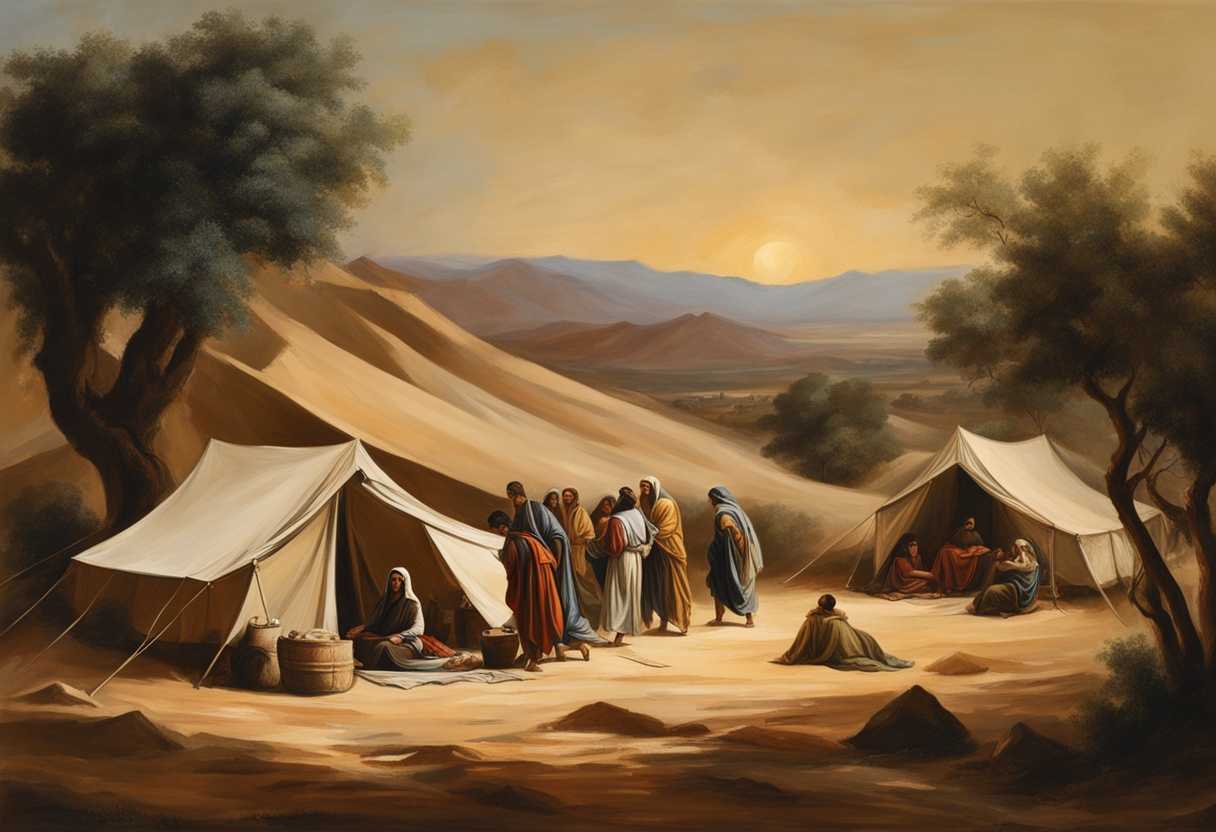
17 But Jacob journeyed to Succoth, and built himself a house and made booths for his livestock. Therefore the name of the place is called Succoth.
18 And Jacob came safely to the city of Shechem, which is in the land of Canaan, on his way from Paddan-aram, and he camped before the city.
19 And from the sons of Hamor, Shechem’s father, he bought for a hundred pieces of money the piece of land on which he had pitched his tent.
20 There he erected an altar and called it El-Elohe-Israel.
Meaning of Succoth in the Bible
Succoth holds significant meaning in the context of the biblical narrative, especially in relation to the Israelites’ journey from bondage in Egypt to the Promised Land. As recorded in Exodus 12:37, the Israelites camped at Succoth as they commenced their exodus, marking it as a place of transition and divine protection. The term “Succoth,” which translates to “booths” or “shelters,” aptly describes the temporary dwellings that the Israelites constructed during their wilderness travels (Leviticus 23:34-43). This imagery not only represents physical structures but also echoes the themes of dependence on God and the fleeting nature of earthly stability.
Moreover, the Feast of Tabernacles (or Succoth) commemorates this period of wandering and serves as a reminder of God’s faithfulness and provision in times of uncertainty. In Leviticus 23:42-43, God commands the Israelites to dwell in booths for seven days, reflecting on their historical experience and acknowledging the transient nature of life. This festival encapsulates a broader spiritual truth about living with an awareness of divine presence and care, encouraging believers to seek shelter in God amidst life’s uncertainties. Ultimately, Succoth symbolizes the importance of remembering where one has come from and the assurance of God’s continual guidance through both physical and spiritual journeys.
In addition to its role as a physical location during the Exodus, Succoth also embodies a deeper theological significance within the biblical narrative. The act of dwelling in booths during the Feast of Tabernacles invites the faithful to introspectively recognize their reliance on God for provision and security. Throughout scripture, temporary abodes often reflect the notion of God’s people not being at home in this world. As they commemorate their time in Succoth, believers learn to appreciate the fragility of human existence and the importance of spiritual anchoring amid the transitory nature of life.
Further, the Hebrew word “Succoth” can be associated with themes of sheltering and protection. This notion is echoed in various psalms where God is portrayed as a refuge—a place of safety during times of trouble. The sheltering imagery of booths serves to affirm that while the Israelites did indeed face physical challenges during their wanderings, there was a divine shelter encompassing them in their trials. This dual symbolism of Succoth reinforces the significance of trust in God’s provision. The observance of the Feast cultivates an attitude of gratitude, as participants not only remember their ancestors’ journey but also the ongoing act of God’s deliverance in their own lives—inviting the faithful to find strength and hope in each new season of wandering, both literally and metaphorically.
The Festival of Booths and Its Significance
Succoth, or the Feast of Tabernacles, represents a time of harvest and thanksgiving. It is a celebration that commemorates the Israelites’ journey through the wilderness and their reliance on God for sustenance and protection. This festival serves as a reminder of the transient nature of life and the importance of faith in divine provision. By dwelling in temporary shelters, participants reflect on their dependence on God and the blessings received during their journey.
A Symbol of Divine Protection
Succoth also embodies the theme of divine protection and guidance. The temporary structures symbolize the shelter provided by God during the Israelites’ exodus from Egypt. This aspect of Succoth emphasizes the belief that God watches over His people, guiding them through difficult times and providing safety in their travels. The observance of this festival reinforces the idea that, despite life’s uncertainties, faith in God’s protection is paramount.
A Call to Remember and Reflect
The observance of Succoth serves as a call to remember the past and reflect on God’s faithfulness. It encourages individuals to look back on their own journeys, acknowledging the challenges faced and the support received along the way. This reflective practice fosters gratitude and strengthens the community’s bond as they collectively celebrate their shared history and the blessings of the present. Through this remembrance, Succoth invites believers to cultivate a spirit of thankfulness and to recognize the ongoing presence of God in their lives.
How to Embrace Faith Through Tradition and Community
Embracing faith through tradition and community is a beautiful journey that can deepen your relationship with God and enrich your spiritual life. Start by participating in the rituals and practices that have been passed down through generations—whether it’s attending church services, celebrating religious holidays, or engaging in prayer groups. These traditions serve as a foundation, connecting you to a larger narrative of faith that transcends time. Additionally, immerse yourself in your community; find a local church or fellowship group where you can share your experiences, struggles, and joys with others. Building relationships with fellow believers not only provides support but also fosters accountability and growth in your faith. Remember, faith is not just a personal endeavor; it thrives in the warmth of shared experiences and collective worship. So, lean into these traditions and community connections, and watch how they transform your spiritual journey into something vibrant and alive.
Bible References to the Meaning of Succoth:
Exodus 12:37-39: 37 And the people of Israel journeyed from Rameses to Succoth, about six hundred thousand men on foot, besides women and children.
38 A mixed multitude also went up with them, and very much livestock, both flocks and herds.
39 And they baked unleavened cakes of the dough that they had brought out of Egypt, for it was not leavened, because they were thrust out of Egypt and could not wait, nor had they prepared any provisions for themselves.
Exodus 13:20-22: 20 And they moved on from Succoth and encamped at Etham, on the edge of the wilderness.
21 And the Lord went before them by day in a pillar of cloud to lead them along the way, and by night in a pillar of fire to give them light, that they might travel by day and by night.
22 The pillar of cloud by day and the pillar of fire by night did not depart from before the people.
Numbers 33:5-6: 5 And the people of Israel set out from Rameses and camped at Succoth.
6 And they set out from Succoth and camped at Etham, which is on the edge of the wilderness.
Judges 8:4-9: 4 And Gideon came to the Jordan and crossed over, he and the 300 men who were with him, exhausted yet pursuing.
5 And he said to the men of Succoth, “Please give loaves of bread to the people who follow me, for they are exhausted, and I am pursuing after Zebah and Zalmunna, the kings of Midian.”
6 And the officials of Succoth said, “Are the hands of Zebah and Zalmunna already in your hand, that we should give bread to your army?”
7 And Gideon said, “Well then, when the Lord has given Zebah and Zalmunna into my hand, I will flail your flesh with the thorns of the wilderness and with briers.”
8 And he went up from there to Penuel and spoke to them in the same way, and the men of Penuel answered him as the men of Succoth had answered.
9 And he said to the men of Penuel, “When I come again in peace, I will break down this tower.”
Judges 8:13-17: 13 Gideon the son of Joash returned from the battle by the ascent of Heres.
14 And he captured a young man of Succoth and questioned him. And he wrote down for him the officials and elders of Succoth, seventy-seven men.
15 And he came to the men of Succoth and said, “Behold Zebah and Zalmunna, about whom you taunted me, saying, ‘Are the hands of Zebah and Zalmunna already in your hand, that we should give bread to your men who are exhausted?’”
16 And he took the elders of the city and he took thorns of the wilderness and briers and with them taught the men of Succoth.
17 And he broke down the tower of Penuel and killed the men of the city.
1 Kings 7:40-46: 40 Hiram also made the pots, the shovels, and the basins. So Hiram finished all the work that he did for King Solomon on the house of the Lord:
41 The two pillars, the two bowls of the capitals that were on the tops of the pillars, and the two latticeworks to cover the two bowls of the capitals that were on the tops of the pillars;
42 the four hundred pomegranates for the two networks, two rows of pomegranates for each network to cover the two bowls of the capitals that were on the tops of the pillars;
43 And the ten stands, and the ten basins on the stands;
44 and the one sea, twelve oxen underneath it.
45 and the pots, the shovels, and the basins. All these vessels that Hiram made for King Solomon for the house of the Lord were of burnished bronze.
46 In the plain of the Jordan the king cast them, in the clay ground between Succoth and Zarethan.
1 Chronicles 2:45-47: 45 The son of Shammai: Maon, and Maon was the father of Beth-zur.
46 Ephah also concubine of Caleb bore Haran, Moza, and Gazez; and Haran fathered Gazez.
47 Jahdai, Regem, Jotham, Geshan, Pelet, Ephah, and Shaaph.
Psalms 60:6-8: 6 God has spoken in his holiness:
“With exultation I will divide up Shechem
and portion out the Valley of Succoth.
7 Gilead is mine; Manasseh is mine; Ephraim is my helmet; Judah is my scepter.
8 Moab is my washbasin; upon Edom I cast my shoe; over Philistia I shout in triumph.”
Psalms 108:7-9: 7 God has promised in his holiness: “With exultation I will divide up Shechem and portion out the Valley of Succoth.
8 Gilead is mine; Manasseh is mine; Ephraim is my helmet; Judah is my scepter.
9 Moab is my washbasin; upon Edom I cast my shoe; over Philistia I shout in triumph.”

Rev. François Dupont is a dedicated church minister with a wealth of experience in serving spiritual communities. With a calm and serene demeanor, he has been devoted to sharing the message of love, compassion, and tolerance for over two decades. Through his thoughtful sermons, compassionate counseling, and unwavering support, Rev. Dupont has touched the lives of countless individuals, allowing them to find solace and strength during difficult times. His serene presence and deep understanding of the human condition make him a trusted guide for those seeking spiritual nourishment and guidance.