
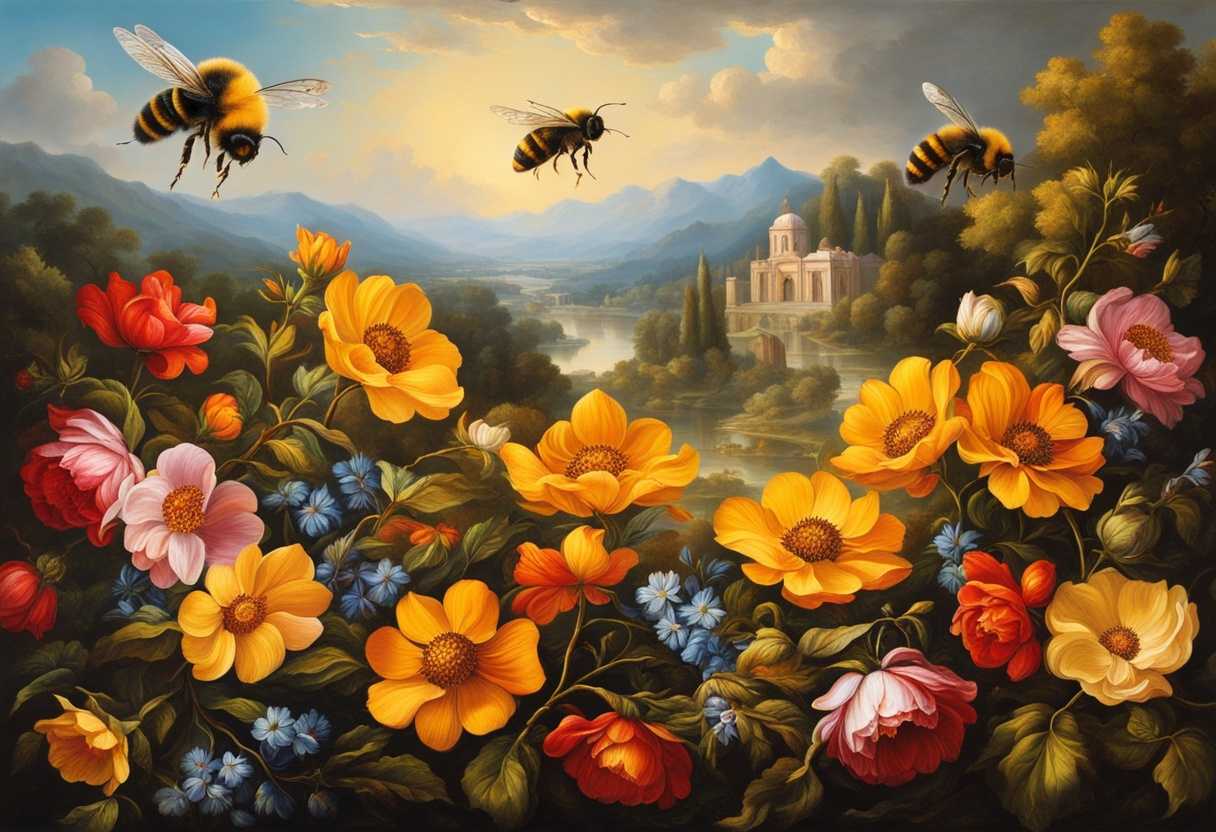
In the Bible, bees symbolize industriousness and the sweetness of God’s blessings. They are mentioned in contexts such as the land of Canaan being described as “a land flowing with milk and honey” (Exodus 3:8), indicating abundance and prosperity.
Scripture
5 Then Samson went down with his father and mother to Timnah, and they came to the vineyards of Timnah. And behold, a young lion came toward him roaring.
6 Then the Spirit of the Lord rushed upon him, and although he had nothing in his hand, he tore the lion in pieces as one tears a young goat. But he did not tell his father or his mother what he had done.
7 Then he went down and talked with the woman, and she was right in Samson’s eyes.
8 After some days he returned to take her. And he turned aside to see the carcass of the lion, and behold, there was a swarm of bees in the body of the lion, and honey.
9 He scraped it out into his hands and went on, eating as he went. And he came to his father and mother and gave some to them, and they ate.
Biblical Significance of Bees
The biblical significance of bees transcends their role as mere insects, illustrating themes of industriousness, community, and divine blessing. In the verse Exodus 3:8, the phrase “a land flowing with milk and honey” not only emphasizes physical abundance but also signifies a spiritual richness associated with God’s promise to the Israelites. Moreover, bees operate within a highly structured society, diligently working together to produce honey, which can be seen as a metaphor for the body of Christ (1 Corinthians 12:12-27) where each member plays a vital role in contributing to the overall health and flavor of the community of believers. This industriousness is further echoed in Proverbs 6:6, which admonishes sluggards to “Go to the ant, you sluggard; consider its ways and be wise,” reinforcing the value of hard work and preparation akin to the behavior of bees in their hives.
Furthermore, honey, produced by bees, is often seen as a representation of God’s blessings and goodness. Psalm 119:103 states, “How sweet are your words to my taste, sweeter than honey to my mouth!” This highlights the spiritual nourishment provided through God’s teachings. The relationship between bees and honey serves to illustrate the concept of diligence leading to reward and the sweetness of abiding in faith. Thus, bees in the biblical context not only reflect the industriousness that God desires from His people but also the abundance and sweetness of His covenantal promises, inviting believers to partake in and share the fruits of their labor as a testament to God’s grace and provision.
In addition to their industrious nature and the sweetness of honey, bees symbolize purity and the divine presence within biblical narratives. In ancient cultures, the bee was often associated with divine messengers, reflecting their industrious behavior and their role in pollination, which was critical for sustaining life. This representation can be correlated with the notion of being set apart for God’s purpose. The honeycomb, crafted with precision by the bees, served as a vital source of sustenance and nourishment, reminiscent of the sacredness of the divine law which sustains the spiritual life of God’s people. The meticulous construction of the hive is akin to the careful planning of God’s creation and His providential care over human affairs, highlighting that order and discipline lead to a fruitful life both materially and spiritually.
Moreover, the presence of bees in biblical texts also brings implications of community and cooperation. The lifecycle of bees, where they work tirelessly for the collective benefit of the hive, mirrors the biblical call to unity among believers. Just as bees bring together pollen from various flowers, contributing to a thriving ecosystem, Christians are encouraged to strengthen one another and build relationships that foster growth. This idea resonates deeply within the context of the church, where each individual is gifted uniquely to contribute to the common good. Thus, the biblical significance of bees is multifaceted, reflecting themes of divine provision, community, and the call to live a life of purposeful diligence that echoes God’s design for humanity, ultimately drawing believers closer to the sweetness of His will and the joy found in service.
Symbol of Hard Work and Diligence
Bees are often seen as a representation of hard work and diligence in the biblical context. Their tireless efforts in gathering nectar and producing honey serve as a metaphor for the importance of labor and perseverance in one’s spiritual and daily life. This symbolism encourages believers to engage in their tasks with dedication and commitment, reflecting the industrious nature of bees.
Representation of Sweetness and Abundance
In the Bible, honey is frequently associated with sweetness and abundance, often symbolizing the blessings and goodness of God. Bees, as the producers of honey, embody this idea of divine provision and the richness of life that comes from following God’s path. This connection highlights the notion that spiritual fulfillment and joy can be found in the fruits of one’s labor and in the blessings bestowed by God.
Community and Cooperation
Bees are known for their highly organized social structure and cooperative behavior within the hive. This aspect of their nature can be seen as a reflection of the importance of community and unity among believers. The biblical significance of bees emphasizes the value of working together in harmony, supporting one another, and contributing to the greater good of the community, much like the way bees collaborate for the survival and success of their hive.
How to Embrace Abundance Through Faith and Service
Embracing abundance through faith and service is a transformative journey that invites us to shift our focus from scarcity to the richness of God’s blessings. When we cultivate a deep trust in God’s provision, we begin to see that abundance isn’t just about material wealth; it’s about the love, joy, and peace that flow from a life dedicated to serving others. Start by nurturing your relationship with God through prayer and scripture, allowing His promises to fill your heart with hope. Then, look for opportunities to serve those around you—whether it’s volunteering at a local shelter, offering a listening ear to a friend in need, or simply sharing a kind word. Each act of service not only enriches the lives of others but also deepens your own sense of purpose and fulfillment. Remember, as you give of yourself, you open the door to experiencing the true abundance that comes from living a life rooted in faith and love.
Bible References to the Significance of Bees:
Deuteronomy 1:44-45: 44 Then the Amorites who lived in that hill country came out against you and chased you as bees do and beat you down in Seir, as far as Hormah.
45 And you returned and wept before the Lord, but the Lord did not listen to your voice or give ear to you.
Psalm 118:12-13: 12 They surrounded me like bees; they went out like a fire among thorns; in the name of the Lord I cut them off!
13 You pushed me hard, so that I was falling, but the Lord helped me.
Isaiah 7:18-19: 18 In that day the Lord will whistle for the fly that is at the end of the streams of Egypt, and for the bee that is in the land of Assyria.
19 And they will all come and settle in the steep ravines, and in the clefts of the rocks, and on all the thornbushes, and on all the pastures.
Proverbs 16:24-25: 24 Gracious words are like a honeycomb,
sweetness to the soul and health to the body.
25 There is a way that seems right to a man, but its end is the way to death.
1 Samuel 14:25-27: 25 Now when all the people came to the forest, behold, there was honey on the ground.
26 And when the people entered the forest, behold, the honey was dropping, but no one put his hand to his mouth, for the people feared the oath.
27 But Jonathan had not heard his father charge the people with the oath, so he put out the tip of the staff that was in his hand and dipped it in the honeycomb and put his hand to his mouth, and his eyes became bright.
Exodus 3:8-10: 8 and I have come down to deliver them out of the hand of the Egyptians and to bring them up out of that land to a good and broad land, a land flowing with milk and honey, to the place of the Canaanites, the Hittites, the Amorites, the Perizzites, the Hivites, and the Jebusites.
9 And now, behold, the cry of the people of Israel has come to me, and I have also seen the oppression with which the Egyptians oppress them.
10 Come, I will send you to Pharaoh that you may bring my people, the children of Israel, out of Egypt.”
Matthew 3:4-5: 4 Now John wore a garment of camel’s hair and a leather belt around his waist, and his food was locusts and wild honey.
5 Then Jerusalem and all Judea and all the region about the Jordan were going out to him,

Reverend Ogunlade is a seasoned Church Minister with over three decades of experience in guiding and nurturing congregations. With profound wisdom and a serene approach, Reverend Ogunlade has carried out various pastoral duties, including delivering uplifting sermons, conducting religious ceremonies, and offering sage counsel to individuals seeking spiritual guidance. Their commitment to fostering harmony and righteousness within their community is exemplified through their compassionate nature, making them a beloved and trusted figure among the congregation.