
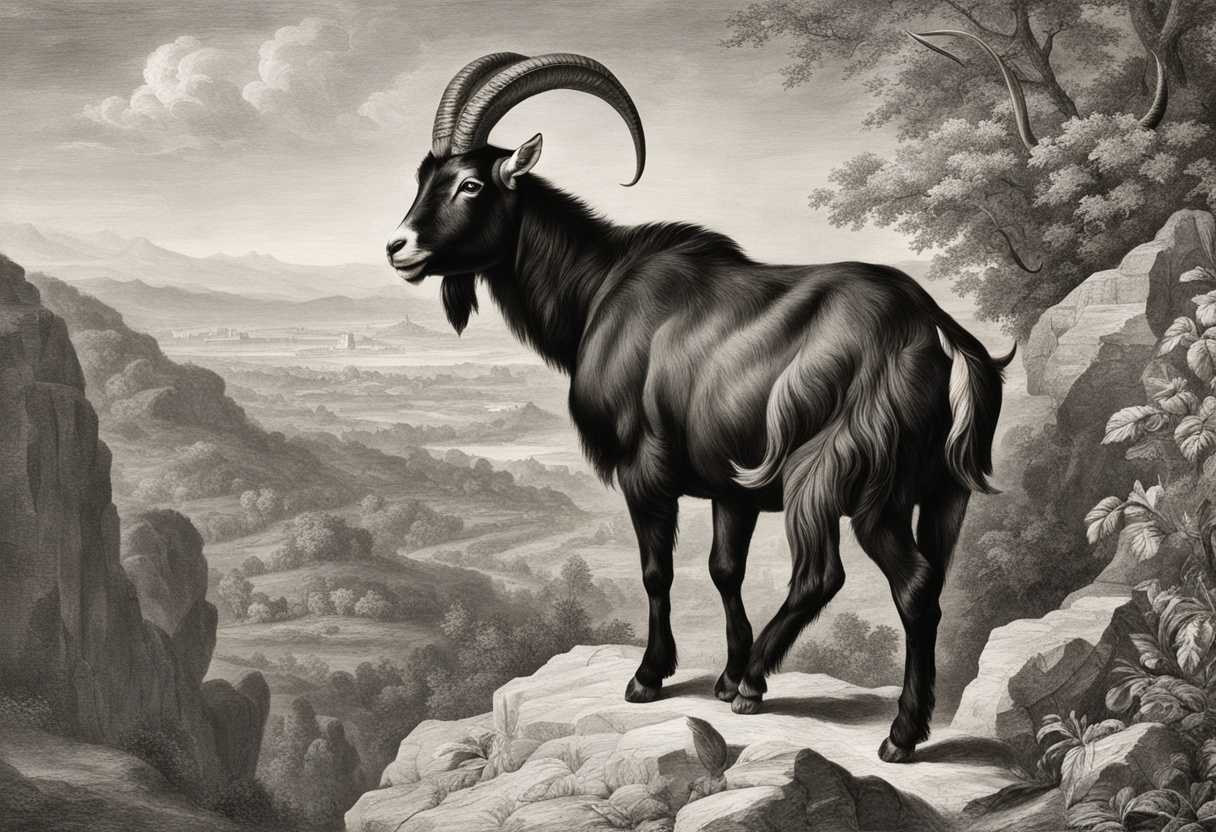
In the Bible, goats often symbolize sin and atonement, as seen in the ritual of the scapegoat in Leviticus 16, where a goat is sent into the wilderness to bear the sins of the people. Additionally, goats are used in various parables and teachings, representing both the unrighteous and the righteous, as seen in the separation of the sheep and goats in Matthew 25:31-46.
Scripture
7 Then he shall take the two goats and set them before the Lord at the entrance of the tent of meeting.
8 And Aaron shall cast lots over the two goats, one lot for the Lord and the other lot for Azazel.
9 And Aaron shall present the goat on which the lot fell for the Lord and use it as a sin offering,
10 But the goat on which the lot fell for Azazel shall be presented alive before the Lord to make atonement over it, that it may be sent away into the wilderness to Azazel.
Biblical Significance of Goats
In biblical literature, goats hold a multifaceted significance that intertwines the themes of sin, atonement, and judgment. In Leviticus 16:10, the concept of the scapegoat is introduced, where one goat is designated to be sacrificed as a sin offering, while another, the scapegoat, symbolically carries the sins of the people into the wilderness. This ritual emphasizes the need for atonement and the hope for purification, as the scapegoat effectively illustrates the transfer of guilt away from the community. The act of sending the goat into the wilderness serves as a powerful metaphor for the removal of sin, echoing the broader theological theme of redemption that permeates the entirety of scripture.
Furthermore, the metaphorical use of goats extends into New Testament teachings, particularly in Matthew 25:31-46, where Jesus speaks of the final judgment and the division of the righteous (represented by sheep) from the unrighteous (represented by goats). This stark imagery serves to illustrate the consequences of one’s actions and faith, emphasizing the importance of compassion and righteousness. In this context, goats symbolize those who fail to embody the principles of the kingdom of God, highlighting a critical call to live a life reflective of faith and service. Collectively, these references to goats in the Bible navigate the complex landscape of sin, atonement, and moral accountability, thereby inviting believers to a deeper understanding of their faith journey and relationship with God.
In addition to their roles in atonement and judgment, goats in the Bible are often emblematic of the dichotomy between worldly desires and spiritual obedience. In the pastoral imagery frequently employed in scripture, goats are depicted as animals that wander and often stray from the flock. This tendency to go astray parallels the biblical narrative of Israel as a chosen people who frequently falter in their covenant with God, illustrating the human inclination toward sin and rebellion. For instance, in Psalm 95, the imagery of straying from the flock resonates with God’s desire for His people to remain committed to Him, serving as a reminder of the both the folly of wandering hearts and the necessity of divine guidance.
Moreover, goats are often associated with the concept of sacrifice and provision. In the story of Abraham and Isaac, the provision of a ram in the thicket serves as a poignant reminder of God’s providential care, with goats frequently substituted for rams and lambs in various sacrificial systems outlined in the Pentateuch. This system of offerings not only reflects an acknowledgment of human sinfulness but also emphasizes God’s desire for reconciliation and relationship. The appearance of goats in these contexts reveals their complex role within the sacrificial economy, serving as tangible representations of both judgment and mercy, thus encapsulating the idea that through sacrifice, redemption can be achieved. The symbolism of goats, therefore, serves as a powerful reminder of the ongoing tension between human fallibility and divine grace, encouraging believers to seek a deeper connection with their faith and the abundant life promised through obedience to God.
Symbol of Sacrifice and Atonement
In biblical tradition, goats often represent the concept of sacrifice and atonement. They were commonly used in various sacrificial rituals, symbolizing the transfer of sin and guilt from the people to the animal. This act of sacrifice was seen as a means to restore the relationship between humanity and God, highlighting the importance of atonement in the spiritual journey.
Representation of Duality
Goats also embody the theme of duality in biblical narratives. They can symbolize both good and evil, as seen in their contrasting roles in different contexts. This duality reflects the broader human experience of moral choices and the struggle between righteousness and sin. The imagery of goats serves to remind believers of the complexities of life and the necessity of discernment in their spiritual walk.
Emblem of Wilderness and Freedom
In many biblical accounts, goats are associated with wilderness and freedom. They are often depicted as creatures that thrive in rugged terrains, symbolizing resilience and adaptability. This connection to the wilderness can also represent the journey of faith, where believers navigate through trials and tribulations, ultimately seeking spiritual liberation and closeness to God.
How to Embrace Sacrifice for a Stronger Faith
Embracing sacrifice is a profound way to deepen your faith and draw closer to God. It often requires stepping out of your comfort zone, whether that means giving up your time to serve others, letting go of material possessions, or even enduring personal hardships for the sake of your beliefs. Remember, Jesus exemplified the ultimate sacrifice, and by following His example, we can find strength in our struggles. Start small—perhaps by volunteering at a local charity or dedicating time to prayer and reflection. As you make these sacrifices, you’ll likely discover a renewed sense of purpose and connection to your faith. Each act of selflessness not only strengthens your relationship with God but also inspires those around you, creating a ripple effect of love and compassion in your community. Embrace the journey, knowing that every sacrifice brings you one step closer to the heart of Christ.
Bible References to the Significance of Goats:
Leviticus 16:20-22: 20 “And when he has made an end of atoning for the Holy Place and the tent of meeting and the altar, he shall present the live goat.”
21 And Aaron shall lay both his hands on the head of the live goat, and confess over it all the iniquities of the people of Israel, and all their transgressions, all their sins. And he shall put them on the head of the goat and send it away into the wilderness by the hand of a man who is in readiness.
22 And the goat shall bear all their iniquities on itself to a remote area, and he shall let the goat go free in the wilderness.
Numbers 15:27-29: 27 “If one person sins unintentionally, he shall offer a female goat a year old for a sin offering.”
28 And the priest shall make atonement before the Lord for the person who makes a mistake, when he sins unintentionally, to make atonement for him, and he shall be forgiven.
29 You shall have one law for him who does anything unintentionally, for him who is native among the people of Israel and for the stranger who sojourns among them.
Numbers 28:19-22: 19 but offer a food offering, a burnt offering to the Lord: two bulls from the herd, one ram, and seven male lambs a year old;
20 And their grain offering shall be of fine flour mixed with oil, three tenths of an ephah for the bull, two tenths for the ram,
21 a tenth of an ephah for each of the seven lambs;
22 one male goat for a sin offering, to make atonement for you.
Deuteronomy 14:4-5: 4 These are the animals you may eat: the ox, the sheep, the goat,
5 the deer, the gazelle, the roebuck, the wild goat, the ibex, the antelope, and the mountain sheep.
Judges 6:19-21: 19 So Gideon went into his house and prepared a young goat and unleavened cakes from an ephah of flour. The meat he put in a basket, and the broth he put in a pot, and brought them to him under the terebinth and presented them.
20 And the angel of God said to him, “Take the meat and the unleavened cakes, and put them on this rock, and pour the broth over them.” And he did so.
21 Then the angel of the Lord reached out the tip of the staff that was in his hand and touched the meat and the unleavened cakes. And fire sprang up from the rock and consumed the meat and the unleavened cakes. And the angel of the Lord vanished from his sight.
1 Samuel 10:3-4: 3 Then you shall go on from there farther and come to the oak of Tabor. Three men going up to God at Bethel will meet you there, one carrying three young goats, another carrying three loaves of bread, and another carrying a skin of wine.
4 And they will greet you and give you two loaves of bread, which you shall accept from their hand.
1 Samuel 15:22-23: 22 And Samuel said, “Has the Lord as great delight in burnt offerings and sacrifices, as in obeying the voice of the Lord? Behold, to obey is better than sacrifice, and to listen than the fat of rams.
23 For rebellion is as the sin of divination, and presumption is as iniquity and idolatry. Because you have rejected the word of the Lord, he has also rejected you from being king.”
2 Chronicles 29:21-24: 21 And they brought seven bulls, seven rams, seven lambs, and seven male goats for a sin offering for the kingdom and for the sanctuary and for Judah. And he commanded the priests, the sons of Aaron, to offer them on the altar of the Lord.
22 So they slaughtered the bulls, and the priests received the blood and threw it against the altar.
23 Then the goats for the sin offering were brought to the king and the assembly, and they laid their hands on them,
24 And the priests slaughtered them and made a sin offering with their blood on the altar, to make atonement for all Israel. For the king commanded that the burnt offering and the sin offering should be made for all Israel.
Isaiah 1:11-15: 11 “What to me is the multitude of your sacrifices? says the Lord; I have had enough of burnt offerings of rams and the fat of well-fed beasts; I do not delight in the blood of bulls, or of lambs, or of goats.”
12 “When you come to appear before me,
who has required of you
this trampling of my courts?
13 Bring no more vain offerings; incense is an abomination to me.
14 Your new moons and your appointed feasts my soul hates; they have become a burden to me; I am weary of bearing them.
15 When you spread out your hands,
I will hide my eyes from you;
even though you make many prayers,
I will not listen;
your hands are full of blood.
Ezekiel 34:17-19: 17 “As for you, my flock, thus says the Lord God: Behold, I judge between sheep and sheep, between rams and male goats.
18 Is it not enough for you to feed on the good pasture, that you must tread down with your feet the rest of your pasture; and to drink of clear water, that you must muddy the rest of the water with your feet?
19 And as for my flock, they shall eat what you have trodden with your feet, and they shall drink what you have muddied with your feet.
Daniel 8:5-8: 5 As I was considering, behold, a male goat came from the west across the face of the whole earth, without touching the ground. And the goat had a conspicuous horn between his eyes.
6 He came to the ram with the two horns, which I had seen standing on the bank of the canal, and he ran at him in his powerful wrath.
7 I saw him come close to the ram, and he was enraged against him and struck the ram and broke his two horns. And the ram had no power to stand before him, but he cast him down to the ground and trampled on him. And there was no one who could rescue the ram from his power.
8 Then the goat became exceedingly great, but when he was strong, the great horn was broken, and instead of it there came up four conspicuous horns toward the four winds of heaven.
Matthew 25:31-33: 31 “When the Son of Man comes in his glory, and all the angels with him, then he will sit on his glorious throne.
32 Before him will be gathered all the nations, and he will separate people one from another as a shepherd separates the sheep from the goats.
33 And he will place the sheep on his right, but the goats on the left.
Matthew 25:34-46: 34 Then the King will say to those on his right, ‘Come, you who are blessed by my Father, inherit the kingdom prepared for you from the foundation of the world.
35 For I was hungry and you gave me food, I was thirsty and you gave me drink, I was a stranger and you welcomed me,
36 I was naked and you clothed me, I was sick and you visited me, I was in prison and you came to me.
37 Then the righteous will answer him, saying, ‘Lord, when did we see you hungry and feed you, or thirsty and give you drink?
38 Then the righteous will answer him, saying, ‘Lord, when did we see you hungry and feed you, or thirsty and give you drink?
39 And when did we see you sick or in prison and visit you?
40 And the King will answer them, ‘Truly, I say to you, as you did it to one of the least of these my brothers, you did it to me.’
41 “Then he will say to those on his left, ‘Depart from me, you cursed, into the eternal fire prepared for the devil and his angels.
42 For I was hungry and you gave me no food, I was thirsty and you gave me no drink,
43 I was a stranger and you did not welcome me, naked and you did not clothe me, sick and in prison and you did not visit me.
44 Then they also will answer, saying, ‘Lord, when did we see you hungry or thirsty or a stranger or naked or sick or in prison, and did not minister to you?’
45 Then he will answer them, saying, ‘Truly, I say to you, as you did not do it to one of the least of these, you did not do it to me.’
46 And these will go away into eternal punishment, but the righteous into eternal life.
Hebrews 9:12-14: 12 he entered once for all into the holy places, not by means of the blood of goats and calves but by means of his own blood, thus securing an eternal redemption.
13 For if the blood of goats and bulls, and the sprinkling of defiled persons with the ashes of a heifer, sanctify for the purification of the flesh,
14 how much more will the blood of Christ, who through the eternal Spirit offered himself without blemish to God, purify our conscience from dead works to serve the living God.

Reverend Ogunlade is a seasoned Church Minister with over three decades of experience in guiding and nurturing congregations. With profound wisdom and a serene approach, Reverend Ogunlade has carried out various pastoral duties, including delivering uplifting sermons, conducting religious ceremonies, and offering sage counsel to individuals seeking spiritual guidance. Their commitment to fostering harmony and righteousness within their community is exemplified through their compassionate nature, making them a beloved and trusted figure among the congregation.