
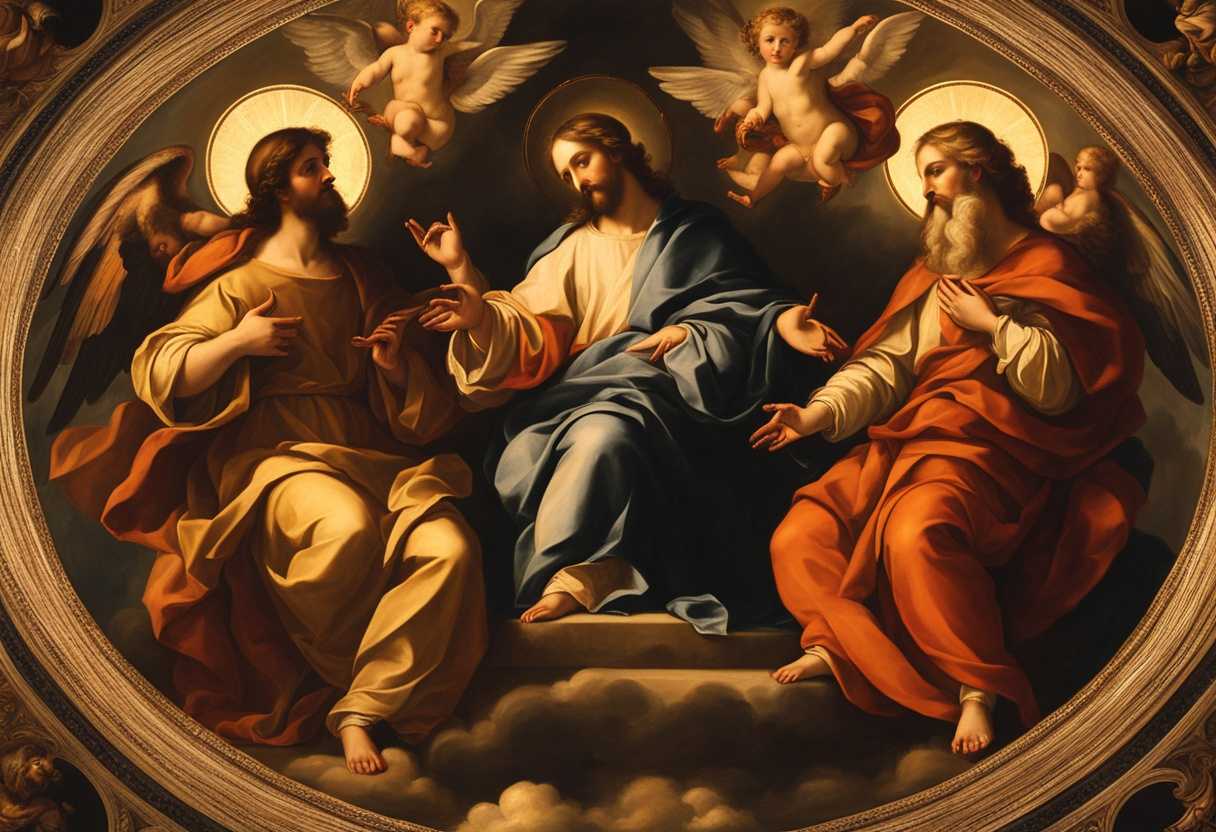
In the Bible, “consubstantial” refers to the belief that Jesus Christ, as the Son of God, is of the same substance or essence as God the Father. This doctrine is central to the understanding of the Holy Trinity, affirming the unity and co-equality of the three persons: the Father, the Son, and the Holy Spirit.
Scripture
26 Then God said, “Let us make man in our image, after our likeness. And let them have dominion over the fish of the sea and over the birds of the heavens and over the livestock and over all the earth and over every creeping thing that creeps on the earth.”
27 So God created man in his own image,
in the image of God he created him;
male and female he created them.
Biblical Definition of Consubstantial
The concept of “consubstantial” is foundational within Christian theology, particularly as articulated in the Nicene Creed, where it proclaims that the Son is “true God from true God, begotten, not made, of one substance with the Father.” This understanding is rooted in various passages of the Bible. For instance, the Gospel of John opens with a profound declaration: “In the beginning was the Word, and the Word was with God, and the Word was God” (John 1:1). This verse underscores the eternal nature of Christ and His complete unity with God the Father. Similarly, Hebrews 1:3 reinforces this by stating that the Son is “the radiance of God’s glory and the exact representation of his being,” highlighting the intimate relationship and shared essence between the Father and the Son.
The theological emphasis on consubstantiality not only affirms the divine nature of Jesus but also serves to establish the framework for understanding the Holy Trinity as a mystery of faith where the three persons exist co-equally and consubstantially. Jesus Himself, in John 10:30, reinforces this unity by saying, “I and the Father are one.” This profound unity bears implications for the believer’s understanding of salvation, as it recognizes that through Christ, who shares the divine nature, humanity is offered redemption and reconciliation to God. Thus, the doctrine of consubstantiality is integral to Christian faith, shaping both the understanding of the divine and the relationship between believers and God.
The doctrine of consubstantiality also finds relevance in the descriptions of Jesus as the Messiah, particularly in the context of the Old Testament prophetic texts, which signal His divine identity. In Isaiah 9:6, titles such as “Mighty God” and “Everlasting Father” are ascribed to the coming Messiah, indicating a nature that transcends mere human existence. This profound characterization suggests a unity of essence with God that underpins the New Testament’s revelation of Christ, inviting believers to perceive this divine relationship as integral to understanding God’s redemptive plan.
Furthermore, the collective worship practice of the early church reflects an understanding of Christ’s consubstantiality with the Father. In the Acts of the Apostles, believers are depicted as gathering to worship and pray to Jesus, often invoking His name alongside the Father. This communal acknowledgment of Jesus’ divine nature implies a recognition of His oneness with God, reinforcing the fundamental tenets of the faith that regard Him as not just a prophet or teacher, but as fully and truly God, sharing the divine essence that is pivotal for the doctrine of salvation. The unity of purpose, character, and power among the Father, Son, and Holy Spirit vividly encapsulates the essence of consubstantiality, manifesting through the lived experiences and beliefs of early Christians, thereby cementing this foundational truth within the broader narrative of Scripture.
The Unity of the Divine Nature
The term “consubstantial” signifies the shared essence or substance among the persons of the Trinity—Father, Son, and Holy Spirit. This concept emphasizes that while each person of the Trinity is distinct, they are united in their divine nature. This unity is foundational for understanding the Christian doctrine of God as a relational being, where love and communion exist eternally within the Godhead.
The Affirmation of Christ’s Divinity
In the context of Christology, the term “consubstantial” affirms the full divinity of Jesus Christ. It asserts that Jesus is not a created being but rather shares the same divine essence as God the Father. This understanding is crucial for the Christian faith, as it underpins the belief in the incarnation, where God became man without losing His divine nature, thus enabling the possibility of salvation through Christ.
The Foundation for Christian Doctrine
The concept of consubstantiality serves as a cornerstone for various Christian doctrines, including the nature of salvation, the authority of Scripture, and the understanding of the Church. By affirming that the Son is consubstantial with the Father, believers are called to recognize the significance of the Trinity in their faith and practice, fostering a deeper relationship with God and a more profound understanding of His revelation to humanity.
How to Embrace the Trinity for Spiritual Growth
Embracing the Trinity—Father, Son, and Holy Spirit—can profoundly enrich your spiritual journey and deepen your relationship with God. Start by recognizing the unique roles each Person of the Trinity plays in your life: the Father as your Creator and sustainer, the Son as your Savior and Redeemer, and the Holy Spirit as your Comforter and Guide. Spend time in prayer, inviting each aspect of the Trinity into your daily life; for instance, thank the Father for His love, seek the Son’s guidance through Scripture, and ask the Holy Spirit to illuminate your path and empower your actions. As you cultivate this relationship, you’ll find that understanding the interconnectedness of the Trinity not only enhances your faith but also encourages you to reflect God’s love and grace in your interactions with others. Remember, spiritual growth is a journey, and embracing the fullness of the Trinity can lead you to a more vibrant and fulfilling Christian life.
Bible References to Consubstantiality Explained:
John 1:1-14: 1 In the beginning was the Word, and the Word was with God, and the Word was God.
2 He was in the beginning with God.
3 All things were made through him, and without him was not any thing made that was made.
4 In him was life, and the life was the light of men.
5 The light shines in the darkness, and the darkness has not overcome it.
6 There was a man sent from God, whose name was John.
7 He came as a witness, to bear witness about the light, that all might believe through him.
8 He was not the light, but came to bear witness about the light.
9 The true light, which gives light to everyone, was coming into the world.
10 He was in the world, and the world was made through him, yet the world did not know him.
11 He came to his own, and his own people did not receive him.
12 But to all who did receive him, who believed in his name, he gave the right to become children of God,
13 who were born, not of blood nor of the will of the flesh nor of the will of man, but of God.
14 And the Word became flesh and dwelt among us, and we have seen his glory, glory as of the only Son from the Father, full of grace and truth.
John 10:30-38: 30 I and the Father are one.
31 The Jews picked up stones again to stone him.
32 Jesus answered them, “I have shown you many good works from the Father; for which of them are you going to stone me?”
33 The Jews answered him, “It is not for a good work that we are going to stone you but for blasphemy, because you, being a man, make yourself God.”
34 Jesus answered them, “Is it not written in your Law, ‘I said, you are gods’?”
35 If he called them gods to whom the word of God came—and Scripture cannot be broken—
36 do you say of him whom the Father consecrated and sent into the world, ‘You are blaspheming,’ because I said, ‘I am the Son of God’?
37 If I am not doing the works of my Father, then do not believe me;
38 but if I do them, even though you do not believe me, believe the works, that you may know and understand that the Father is in me and I am in the Father.”
John 14:8-11: 8 Philip said to him, “Lord, show us the Father, and it is enough for us.”
9 Jesus said to him, “Have I been with you so long, and you still do not know me, Philip? Whoever has seen me has seen the Father. How can you say, ‘Show us the Father’?
10 Do you not believe that I am in the Father and the Father is in me? The words that I say to you I do not speak on my own authority, but the Father who dwells in me does his works.
11 Believe me that I am in the Father and the Father is in me, or else believe on account of the works themselves.
Colossians 1:15-20: 15 He is the image of the invisible God, the firstborn of all creation.
16 For by him all things were created, in heaven and on earth, visible and invisible, whether thrones or dominions or rulers or authorities—all things were created through him and for him.
17 And he is before all things, and in him all things hold together.
18 And he is the head of the body, the church. He is the beginning, the firstborn from the dead, that in everything he might be preeminent.
19 For in him all the fullness of God was pleased to dwell,
20 and through him to reconcile to himself all things, whether on earth or in heaven, making peace by the blood of his cross.
Philippians 2:5-8: 5 Have this mind among yourselves, which is yours in Christ Jesus,
6 who, though he was in the form of God, did not count equality with God a thing to be grasped,
7 but emptied himself, by taking the form of a servant, being born in the likeness of men.
8 And being found in human form, he humbled himself by becoming obedient to the point of death, even death on a cross.
Hebrews 1:1-4: 1 Long ago, at many times and in many ways, God spoke to our fathers by the prophets,
2 but in these last days he has spoken to us by his Son, whom he appointed the heir of all things, through whom also he created the world.
3 He is the radiance of the glory of God and the exact imprint of his nature, and he upholds the universe by the word of his power. After making purification for sins, he sat down at the right hand of the Majesty on high,
4 having become as much superior to angels as the name he has inherited is more excellent than theirs.
1 John 5:6-8: 6 This is he who came by water and blood—Jesus Christ; not by the water only but by the water and the blood. And the Spirit is the one who testifies, because the Spirit is the truth.
For there are three that testify:
8 the Spirit and the water and the blood; and these three agree.

Reverend Michael Johnson is an experienced Church Minister with a profound expertise in spirituality and guidance. With a serene presence and a compassionate heart, he has faithfully served his congregation for over 20 years, leading them on a spiritual journey towards inner peace and enlightenment. Reverend Johnson’s extensive knowledge of religious philosophies and profound understanding of human nature have made him a trusted confidant and mentor to many, as he seamlessly weaves his profound wisdom into life teachings. Reverend Johnson’s calming demeanor and empathetic nature continue to uplift and heal souls, nurturing a sense of unity and tranquility within his community.