
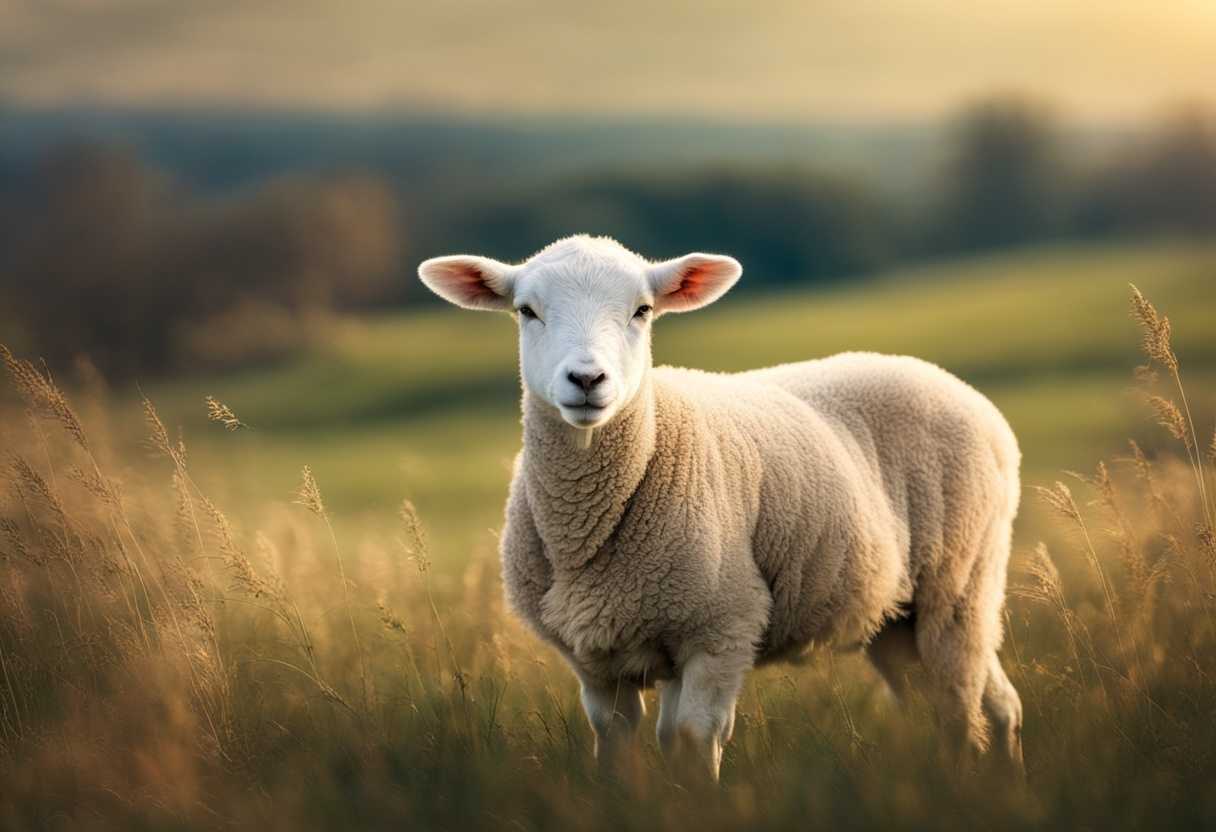
In the Bible, a lamb often symbolizes innocence and purity, as seen in its use in sacrificial practices (e.g., the Passover lamb in Exodus 12). Additionally, Jesus is referred to as the “Lamb of God” (John 1:29), representing His role as the ultimate sacrifice for humanity’s sins.
Scripture
7 And Isaac said to his father Abraham, “My father!” And he said, “Here I am, my son.” He said, “Behold, the fire and the wood, but where is the lamb for a burnt offering?”
8 Abraham said, “God will provide for himself the lamb for a burnt offering, my son.” So they went both of them together.
Biblical Significance of the Lamb
The symbolism of the lamb in the Bible extends beyond mere innocence and purity; it encapsulates themes of sacrifice, redemption, and God’s covenantal relationships with humanity. In the Old Testament, the Passover lamb serves as a pivotal figure during the Exodus, where its blood marked the doors of the Israelites to protect them from the final plague (Exodus 12:21-23). This act of sacrificial grace highlights God’s mercy and foreshadows the redemptive work of Jesus Christ in the New Testament. The imagery of the lamb resurfaces in the prophetic writings, with references like Isaiah 53:7, which describes the suffering servant as “led like a lamb to the slaughter,” revealing innocence being offered up for the sake of others.
In the New Testament, the designation of Jesus as the “Lamb of God” (John 1:29) culminates in the narrative of salvation, converging the Old Testament sacrificial system with Christ’s ultimate sacrifice on the cross. John the Baptist’s designation of Jesus emphasizes His role as the final sacrifice, overcoming sin and death, thus fulfilling the law and the prophets (Matthew 5:17). This theological layer invites believers to embrace the transformative power of His sacrificial love. The Revelation 7:17 further extends this symbolism, depicting the Lamb as the shepherd who leads His followers to eternal life and sustains them. In this way, the lamb resonates as a profound symbol of hope and faith for Christians, embodying the convergence of divine love, justice, and the call to live with purity and innocence in response to such grace.
The significance of the lamb as a biblical symbol also manifests in themes of atonement and divine provision, particularly in the context of the sacrificial system established in the Mosaic Law. In Leviticus, various offerings required lambs as a means of atonement for sin, illustrating the principle that sin incurs a cost. The lamb’s role in these sacrifices emphasizes the necessity for life given for life, a profound acknowledgment of the consequences of human transgression. These ritual practices laid the groundwork for understanding the depth of Jesus’ sacrifice, as the New Testament writers draw direct parallels between the unblemished lambs of the Old Covenant and Christ’s own sinless life offered for humanity’s redemption.
Moreover, the theme of the lamb invites reflection on God’s intimate care for His people. Psalm 23 presents the Lord as a shepherd, a theme closely related to the imagery of the lamb. The shepherd’s role underscores protection, guidance, and sustenance, highlighting a relationship of trust and dependence. This pastoral imagery evokes a sense of peace and assurance, reinforcing that just as a shepherd leads and cares for his flock, God lovingly shepherds His people. Thus, the lamb emerges as a multifaceted symbol—a representation of the innocence sacrificed for humanity, a means of atonement and redemption, and an embodiment of God’s unwavering commitment to nurture and guide His creation. All these layers contribute to a rich theological tapestry that invites believers to delve deeper into their understanding of God’s character and His plan for salvation.
Symbol of Sacrifice
In the Bible, the lamb is often associated with the concept of sacrifice. It represents the idea of atonement for sin, where the innocent lamb is offered to God as a means of reconciliation. This symbolism highlights the importance of purity and innocence in the act of sacrifice, emphasizing that the offering must be without blemish. The lamb’s role in sacrificial practices underscores the gravity of sin and the need for redemption.
Representation of Innocence and Purity
The lamb is also a powerful symbol of innocence and purity. Its gentle nature and vulnerability make it an apt representation of those qualities. In biblical narratives, the lamb often embodies the ideal of being meek and humble, serving as a reminder of the virtues that believers are encouraged to cultivate in their own lives. This association with innocence extends to the portrayal of Jesus as the “Lamb of God,” who embodies these traits in his life and teachings.
Foreshadowing of Redemption
Throughout the biblical narrative, the lamb serves as a foreshadowing of the ultimate redemption that is to come. The imagery of the lamb points toward the future fulfillment of God’s promise of salvation through Jesus Christ. This prophetic significance illustrates the continuity of God’s plan for humanity, where the lamb’s role evolves from a mere sacrificial animal to the embodiment of divine grace and mercy, culminating in the New Testament’s portrayal of Jesus as the sacrificial lamb for all.
How to Embrace Sacrifice for a Deeper Faith
Embracing sacrifice as a pathway to a deeper faith can be both challenging and transformative. It often requires us to step outside our comfort zones, whether that means giving up our time to serve others, letting go of material possessions, or even enduring personal hardships for the sake of our beliefs. Reflecting on Jesus’ ultimate sacrifice on the cross can inspire us to view our own sacrifices not as losses, but as opportunities to grow closer to God and to embody His love in the world. Start small—perhaps by volunteering your time or resources to those in need—and allow these acts of kindness to deepen your connection with Christ. Remember, every sacrifice made in love brings us one step closer to understanding the profound depth of His grace and the joy that comes from living a life dedicated to serving others. As you embrace this journey, you may find that your faith flourishes in ways you never imagined, transforming not just your relationship with God, but also your perspective on life itself.
Bible References to the Meaning of Lamb:
Exodus 12:3-13: 3 Tell all the congregation of Israel that on the tenth day of this month every man shall take a lamb according to their fathers’ houses, a lamb for a household.
4 And if the household is too small for a lamb, then he and his nearest neighbor shall take according to the number of persons; according to what each can eat you shall make your count for the lamb.
5 Your lamb shall be without blemish, a male a year old.
6 and you shall keep it until the fourteenth day of this month, when the whole assembly of the congregation of Israel shall kill their lambs at twilight.
7 Then they shall take some of the blood and put it on the two doorposts and the lintel of the houses in which they eat it.
8 They shall eat the flesh that night, roasted on the fire; with unleavened bread and bitter herbs they shall eat it.
9 Do not eat any of it raw or boiled in water, but roasted, its head with its legs and its inner parts.
10 And you shall let none of it remain until the morning; anything that remains until the morning you shall burn.
11 In this manner you shall eat it: with your belt fastened, your sandals on your feet, and your staff in your hand. And you shall eat it in haste. It is the Lord’s Passover.
12 For I will pass through the land of Egypt that night, and I will strike all the firstborn in the land of Egypt, both man and beast; and on all the gods of Egypt I will execute judgments: I am the Lord.
13 The blood shall be a sign for you, on the houses where you are. And when I see the blood, I will pass over you, and no plague will befall you to destroy you when I strike the land of Egypt.
Leviticus 4:32-35: 32 And if he brings a lamb as his offering for a sin offering, he shall bring a female without blemish.
33 And all its fat he shall remove as the fat is removed from the lamb, and the priest shall burn it on the altar, on top of the Lord’s food offerings. And the priest shall make atonement for him for the sin which he has committed, and he shall be forgiven.
34 And the priest shall take some of the blood of the sin offering with his finger and put it on the horns of the altar of burnt offering and pour out all the rest of its blood at the base of the altar.
35 And all its fat he shall remove as the fat of the lamb is removed from the sacrifice of peace offerings, and the priest shall burn it on the altar, on top of the Lord’s food offerings. And the priest shall make atonement for him for the sin which he has committed, and he shall be forgiven.
Isaiah 53:6-7: 6 All we like sheep have gone astray;
we have turned—every one—to his own way;
and the Lord has laid on him
the iniquity of us all.
7 He was oppressed, and he was afflicted,
yet he opened not his mouth;
like a lamb that is led to the slaughter,
and like a sheep that before its shearers is silent,
so he opened not his mouth.
John 1:29-36: 29 The next day he saw Jesus coming toward him, and said, “Behold, the Lamb of God, who takes away the sin of the world!
30 This is he of whom I said, ‘After me comes a man who ranks before me, because he was before me.’
31 I myself did not know him, but for this purpose I came baptizing with water, that he might be revealed to Israel.”
32 And John bore witness: “I saw the Spirit descend from heaven like a dove, and it remained on him.
33 I myself did not know him, but he who sent me to baptize with water said to me, ‘He on whom you see the Spirit descend and remain, this is he who baptizes with the Holy Spirit.’
34 And I have seen and have borne witness that this is the Son of God.”
35 The next day again John was standing with two of his disciples,
36 and he looked at Jesus as he walked by and said, “Behold, the Lamb of God!”
1 Peter 1:18-19: 18 knowing that you were ransomed from the futile ways inherited from your forefathers, not with perishable things such as silver or gold,
19 but with the precious blood of Christ, like that of a lamb without blemish or spot.
Revelation 5:6-14: 6 And between the throne and the four living creatures and among the elders I saw a Lamb standing, as though it had been slain, with seven horns and with seven eyes, which are the seven spirits of God sent out into all the earth.
7 And he went and took the scroll from the right hand of him who was seated on the throne.
8 And when he had taken the scroll, the four living creatures and the twenty-four elders fell down before the Lamb, each holding a harp, and golden bowls full of incense, which are the prayers of the saints.
9 And they sang a new song, saying, “Worthy are you to take the scroll and to open its seals, for you were slain, and by your blood you ransomed people for God from every tribe and language and people and nation,
10 and you have made them a kingdom and priests to our God, and they shall reign on the earth.”
11 Then I looked, and I heard around the throne and the living creatures and the elders the voice of many angels, numbering myriads of myriads and thousands of thousands,
12 saying with a loud voice, “Worthy is the Lamb who was slain, to receive power and wealth and wisdom and might and honor and glory and blessing!”
13 And I heard every creature in heaven and on earth and under the earth and in the sea, and all that is in them, saying, “To him who sits on the throne and to the Lamb be blessing and honor and glory and might forever and ever!”
14 And the four living creatures said, “Amen!” and the elders fell down and worshiped.
Revelation 7:9-17: 9 After this I looked, and behold, a great multitude that no one could number, from every nation, from all tribes and peoples and languages, standing before the throne and before the Lamb, clothed in white robes, with palm branches in their hands,
10 and crying out with a loud voice, “Salvation belongs to our God who sits on the throne, and to the Lamb!”
11 And all the angels were standing around the throne and around the elders and the four living creatures, and they fell on their faces before the throne and worshiped God,
12 saying, “Amen! Blessing and glory and wisdom and thanksgiving and honor and power and might be to our God forever and ever! Amen.”
13 Then one of the elders addressed me, saying, “Who are these, clothed in white robes, and from where have they come?”
14 I said to him, “Sir, you know.” And he said to me, “These are the ones coming out of the great tribulation. They have washed their robes and made them white in the blood of the Lamb.
15 “Therefore they are before the throne of God, and serve him day and night in his temple; and he who sits on the throne will shelter them with his presence.”
16 They shall hunger no more, neither thirst anymore; the sun shall not strike them, nor any scorching heat.
17 For the Lamb in the midst of the throne will be their shepherd, and he will guide them to springs of living water, and God will wipe away every tear from their eyes.
Revelation 12:10-11: 10 And I heard a loud voice in heaven, saying, “Now the salvation and the power and the kingdom of our God and the authority of his Christ have come, for the accuser of our brothers has been thrown down, who accuses them day and night before our God.
11 And they have conquered him by the blood of the Lamb and by the word of their testimony, for they loved not their lives even unto death.
Revelation 19:7-9: 7 Let us rejoice and exult and give him the glory, for the marriage of the Lamb has come, and his Bride has made herself ready;
8 it was granted her to clothe herself with fine linen, bright and pure— for the fine linen is the righteous deeds of the saints.
9 And the angel said to me, “Write this: Blessed are those who are invited to the marriage supper of the Lamb.” And he said to me, “These are the true words of God.”

Reverend Ogunlade is a seasoned Church Minister with over three decades of experience in guiding and nurturing congregations. With profound wisdom and a serene approach, Reverend Ogunlade has carried out various pastoral duties, including delivering uplifting sermons, conducting religious ceremonies, and offering sage counsel to individuals seeking spiritual guidance. Their commitment to fostering harmony and righteousness within their community is exemplified through their compassionate nature, making them a beloved and trusted figure among the congregation.