
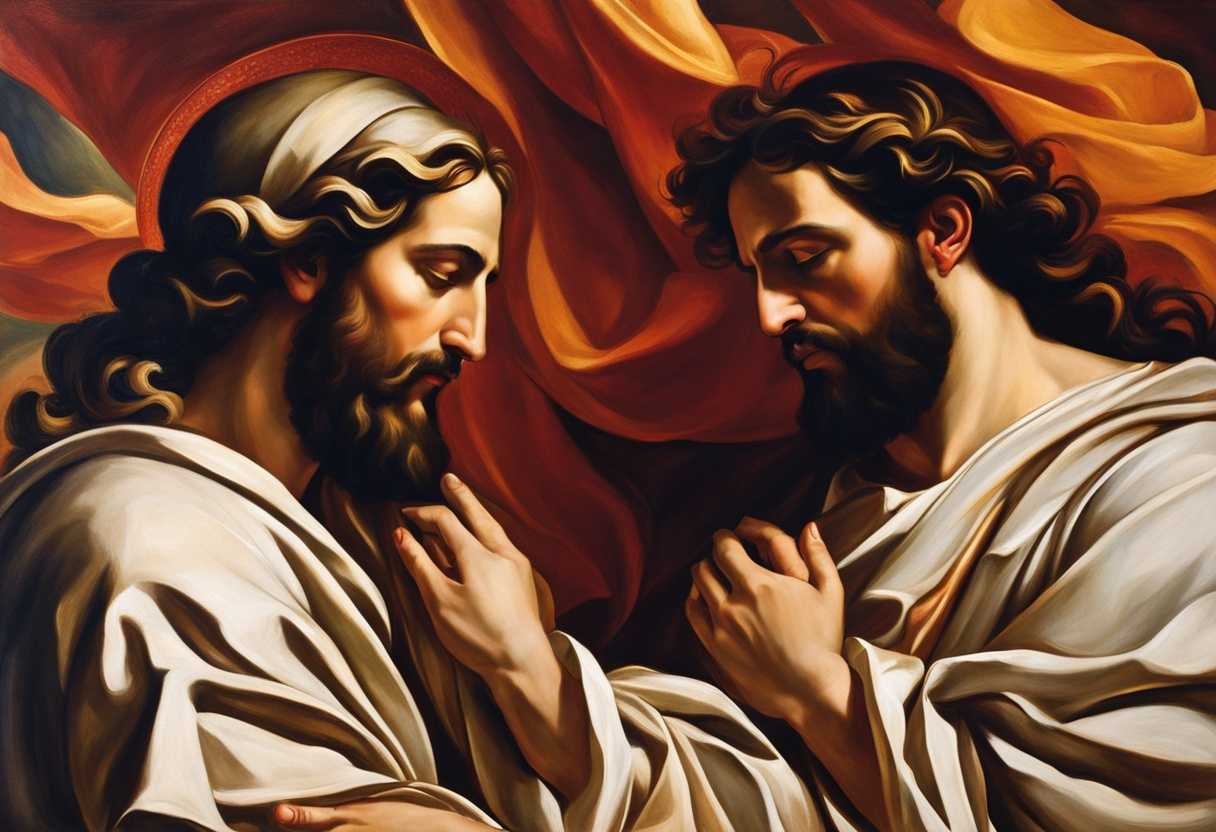
The term “Sons of Thunder” refers to the apostles James and John in the New Testament, specifically in Mark 3:17. It signifies their passionate and fervent nature, indicating a powerful character and possibly a propensity for zeal in their ministry.
Scripture
13 And he went up on the mountain and called to him those whom he desired, and they came to him.
14 And he appointed twelve (whom he also named apostles) so that they might be with him and he might send them out to preach
15 and have authority to cast out demons.
16 He appointed the twelve: Simon (to whom he gave the name Peter);
17 James the son of Zebedee and John the brother of James (to whom he gave the name Boanerges, that is, Sons of Thunder);
18 Andrew, and Philip, and Bartholomew, and Matthew, and Thomas, and James the son of Alphaeus, and Thaddaeus, and Simon the Cananaean,
19 and Judas Iscariot, who betrayed him.
“Sons of Thunder” in the Bible
The term “Sons of Thunder” is used in Mark 3:17 to describe the apostles James and John, underscoring their intense and passionate personalities. This designation likely reflects their zealous spirits, as seen in Luke 9:54, when they asked Jesus if they should call down fire from heaven to consume a Samaritan village that rejected him. This impulsive desire for judgment illustrates their fervor, but also points to a lack of understanding of Jesus’ message of grace and mercy. Additionally, their nickname serves as a contrast to their transformation throughout the New Testament; from aggressive zealots to prominent leaders in the early church, embodying love and compassion—a theme reinforced by their close relationship with Jesus.
The broader meaning of “Sons of Thunder” also highlights the transformative power of Jesus’ ministry. As John later refers to himself in his writings as “the disciple whom Jesus loved” (John 13:23), it becomes evident that their identity shifted from one characterized by anger and fervor to one defined by love and a deeper spiritual understanding. This transformation emphasizes the capacity for growth and redemption available to all believers, showcasing how a person’s initial zeal, if refined by the teachings of Christ, can lead to significant contributions to the faith. Thus, the term “Sons of Thunder” encapsulates not only their emotional intensity but also the potential for spiritual evolution through discipleship.
The title “Sons of Thunder” evokes the dynamic interplay between strength and the evolving understanding of discipleship that characterized the early followers of Christ. This phrase can symbolize the intense emotions and passionate responses one can experience on the journey of faith. In the early narratives of the apostles, we see their zealousness often manifesting in confrontational ways, as reflected in their actions and words throughout different passages. This fervent disposition can be appreciated as part of their fervor to protect the honor of Jesus and uphold the tenets of their faith amidst confusion and opposition.
As we explore further into the actions of the apostles, it is clear that the label is not just a mere identification of their temperamental attributes. Instead, it encapsulates a profound lesson about the journey of redemption and growth for all disciples. The transformation from “Sons of Thunder” to leaders who preached love and reconciliation illuminates the broader gospel message that emphasizes the capacity for believers to evolve. Their initial zeal can be channeled towards building the church rather than destruction, advocating for a shift from a spirit of wrath to one of service. Ultimately, the transformative journey of James and John serves as a powerful testament that anyone, regardless of their past impulses or fiery temperament, has the potential to embody Christlike love and be instruments of peace in the world.
The Zeal and Passion of the Disciples
The term “Sons of Thunder” reflects the intense zeal and passion exhibited by the disciples, particularly James and John. This nickname suggests a fiery temperament and a strong commitment to their beliefs. Their fervor can be seen as a representation of the passionate nature of early followers of Christ, who were often willing to confront challenges and opposition with boldness. This aspect of their character serves as a reminder of the importance of zeal in the pursuit of faith and the spread of the Gospel.
The Transformation of Character
The nickname also signifies the transformative journey of the disciples. Initially characterized by their impulsive and aggressive tendencies, James and John evolved into leaders of the early church, embodying love, compassion, and humility. This transformation illustrates the power of Christ to change individuals, turning their raw potential into instruments of peace and reconciliation. It highlights the theme of personal growth and the ability to channel one’s strengths in a more constructive and loving manner.
The Duality of Human Nature
“Sons of Thunder” can also be interpreted as a representation of the duality of human nature—where passion can lead to both constructive and destructive outcomes. The disciples’ initial desire to call down fire from heaven reflects a human inclination towards vengeance and judgment. However, their eventual understanding of Christ’s message of love and forgiveness showcases the potential for redemption and the importance of aligning one’s passions with divine purpose. This duality serves as a reminder of the ongoing struggle between our innate impulses and the call to embody Christ-like virtues.
How to Cultivate Zealous Faith in Christian Living
Cultivating zealous faith in your Christian living is a beautiful journey that begins with a heart fully surrendered to God. Start by immersing yourself in Scripture, allowing the Word to ignite your spirit and deepen your understanding of His promises and character. Prayer is your lifeline—make it a daily practice to communicate with God, seeking His guidance and expressing your gratitude. Surround yourself with a community of believers who inspire and challenge you; their testimonies can fuel your passion and commitment. Remember, zeal is not just about fervor but also about action—look for opportunities to serve others, share the Gospel, and live out your faith in tangible ways. As you grow in love and obedience, your zeal will naturally overflow, reflecting Christ’s light in a world that desperately needs it. Embrace this journey with an open heart, and watch how God transforms your faith into a vibrant, zealous expression of His love.
Bible References to “Sons of Thunder”:
Luke 9:51-56: 51 When the days drew near for him to be taken up, he set his face to go to Jerusalem.
52 And he sent messengers ahead of him, who went and entered a village of the Samaritans, to make preparations for him.
53 But the people did not receive him, because his face was set toward Jerusalem.
54 And when his disciples James and John saw it, they said, “Lord, do you want us to tell fire to come down from heaven and consume them?”
55 But he turned and rebuked them.
56 For the Son of Man did not come to destroy men’s lives but to save them.” And they went on to another village.
Matthew 20:20-28: 20 Then the mother of the sons of Zebedee came up to him with her sons, and kneeling before him she asked him for something.
21 And he said to her, “What do you want?” She said to him, “Say that these two sons of mine are to sit, one at your right hand and one at your left, in your kingdom.”
22 Jesus answered, “You do not know what you are asking. Are you able to drink the cup that I am to drink?” They said to him, “We are able.”
23 He said to them, “You will drink my cup, but to sit at my right hand and at my left is not mine to grant, but it is for those for whom it has been prepared by my Father.”
24 And when the ten heard it, they were indignant at the two brothers.
25 But Jesus called them to him and said, “You know that the rulers of the Gentiles lord it over them, and their great ones exercise authority over them.
26 It shall not be so among you. But whoever would be great among you must be your servant,
27 and whoever would be first among you must be your slave—
28 even as the Son of Man came not to be served but to serve, and to give his life as a ransom for many.”
Mark 10:35-45: 35 And James and John, the sons of Zebedee, came up to him and said to him, “Teacher, we want you to do for us whatever we ask of you.”
36 And he said to them, “What do you want me to do for you?”
37 And they said to him, “Grant us to sit, one at your right hand and one at your left, in your glory.”
38 But Jesus said to them, “You do not know what you are asking. Are you able to drink the cup that I drink, or to be baptized with the baptism with which I am baptized?”
39 And they said to him, “We are able.” And Jesus said to them, “The cup that I drink you will drink, and with the baptism with which I am baptized, you will be baptized,
40 but to sit at my right hand or at my left is not mine to grant, but it is for those for whom it has been prepared.”
41 And when the ten heard it, they began to be indignant at James and John.
42 And Jesus called them to him and said to them, “You know that those who are considered rulers of the Gentiles lord it over them, and their great ones exercise authority over them.
43 But it shall not be so among you. But whoever would be great among you must be your servant,
44 and whoever would be first among you must be slave of all.
45 For even the Son of Man came not to be served but to serve, and to give his life as a ransom for many.
John 12:20-26: 20 Now among those who went up to worship at the feast were some Greeks.
21 So these came to Philip, who was from Bethsaida in Galilee, and asked him, “Sir, we wish to see Jesus.”
22 Philip went and told Andrew; Andrew and Philip went and told Jesus.
23 And Jesus answered them, “The hour has come for the Son of Man to be glorified.
24 Truly, truly, I say to you, unless a grain of wheat falls into the earth and dies, it remains alone; but if it dies, it bears much fruit.
25 Whoever loves his life loses it, and whoever hates his life in this world will keep it for eternal life.
26 If anyone serves me, he must follow me; and where I am, there will my servant be also. If anyone serves me, the Father will honor him.
Acts 12:1-2: 1 About that time Herod the king laid violent hands on some who belonged to the church.
2 He killed James the brother of John with the sword.
Revelation 1:9-11: 9 I, John, your brother and partner in the tribulation and the kingdom and the patient endurance that are in Jesus, was on the island called Patmos on account of the word of God and the testimony of Jesus.
10 I was in the Spirit on the Lord’s day, and I heard behind me a loud voice like a trumpet.
11 saying, “Write what you see in a book and send it to the seven churches, to Ephesus and to Smyrna and to Pergamum and to Thyatira and to Sardis and to Philadelphia and to Laodicea.”

Reverend Michael Johnson is an experienced Church Minister with a profound expertise in spirituality and guidance. With a serene presence and a compassionate heart, he has faithfully served his congregation for over 20 years, leading them on a spiritual journey towards inner peace and enlightenment. Reverend Johnson’s extensive knowledge of religious philosophies and profound understanding of human nature have made him a trusted confidant and mentor to many, as he seamlessly weaves his profound wisdom into life teachings. Reverend Johnson’s calming demeanor and empathetic nature continue to uplift and heal souls, nurturing a sense of unity and tranquility within his community.