
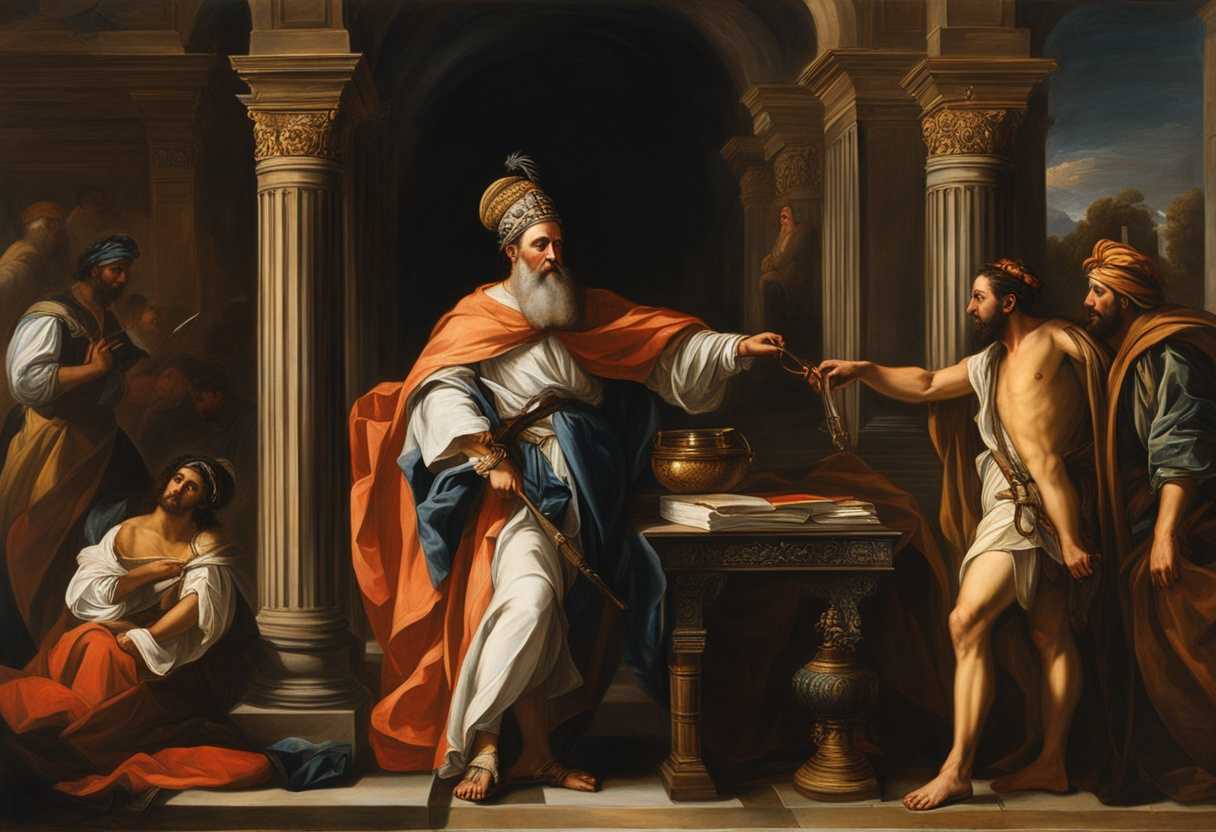
In the Bible, Mordecai is a key figure in the Book of Esther, identified as a Jewish leader and the cousin and guardian of Esther. His name may mean “warrior” or “follower of Marduk,” reflecting his Persian heritage and role in defending the Jewish people against Haman’s plot.
Scripture
5 Now there was a Jew in Susa the citadel whose name was Mordecai, the son of Jair, son of Shimei, son of Kish, a Benjaminite,
6 who had been carried away from Jerusalem among the captives carried away with Jeconiah king of Judah, whom Nebuchadnezzar king of Babylon had carried away.
7 He was bringing up Hadassah, that is Esther, the daughter of his uncle, for she had neither father nor mother. The young woman had a beautiful figure and was lovely to look at, and when her father and her mother died, Mordecai took her as his own daughter.
Meaning of Mordecai in the Bible
The character of Mordecai in the Book of Esther embodies courage, wisdom, and faithfulness, acting as a pivotal figure in the narrative that highlights the themes of divine providence and the struggle for identity among the Jewish people in a foreign land. His refusal to bow to Haman, as recounted in Esther 3:2, sets into motion a chain of events that catalyzes the conflict central to the story. Mordecai’s actions demonstrate a profound commitment to his faith and heritage, as he encourages Esther to reveal her identity as a Jew and intercede for her people, famously stating in Esther 4:14, “And who knows whether you have not come to the kingdom for such a time as this?” This line underscores the idea of being divinely appointed to a significant task, reinforcing the belief that one’s actions can have far-reaching implications in God’s greater plan.
Additionally, the broader meaning of Mordecai serves as a symbol of resistance against oppression and a reminder of the importance of standing firm in one’s beliefs. Through Mordecai’s leadership, wisdom, and unwavering faith, the Jewish people find strength against adversity. His role culminates not only in the preservation of Esther’s identity and the deliverance of the Jewish people from annihilation—categorically noted in Esther 9:1-5—but also instills a sense of hope and resilience within the community. Thus, Mordecai represents the call for believers to embody faith and action in the face of adversity, revealing that, while the circumstances may seem dire, divine guidance and intervention can lead to triumph and restoration.
Mordecai’s character also serves as a profound example of loyalty and familial responsibility within the Jewish community. His relationship with Esther, whom he raised as his own daughter, illustrates the importance of mentorship and guidance in maintaining cultural identity. The book explicitly depicts Mordecai as not only a protector but also a teacher, ensuring that Esther remains aware of her Jewish heritage and the corresponding moral imperatives that accompany it. In this context, Mordecai’s influence extends beyond mere survival; it speaks to the broader theme of cultural preservation amid increasing secularization and potential erasure.
Furthermore, Mordecai’s eventual rise to prominence in the royal court symbolizes the power of wisdom and integrity as tools for change. His strategic advising to Esther and his actions against Haman culminate in his own elevation to a position of authority, where he uses his influence to enact justice for the Jewish people. This transformation from obscurity to prominence underscores the biblical principle that faithfulness to one’s beliefs can lead to significant societal impact. In every decision and action, Mordecai exemplifies the ideal that steadfastness in faith, combined with strategic thinking and courage, creates opportunities for divine intervention, ultimately enabling the faithful to rise in the face of persecution and inspire future generations.
The Role of Loyalty and Courage
Mordecai exemplifies unwavering loyalty to his family and his people. His courage in the face of adversity highlights the importance of standing up for one’s beliefs and protecting loved ones. This theme resonates throughout the narrative, showcasing how loyalty can inspire bravery and lead to significant outcomes in challenging situations.
The Significance of Identity and Heritage
Mordecai’s Jewish identity plays a crucial role in the story, emphasizing the importance of cultural heritage and the impact it has on one’s actions and decisions. His commitment to his roots serves as a reminder of the strength that comes from understanding and embracing one’s background, particularly in times of crisis.
The Power of Providence and Divine Timing
Mordecai’s actions and the events surrounding him illustrate the concept of divine providence. His strategic decisions and timely interventions suggest that there is a greater plan at work, encouraging readers to trust in a higher purpose even when circumstances seem dire. This theme reinforces the belief that individuals can be instruments of change within a divine framework.
How to Trust in God’s Plan for Your Life
Trusting in God’s plan for your life can often feel daunting, especially when faced with uncertainty or challenges. It’s important to remember that faith is a journey, not a destination. Start by cultivating a personal relationship with God through prayer and scripture; these practices can help you discern His voice amidst the noise of daily life. Reflect on past experiences where you felt His guidance, and let those memories strengthen your trust. Surround yourself with a supportive community of fellow believers who can encourage you and share their own stories of faith. Remember, trusting in God doesn’t mean you won’t face difficulties; rather, it means believing that He is with you every step of the way, working all things for your good (Romans 8:28). Embrace the unknown with an open heart, knowing that His plans for you are filled with hope and purpose.
Bible References to the Meaning of Mordecai:
Esther 2:21-23: 21 In those days, as Mordecai was sitting at the king’s gate, Bigthan and Teresh, two of the king’s eunuchs, who guarded the threshold, became angry and sought to lay hands on King Ahasuerus.
22 But Mordecai found out about the plot and told Queen Esther, who in turn reported it to the king, giving credit to Mordecai.
23 When the affair was investigated and found to be so, the men were both hanged on the gallows. And it was recorded in the book of the chronicles in the presence of the king.
Esther 3:1-6: 1 After these things King Ahasuerus promoted Haman the Agagite, the son of Hammedatha, and advanced him and set his throne above all the officials who were with him.
2 And all the king’s servants who were at the king’s gate bowed down and paid homage to Haman, for the king had so commanded concerning him. But Mordecai did not bow down or pay homage.
3 Then the king’s servants who were at the king’s gate said to Mordecai, “Why do you transgress the king’s command?”
4 Then the king’s servants who were at the king’s gate said to Mordecai, “Why do you transgress the king’s command?”
5 And when Haman saw that Mordecai did not bow down or pay homage to him, Haman was filled with fury.
6 But he disdained to lay hands on Mordecai alone. So, as they had made known to him the people of Mordecai, Haman sought to destroy all the Jews, the people of Mordecai, throughout the whole kingdom of Ahasuerus.
Esther 4:1-3: 1 When Mordecai learned all that had been done, Mordecai tore his clothes and put on sackcloth and ashes, and went out into the midst of the city, and he cried out with a loud and bitter cry.
2 And in every province, wherever the king’s command and his decree reached, there was great mourning among the Jews, with fasting and weeping and lamenting, and many of them lay in sackcloth and ashes.
3 And in every province, wherever the king’s command and his decree reached, there was great mourning among the Jews, with fasting and weeping and lamenting, and many of them lay in sackcloth and ashes.
Esther 4:12-17: 12 And they told Mordecai what Esther had said.
13 Then Mordecai told them to reply to Esther, “Do not think to yourself that in the king’s palace you will escape any more than all the other Jews.
14 For if you keep silent at this time, relief and deliverance will rise for the Jews from another place, but you and your father’s house will perish. And who knows whether you have not come to the kingdom for such a time as this?”
15 Then Esther told them to reply to Mordecai,
16 “Go, gather all the Jews to be found in Susa, and hold a fast on my behalf, and do not eat or drink for three days, night or day. I and my young women will also fast as you do. Then I will go to the king, though it is against the law, and if I perish, I perish.”
17 So Mordecai went away and did everything as Esther had ordered him.
Esther 5:9-14: 9 And Haman went out that day joyful and glad of heart. But when Haman saw Mordecai in the king’s gate, that he neither rose nor trembled before him, he was filled with wrath against Mordecai.
10 Nevertheless, Haman restrained himself and went home, and he sent and brought his friends and his wife Zeresh.
11 And Haman recounted to them the splendor of his riches, the number of his sons, all the promotions with which the king had honored him, and how he had advanced him above the officials and the servants of the king.
12 And Haman said, “Even Queen Esther let no one but me come with the king to the feast she prepared. And tomorrow also I am invited by her together with the king.
13 Yet all this is worth nothing to me, so long as I see Mordecai the Jew sitting at the king’s gate.”
14 Then his wife Zeresh and all his friends said to him, “Let a gallows fifty cubits high be made, and in the morning tell the king to have Mordecai hanged upon it. Then go joyfully with the king to the feast.” This idea pleased Haman, and he had the gallows made.
Esther 6:1-14: 1 On that night the king could not sleep. And he gave orders to bring the book of memorable deeds, the chronicles, and they were read before the king.
2 And it was found written how Mordecai had told about Bigthana and Teresh, two of the king’s eunuchs, who guarded the threshold, and who had sought to lay hands on King Ahasuerus.
3 And the king said, “What honor or distinction has been bestowed on Mordecai for this?” The king’s young men who attended him said, “Nothing has been done for him.”
4 And the king said, “Who is in the court?” Now Haman had just entered the outer court of the king’s palace to speak to the king about having Mordecai hanged on the gallows that he had prepared for him.
5 And the king’s young men told him, “Haman is there, standing in the court.” And the king said, “Let him come in.”
6 So Haman came in, and the king said to him, “What should be done to the man whom the king delights to honor?” And Haman said to himself, “Whom would the king delight to honor more than me?”
7 And Haman said to the king, “For the man whom the king delights to honor,
8 let royal robes be brought, which the king has worn, and the horse that the king has ridden, and on whose head a royal crown is set.
9 And let the robes and the horse be handed over to one of the king’s most noble officials. And let them dress the man whom the king delights to honor, and lead him on the horse through the square of the city, proclaiming before him: ‘Thus shall it be done to the man whom the king delights to honor.’”
10 Then the king said to Haman, “Hurry; take the robes and the horse, as you have said, and do so to Mordecai the Jew, who sits at the king’s gate. Leave out nothing that you have mentioned.”
11 Then Haman took the robes and the horse, and he dressed Mordecai and led him through the square of the city, proclaiming before him, “Thus shall it be done to the man whom the king delights to honor.”
12 Then Mordecai returned to the king’s gate. But Haman hurried to his house, mourning and with his head covered.
13 And Haman told his wife Zeresh and all his friends everything that had happened to him. Then his wise men and his wife Zeresh said to him, “If Mordecai, before whom you have begun to fall, is of the Jewish people, you will not overcome him but will surely fall before him.”
14 While they were yet talking with him, the king’s eunuchs arrived and hurried to bring Haman to the feast that Esther had prepared.
Esther 7:9-10: 9 Then Harbona, one of the eunuchs in attendance on the king, said, “Moreover, the gallows that Haman has prepared for Mordecai, whose word saved the king, is standing at Haman’s house, fifty cubits high.” And the king said, “Hang him on that.”
10 So they hanged Haman on the gallows that he had prepared for Mordecai. Then the wrath of the king abated.
Esther 8:1-2: 1 On that day King Ahasuerus gave to Queen Esther the house of Haman, the enemy of the Jews. And Mordecai came before the king, for Esther had told what he was to her.
2 And the king took off his signet ring, which he had taken from Haman, and gave it to Mordecai. And Esther set Mordecai over the house of Haman.
Esther 8:15-17: 15 Then Mordecai went out from the presence of the king in royal robes of blue and white, with a great golden crown and a robe of fine linen and purple, and the city of Susa shouted and rejoiced.
16 The Jews had light and gladness and joy and honor.
17 In every province and in every city, wherever the king’s command and his edict reached, there was gladness and joy among the Jews, a feast and a holiday. And many from the peoples of the country declared themselves Jews, for fear of the Jews had fallen on them.
Esther 9:3-4: 3 All the officials of the provinces and the satraps and the governors and the royal agents also helped the Jews, for the fear of Mordecai had fallen on them.
4 For Mordecai was great in the king’s house, and his fame spread throughout all the provinces, for the man Mordecai grew more and more powerful.
Esther 9:20-23: 20 And Mordecai recorded these things and sent letters to all the Jews who were in all the provinces of King Ahasuerus, both near and far,
21 to command them to keep the fourteenth day of the month of Adar and also the fifteenth day of the same, year by year, as the days on which the Jews got relief from their enemies, and as the month that had been turned for them from sorrow into gladness and from mourning into a holiday; that they should make them days of feasting and gladness, days for sending gifts of food to one another and gifts to the poor.
22 as the days on which the Jews got relief from their enemies, and as the month that had been turned for them from sorrow into gladness and from mourning into a holiday; that they should make them days of feasting and gladness, days for sending gifts of food to one another and gifts to the poor.
23 The Jews accepted what they had started to do, and what Mordecai had written to them.
Esther 9:29-32: 29 Then Queen Esther, the daughter of Abihail, and Mordecai the Jew gave full written authority, confirming this second letter about Purim.
30 Letters were sent to all the Jews, to the 127 provinces of the kingdom of Ahasuerus, in words of peace and truth,
31 to confirm these days of Purim at their appointed time, as Mordecai the Jew and Queen Esther obligated them, and as they had obligated themselves and their offspring, with regard to their fasts and their lamenting.
32 The command of Esther confirmed these practices of Purim, and it was recorded in writing.
Esther 10:1-3: 1 King Ahasuerus imposed tax on the land and on the coastlands of the sea.
2 And all the acts of his power and might, and the full account of the high honor of Mordecai, to which the king advanced him, are they not written in the Book of the Chronicles of the kings of Media and Persia?
3 For Mordecai the Jew was second in rank to King Ahasuerus, and he was great among the Jews and popular with the multitude of his brothers, for he sought the welfare of his people and spoke peace to all his people.

Reverend Michael Johnson is an experienced Church Minister with a profound expertise in spirituality and guidance. With a serene presence and a compassionate heart, he has faithfully served his congregation for over 20 years, leading them on a spiritual journey towards inner peace and enlightenment. Reverend Johnson’s extensive knowledge of religious philosophies and profound understanding of human nature have made him a trusted confidant and mentor to many, as he seamlessly weaves his profound wisdom into life teachings. Reverend Johnson’s calming demeanor and empathetic nature continue to uplift and heal souls, nurturing a sense of unity and tranquility within his community.