
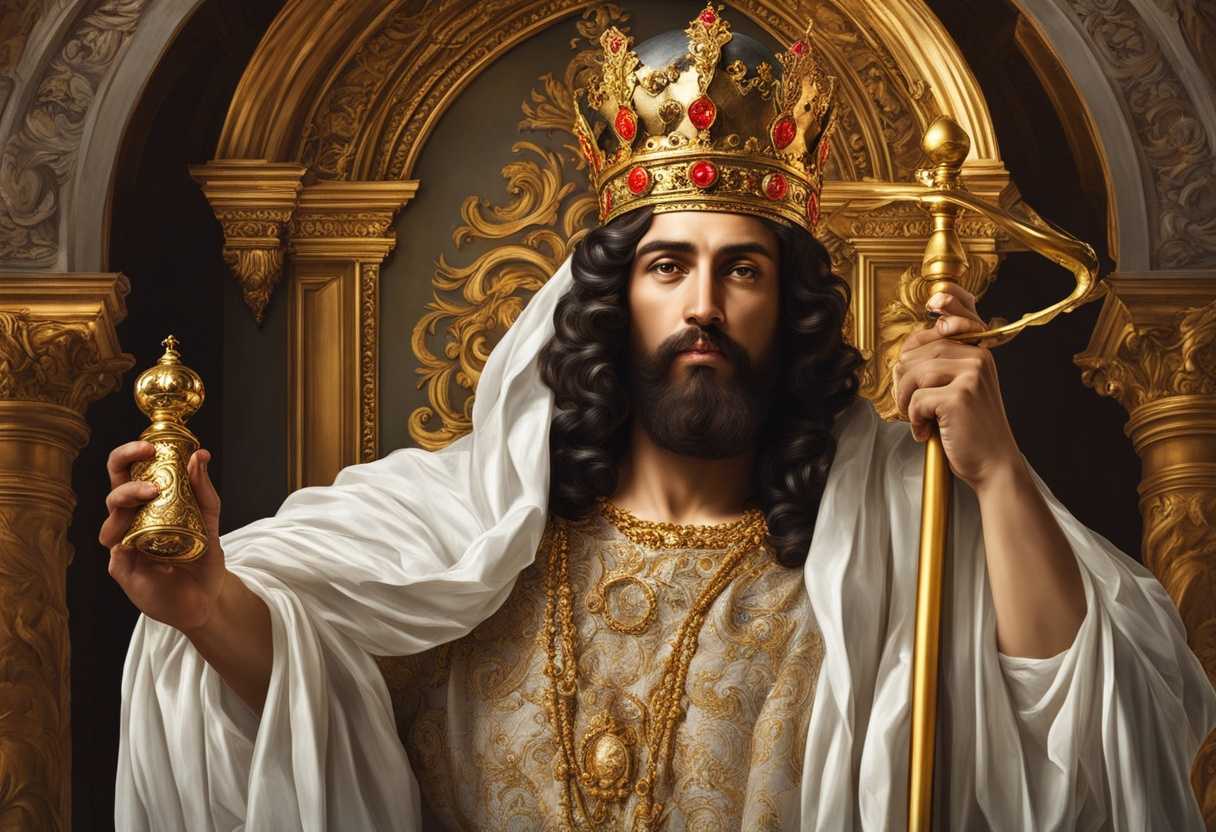
In the Bible, a sceptre symbolizes authority, kingship, and rule, often representing God’s governance or a king’s power over his people (see Genesis 49:10 and Hebrews 1:8). It is a physical object that signifies sovereignty and the right to exercise dominion.
Scripture
10 The scepter shall not depart from Judah, nor the ruler’s staff from between his feet, until tribute comes to him; and to him shall be the obedience of the peoples.
11 Binding his foal to the vine
and his donkey’s colt to the choice vine,
he has washed his garments in wine
and his vesture in the blood of grapes.
12 His eyes are darker than wine,
and his teeth whiter than milk.
Sceptre Meaning in the Bible
In the Bible, the sceptre serves as a potent symbol of authority and divine governance, intricately linked to the concept of kingship. Genesis 49:10 indicates that “The sceptre shall not depart from Judah,” suggesting that the lineage from Judah would carry a royal promise, ultimately fulfilled in the lineage of Christ. This not only establishes the kingly authority of Judah but also foreshadows the eternal reign of Jesus, who embodies the perfect king, ruling with righteousness. The sceptre thus represents not just earthly authority but also God’s sovereign hand in the unfolding of human history, leading to the establishment of His Kingdom.
Furthermore, Hebrews 1:8 reinforces this notion by quoting Psalm 45:6, where God’s Son is addressed as a king whose sceptre signifies a kingdom based on righteousness: “But of the Son he says, ‘Your throne, O God, is forever and ever, and the sceptre of uprightness is the sceptre of your kingdom.’” Here, the sceptre is intricately tied to the moral and ethical foundation of leadership, highlighting that true authority is rooted in justice and integrity. Consequently, the sceptre transcends its literal definition, acting as a metaphor for God’s ultimate triumph over chaos and the assurance of His righteous governance, inviting believers into a relationship with the King who wields it.
In addition to its implications for authority and kingship, the sceptre represents God’s covenantal promises to His people. The sceptre not only embodies a physical tool of monarchy but also signifies the spiritual power and divine right given to the rulers in Israel. In biblical history, kings were often depicted as God’s chosen representatives on earth, wielding their sceptres as symbols of their divinely appointed role to lead and protect the people according to God’s will. This divine backing provides a profound responsibility, calling leaders to live righteously and uphold justice, which becomes a recurring theme throughout the prophetic literature.
Moreover, the sceptre can also be seen in a broader eschatological context, representing the ultimate reign of Christ in the established Kingdom of God. The prophetic writings speak of a future in which the sceptre of divine rule will prevail not only over Israel but over all nations. This foreshadowing illustrates the universality of Christ’s authority as He ultimately reconciles creation to Himself. Such envisioning signals hope for believers, both in their present struggles and in the anticipation of the fulfillment of God’s promises. Thus, the sceptre stands as a metaphor of hope, governance, and divine promise, signifying a steadfast relationship between God, His appointed leaders, and the faithful community awaiting His righteous rule.
Symbol of Authority and Kingship
In the Bible, the sceptre is often a powerful symbol representing authority, governance, and the right to rule. It signifies the legitimacy of a king or leader, embodying their power to enact laws and maintain order within their realm. The sceptre serves as a reminder of the divine right of kings, indicating that their authority is sanctioned by God.
Instrument of Justice
The sceptre also represents justice and righteousness. It is associated with the responsibility of a ruler to uphold moral standards and ensure fairness within their kingdom. The presence of a sceptre in biblical texts often implies that the ruler is expected to wield their power wisely and justly, reflecting God’s character in their governance.
Sign of Divine Favor
In many instances, the sceptre symbolizes divine favor and blessing. It indicates that a ruler has been chosen or anointed by God to lead His people. This connection highlights the belief that true authority comes from God, and those who possess the sceptre are seen as instruments of His will on earth.
How to Embrace Humility in Authority as a Christian
Embracing humility in authority as a Christian is a profound journey that invites us to reflect on the teachings of Christ, who exemplified servant leadership. It’s essential to remember that true authority is not about exerting power over others but about lifting them up and serving their needs. Start by recognizing that your position, whether in the workplace, at home, or within the church, is a responsibility entrusted to you by God. Approach your role with a heart of gratitude and a willingness to listen, valuing the perspectives and contributions of those around you. Practicing humility means being open to correction, admitting when you’re wrong, and seeking to learn from others, regardless of their status. As you cultivate this mindset, you’ll find that your influence grows not through dominance but through genuine relationships built on respect and love, reflecting the heart of Christ in all you do. Remember, as Philippians 2:3-4 reminds us, “Do nothing out of selfish ambition or vain conceit. Rather, in humility value others above yourselves, not looking to your own interests but each of you to the interests of the others.”
Bible References to Sceptre Meaning:
Numbers 24:17-19: 17 I see him, but not now; I behold him, but not near: a star shall come out of Jacob, and a scepter shall rise out of Israel; it shall crush the forehead of Moab and break down all the sons of Sheth.
18 Edom shall be dispossessed; Seir also, his enemies, shall be dispossessed. Israel is doing valiantly.
19 “A ruler shall come out of Jacob and destroy the survivors of the city.”
Psalm 45:6-7: 6 Your throne, O God, is forever and ever. The scepter of your kingdom is a scepter of uprightness;
7 You have loved righteousness and hated wickedness. Therefore God, your God, has anointed you with the oil of gladness beyond your companions;
Isaiah 14:5-6: 5 The Lord has broken the staff of the wicked, the scepter of rulers,
6 that struck the peoples in wrath with unceasing blows, that ruled the nations in anger with unrelenting persecution.
Ezekiel 19:10-14: 10 Your mother was like a vine in a vineyard planted by the water, fruitful and full of branches by reason of abundant water.
11 Its strong stem became a ruler’s scepter; it towered aloft among the thick boughs; it was seen in its height with the mass of its branches.
12 But she was plucked up in fury; she was cast down to the ground; the east wind dried up her fruit; her strong rods were broken and withered; the fire consumed them.
13 And now she is planted in the wilderness, in a dry and thirsty land.
14 And fire has gone out from the stem of its shoots, has consumed its fruit, so that there remains in it no strong stem, no scepter for ruling. This is a lamentation and has become a lamentation.
Amos 1:5-8: 5 I will break the gate-bar of Damascus, and cut off the inhabitants from the Valley of Aven, and him who holds the scepter from Beth-eden; and the people of Syria shall go into exile to Kir,” says the Lord.
6 Thus says the Lord: “For three transgressions of Gaza, and for four, I will not revoke the punishment, because they carried into exile a whole people to deliver them up to Edom.
7 So I will send a fire upon the wall of Gaza, and it shall devour her strongholds.
8 I will cut off the inhabitants from Ashdod, and him who holds the scepter from Ashkelon; I will turn my hand against Ekron, and the remnant of the Philistines shall perish,” says the Lord God.
Zechariah 10:11-12: 11 He shall pass through the sea of troubles and strike down the waves of the sea, and all the depths of the Nile shall be dried up. The pride of Assyria shall be laid low, and the scepter of Egypt shall depart.
12 I will make them strong in the Lord, and they shall walk in his name,” declares the Lord.
Hebrews 1:8-9: 8 But of the Son he says, “Your throne, O God, is forever and ever, the scepter of uprightness is the scepter of your kingdom.
7 Of the angels he says, “He makes his angels winds, and his ministers a flame of fire.”
Revelation 2:26-27: 26 The one who conquers and who keeps my works until the end, to him I will give authority over the nations,
27 and he will rule them with a rod of iron, as when earthen pots are broken in pieces, even as I myself have received authority from my Father.

Rev. François Dupont is a dedicated church minister with a wealth of experience in serving spiritual communities. With a calm and serene demeanor, he has been devoted to sharing the message of love, compassion, and tolerance for over two decades. Through his thoughtful sermons, compassionate counseling, and unwavering support, Rev. Dupont has touched the lives of countless individuals, allowing them to find solace and strength during difficult times. His serene presence and deep understanding of the human condition make him a trusted guide for those seeking spiritual nourishment and guidance.