
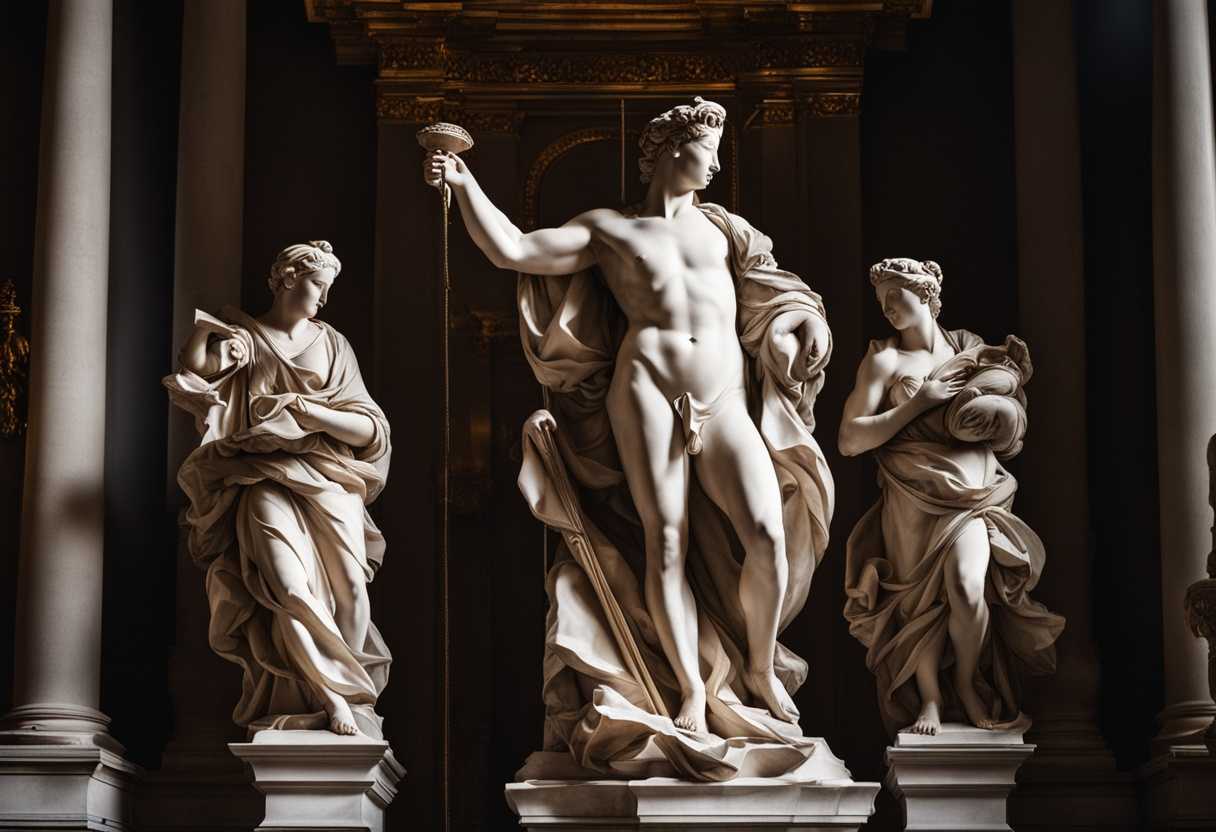
In the Bible, statues often represent a form of idolatry, where physical representations of gods are created and worshipped, contrary to God’s commandment against making graven images (Exodus 20:4-5). They symbolize the misplaced faith in tangible objects rather than in the spiritual and unseen God.
Scripture
4 “You shall not make for yourself a carved image, or any likeness of anything that is in heaven above, or that is in the earth beneath, or that is in the water under the earth.
5 You shall not bow down to them or serve them, for I the Lord your God am a jealous God, visiting the iniquity of the fathers on the children to the third and the fourth generation of those who hate me,
6 but showing steadfast love to thousands of those who love me and keep my commandments.
Biblical Significance of Statues
In the biblical context, the creation and worship of statues or idols are consistently portrayed as significant moral and spiritual failings. The commandment against making graven images (Exodus 20:4-5) serves as a fundamental principle that underscores the inherent danger of equating the divine with human-made objects. This prohibition emphasizes God’s transcendence and the futility of attempting to encapsulate the divine nature within physical forms. In Isaiah 44:9-20, the prophet critiques idol makers who craft images from wood and metal, highlighting the absurdity of worshipping creations of their own hands while failing to recognize the living God who formed them. This reflects a broader biblical theme that warns against placing faith in materialism or the transient, which can lead to spiritual blindness and alienation from God’s true nature.
Moreover, the significance of statues in the Bible is not only about the objects themselves but also about what they represent in terms of human devotion and relationship with God. In contrast to the hollow worship of idols, biblical worship is meant to be a heart-focused engagement with God, who is spirit (John 4:24). Jesus’ teachings reinforced this idea, encouraging followers to seek a relationship with God rooted in spirit and truth rather than ritualistic practices associated with statues and symbols. Ultimately, the notion of statues in the Bible serves as a powerful reminder of the importance of faith in an invisible, sovereign God, whose presence and authority cannot be contained or accurately represented by material objects.
The Bible also reflects on the historical and cultural implications of statues and idols, often presenting them as symbols of societal and spiritual decline. For instance, when the Israelites turned to create a golden calf during Moses’ absence on Mount Sinai, it illustrated a profound breach of trust in God. This incident highlights how swiftly human hearts can gravitate toward tangible objects for reassurance and comfort, even when those objects symbolize a departure from true worship. The incident underscores the inherent danger in allowing cultural practices to supersede one’s relationship with the divine, revealing a persistent tension between the spiritual and the material.
Additionally, the prophetic literature frequently critiques the reliance on statues as a form of faithlessness. Prophets like Jeremiah and Ezekiel call out the futility of idol worship, reminding the people that these figures cannot offer guidance, salvation, or protection, as they lack the power of the living God. The critique extends beyond mere physical idols to condemn the underlying attitudes of the people: their hearts have become hardened, preferring the familiar and the immediate rather than seeking the deeper, often more challenging, relationship with God. Ultimately, the biblical narrative emphasizes that the divine relationship cannot be mediated through material representations but must be nurtured through faith, repentance, and divine communion. This theme serves as a reminder that true worship transcends physical forms and is rooted in the acknowledgment of God’s unapproachable holiness and intimate presence in the lives of believers.
Idolatry and False Worship
In the biblical context, statues often symbolize the temptation of idolatry, where physical representations are created to worship instead of the true God. This reflects humanity’s inclination to seek tangible forms of divinity, leading to a distortion of faith and a departure from spiritual truth. The creation of statues can represent a misunderstanding of God’s nature, as they limit the divine to human-made objects, thus undermining the essence of worship.
Symbolism of Authority and Power
Statues in the Bible can also represent authority and power, often serving as symbols of kingship or divine rule. They may be erected to commemorate significant events or figures, reflecting the societal values and beliefs of the time. In this sense, statues can embody the cultural and political dynamics of a community, illustrating how power is visually represented and revered within a society.
Reflection of Human Nature
The presence of statues in biblical narratives can also serve as a reflection of human nature and its complexities. They highlight the struggle between faith and doubt, the desire for connection with the divine, and the tendency to create physical representations of spiritual beliefs. This duality illustrates the ongoing challenge of maintaining a pure and authentic relationship with God amidst the distractions and temptations of the material world.
How to Cultivate True Worship in Everyday Life
Cultivating true worship in our everyday lives is about more than just attending church on Sundays; it’s about creating a heart posture that honors God in every moment. Start by integrating prayer into your daily routine—whether it’s a quick thank you for the beauty of creation during your morning walk or a moment of reflection before meals. Engage with Scripture not just as a book, but as a living guide that shapes your thoughts and actions. Look for opportunities to serve others, as Jesus taught us that serving is a form of worship. Remember, worship is not confined to music or rituals; it’s found in the way we treat others, the integrity we uphold in our work, and the love we share in our communities. By intentionally seeking God in the mundane, we can transform our daily activities into acts of worship, allowing our lives to reflect His glory in every aspect.
Bible References to Statues and Idolatry:
Leviticus 26:1-2: 1 “You shall not make idols for yourselves or erect an image or pillar, and you shall not set up a figured stone in your land to bow down to it, for I am the Lord your God.”
2 You shall keep my Sabbaths and reverence my sanctuary: I am the Lord.
Deuteronomy 4:15-19: 15 “Therefore watch yourselves very carefully. Since you saw no form on the day that the Lord spoke to you at Horeb out of the midst of the fire,”
16 Beware lest you act corruptly by making a carved image for yourselves, in the form of any figure, the likeness of male or female,
17 the likeness of any animal that is on the earth, the likeness of any winged bird that flies in the air,
18 the likeness of anything that creeps on the ground, the likeness of any fish that is in the water under the earth.
19 And beware lest you raise your eyes to heaven, and when you see the sun and the moon and the stars, all the host of heaven, you be drawn away and bow down to them and serve them, things that the Lord your God has allotted to all the peoples under the whole heaven.
Deuteronomy 27:15-16: 15 “‘Cursed be the man who makes a carved or cast metal image, an abomination to the Lord, a thing made by the hands of a craftsman, and sets it up in secret.’ And all the people shall answer and say, ‘Amen.’
16 “‘Cursed be anyone who dishonors his father or his mother.’ And all the people shall say, ‘Amen.’
2 Kings 17:15-17: 15 They despised his statutes and his covenant that he made with their fathers and the warnings that he gave them. They went after false idols and became false, and they followed the nations that were around them, concerning whom the Lord had commanded them that they should not do like them.
16 And they abandoned all the commandments of the Lord their God and made for themselves metal images of two calves; and they made an Asherah and worshiped all the host of heaven and served Baal.
17 And they burned their sons and their daughters as offerings and used divination and omens and sold themselves to do evil in the sight of the Lord, provoking him to anger.
2 Chronicles 33:7-9: 7 And the carved image of the idol that he had made he set in the house of God, of which God said to David and to Solomon his son, “In this house, and in Jerusalem, which I have chosen out of all the tribes of Israel, I will put my name forever.
8 and I will not again remove the foot of Israel from the land that I have appointed for your fathers, if only they will be careful to do all that I have commanded them, all the law, the statutes, and the rules given through Moses.
9 Manasseh led Judah and the inhabitants of Jerusalem astray, to do more evil than the nations whom the Lord destroyed before the people of Israel.
Psalm 115:4-8: 4 Their idols are silver and gold, the work of human hands.
5 They have mouths, but do not speak; eyes, but do not see;
6 They have ears, but do not hear; noses, but do not smell.
7 They have hands, but do not feel; they have feet, but do not walk; they have mouths, but do not speak.
8 Those who make them become like them; so do all who trust in them.
Isaiah 40:18-20: 18 To whom then will you liken God,
or what likeness compare with him?
19 The idol! a workman casts it, and a goldsmith overlays it with gold and casts for it silver chains.
20 He who is too impoverished for an offering chooses wood that will not rot; he seeks out a skillful craftsman to set up an idol that will not move.
Isaiah 44:9-20: 9 All who fashion idols are nothing, and the things they delight in do not profit. Their witnesses neither see nor know, that they may be put to shame.
10 Who fashions a god or casts an idol that is profitable for nothing?
11 Behold, all his companions shall be put to shame, and the craftsmen are only human. Let them all assemble, let them stand forth. They shall be terrified; they shall be put to shame together.
12 The ironsmith takes a cutting tool and works it over the coals. He fashions it with hammers and works it with his strong arm. He becomes hungry, and his strength fails; he drinks no water and is faint.
13 The carpenter stretches a line; he marks it out with a pencil. He shapes it with planes and marks it with a compass. He shapes it into the figure of a man, with the beauty of a man, to dwell in a house.
14 He cuts down cedars, or he chooses a cypress tree or an oak and lets it grow strong among the trees of the forest. He plants a cedar and the rain nourishes it.
15 Then it becomes fuel for a man. He takes a part of it and warms himself; he kindles a fire and bakes bread. Also he makes a god and worships it; he makes it an idol and falls down before it.
16 Half of it he burns in the fire. Over the half he eats meat; he roasts it and is satisfied. Also he warms himself and says, “Aha, I am warm, I have seen the fire!”
17 And the rest of it he makes into a god, his idol, and falls down to it and worships it. He prays to it and says, “Deliver me, for you are my god!”
18 They know not, nor do they discern, for he has shut their eyes, so that they cannot see, and their hearts, so that they cannot understand.
19 No one considers, nor is there knowledge or discernment to say, “Half of it I burned in the fire; I also baked bread on its coals; I roasted meat and have eaten. And shall I make the rest of it an abomination? Shall I fall down before a block of wood?”
20 He feeds on ashes; a deluded heart has led him astray, and he cannot deliver himself or say, “Is there not a lie in my right hand?”
Jeremiah 10:3-5: 3 for the customs of the peoples are vanity.
4 They decorate it with silver and gold; they fasten it with hammer and nails so that it cannot move.
5 Their idols are like scarecrows in a cucumber field, and they cannot speak; they have to be carried, for they cannot walk. Do not be afraid of them, for they cannot do evil, neither is it in them to do good.”
Ezekiel 20:7-8: 7 And I said to them, Cast away the detestable things your eyes feast on, every one of you, and do not defile yourselves with the idols of Egypt; I am the Lord your God.
8 But they rebelled against me and were not willing to listen to me. None of them cast away the detestable things their eyes feasted on, nor did they forsake the idols of Egypt.
Daniel 3:1-7: 1 King Nebuchadnezzar made an image of gold, whose height was sixty cubits and its breadth six cubits. He set it up on the plain of Dura, in the province of Babylon.
2 Then King Nebuchadnezzar sent to gather the satraps, the prefects, and the governors, the counselors, the treasurers, the justices, the magistrates, and all the officials of the provinces to come to the dedication of the image that King Nebuchadnezzar had set up.
3 Then the satraps, the prefects, and the governors, the counselors, the treasurers, the justices, the magistrates, and all the officials of the provinces gathered for the dedication of the image that King Nebuchadnezzar had set up. And they stood before the image that Nebuchadnezzar had set up.
4 And the herald proclaimed aloud, “You are commanded, O peoples, nations, and languages,
5 that when you hear the sound of the horn, pipe, lyre, trigon, harp, bagpipe, and every kind of music, you are to fall down and worship the golden image that King Nebuchadnezzar has set up.
6 And whoever does not fall down and worship shall immediately be cast into a burning fiery furnace.
7 Therefore, as soon as all the peoples heard the sound of the horn, pipe, lyre, trigon, harp, bagpipe, and every kind of music, all the peoples, nations, and languages fell down and worshiped the golden image that King Nebuchadnezzar had set up.
Habakkuk 2:18-20: 18 “What profit is an idol
when its maker has shaped it,
a metal image, a teacher of lies?
For its maker trusts in his own creation
when he makes speechless idols!
19 Woe to him who says to a wooden thing, Awake; to a silent stone, Arise! Can this teach? Behold, it is overlaid with gold and silver, and there is no breath at all in it.
20 But the Lord is in his holy temple;
let all the earth keep silence before him.”
Acts 17:29-31: 29 Being then God’s offspring, we ought not to think that the divine being is like gold or silver or stone, an image formed by the art and imagination of man.
30 The times of ignorance God overlooked, but now he commands all people everywhere to repent,
31 because he has fixed a day on which he will judge the world in righteousness by a man whom he has appointed; and of this he has given assurance to all by raising him from the dead.”
Romans 1:22-25: 22 Claiming to be wise, they became fools,
23 and exchanged the glory of the immortal God for images resembling mortal man and birds and animals and creeping things.
24 Therefore God gave them up in the lusts of their hearts to impurity, to the dishonoring of their bodies among themselves,
25 because they exchanged the truth about God for a lie and worshiped and served the creature rather than the Creator, who is blessed forever! Amen.
1 Corinthians 10:14-22: 14 Therefore, my beloved, flee from idolatry.
15 I speak as to sensible people; judge for yourselves what I say.
16 The cup of blessing that we bless, is it not a participation in the blood of Christ? The bread that we break, is it not a participation in the body of Christ?
17 Because there is one bread, we who are many are one body, for we all partake of the one bread.
18 Consider the people of Israel: are not those who eat the sacrifices participants in the altar?
19 What do I imply then? That food offered to idols is anything, or that an idol is anything?
20 No, I imply that what pagans sacrifice they offer to demons and not to God. I do not want you to be participants with demons.
21 You cannot drink the cup of the Lord and the cup of demons. You cannot partake of the table of the Lord and the table of demons.
22 Shall we provoke the Lord to jealousy? Are we stronger than he?
1 John 5:20-21: 20 And we know that the Son of God has come and has given us understanding, so that we may know him who is true; and we are in him who is true, in his Son Jesus Christ. He is the true God and eternal life.
21 Little children, keep yourselves from idols.

Reverend Ogunlade is a seasoned Church Minister with over three decades of experience in guiding and nurturing congregations. With profound wisdom and a serene approach, Reverend Ogunlade has carried out various pastoral duties, including delivering uplifting sermons, conducting religious ceremonies, and offering sage counsel to individuals seeking spiritual guidance. Their commitment to fostering harmony and righteousness within their community is exemplified through their compassionate nature, making them a beloved and trusted figure among the congregation.