
1 Now the famine was severe in the land.
2 And when they had eaten the grain that they had brought from Egypt, their father said to them, “Go again, buy us a little food.”
3 But Judah said to him, “The man solemnly warned us, saying, ‘You shall not see my face unless your brother is with you.’”
4 If you send our brother with us, we will go down and buy you food.
5 But if you will not send him, we will not go down, for the man said to us, ‘You shall not see my face, unless your brother is with you.’
6 And Israel said, “Why did you treat me so badly as to tell the man that you had another brother?”
7 They replied, “The man questioned us carefully about ourselves and our kindred, saying, ‘Is your father still alive? Do you have another brother?’ What we told him was in answer to these questions.
8 And Judah said to Israel his father, “Send the boy with me, and we will arise and go, that we may live and not die, both we and you and also our little ones.
9 I will be a pledge of his safety. From my hand you shall require him. If I do not bring him back to you and set him before you, then let me bear the blame forever.
10 For if we had not delayed, surely by now we could have returned twice.”
11 Then their father Israel said to them, “If it must be so, then do this: take some of the choice fruits of the land in your bags, and carry a present down to the man, a little balm and a little honey, gum, myrrh, pistachio nuts, and almonds.”
12 Take double the money with you. Carry back with you the money that was returned in the mouth of your sacks. Perhaps it was an oversight.
13 Take also your brother, and arise, go again to the man.
14 May God Almighty grant you mercy before the man, and may he send back your other brother and Benjamin. And as for me, if I am bereaved of my children, I am bereaved.
15 So the men took this present, and they took double the money with them, and Benjamin. They arose and went down to Egypt and stood before Joseph.
16 When Joseph saw Benjamin with them, he said to the steward of his house, “Bring the men into the house, and slaughter an animal and make ready, for the men are to dine with me at noon.”
17 And the man did as Joseph told him and brought the men to Joseph’s house.
18 And the men were afraid because they were brought to Joseph’s house, and they said, “It is because of the money, which was replaced in our sacks the first time, that we are brought in, so that he may assault us and fall upon us to make us servants and seize our donkeys.”
19 So they went up to the steward of Joseph’s house and spoke with him at the door of the house,
20 and said, “Oh, my lord, we came down the first time to buy food.
21 And when we came to the lodging place we opened our sacks, and there was each man’s money in the mouth of his sack, our money in full weight. So we have brought it again with us,
22 We have brought other money down with us to buy food. We do not know who put our money in our sacks.”
23 He said, “Peace to you, do not be afraid. Your God and the God of your father has put treasure in your sacks for you. I received your money.” Then he brought Simeon out to them.
24 And the man brought the men into Joseph’s house and gave them water, and they washed their feet, and he gave their donkeys fodder.
25 And they prepared the present for Joseph’s coming at noon, for they heard that they should eat bread there.
26 When Joseph came home, they brought into the house to him the present that they had with them and bowed down to him to the ground.
27 And he inquired about their welfare and said, “Is your father well, the old man of whom you spoke? Is he still alive?”
28 They said, “Your servant our father is well; he is still alive.” And they bowed their heads and prostrated themselves.
29 And he lifted up his eyes and saw his brother Benjamin, his mother’s son, and said, “Is this your youngest brother, of whom you spoke to me? God be gracious to you, my son!”
30 Then Joseph hurried out, for his compassion grew warm for his brother, and he sought a place to weep. And he entered his chamber and wept there.
31 Then he washed his face and came out. And controlling himself he said, “Serve the food.”
32 They served him by himself, and them by themselves, and the Egyptians who ate with him by themselves, because the Egyptians could not eat with the Hebrews, for that is an abomination to the Egyptians.
33 And they sat before him, the firstborn according to his birthright and the youngest according to his youth. And the men looked at one another in amazement.
34 Portions were taken to them from Joseph’s table, but Benjamin’s portion was five times as much as any of theirs. And they drank and were merry with him.
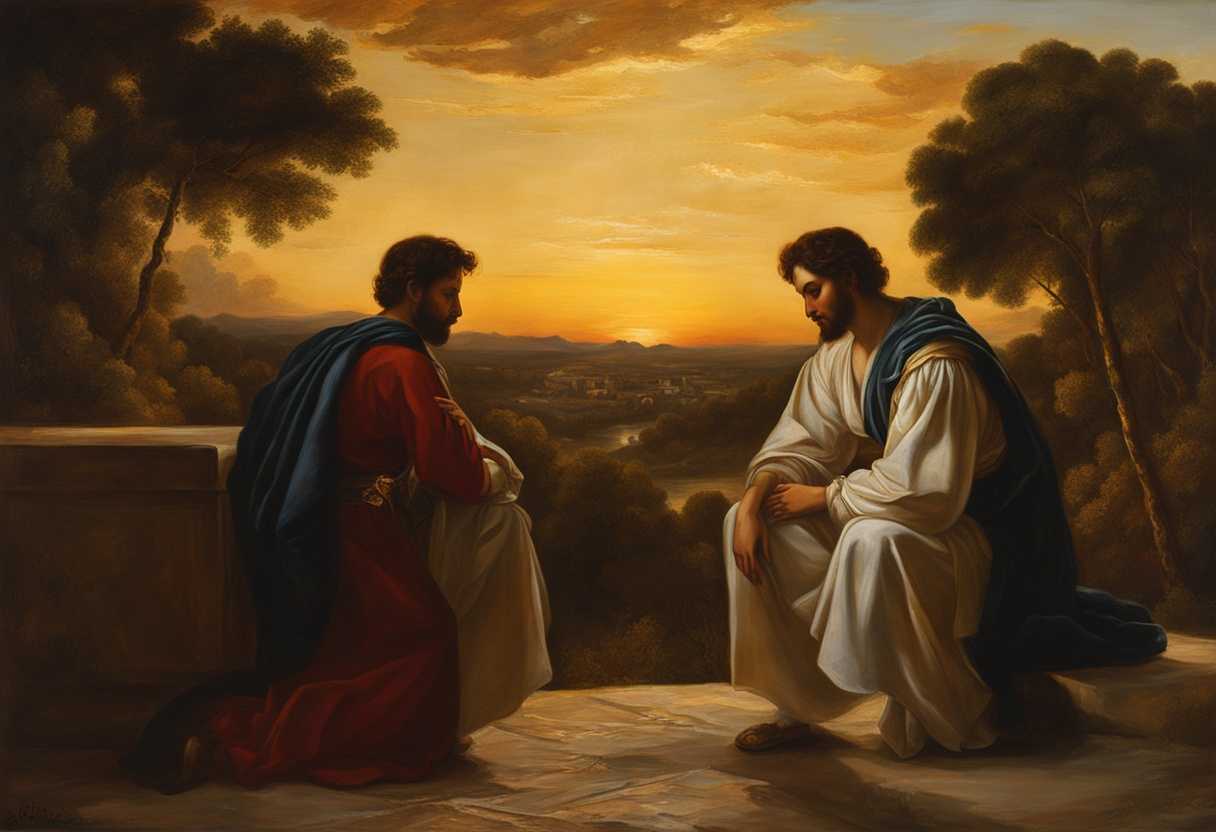
The True Meaning of Genesis 43
This chapter of Genesis is written by the author Moses, who was a prominent figure in the Israelite faith. He was a prophet chosen by God to lead the Israelites out of slavery in Egypt and guide them to the Promised Land. Joseph and his brothers continue their story in this chapter. After a severe famine struck the land, Joseph’s brothers are forced to return to Egypt to buy more food. However, Joseph, now a powerful ruler in Egypt, has not revealed his true identity to his brothers. The stage is set for a dramatic reunion and the unfolding of God’s plan for the Israelite people. Echoes of earlier events, such as the brothers’ treatment of Joseph and the importance of maintaining family unity, will be seen as we read this chapter. These themes are woven throughout the book of Genesis, reminding us of God’s overarching plan for His chosen people. We will also witness the power of forgiveness and the ways in which God can use even the most difficult circumstances to bring about His purposes.
Genesis 43:1-5
We witness an important turning point in the story of Joseph and his brothers in Genesis 43:1-5. The famine that had struck the land had caused Jacob to send his sons back to Egypt for more grain. However, he was hesitant to send Benjamin, Joseph’s full brother, along with them, fearing for his safety. Jacob’s reluctance to send Benjamin reflects his deep love and concern for him, knowing that he is the only remaining son of his beloved wife Rachel.
This section of the verse highlights the complex dynamics within Jacob’s family, specifically focusing on the relationship between the brothers and their father. The mention of Benjamin serves as a reminder of the pain and betrayal that Joseph experienced at the hands of his older brothers, who sold him into slavery out of jealousy. The brothers’ treatment of Joseph reflects themes of jealousy, betrayal, and ultimately redemption that are prevalent throughout the Bible.
Jacob’s insistence on keeping Benjamin at home also brings to light the theme of testing and faith. Just as Abraham was tested when asked to sacrifice his son Isaac in Genesis 22, Jacob is now faced with the dilemma of trusting in God’s plan even when it seems risky and uncertain. This illustrates the importance of faith and obedience in the face of adversity, a theme that reverberates throughout the Bible.
The reluctance of Jacob to send Benjamin can also be seen as a reflection of the consequences of past sins. Joseph’s brothers had committed a grave sin by selling him into slavery, and now they are facing the repercussions of their actions. This serves as a reminder of the biblical principle that our choices and actions have consequences, both for ourselves and for future generations, as discussed in Exodus 20:5 where it mentions the sins of the fathers being visited upon the children. Themes of family dynamics, faith, testing, consequences of sin, and ultimately trust in God’s plan are laden in this section of Genesis 43. It sets the stage for the unfolding drama that will lead to a powerful reconciliation between Joseph and his brothers, demonstrating God’s sovereignty and his ability to bring about redemption even in the midst of brokenness and betrayal.
Genesis 43:6-10
Jacob and his sons, particularly Judah, plan to return to Egypt to buy more food in Genesis 43:6-10. This section highlights the desperation faced by Jacob’s family due to the severe famine in the land. Jacob is reluctant to send Benjamin, his youngest son and Rachel’s second child, to Egypt, fearing that harm might come to him as well. This fear stems from the deep loss Jacob has already experienced with Rachel’s first son, Joseph, who he believes was killed by a wild animal.
The mention of Benjamin is significant because he holds a special place in Jacob’s heart as the full brother of Joseph and the last remaining son of his beloved wife Rachel. Jacob is deeply concerned for Benjamin’s safety, which shows a growth in his character since the time he favored Joseph over his other sons, leading to jealousy and the eventual sale of Joseph into slavery by his brothers.
Furthermore, the mention of Egypt in this context is pivotal. Egypt represents a place of provision and salvation during the famine, but it also symbolizes a place of testing and redemption for Jacob’s family. The events surrounding Joseph’s time in Egypt, from being sold as a slave to eventually becoming a ruler, reflect God’s providence and ability to turn even the most dire situations into blessings. This theme of God’s sovereignty and redemptive power is central throughout the Bible, reminding us that even in our darkest moments, God is working behind the scenes for our good (Romans 8:28).
The conversation between Jacob and his sons also signifies a shift in their relationships. Judah, who was once part of the plan to sell Joseph, now steps forward as a responsible and empathetic leader within the family. His willingness to take personal responsibility for Benjamin’s safety and offer himself as a pledge for Benjamin reveals a transformation in his character. This foreshadows Judah’s eventual repentance and redemption in the future, as he becomes an ancestor of Jesus Christ (Matthew 1:2-3). This passage in Genesis 43 reinforces the themes of trust, redemption, and God’s faithfulness in the face of adversity. It serves as a reminder that God can bring beauty from ashes and that His plans are always higher than our own (Isaiah 55:8-9). The journey of Jacob’s family to Egypt not only addresses their physical needs but also delves into their spiritual growth and transformation, displaying the overarching narrative of God’s redemptive work throughout the Bible.
Genesis 43:11-14
Jacob and his sons prepare to return to Egypt to buy more grain in an exchange seen in Genesis 43:11-14. Jacob reluctantly agrees to allow Benjamin, his youngest and most beloved son, to accompany them on the journey. This decision is significant as Benjamin holds a special place in Jacob’s heart, especially since he is the full brother of Joseph, who Jacob believed was dead. Jacob’s reluctance to send Benjamin highlights his deep concern for his son’s safety, as losing Benjamin would compound the grief he already carries from having lost Joseph.
This passage speaks to the theme of trust and faith in God’s plan. Jacob had already experienced tremendous loss and heartache, but he eventually puts his trust in God and allows Benjamin to go to Egypt. This act of faith is a turning point for Jacob, showing that he is willing to surrender his fears and uncertainties to the will of God. It serves as a reminder that sometimes we are called to trust in God’s greater plan, even in the face of uncertainty and fear.
The mention of Benjamin in this passage also draws attention to the larger narrative of the reconciliation between Joseph and his brothers. Benjamin was not present when Joseph was sold into slavery by his other brothers, and he represents a link to Joseph’s past and to Jacob’s deepest sorrow. The brothers returning to Egypt with Benjamin set the stage for the dramatic reunion between Joseph and his family, a moment that will ultimately bring healing and restoration to the fractured relationships within the household.
The story of Joseph and his brothers is a powerful illustration of forgiveness, redemption, and reconciliation. Through the brothers’ journey to Egypt and their encounters with Joseph, we see how God can work through even the most difficult and painful circumstances to bring about healing and restoration. This theme of forgiveness and reconciliation is echoed throughout the Bible, most notably in the teachings of Jesus, who emphasized the importance of forgiving others as we ourselves have been forgiven. Jacob makes the difficult decision to send Benjamin to Egypt, capturing a pivotal moment in the story of Joseph and his family in Genesis 43:11-14. This passage underscores the themes of trust, faith, and reconciliation, demonstrating how God’s plan unfolds even in the midst of uncertainty and hardship. It serves as a powerful reminder of the importance of trusting in God’s timing and providence, even when the path ahead seems uncertain.
Genesis 43:15-18
Joseph administers a test to his brothers when they come to Egypt to buy food during the famine in Genesis 43:15-18, after being estranged from them due to jealousy and their betrayal. The brothers approach Joseph’s house, afraid because of the money that had been returned to their sacks on a previous visit, not knowing that Joseph himself had orchestrated this act of grace. We witness here the complexity of Joseph’s emotions as he sees his brothers after so long and grapples with the desire to reveal himself and the need to test their character and repentance.
This passage highlights the importance of forgiveness, redemption, and reconciliation in the biblical narrative. Despite the brothers’ past transgressions, Joseph demonstrates a willingness to extend grace and provide them with an opportunity to demonstrate their changed hearts. This act of testing reflects the idea of repentance and the need for a genuine transformation in order to receive forgiveness. It also serves as a reminder of God’s ability to bring about reconciliation and healing in broken relationships.
The story of Joseph and his brothers serves as a powerful illustration of forgiveness and redemption. It is a foreshadowing of the ultimate reconciliation that is made possible through Jesus Christ. Just as Joseph tested his brothers to discern their true intentions, God often tests our hearts to reveal our true nature and our need for repentance. This passage invites us to reflect on our own capacity to forgive and seek reconciliation with those who have wronged us, as well as to consider the depths of God’s mercy and grace in our lives.
Furthermore, this passage underscores the theme of providence and God’s sovereignty in the lives of His people. Despite the brothers’ intentions to buy food in Egypt, they were unknowingly led back to Joseph, who held their fate in his hands. This event echoes the biblical truth that God works all things together for the good of those who love Him (Romans 8:28) and that His plans will ultimately prevail, even in the midst of adversity and human free will. Genesis 43:15-18 showcases the intricate interplay of forgiveness, redemption, repentance, and divine providence within the biblical narrative. Through the story of Joseph and his brothers, we are reminded of the transformative power of forgiveness, the importance of genuine repentance, and the ultimate sovereignty of God in orchestrating His purposes through human events and decisions.
Genesis 43:19-25
The steward of Joseph’s house confronts Joseph’s brothers with a mysterious situation in Genesis 43:19-25 as they come to Egypt to buy grain. The section begins with the brothers arriving to purchase grain, being accused by the steward of stealing a silver cup belonging to Joseph. The steward informs them that the owner of the cup is the man with whom they had eaten and drank, and that he uses it for divination. This accusation shakes the brothers deeply, as they cannot fathom how such a thing could happen.
This event is crucial within the grand arc of the story of Joseph and his brothers. It is a pivotal moment designed by Joseph to test his brothers and see if their characters have truly changed since the days when they sold him into slavery. Joseph’s brothers have already gone through a series of trials and tribulations, including their initial betrayal of Joseph, the guilt they felt over deceiving their father Jacob about Joseph’s supposed death, and the famine that led them to Egypt. Now, facing the accusation of theft, they are given another opportunity to demonstrate how they have grown as individuals.
The mention of the silver cup being used for divination is interesting. People in ancient times commonly practiced divination to seek guidance or insight from the spiritual realm. The steward adds another layer to the mysterious persona that Joseph has crafted in front of his brothers by attributing this practice to Joseph. This detail emphasizes Joseph’s power and authority in Egypt, as well as his connection to the divine. It also serves to put additional pressure on the brothers, making them feel as if they are facing a force beyond them.
The steward’s actions in framing the brothers and demanding that the guilty party become a servant in Joseph’s house reflect the theme of justice and consequences for one’s actions. The brothers are forced to face the repercussions of their past sins, as their current predicament is a result of their mistreatment of Joseph years ago. This narrative thread weaves throughout the Bible, emphasizing the idea of reaping what one sows and the importance of repentance and redemption. It also underscores the concept of forgiveness, as Joseph’s ultimate goal is not revenge but reconciliation with his brothers.
This section also serves as a test of the brothers’ relationship with their youngest brother, Benjamin. Judah steps forward as the brothers’ spokesman and offers to become a servant in Benjamin’s place, demonstrating a newfound sense of responsibility and care for his brother. Judah’s willingness to sacrifice himself for Benjamin shows a stark contrast to the callousness they had shown towards Joseph in the past. This act of selflessness and protection for their brother is a pivotal moment of growth and redemption for the brothers. Themes of redemption, forgiveness, justice, and the transformative power of love and sacrifice are highlighted in this passage in Genesis 43:19-25. It showcases the complexity of human relationships, the consequences of past actions, and the possibility of growth and change. Through the trials faced by Joseph and his brothers, we see the unfolding of a divine plan that ultimately leads to reconciliation and restoration. The story of Joseph and his brothers serves as a powerful testament to the enduring message of hope and redemption found throughout the Bible.
Genesis 43:26-31
A pivotal moment in the story of Joseph and his brothers is seen in Genesis 43:26-31. This passage describes the brothers’ return to Egypt to buy grain during the famine. Upon their arrival, they are taken to Joseph’s house, and when Joseph sees Benjamin, his own full brother, he is overcome with emotion.
Joseph instructs his house steward to prepare a feast for his brothers. This is a significant gesture, as it shows Joseph’s deep care and love for his family, despite the betrayal and mistreatment he suffered at their hands. It also demonstrates Joseph’s forgiving nature, as he does not seek revenge but instead longs to be reconciled with his brothers.
The mention of Joseph being deeply moved at the sight of Benjamin is particularly poignant. Benjamin holds a special place in Joseph’s heart, as they share the same mother, Rachel. The bond between them is a reminder of the complex family dynamics present in the lineage of Jacob, where favoritism and sibling rivalry have been recurring themes.
This scene also foreshadows the eventual revelation of Joseph’s identity to his brothers. Joseph tests his brothers’ character as the narrative unfolds, longing to see if they have truly changed and repented for their past actions. This theme of forgiveness, redemption, and transformation is central to the biblical message, emphasizing the possibility of reconciliation and healing even in the face of deep-seated conflicts. The story of Joseph and his brothers in the broader context of the Bible serves as a powerful example of God’s providence and the ultimate triumph of good over evil. Joseph’s journey from being sold into slavery by his brothers to becoming a powerful ruler in Egypt is a testament to God’s faithfulness and His ability to work all things together for good for those who trust in Him (Romans 8:28). Genesis 43:26-31 portrays a profound moment of reconciliation and restoration within a family torn apart by jealousy and betrayal. It underscores the themes of forgiveness, compassion, and the transformative power of love, pointing towards the overarching message of redemption and the importance of unity among God’s people.
Genesis 43:32-34
A pivotal moment in the story of Joseph and his brothers is found in Genesis 43:32-34. After the brothers have been invited to eat with Joseph, they are seated according to their birth order and they are astonished at this display of Joseph’s knowledge about them. Not only that, but Joseph’s actions of providing Benjamin with five times more food than his brothers, from Joseph’s own table, not only showed favoritism but also tested the true feelings of his brothers towards Benjamin. This act played a significant role in Joseph’s plan to reveal himself to them later.
This section highlights the theme of reconciliation, forgiveness, and testing of characters. It shows Joseph’s wisdom and his understanding of his brothers’ hearts. It also symbolizes the forgiveness and love that Joseph had for his brothers despite the wrongs they had committed against him. This event foreshadows the eventual reconciliation and restoration of the broken relationship between Joseph and his brothers as they are forced to confront their past actions and attitudes towards one another.
It is essential to note that the placement of Benjamin in this story is significant. Benjamin, being the youngest son of Jacob, was Joseph’s full brother, and he held a special place in Jacob’s heart due to being the last son of his beloved wife, Rachel. Benjamin’s presence was crucial to Joseph’s plan as it stirred up deep emotions and protective instincts within his brothers. Joseph’s actions towards Benjamin reflect his desire to ensure Benjamin’s safety and test his brothers’ loyalty and character. This test was instrumental in Joseph’s plan to bring about a transformation in his brothers’ hearts and ultimately lead to their reconciliation.
This narrative also echoes the biblical theme of testing and refining one’s character. Just like how Joseph tested his brothers to see if they had truly changed and repented of their past sins, God often allows trials and challenges in our lives to test our faith, sincerity, and loyalty to Him. The story of Joseph and his brothers serves as a powerful reminder that forgiveness, reconciliation, and redemption are possible through God’s grace, even in the midst of betrayal and brokenness. Joseph’s brothers experienced a transformation in their relationship with both Joseph and each other, exemplifying the power of forgiveness and the restoration of broken relationships, portraying a profound message of hope and redemption in the midst of human frailty and sin.
After Genesis 43
The brothers had no choice but to return to Egypt with Benjamin. They feared what might happen if they did not comply with the demands of the powerful ruler. They must have been filled with anxiety as they made their way back, wondering what fate awaited them and their beloved brother. Little did they know, the events that were about to unfold would change the course of their lives forever. The Lord’s plan was unfolding, and the brothers were about to witness His divine providence in a most remarkable way.

Reverend Michael Johnson is an experienced Church Minister with a profound expertise in spirituality and guidance. With a serene presence and a compassionate heart, he has faithfully served his congregation for over 20 years, leading them on a spiritual journey towards inner peace and enlightenment. Reverend Johnson’s extensive knowledge of religious philosophies and profound understanding of human nature have made him a trusted confidant and mentor to many, as he seamlessly weaves his profound wisdom into life teachings. Reverend Johnson’s calming demeanor and empathetic nature continue to uplift and heal souls, nurturing a sense of unity and tranquility within his community.