
1 Now when they drew near to Jerusalem, to Bethphage and Bethany, at the Mount of Olives, Jesus sent two of his disciples
2 and said to them, “Go into the village in front of you, and immediately as you enter it you will find a colt tied, on which no one has ever sat. Untie it and bring it.
3 And if anyone says to you, ‘Why are you doing this?’ say, ‘The Lord has need of it and will send it back here immediately.’
4 And they went away and found a colt tied at a door outside in the street, and they untied it.
5 And some of those standing there said to them, “What are you doing, untying the colt?”
6 And they said to them what Jesus had said, and they let them go.
7 And they brought the colt to Jesus and threw their cloaks on it, and he sat on it.
8 And many spread their cloaks on the road, and others spread leafy branches that they had cut from the fields.
9 And those who went before and those who followed were shouting, “Hosanna! Blessed is he who comes in the name of the Lord!
10 Blessed is the coming kingdom of our father David! Hosanna in the highest!
11 And he entered Jerusalem and went into the temple. And when he had looked around at everything, as it was already late, he went out to Bethany with the twelve.
12 On the following day, when they came from Bethany, he was hungry.
13 And seeing in the distance a fig tree in leaf, he went to see if he could find anything on it. When he came to it, he found nothing but leaves, for it was not the season for figs.
14 And he said to it, “May no one ever eat fruit from you again.” And his disciples heard it.
15 And they came to Jerusalem. And he entered the temple and began to drive out those who sold and those who bought in the temple, and he overturned the tables of the money-changers and the seats of those who sold pigeons.
16 and would not allow anyone to carry anything through the temple.
17 And he was teaching them and saying to them, “Is it not written, ‘My house shall be called a house of prayer for all the nations’? But you have made it a den of robbers.”
18 And the chief priests and the scribes heard it and were seeking a way to destroy him, for they feared him, because all the crowd was astonished at his teaching.
19 And when evening came they went out of the city.
20 As they passed by in the morning, they saw the fig tree withered away to its roots.
21 And Peter remembered and said to him, “Rabbi, look! The fig tree that you cursed has withered.”
22 And Jesus answered them, “Have faith in God.
23 Truly, I say to you, whoever says to this mountain, ‘Be taken up and thrown into the sea,’ and does not doubt in his heart, but believes that what he says will come to pass, it will be done for him.
24 Therefore I tell you, whatever you ask in prayer, believe that you have received it, and it will be yours.
25 And whenever you stand praying, forgive, if you have anything against anyone, so that your Father also who is in heaven may forgive you your trespasses.”
26 But if you do not forgive, neither will your Father who is in heaven forgive your trespasses.”
27 And they came again to Jerusalem. And as he was walking in the temple, the chief priests and the scribes and the elders came to him,
28 and said to him, “By what authority are you doing these things, or who gave you this authority to do them?”
29 Jesus said to them, “I will ask you one question; answer me, and I will tell you by what authority I do these things.
30 Was the baptism of John from heaven or from man? Answer me.”
31 And they discussed it with one another, saying, “If we say, ‘From heaven,’ he will say, ‘Why then did you not believe him?’
32 But shall we say, ‘From man’?”—they were afraid of the people, for they all held that John really was a prophet.
33 So they answered Jesus, “We do not know.” And Jesus said to them, “Neither will I tell you by what authority I do these things.”
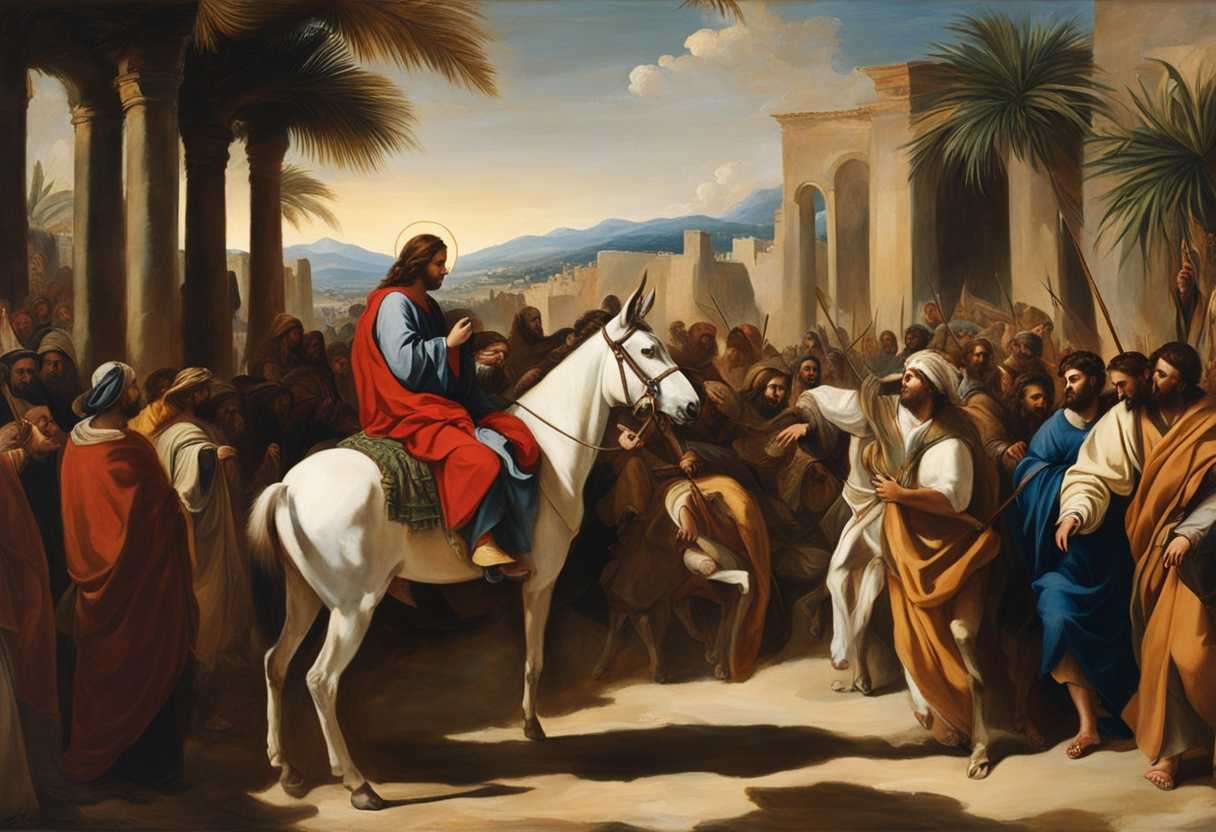
The True Meaning of Mark 11
The Gospel of Mark, one of the four canonical gospels, was written by John Mark, a companion of the apostle Peter. Mark’s account provides a vivid and concise narrative of the life, ministry, death, and resurrection of Jesus Christ. Jesus triumphantly enters Jerusalem, cleanses the temple, and curses the fig tree in this chapter. These events mark a pivotal moment in Jesus’ earthly ministry, as he confronts the religious authorities and prepares for the ultimate sacrifice that will redeem humanity. Jesus challenges the status quo with his actions and foreshadows the dramatic events that will unfold in the coming days as we delve into this passage, leading to his crucifixion and the establishment of the new covenant. The themes of faith, authority, and the true purpose of the temple will be central to our understanding of this transformative chapter.
Mark 11:1-11
We witness the triumphant entry of Jesus into Jerusalem in Mark 11:1-11, a momentous event known as Palm Sunday in Christian tradition. This passage is rich with symbolism and significance, showcasing Jesus as the awaited Messianic King. Let’s break down this powerful narrative into key sections and explore their deeper meanings.
- Jesus sent two of his disciples as they approached Jerusalem and came to Bethphage and Bethany at the Mount of Olives, saying to them, ‘Go to the village ahead of you, and just as you enter it, you will find a colt tied there, which no one has ever ridden.’ Untie it and bring it here.’” (Mark 11:1-2)
Here, Jesus displays his divine knowledge and authority by instructing his disciples to fetch a colt for him to ride into Jerusalem. This foretells the fulfillment of the prophecy in Zechariah 9:9, “Rejoice greatly, Daughter Zion! Shout, Daughter Jerusalem! See, your king comes to you, righteous and victorious, lowly and riding on a donkey, on a colt, the foal of a donkey.” This act symbolizes Jesus’ humility and peaceful intentions as the promised Messiah.
- “They brought the colt to Jesus and threw their cloaks over it, and he sat on it. Many people spread their cloaks on the road, while others spread branches they had cut in the fields.” (Mark 11:7-8)
The crowds welcoming Jesus with cloaks and palm branches is a gesture of honor and recognition reserved for royalty. This act echoes the practice of strewing garments and branches during the anointing of kings in the Old Testament, as seen in 2 Kings 9:13 when Jehu was anointed as king. The people’s actions signify their acknowledgment of Jesus as the long-awaited King of Israel, ushering in the Kingdom of God.
- “Blessed is he who comes in the name of the Lord! Blessed is the kingdom of our father David that is coming! Hosanna in the highest!” (Mark 11:9-10)
The cries of “Hosanna” from the crowd reflect their recognition of Jesus as the fulfillment of Messianic prophecies and their anticipation of deliverance. “Hosanna” means “save, we pray,” and the people’s exclamation underscores their hope that Jesus would save them. This phrase was commonly used in the context of seeking salvation and rescue, as seen in Psalm 118:25-26. The crowd’s declaration of “Blessed is he who comes in the name of the Lord” is a direct reference to Psalm 118, affirming Jesus as the promised King and Savior. The triumphal entry into Jerusalem presented in Mark 11:1-11 sets the stage for the events that would follow, including Jesus’ ultimate sacrifice on the cross. This passage emphasizes Jesus’ identity as the prophesied Messiah, the humble King who came to bring salvation and establish the Kingdom of God. It calls us to reflect on our own recognition of Jesus’ kingship in our lives and to welcome him with hearts full of praise and gratitude.
Mark 11:12-14
Jesus curses the fig tree in Mark 11:12-14. This incident is a powerful and often perplexing moment in the Gospels. On the surface, it may seem harsh for Jesus to curse a fig tree simply because it did not have any fruit, especially since it was not even the season for figs. However, when we dig deeper into the context and symbolism, we can unravel the profound meaning behind this seemingly harsh action.
When Jesus sees the fig tree from a distance and approaches it to find nothing but leaves, He uses this moment to teach a lesson to His disciples and to all of us. The fig tree, in this instance, can be seen as a symbol of outward religiosity or the lack of spiritual fruitfulness. While the tree had the appearance of health and vitality with its leaves, it was barren when it came to producing fruit. Jesus often criticized the religious leaders of His time who appeared righteous on the outside but lacked true faith and compassion.
This event serves as a powerful warning to all believers, urging us to bear spiritual fruit in our lives. Jesus says in John 15:1-2, “I am the true vine, and my Father is the gardener.” He cuts off every branch in me that bears no fruit, while every branch that does bear fruit he prunes so that it will be even more fruitful.” Just like the fig tree that was cursed for its lack of fruit, we are called to bear fruits of righteousness, love, kindness, and faith in our lives.
Furthermore, this passage also highlights the authority of Jesus. He caused the fig tree to wither from its roots by simply speaking a word. This miraculous act displays Jesus’ power over nature and His ability to bring about immediate consequences. It reminds us of the magnitude of His authority as the Son of God and the importance of recognizing and submitting to His sovereignty. The cursing of the fig tree in Mark 11:12-14 ultimately serves as a poignant reminder for us to not only appear fruitful on the outside but to have genuine faith and produce good fruit in our lives, reflecting the transformative power of Christ within us.
Mark 11:15-19
Jesus entered the temple in Jerusalem and overturned the tables of the money changers and the seats of those selling doves, as described in Mark 11:15-19. It is important to note the significance of this event as it demonstrates Jesus’ righteous anger and his displeasure with the corruption that had infiltrated the religious practices of the time. The temple, which was meant to be a house of prayer, had been turned into a marketplace where greed and exploitation were prevalent.
Jesus’ actions in the temple convey a powerful message about the importance of true worship and the purity of one’s intentions. Jesus was making a statement against the ceremonial rigidity and hypocrisy of the religious leaders by cleansing the temple. This event also underscores Jesus’ role as a prophet calling out injustice and challenging the status quo.
The use of the term “den of robbers” in this passage is significant as it echoes the words of the Old Testament prophets, particularly Jeremiah (Jeremiah 7:11), who also denounced the corruption in the temple. Jesus aligns himself with those who came before him and establishes the continuity of his message with the teachings of the Hebrew Scriptures by referencing this prophetic tradition.
Furthermore, the reaction of the chief priests and scribes in seeking to destroy Jesus following this incident highlights the threat that Jesus posed to the religious establishment. His actions challenged their authority and exposed their hypocrisy, leading them to conspire against him. This sets the stage for the events that would unfold leading to Jesus’ crucifixion, illustrating the fierce opposition he faced from those in power. This passage serves as a reminder of the importance of sincerity and humility in our worship when considering its broader implications. It calls believers to examine their own hearts and motives, ensuring that their actions are aligned with true devotion rather than self-serving interests. The account of Jesus cleansing the temple also points to the need for reform and renewal within religious institutions, emphasizing the call to uphold justice, integrity, and compassion in all aspects of faith and practice.
Mark 11:20-25
Jesus and his disciples passed by a withered fig tree the day after Jesus had cursed it in Mark 11:20-25, causing it to wither from the roots. This tree, which symbolically represented Israel and its fruitlessness, serves as a powerful visual lesson for the disciples and all believers. Jesus used this incident to teach his disciples about the power of faith and prayer, showing them that through faith, they could also perform great miracles and even move mountains.
The passage begins with the disciples noticing that the fig tree which Jesus had cursed the previous day had withered from the roots up. This immediate and dramatic result of Jesus’ words demonstrated his authority over nature and reinforced the importance of faith. The fact that the tree withered from the roots symbolizes the deep, underlying issues within Israel that needed addressing. This event serves as a metaphor for the spiritual condition of the nation at that time, emphasizing the importance of bearing spiritual fruit and the consequences of spiritual barrenness.
Jesus then uses this moment to teach his disciples about the power of faith and prayer. He tells them that if they have faith and do not doubt in their hearts, they can say to a mountain to be thrown into the sea, and it will be done. This emphasizes the incredible power of faith and prayer to overcome obstacles and perform miracles. It underscores the importance of unwavering faith in God’s power and His ability to work through His followers.
Jesus goes on to highlight the importance of forgiveness in prayer. He stresses that when they pray, they should forgive anyone they have grievances against so that their Father in heaven may also forgive them. This concept of forgiveness is a fundamental principle throughout the Bible, demonstrating the importance of harboring no bitterness or unforgiveness in our hearts. Jesus ties the efficacy of our prayers to the condition of our hearts towards others, reinforcing the need for love, compassion, and forgiveness in our relationships. These verses demonstrate Jesus’ authority powerfully, emphasize the importance of faith and prayer, and underscore the necessity of forgiveness in the life of a believer. This passage challenges us to examine our own faith, prayer life, and attitudes towards others. It reminds us that with unwavering faith, genuine prayer, and hearts filled with forgiveness and love, we can see mountains move and miracles happen in our lives and in the lives of others.
Mark 11:27-33
Jesus confronts the religious leaders in Mark 11:27-33. The section starts with the chief priests, the teachers of the law, and the elders coming to question Jesus about His authority. This question is not out of genuine curiosity but rather a trap set by the religious leaders to try to discredit Jesus. They were probably threatened by the authority Jesus possessed and were looking for a way to undermine Him in front of the people.
Jesus, being aware of their malicious intent, responds with a question of His own. He asks whether the baptism of John was from heaven or of human origin. Jesus puts the religious leaders in a dilemma because however they answered, they would be caught in their own trap. If they said John’s baptism was from heaven, they would have to explain why they didn’t believe him. If they said it was of human origin, they risked angering the people who believed John was a prophet.
This interaction highlights the wisdom and discernment of Jesus. He often turned the tables on those trying to test or trap Him, revealing their motives and challenging them to think deeper. It also shows that Jesus’ authority comes from a higher source, and the religious leaders, despite their position, were unable to comprehend or accept it.
This passage serves as a reminder of the importance of discernment and wisdom in dealing with challenges to our faith. It also emphasizes the need to always be prepared to defend our beliefs and to be aware of the motives of those who seek to undermine the truth. Just as Jesus stood firm in the face of opposition, we are called to stand firm in our faith and not be swayed by the opinions or schemes of others.
Throughout the Gospels, we see Jesus constantly being tested and questioned by the religious leaders of His time. This pattern culminates in His trial and crucifixion, where the religious leaders, threatened by His teachings and authority, ultimately conspire to have Him put to death. However, Jesus’ ultimate victory over sin and death through His resurrection demonstrates that His authority is indeed divine and cannot be extinguished by human efforts. Jesus delivers a scathing rebuke to the religious leaders in Matthew 23:13-36, denouncing their hypocrisy and warning of the consequences of their actions. This serves as a parallel to the encounter in Mark 11, where we see the religious leaders trying to trap Jesus. The consistent message throughout the Gospels is that true authority comes from God and is demonstrated through humility, service, and love, rather than through power plays and manipulation.
After Mark 11
Jesus enters Jerusalem triumphantly in Mark 11, welcomed by crowds waving palm branches and shouting praises. He cleanses the temple, teaching about faith and forgiveness. Jesus’ authority is questioned by the religious leaders, but he responds with wisdom and parables. Jesus emphasizes the importance of prayer and forgiveness as the chapter concludes, setting the stage for the events that will unfold in the following chapters. We should continue to follow Jesus’ teachings and example, seeking to deepen our faith and live lives of love and grace.

Reverend Michael Johnson is an experienced Church Minister with a profound expertise in spirituality and guidance. With a serene presence and a compassionate heart, he has faithfully served his congregation for over 20 years, leading them on a spiritual journey towards inner peace and enlightenment. Reverend Johnson’s extensive knowledge of religious philosophies and profound understanding of human nature have made him a trusted confidant and mentor to many, as he seamlessly weaves his profound wisdom into life teachings. Reverend Johnson’s calming demeanor and empathetic nature continue to uplift and heal souls, nurturing a sense of unity and tranquility within his community.