
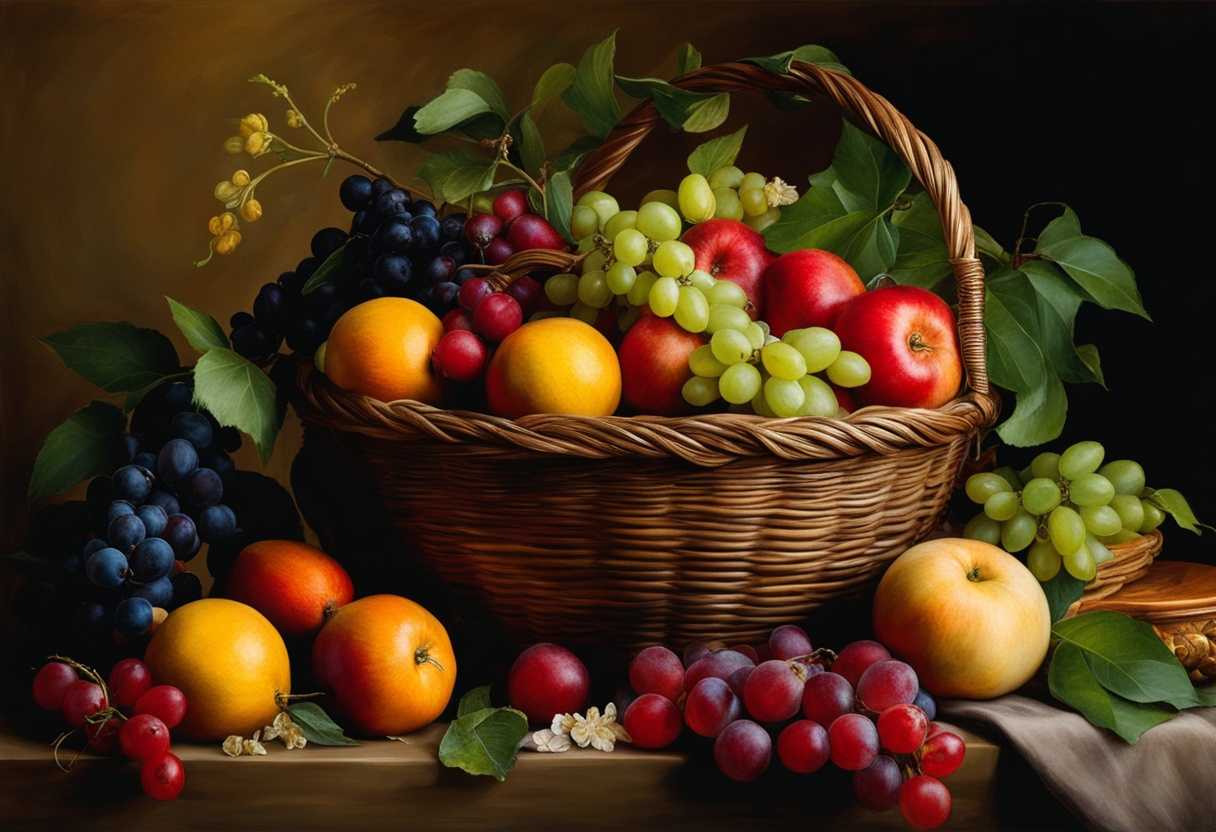
In the Bible, baskets often symbolize abundance and provision, as seen in the miraculous feeding of the 5,000, where leftovers were collected in baskets (John 6:13). They also represent the gathering of offerings or the receptacles for God’s blessings, illustrating both physical sustenance and spiritual nourishment.
Scripture
1 Now a man from the house of Levi went and took as his wife a Levite woman.
2 The woman conceived and bore a son, and when she saw that he was a fine child, she hid him three months.
3 When she could hide him no longer, she took for him a basket made of bulrushes and daubed it with bitumen and pitch. She put the child in it and placed it among the reeds by the river bank.
4 And his sister stood at a distance to know what would be done to him.
5 Now the daughter of Pharaoh came down to bathe at the river, while her young women walked beside the river. She saw the basket among the reeds and sent her servant woman, and she took it.
6 When she opened it, she saw the child, and behold, the baby was crying. She took pity on him and said, “This is one of the Hebrews’ children.”
7 Then his sister said to Pharaoh’s daughter, “Shall I go and call you a nurse from the Hebrew women to nurse the child for you?”
8 Then Pharaoh’s daughter said to her, “Take this child away and nurse him for me, and I will give you your wages.” So the woman took the child and nursed him.
9 She said to Pharaoh’s daughter, “Shall I go and call you a nurse from the Hebrew women to nurse the child for you?”
10 When the child grew older, she brought him to Pharaoh’s daughter, and he became her son. She named him Moses, “Because,” she said, “I drew him out of the water.”
Biblical Significance of Baskets
The symbolism of baskets in the Bible encapsulates themes of abundance, provision, and divine blessing. In John 6:13, after the miracle of feeding the 5,000, Jesus instructs His disciples to collect the leftovers, resulting in twelve baskets filled with fragments from the five barley loaves. This act not only emphasizes the overflowing generosity of God’s provision but also signifies that in God’s economy, there is always more than enough. Baskets, in this sense, serve as a tangible reminder of how God cares for our needs, reinforcing the idea that He provides not just in sufficiency, but in abundance.
Furthermore, baskets can also reflect the spiritual practices of gathering and offering. In the Old Testament, the Israelites were instructed to bring their first fruits to God, often using baskets to present their offerings (Deuteronomy 26:2). This act of gathering and giving underscores a relationship of reciprocity between God and His people—a recognition of His blessings and provision and a response of gratitude. Thus, the basket becomes a symbol of faith, inviting believers to trust in God’s ongoing provision while participating in the act of sharing His blessings with others, encapsulating both the physical sustenance and the spiritual nourishment that comes from living in accordance with His will.
In addition to the themes of abundance and gratitude, baskets in the Bible often symbolize the preservation of life and the importance of community support. For instance, in the story of Moses’ infancy, his mother places him in a basket and sets it adrift on the Nile River to protect him from the Pharaoh’s decree of infanticide. This vessel becomes a means of deliverance, illustrating how God uses simple objects—in this case, a basket—to orchestrate His plans for salvation and the continuation of the Hebrew people. The basket thus comes to represent divine intervention, resourcefulness, and the importance of taking action to safeguard future generations, reminding the faithful that God can work through everyday items to fulfill His greater purpose.
Moreover, baskets are found in the context of communal sharing and support. In the early church, followers of Christ were known to provide for one another’s needs, often gathering resources to support the poor and widow among them. The imagery of baskets here symbolizes not only material assistance but also the unity of believers working together to foster a compassionate community grounded in love and generosity. This use of baskets conveys a profound message about stewardship and the collective responsibility of the church as the body of Christ—to ensure that no one is left wanting. Thus, baskets serve as a vital reminder of the interconnectedness of believers and the importance of sharing God’s blessings in service to one another, deepening both individual and communal faith experiences.
Symbol of Abundance and Provision
Baskets in the Bible often symbolize abundance and God’s provision for His people. They are used to collect and carry food, representing the blessings that God bestows upon His followers. The act of gathering food into baskets can be seen as a reminder of God’s faithfulness in supplying needs, both physically and spiritually. This symbolism extends to the idea that God provides not just enough, but overflowing blessings, encouraging believers to trust in His generosity.
Representation of Community and Sharing
Baskets also signify community and the importance of sharing resources among one another. In biblical narratives, baskets are often used in communal settings, where food is distributed among groups. This reflects the principle of sharing and caring for one another, emphasizing the need for unity and support within the community of believers. The act of sharing what is in the basket can serve as a metaphor for the sharing of spiritual gifts and resources, fostering a sense of togetherness and mutual aid.
Tool for Teaching and Miracles
In various biblical accounts, baskets serve as tools for teaching and demonstrating God’s power through miracles. They are often involved in miraculous events, such as the feeding of the multitudes, where baskets are used to collect the leftovers, symbolizing the abundance that results from faith and divine intervention. This aspect highlights the role of baskets in conveying deeper spiritual truths, illustrating how God can take what seems insufficient and multiply it for His purposes, thereby teaching lessons of faith, gratitude, and reliance on divine providence.
How to Cultivate Faith and Resourcefulness in Community
Cultivating faith and resourcefulness in community is a beautiful journey that requires intentionality and openness. Start by surrounding yourself with fellow believers who inspire and challenge you; their stories and experiences can deepen your understanding of faith. Engage in regular fellowship—whether through small groups, church events, or service projects—where you can share your struggles and victories, creating a safe space for vulnerability. Remember, resourcefulness often springs from collaboration; when we pool our talents and resources, we can tackle challenges together and support one another in ways we might not have imagined alone. Pray for guidance and be willing to listen to the Holy Spirit, as He often speaks through the wisdom of others. As you invest in these relationships, you’ll find that your faith grows stronger, and your ability to navigate life’s challenges becomes more resilient, all while reflecting Christ’s love in your community.
Bible References to the Significance of Baskets:
Leviticus 8:25-29: 25 And he took the fat, and the fat tail, and all the fat that was on the entrails, and the long lobe of the liver and the two kidneys with their fat, and Moses burned them on the altar.
26 And out of the basket of unleavened bread that was before the Lord, he took one unleavened loaf and one loaf of bread with oil and one wafer and placed them on the pieces of fat and on the right thigh.
27 And he put all these in the hands of Aaron and in the hands of his sons and waved them as a wave offering before the Lord.
28 Then Moses took them from their hands and burned them on the altar with the burnt offering. This was an ordination offering for a pleasing aroma, a food offering to the Lord.
29 And Moses took the breast and waved it for a wave offering before the Lord. It was Moses’ portion of the ram of ordination, as the Lord commanded Moses.
Numbers 6:19-20: 19 And the priest shall take the shoulder of the ram, when it is boiled, and one unleavened loaf out of the basket and one unleavened wafer, and shall put them on the hands of the Nazirite, after he has shaved the hair of his consecration,
20 And the priest shall wave them for a wave offering before the Lord. They are a holy portion for the priest, together with the breast that is waved and the thigh that is contributed. And after that the Nazirite may drink wine.
Deuteronomy 26:1-11: 1 “When you come into the land that the Lord your God is giving you for an inheritance and have taken possession of it and live in it,
2 you shall take some of the first of all the fruit of the ground, which you harvest from your land that the Lord your God is giving you, and you shall put it in a basket, and you shall go to the place that the Lord your God will choose, to make his name to dwell there.
3 And you shall go to the priest who is in office at that time and say to him, ‘I declare today to the Lord your God that I have come into the land that the Lord swore to our fathers to give us.’
4 Then the priest shall take the basket from your hand and set it down before the altar of the Lord your God.
5 “And you shall make response before the Lord your God, ‘A wandering Aramean was my father. And he went down into Egypt and sojourned there, few in number, and there he became a nation, great, mighty, and populous.
6 And the Egyptians treated us harshly and humiliated us and laid on us hard labor.
7 Then we cried to the Lord, the God of our fathers, and the Lord heard our voice and saw our affliction, our toil, and our oppression.
8 And the Lord brought us out of Egypt with a mighty hand and an outstretched arm, with great deeds of terror, with signs and wonders.
9 and he brought us into this place and gave us this land, a land flowing with milk and honey.
10 And behold, now I bring the first of the fruit of the ground, which you, O Lord, have given me.’ And you shall set it down before the Lord your God and worship before the Lord your God.
11 And you shall rejoice in all the good that the Lord your God has given to you and to your house, you, and the Levite, and the sojourner who is among you.
Judges 6:19-21: 19 So Gideon went into his house and prepared a young goat and unleavened cakes from an ephah of flour. The meat he put in a basket, and the broth he put in a pot, and brought them to him under the terebinth and presented them.
20 And the angel of God said to him, “Take the meat and the unleavened cakes, and put them on this rock, and pour the broth over them.” And he did so.
21 Then the angel of the Lord reached out the tip of the staff that was in his hand and touched the meat and the unleavened cakes. And fire sprang up from the rock and consumed the meat and the unleavened cakes. And the angel of the Lord vanished from his sight.
1 Kings 17:8-16: 8 Then the word of the Lord came to him,
9 “Arise, go to Zarephath, which belongs to Sidon, and dwell there. Behold, I have commanded a widow there to feed you.”
10 So he arose and went to Zarephath. And when he came to the gate of the city, behold, a widow was there gathering sticks. And he called to her and said, “Bring me a little water in a vessel, that I may drink.”
11 And as she was going to bring it, he called to her and said, “Bring me a morsel of bread in your hand.”
12 And she said, “As the Lord your God lives, I have nothing baked, only a handful of flour in a jar and a little oil in a jug. And now I am gathering a couple of sticks that I may go in and prepare it for myself and my son, that we may eat it and die.”
13 And Elijah said to her, “Do not fear; go and do as you have said. But first make me a little cake of it and bring it to me, and afterward make something for yourself and your son.
14 For thus says the Lord, the God of Israel, ‘The jar of flour shall not be spent, and the jug of oil shall not be empty, until the day that the Lord sends rain upon the earth.’”
15 She went and did as Elijah said. And she and he and her household ate for many days.
16 The jar of flour was not spent, neither did the jug of oil become empty, according to the word of the Lord that he spoke by Elijah.
2 Kings 4:42-44: 42 A man came from Baal-shalishah, bringing the man of God bread of the firstfruits, twenty loaves of barley and fresh ears of grain in his sack. And Elisha said, “Give to the men, that they may eat.”
43 But his servant said, “How can I set this before a hundred men?” So he repeated, “Give them to the men, that they may eat, for thus says the Lord, ‘They shall eat and have some left.’”
44 So he set it before them. And they ate and had some left, according to the word of the Lord.
Jeremiah 24:1-10: 1 After Nebuchadnezzar king of Babylon had taken into exile from Jerusalem Jeconiah the son of Jehoiakim, king of Judah, together with the officials of Judah, the craftsmen, and the metal workers, and had brought them to Babylon, the Lord showed me this vision: behold, two baskets of figs placed before the temple of the Lord.
2 One basket had very good figs, like first-ripe figs, but the other basket had very bad figs, so bad that they could not be eaten.
3 Then the Lord said to me, “What do you see, Jeremiah?” I said, “Figs, the good figs very good, and the bad figs very bad, that cannot be eaten due to their badness.”
4 Then the word of the Lord came to me:
5 “Thus says the Lord, the God of Israel: Like these good figs, so I will regard as good the exiles from Judah, whom I have sent away from this place to the land of the Chaldeans.”
6 I will set my eyes on them for good, and I will bring them back to this land. I will build them up, and not tear them down; I will plant them, and not uproot them.
7 I will give them a heart to know that I am the Lord, and they shall be my people and I will be their God, for they shall return to me with their whole heart.
8 “But thus says the Lord: Like the bad figs that are so bad they cannot be eaten, so will I treat Zedekiah the king of Judah, his officials, the remnant of Jerusalem who remain in this land, and those who dwell in the land of Egypt.
9 I will make them a horror to all the kingdoms of the earth, to be a reproach, a byword, a taunt, and a curse in all the places where I shall drive them.
10 And I will send sword, famine, and pestilence upon them, until they shall be utterly destroyed from the land that I gave to them and their fathers.
Matthew 14:13-21: 13 Now when Jesus heard this, he withdrew from there in a boat to a desolate place by himself. But when the crowds heard it, they followed him on foot from the towns.
14 When he went ashore he saw a great crowd, and he had compassion on them and healed their sick.
15 Now when it was evening, the disciples came to him and said, “This is a desolate place, and the day is now over; send the crowds away to go into the villages and buy food for themselves.”
16 But Jesus said, “They need not go away; you give them something to eat.”
17 They said to him, “We have only five loaves here and two fish.”
18 He said, “Bring them here to me.”
19 Then he ordered the crowds to sit down on the grass, and taking the five loaves and the two fish, he looked up to heaven and said a blessing. Then he broke the loaves and gave them to the disciples, and the disciples gave them to the crowds.
20 And they all ate and were satisfied. And they took up twelve baskets full of the broken pieces left over.
21 And those who ate were about five thousand men, besides women and children.
Matthew 15:32-39: 32 Then Jesus called his disciples to him and said, “I have compassion on the crowd because they have been with me now three days and have nothing to eat. And I am unwilling to send them away hungry, lest they faint on the way.”
33 And the disciples said to him, “Where are we to get enough bread in such a desolate place to feed so great a crowd?”
34 And Jesus said to them, “How many loaves do you have?” They said, “Seven, and a few small fish.”
35 And directing the crowd to sit down on the ground,
36 he took the seven loaves and the fish, and having given thanks he broke them and gave them to the disciples, and the disciples gave them to the crowds.
37 And they all ate and were satisfied. And they took up seven baskets full of the broken pieces left over.
38 And those who ate were four thousand men, besides women and children.
39 And after sending away the crowds, he got into the boat and went to the region of Magadan.
Mark 6:30-44: 30 The apostles returned to Jesus and told him all that they had done and taught.
31 And he said to them, “Come away by yourselves to a desolate place and rest a while.” For many were coming and going, and they had no leisure even to eat.
32 And they went away in the boat to a desolate place by themselves.
33 Now many saw them going and recognized them, and they ran there on foot from all the towns and got there ahead of them.
34 When he went ashore he saw a great crowd, and he had compassion on them, because they were like sheep without a shepherd. And he began to teach them many things.
35 And when it grew late, his disciples came to him and said, “This is a desolate place, and the hour is now late.
36 Send them away to go into the surrounding countryside and villages and buy themselves something to eat.
37 But he answered them, “You give them something to eat.” And they said to him, “Shall we go and buy two hundred denarii worth of bread and give it to them to eat?”
38 And he said to them, “How many loaves do you have? Go and see.” And when they had found out, they said, “Five, and two fish.”
39 Then he commanded them all to sit down in groups on the green grass.
40 So they sat down in groups, by hundreds and by fifties.
41 And taking the five loaves and the two fish, he looked up to heaven and said a blessing and broke the loaves and gave them to the disciples to set before the people. And he divided the two fish among them all.
42 And they all ate and were satisfied.
43 And they took up twelve baskets full of broken pieces and of the fish.
44 And those who ate the loaves were five thousand men.
Mark 8:1-10: In those days, when again a great crowd had gathered, and they had nothing to eat, he called his disciples to him and said to them,
2 “I have compassion on the crowd, because they have been with me now three days and have nothing to eat.”
3 And if I send them away hungry to their homes, they will faint on the way. And some of them have come from far away.”
4 And his disciples answered him, “How can one feed these people with bread here in this desolate place?”
5 And he asked them, “How many loaves do you have?” They said, “Seven.”
6 And he directed the crowd to sit down on the ground. And he took the seven loaves, and having given thanks, he broke them and gave them to his disciples to set before the people; and they set them before the crowd.
7 And they had a few small fish.
8 And they ate and were satisfied. And they took up the broken pieces left over, seven baskets full.
9 And they ate and were satisfied. And they took up the broken pieces left over, seven baskets full.
10 And immediately he got into the boat with his disciples and went to the district of Dalmanutha.
Luke 9:10-17: 10 On their return the apostles told him all that they had done. And he took them and withdrew apart to a town called Bethsaida.
11 When the crowds learned it, they followed him, and he welcomed them and spoke to them of the kingdom of God and cured those who had need of healing.
12 Now the day began to wear away, and the twelve came and said to him, “Send the crowd away to go into the surrounding villages and countryside to find lodging and get provisions, for we are here in a desolate place.”
13 But he said to them, “You give them something to eat.” They said, “We have no more than five loaves and two fish—unless we are to go and buy food for all these people.”
14 For there were about five thousand men. And he said to his disciples, “Have them sit down in groups of about fifty each.”
15 And they did so, and had them all sit down.
16 And taking the five loaves and the two fish, he looked up to heaven and said a blessing over them. Then he broke the loaves and gave them to the disciples to set before the crowd.
17 And they all ate and were satisfied. And what was left over was picked up, twelve baskets of broken pieces.
John 6:1-14: 1 After this Jesus went away to the other side of the Sea of Galilee, which is the Sea of Tiberias.
2 And a large crowd was following him, because they saw the signs that he was doing on the sick.
3 And Jesus went up on the mountain, and there he sat down with his disciples.
4 Now the Passover, the feast of the Jews, was at hand.
5 Lifting up his eyes, then, and seeing that a large crowd was coming toward him, Jesus said to Philip, “Where are we to buy bread, so that these people may eat?”
6 He said this to test him, for he himself knew what he would do.
7 Philip answered him, “Two hundred denarii worth of bread would not be enough for each of them to get a little.”
8 One of his disciples, Andrew, Simon Peter’s brother, said to him,
9 “There is a boy here who has five barley loaves and two fish, but what are they for so many?”
10 Jesus said, “Have the people sit down.” Now there was much grass in the place. So the men sat down, about five thousand in number.
11 Jesus then took the loaves, and when he had given thanks, he distributed them to those who were seated. So also the fish, as much as they wanted.
12 And when they had eaten their fill, he told his disciples, “Gather up the leftover fragments, that nothing may be lost.”
13 So they gathered them up and filled twelve baskets with fragments from the five barley loaves left by those who had eaten.
14 When the people saw the sign that he had done, they said, “This is indeed the Prophet who is to come into the world!”
Acts 9:23-25: 23 When many days had passed, the Jews plotted to kill him,
24 but their plot became known to Saul. They were watching the gates day and night in order to kill him,
25 but his disciples took him by night and let him down through an opening in the wall, lowering him in a basket.
Acts 11:27-30: 27 Now in these days prophets came down from Jerusalem to Antioch.
28 And one of them named Agabus stood up and foretold by the Spirit that there would be a great famine over all the world (this took place in the days of Claudius).
29 So the disciples determined, everyone according to his ability, to send relief to the brothers living in Judea.
30 This they did, sending it to the elders by the hand of Barnabas and Saul.

Reverend Michael Johnson is an experienced Church Minister with a profound expertise in spirituality and guidance. With a serene presence and a compassionate heart, he has faithfully served his congregation for over 20 years, leading them on a spiritual journey towards inner peace and enlightenment. Reverend Johnson’s extensive knowledge of religious philosophies and profound understanding of human nature have made him a trusted confidant and mentor to many, as he seamlessly weaves his profound wisdom into life teachings. Reverend Johnson’s calming demeanor and empathetic nature continue to uplift and heal souls, nurturing a sense of unity and tranquility within his community.