
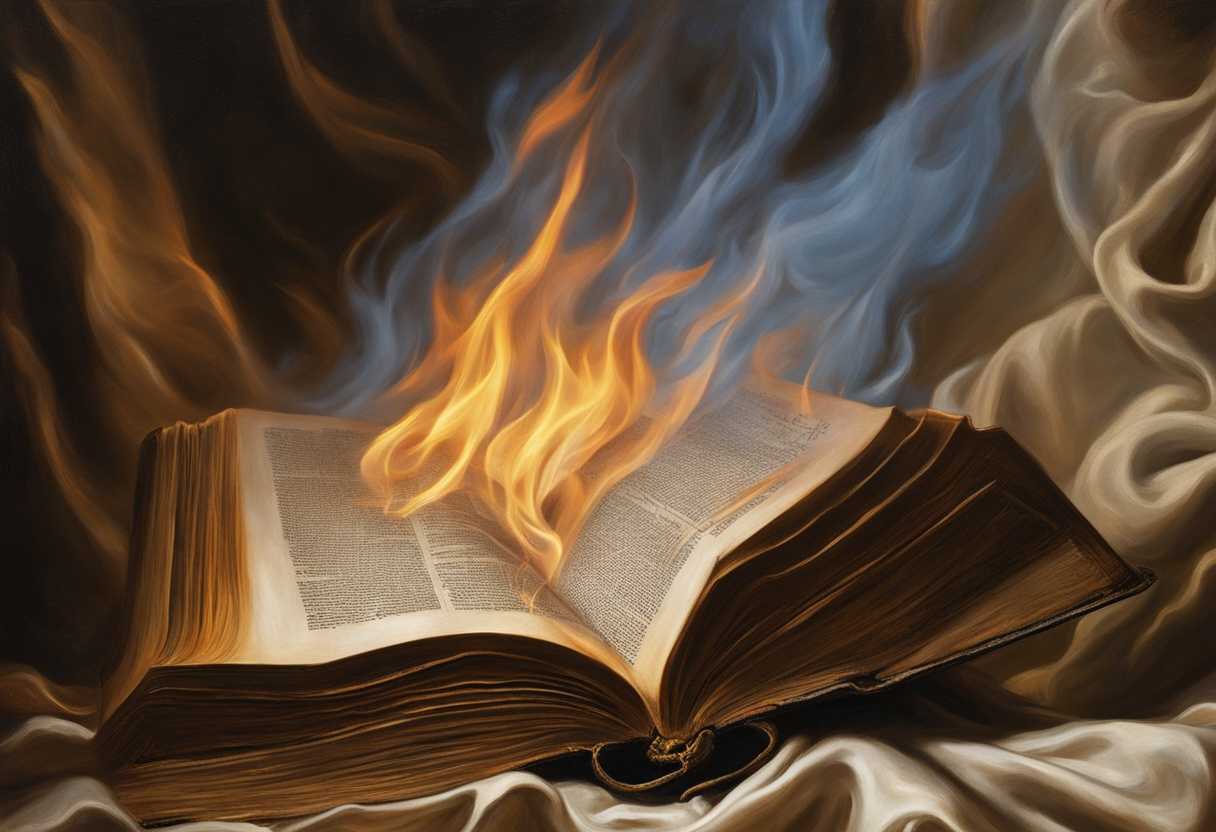
Burning a Bible symbolizes a rejection of its teachings, authority, or religious faith. It can represent spiritual rebellion, the desire to discard tradition, or a profound disconnection from sacred beliefs.
Scripture
1 Now Moses was keeping the flock of his father-in-law, Jethro, the priest of Midian, and he led his flock to the west side of the wilderness and came to Horeb, the mountain of God.
2 And the angel of the Lord appeared to him in a flame of fire out of the midst of a bush. He looked, and behold, the bush was burning, yet it was not consumed.
3 And Moses said, “I will turn aside to see this great sight, why the bush is not burned.”
4 When the Lord saw that he turned aside to see, God called to him out of the bush, “Moses, Moses!” And he said, “Here I am.”
5 Then he said, “Do not come near; take your sandals off your feet, for the place on which you are standing is holy ground.”
6 And he said, “I am the God of your father, the God of Abraham, the God of Isaac, and the God of Jacob.” And Moses hid his face, for he was afraid to look at God.
Burning Bible Symbolism in Scripture
The act of burning a Bible can be seen as a profound repudiation of its teachings and authority, reflecting a deep spiritual rebellion against the foundational doctrines outlined in Scripture. In Hebrews 4:12, the Bible is described as “living and active, sharper than any two-edged sword,” highlighting its role as an instrument of divine truth and moral guidance. To burn the Bible symbolizes a deliberate choice to reject this living truth, representing a conscious act of denial of its spiritual significance and moral teachings. This act embodies a broader societal critique of established faith systems and an assertion of individual autonomy in spiritual matters.
Moreover, the symbolism of burning the Bible can evoke themes of disconnection and the erosion of trust in the divine. Isaiah 40:8 asserts, “The grass withers, the flower fades, but the word of our God will stand forever,” emphasizing the eternal nature of God’s word. Yet, the incendiary act suggests a transient perspective on sacred truths, where the eternal is discarded for the ephemeral. In this sense, burning the Bible can reflect a personal struggle with faith, the desire for liberation from tradition, or an expression of anger and pain directed towards perceived injustices within religious institutions. Ultimately, it invites a deeper reflection on what it means to engage with Scripture genuinely and the implications of altering one’s relationship with the sacred text.
The act of burning a Bible can also symbolize the broader societal tensions between tradition and modernity, reflecting an ongoing struggle between established beliefs and contemporary values. In a world where individuals often grapple with the relevance of ancient texts in a rapidly changing society, the destruction of a Bible can serve as a powerful metaphor for the rejection of outdated ideologies. This act may evoke a quest for personal identity that seeks to break free from the constraints of conventional spirituality, challenging communities to re-evaluate their doctrines and practices. In this light, burning a Bible is not merely an act of defiance but can also signal a desire for transformation, urging believers and non-believers alike to envision new narratives of faith and meaning.
Furthermore, the symbolism of burning the Bible touches upon the themes of conflict and renewal. Throughout history, many movements have sought to challenge oppressive systems, advocating for justice, equality, and freedom. In the context of such struggles, burning a Bible may represent the rejection of religious dogma that has been used to justify exclusion or violence. It can serve as a catalyst for dialogue, prompting discussions about the role of Scripture in shaping moral and ethical frameworks within society. This discourse may ultimately pave the way for a reexamination of the text’s teachings, encouraging an interpretation that aligns more closely with the ideals of compassion and inclusivity. Thus, while the act of burning the Bible might seem steeped in destruction, it can also ignite a passion for reform and a renewed commitment to a more profound exploration of spiritual truths.
Divine Judgment and Purification
The symbolism of burning in the Bible often represents divine judgment and the purification process. Fire is frequently associated with God’s wrath and the consequences of sin. In this context, burning serves as a metaphor for the refining process, where impurities are removed, and individuals or nations are held accountable for their actions. This purification through fire signifies a transformative experience, leading to spiritual renewal and a return to righteousness.
The Presence of God
Another significant meaning of burning in biblical symbolism is the manifestation of God’s presence. Fire is often depicted as a means through which God reveals Himself, such as in the burning bush encountered by Moses. This imagery conveys the idea that God’s presence is both awe-inspiring and consuming, highlighting His holiness and the reverence that should accompany an encounter with the divine. The burning aspect signifies the intensity and purity of God’s nature, inviting believers to draw near while also recognizing the need for respect and humility.
The Power of the Word
Burning can also symbolize the power and impact of God’s Word. Just as fire can spread rapidly and transform its surroundings, the teachings and messages found in the Bible have the potential to ignite change in the hearts and lives of individuals. This symbolism emphasizes the idea that the Word of God is alive and active, capable of penetrating deep into the human spirit, inspiring action, and fostering spiritual growth. The burning nature of the Word serves as a reminder of its transformative power and the urgency of responding to its call.
How to Strengthen Faith Amidst Rejection and Doubt
Strengthening your faith amidst rejection and doubt can feel like an uphill battle, but it’s also a profound opportunity for growth. When you face challenges, remember that even the most faithful figures in the Bible experienced moments of uncertainty—think of Job or Thomas. Embrace these feelings as part of your journey, and don’t shy away from bringing your doubts to God in prayer; He welcomes your honesty. Surround yourself with a supportive community, whether through a church group or friends who share your beliefs, as their encouragement can be a lifeline. Dive into Scripture, allowing the words to remind you of God’s promises and faithfulness. Lastly, take small steps of faith, even when it feels uncomfortable; each act of trust can build a stronger foundation for your belief. Remember, faith isn’t the absence of doubt, but the choice to believe despite it.
Bible References to Burning Bible Symbolism:
Leviticus 6:8-13: 8 The Lord spoke to Moses, saying:
9 “Command Aaron and his sons, saying, This is the law of the burnt offering. The burnt offering shall be on the hearth on the altar all night until the morning, and the fire of the altar shall be kept burning on it.
10 And the priest shall put on his linen garment and put his linen undergarment on his body, and he shall take up the ashes to which the fire has reduced the burnt offering on the altar and put them beside the altar.
11 Then he shall take off his garments and put on other garments and carry the ashes outside the camp to a clean place.
12 The fire on the altar shall be kept burning on it; it shall not go out. The priest shall burn wood on it every morning, and he shall arrange the burnt offering on it and shall burn on it the fat of the peace offerings.
13 Fire shall be kept burning on the altar continually; it shall not go out.
Deuteronomy 4:23-24: 23 Take care, lest you forget the covenant of the Lord your God, which he made with you, and make a carved image, the form of anything that the Lord your God has forbidden you.
24 For the Lord your God is a consuming fire, a jealous God.
1 Kings 18:20-40: 20 So Ahab sent to all the people of Israel and gathered the prophets together at Mount Carmel.
21 And Elijah came near to all the people and said, “How long will you go limping between two different opinions? If the Lord is God, follow him; but if Baal, then follow him.” And the people did not answer him a word.
22 Then Elijah said to the people, “I, even I only, am left a prophet of the Lord, but Baal’s prophets are 450 men.
23 Let two bulls be given to us, and let them choose one bull for themselves and cut it in pieces and lay it on the wood, but put no fire to it. And I will prepare the other bull and lay it on the wood and put no fire to it.
24 And you call upon the name of your god, and I will call upon the name of the Lord, and the God who answers by fire, he is God.” And all the people answered, “It is well spoken.”
25 Then Elijah said to the prophets of Baal, “Choose for yourselves one bull and prepare it first, for you are many, and call upon the name of your god, but put no fire to it.”
26 And they took the bull that was given them, and they prepared it and called upon the name of Baal from morning until noon, saying, “O Baal, answer us!” But there was no voice, and no one answered. And they limped around the altar that they had made.
27 And at noon Elijah mocked them, saying, “Cry aloud, for he is a god. Either he is musing, or he is relieving himself, or he is on a journey, or perhaps he is asleep and must be awakened.”
28 And they cried aloud and cut themselves after their custom with swords and lances, until the blood gushed out upon them.
29 And as midday passed, they raved on until the time of the offering of the oblation, but there was no voice. No one answered; no one paid attention.
30 Then Elijah said to all the people, “Come near to me.” And all the people came near to him. And he repaired the altar of the Lord that had been thrown down.
31 Elijah took twelve stones, according to the number of the tribes of the sons of Jacob, to whom the word of the Lord came, saying, “Israel shall be your name,”
32 And with the stones he built an altar in the name of the Lord.
33 And he put the wood in order and cut the bull in pieces and laid it on the wood. And he said, “Fill four jars with water and pour it on the burnt offering and on the wood.”
34 And he said, “Fill four jars with water and pour it on the burnt offering and on the wood.”
35 And the water ran around the altar and filled the trench also with water.
36 And at the time of the offering of the oblation, Elijah the prophet came near and said, “O Lord, God of Abraham, Isaac, and Israel, let it be known this day that you are God in Israel, and that I am your servant, and that I have done all these things at your word.
37 Answer me, O Lord, answer me, that this people may know that you, O Lord, are God, and that you have turned their hearts back.”
38 Then the fire of the Lord fell and consumed the burnt offering and the wood and the stones and the dust, and licked up the water that was in the trench.
39 And when all the people saw it, they fell on their faces and said, “The Lord, he is God; the Lord, he is God.”
40 And Elijah said to them, “Seize the prophets of Baal; let not one of them escape.” And they seized them. And Elijah brought them down to the brook Kishon and slaughtered them there.
2 Kings 2:11-12: 11 And as they still went on and talked, behold, chariots of fire and horses of fire separated the two of them. And Elijah went up by a whirlwind into heaven.
12 And Elisha saw it and he cried, “My father, my father! The chariots of Israel and its horsemen!” And he saw him no more. Then he took hold of his own clothes and tore them in two pieces.
Isaiah 6:1-7: 1 In the year that King Uzziah died I saw the Lord sitting upon a throne, high and lifted up; and the train of his robe filled the temple.
2 Above him stood the seraphim. Each had six wings: with two he covered his face, and with two he covered his feet, and with two he flew.
3 And one called to another and said: “Holy, holy, holy is the Lord of hosts; the whole earth is full of his glory!”
4 And the foundations of the thresholds shook at the voice of him who called, and the house was filled with smoke.
5 And I said: “Woe is me! For I am lost; for I am a man of unclean lips, and I dwell in the midst of a people of unclean lips; for my eyes have seen the King, the Lord of hosts!”
6 Then one of the seraphim flew to me, having in his hand a burning coal that he had taken with tongs from the altar.
7 And he touched my mouth and said: “Behold, this has touched your lips; your guilt is taken away, and your sin atoned for.”
Jeremiah 20:9: 9 If I say, “I will not mention him, or speak any more in his name,” there is in my heart as it were a burning fire shut up in my bones, and I am weary with holding it in, and I cannot.
Ezekiel 1:4-28: 4 As I looked, behold, a stormy wind came out of the north, and a great cloud, with brightness around it, and fire flashing forth continually, and in the midst of the fire, as it were gleaming metal.
5 And from the midst of it came the likeness of four living creatures. And this was their appearance: they had a human likeness.
6 but each had four faces, and each of them had four wings.
7 Their legs were straight, and the soles of their feet were like the sole of a calf’s foot. And they sparkled like burnished bronze.
8 Under their wings on their four sides they had human hands.
9 their wings touched one another. Each one of them went straight forward, without turning as they went.
10 As for the likeness of their faces, each had a human face. The four had the face of a lion on the right side, the four had the face of an ox on the left side, and the four had the face of an eagle.
11 Such were their faces. And their wings were spread out above. Each creature had two wings, each of which touched the wing of another, while two covered their bodies.
12 And each went straight forward. Wherever the spirit would go, they went, without turning as they went.
13 As for the likeness of the living creatures, their appearance was like burning coals of fire, like the appearance of torches moving to and fro among the living creatures. And the fire was bright, and out of the fire went forth lightning.
14 And the living creatures darted to and fro, like the appearance of a flash of lightning.
15 Now as I looked at the living creatures, I saw a wheel on the earth beside the living creatures, one for each of the four of them.
16 As for the appearance of the wheels and their construction: their appearance was like the gleaming of beryl. And the four had the same likeness, their appearance and construction being as it were a wheel within a wheel.
17 When they went, they went in any of their four directions without turning as they went, but in whatever direction the front wheel faced, the others followed without turning as they went.
18 And their rims were tall and awesome, and the rims of all four were full of eyes all around.
19 And when the living creatures went, the wheels went beside them; and when the living creatures rose from the earth, the wheels rose.
20 Wherever the spirit wanted to go, they went, and the wheels rose along with them, for the spirit of the living creatures was in the wheels.
21 When those went, these went; and when those stood, these stood; and when those rose from the earth, the wheels rose along with them, for the spirit of the living creatures was in the wheels.
22 Over the heads of the living creatures there was the likeness of an expanse, shining like awe-inspiring crystal, spread out above their heads.
23 And under the expanse their wings were stretched out straight, one toward another. Each creature had two wings covering its body.
24 And when they went, I heard the sound of their wings like the sound of many waters, like the sound of the Almighty, a sound of tumult like the sound of an army. When they stood still, they let down their wings.
25 And there came a voice from above the expanse over their heads when they stood still and let down their wings.
26 And above the expanse over their heads there was the likeness of a throne, in appearance like sapphire; and seated above the likeness of a throne was a likeness with a human appearance.
27 And I saw as it were gleaming metal, like the appearance of fire enclosed all around. And downward from what had the appearance of his waist I saw as it were the appearance of fire, and there was brightness around him.
28 Like the appearance of the bow that is in the cloud on the day of rain, so was the appearance of the brightness all around. Such was the appearance of the likeness of the glory of the Lord. And when I saw it, I fell on my face, and I heard the voice of one speaking.
Daniel 3:19-27: 19 Then Nebuchadnezzar was filled with fury, and the expression of his face was changed against Shadrach, Meshach, and Abednego. He ordered the furnace heated seven times more than it was usually heated.
20 And he ordered some of the mighty men of his army to bind Shadrach, Meshach, and Abednego, and to cast them into the burning fiery furnace.
21 Then these men were bound in their cloaks, their tunics, their hats, and their other garments, and they were thrown into the burning fiery furnace.
22 Because the king’s order was urgent and the furnace overheated, the flame of the fire killed those men who took up Shadrach, Meshach, and Abednego.
23 And these three men, Shadrach, Meshach, and Abednego, fell bound into the burning fiery furnace.
24 Then King Nebuchadnezzar was astonished and rose up in haste. He declared to his counselors, “Did we not cast three men bound into the fire?” They answered and said to the king, “True, O king.”
3 He answered and said, “But I see four men unbound, walking in the midst of the fire, and they are not hurt; and the appearance of the fourth is like a son of the gods.”
26 Then Nebuchadnezzar came near to the door of the burning fiery furnace; he declared, “Shadrach, Meshach, and Abednego, servants of the Most High God, come out, and come here!” Then Shadrach, Meshach, and Abednego came out from the fire.
27 And the satraps, the prefects, the governors, and the king’s counselors gathered together and saw that the fire had not had any power over the bodies of those men. The hair of their heads was not singed, their cloaks were not harmed, and no smell of fire had come upon them.
Matthew 3:11-12: 11 “I baptize you with water for repentance, but he who is coming after me is mightier than I, whose sandals I am not worthy to carry. He will baptize you with the Holy Spirit and fire.”
12 His winnowing fork is in his hand, and he will clear his threshing floor and gather his wheat into the barn, but the chaff he will burn with unquenchable fire.
Luke 3:16-17: 16 John answered them all, saying, “I baptize you with water, but he who is mightier than I is coming, the strap of whose sandals I am not worthy to untie. He will baptize you with the Holy Spirit and fire.
17 His winnowing fork is in his hand, to clear his threshing floor and to gather the wheat into his barn, but the chaff he will burn with unquenchable fire.
Acts 2:1-4: 1 When the day of Pentecost arrived, they were all together in one place.
2 And suddenly there came from heaven a sound like a mighty rushing wind, and it filled the entire house where they were sitting.
3 And divided tongues as of fire appeared to them and rested on each one of them.
4 And they were all filled with the Holy Spirit and began to speak in other tongues as the Spirit gave them utterance.
1 Corinthians 3:11-15: 11 For no one can lay a foundation other than that which is laid, which is Jesus Christ.
12 Now if anyone builds on the foundation with gold, silver, precious stones, wood, hay, straw—
13 each one’s work will become manifest, for the Day will disclose it, because it will be revealed by fire, and the fire will test what sort of work each one has done.
14 If the work that anyone has built on the foundation survives, he will receive a reward.
15 If anyone’s work is burned up, he will suffer loss, though he himself will be saved, but only as through fire.
Hebrews 12:28-29: 28 Therefore let us be grateful for receiving a kingdom that cannot be shaken, and thus let us offer to God acceptable worship, with reverence and awe,
29 for our God is a consuming fire.
Revelation 1:12-16: 12 Then I turned to see the voice that was speaking to me, and on turning I saw seven golden lampstands,
13 and in the midst of the lampstands one like a son of man, clothed with a long robe and with a golden sash around his chest.
14 The hairs of his head were white, like white wool, like snow. His eyes were like a flame of fire,
15 his feet were like burnished bronze, refined in a furnace, and his voice was like the roar of many waters.
16 In his right hand he held seven stars, from his mouth came a sharp two-edged sword, and his face was like the sun shining in full strength.
Revelation 8:5-7: 5 Then the angel took the censer and filled it with fire from the altar and threw it on the earth, and there were peals of thunder, rumblings, flashes of lightning, and an earthquake.
6 Now the seven angels who had the seven trumpets prepared to blow them.
7 The first angel blew his trumpet, and there followed hail and fire, mixed with blood, and these were thrown upon the earth. And a third of the earth was burned up, and a third of the trees were burned up, and all green grass was burned up.

Rev. François Dupont is a dedicated church minister with a wealth of experience in serving spiritual communities. With a calm and serene demeanor, he has been devoted to sharing the message of love, compassion, and tolerance for over two decades. Through his thoughtful sermons, compassionate counseling, and unwavering support, Rev. Dupont has touched the lives of countless individuals, allowing them to find solace and strength during difficult times. His serene presence and deep understanding of the human condition make him a trusted guide for those seeking spiritual nourishment and guidance.