
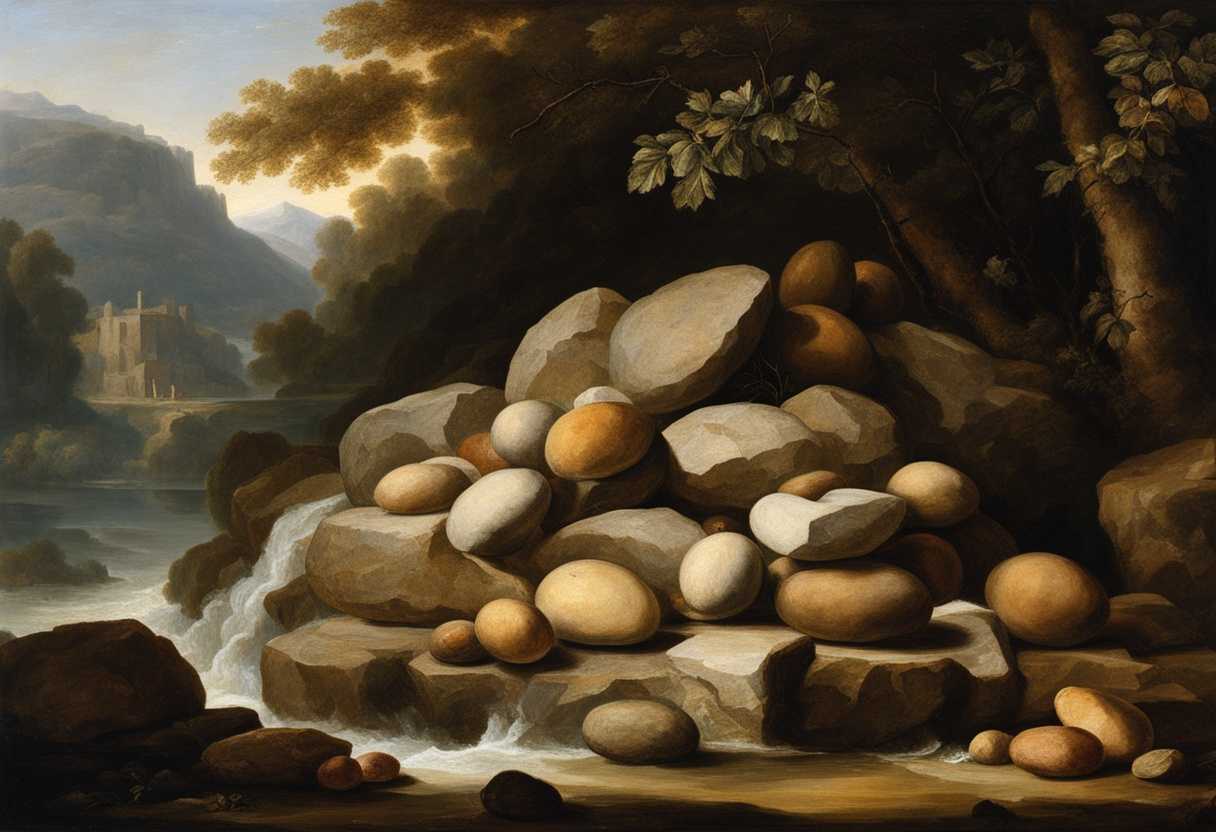
In the Bible, a pile of rocks often symbolizes a memorial or reminder of a significant event, such as God’s faithfulness or deliverance. For example, in Joshua 4:20-24, the Israelites set up a pile of stones to commemorate their crossing of the Jordan River, serving as a testament to God’s miraculous power and a teaching tool for future generations.
Scripture
44 Come now, let us make a covenant, you and I. And let it be a witness between you and me.”
45 So Jacob took a stone and set it up as a pillar.
46 Then Jacob said to his kinsmen, “Gather stones.” And they took stones and made a heap, and they ate there by the heap.
47 Laban called it Jegar-sahadutha, but Jacob called it Galeed.
48 Laban said, “This heap is a witness between you and me today.” Therefore he named it Galeed,
49 and Mizpah, for he said, “The LORD watch between you and me, when we are out of one another’s sight.
50 If you oppress my daughters, or if you take wives besides my daughters, although no one is with us, see, God is witness between you and me.”
51 Then Laban said to Jacob, “See this heap and the pillar, which I have set between you and me.
52 This heap is a witness, and the pillar is a witness, that I will not pass over this heap to you, and you will not pass over this heap and this pillar to me, for harm.
53 The God of Abraham and the God of Nahor, the God of their father, judge between us.” So Jacob swore by the Fear of his father Isaac.
54 Then Jacob offered a sacrifice on the mountain and called his kinsmen to eat bread. They ate bread and spent the night on the mountain.
Biblical Significance of Piles of Rocks
The biblical significance of a pile of rocks serves as a multifaceted symbol of remembrance, testimony, and divine interaction in key moments of Israelite history. In Joshua 4:20-24, the act of gathering stones from the Jordan River marks not just a physical milestone—the crossing into the Promised Land—but also a profound spiritual marker that encapsulates God’s faithfulness. These stones were set as a lasting memorial for future generations, providing a narrative of God’s miraculous interventions and serving a dual purpose: to evoke faith by recounting the past and to inspire continued trust in God’s promises. This practice is consistent with the broader biblical theme of tangible reminders of divine encounters, which is echoed in various instances throughout Scripture, such as the stones Samuel erected after defeating the Philistines (1 Samuel 7:12) to signify God’s help.
The pile of rocks thus represents an anchor for faith amidst the uncertainties of life. It calls believers to pause and reflect on God’s providence and guidance, emphasizing the importance of remembrance in spiritual communities. In a global context, these memorials transcend the individual and become collective teaching tools that bridge generations, reinforcing the continuity of faith. The symbolism also extends to the New Testament with the concept of spiritual stones, where believers are regarded as “living stones” (1 Peter 2:5), collectively shaping the spiritual house of God. This layering of meanings illustrates that such monuments are not mere relics, but rather dynamic reminders that encourage ongoing faithfulness, reflection, and reliance on God’s unwavering presence through life’s journey.
The theme of a pile of rocks as a symbol of remembrance and divine engagement can be found throughout various narratives in Scripture, illuminating God’s ongoing covenant with His people. For instance, in Genesis, Jacob utilizes a pile of stones to mark the spot where he encounters God in a dream at Bethel. He names that place “House of God” (Beth-El) and sets up the stones as a monument, signifying the sacredness of that encounter and establishing a physical reminder of his transformative experience with the divine. Such actions demonstrate the significance of creating tangible markers that encapsulate spiritual milestones, reminding subsequent generations of pivotal moments when God intervened in human affairs.
Moreover, the custom of erecting memorials can be traced further in biblical history through the practice of altars, constructed from stones to honor God and commemorate significant events. These altars served dual roles of worship and remembrance, bridging the spiritual and physical realms. They were places of sacrifice, consecrated to the Lord, and sites where the community would gather to reflect on God’s faithfulness, often connected to key promises and covenants made by God. From Abraham’s altars proclaiming God’s promises to the Israelites to the rock formations around Jerusalem symbolizing stability and God’s enduring presence, the foundation laid by these physical reminders emphasizes the essential nature of anchoring faith in tangible realities. This theme consistently reinforces the call to remembrance and the importance of community, making piles of rocks not just symbols, but powerful pedagogical tools that propagate the essence of belief through generations.
Memorialization and Remembrance
In the Bible, piles of rocks often serve as physical memorials to commemorate significant events or divine interventions. These stone markers act as reminders for future generations, ensuring that the stories of faith, deliverance, and God’s promises are not forgotten. They symbolize the importance of remembering God’s faithfulness and the pivotal moments in the spiritual journey of a community or individual.
Symbol of Covenant and Commitment
Piles of rocks can also represent a covenant or commitment between God and His people. They signify a promise or agreement, often marking a place where a significant decision was made or a divine encounter occurred. This physical representation serves as a tangible reminder of the commitments made, encouraging individuals and communities to uphold their vows and remain faithful to their relationship with God.
Transformation and New Beginnings
In a broader sense, a pile of rocks can symbolize transformation and new beginnings. Just as rocks are often reshaped and repurposed, they can represent the idea of God taking the brokenness or remnants of the past and creating something new. This theme resonates with the biblical narrative of redemption, where God transforms lives and situations, offering hope and a fresh start to those who seek Him.
How to Strengthen Your Faith Through Remembrance and Sacrifice
Strengthening your faith through remembrance and sacrifice is a deeply personal journey that invites you to reflect on the profound love and grace that God has shown us. Take time to remember the moments in your life where you felt His presence—those quiet whispers during prayer, the comfort in times of trouble, or the joy in unexpected blessings. Journaling these experiences can help solidify your faith and remind you of His faithfulness. Additionally, consider what sacrifices you can make in your daily life, whether it’s dedicating time to serve others, giving up certain comforts, or simply being more present for those around you. These acts of sacrifice not only deepen your relationship with God but also mirror the ultimate sacrifice He made for us through Jesus. As you engage in remembrance and sacrifice, you’ll find that your faith grows stronger, rooted in gratitude and love, allowing you to navigate life’s challenges with a renewed spirit.
Bible References to Piles of Rocks:
Joshua 4:1-9: 1 When all the nation had finished passing over the Jordan, the Lord said to Joshua,
2 “Take twelve men from the people, from each tribe a man,
3 and command them, saying, ‘Take twelve stones from here out of the midst of the Jordan, from the very place where the priests’ feet stood firmly, and bring them over with you and lay them down in the place where you lodge tonight.’”
4 Then Joshua called the twelve men from the people of Israel, whom he had appointed, a man from each tribe.
5 And Joshua said to them, “Pass on before the ark of the Lord your God into the midst of the Jordan, and take up each of you a stone upon his shoulder, according to the number of the tribes of the people of Israel,
6 that this may be a sign among you. When your children ask in time to come, ‘What do those stones mean to you?’
7 then you shall tell them that the waters of the Jordan were cut off before the ark of the covenant of the Lord. When it passed over the Jordan, the waters of the Jordan were cut off. So these stones shall be to the people of Israel a memorial forever.”
8 And the people of Israel did just as Joshua commanded and took up twelve stones out of the midst of the Jordan, according to the number of the tribes of the people of Israel, just as the Lord told Joshua. And they carried them over with them to the place where they lodged and laid them down there.
9 And Joshua set up twelve stones in the midst of the Jordan, in the place where the feet of the priests bearing the ark of the covenant had stood; and they are there to this day.
Joshua 7:24-26: 24 And Joshua and all Israel with him took Achan the son of Zerah, and the silver and the cloak and the bar of gold, and his sons and daughters and his oxen and donkeys and sheep and his tent and all that he had. And they brought them up to the Valley of Achor.
25 And Joshua said, “Why did you bring trouble on us? The Lord brings trouble on you today.” And all Israel stoned him with stones. They burned them with fire and stoned them with stones.
26 And they raised over him a great heap of stones that remains to this day. Then the Lord turned from his burning anger. Therefore, to this day the name of that place is called the Valley of Achor.
Joshua 8:30-35: 30 At that time Joshua built an altar to the Lord, the God of Israel, on Mount Ebal,
31 just as Moses the servant of the Lord had commanded the people of Israel, as it is written in the Book of the Law of Moses, “an altar of uncut stones, upon which no man has wielded an iron tool.” And they offered on it burnt offerings to the Lord and sacrificed peace offerings.
32 And there in the presence of the people of Israel he wrote on the stones a copy of the law of Moses, which he had written.
33 And all Israel, sojourner as well as native born, with their elders and officers and their judges, stood on opposite sides of the ark before the Levitical priests who carried the ark of the covenant of the Lord, half of them in front of Mount Gerizim and half of them in front of Mount Ebal, just as Moses the servant of the Lord had commanded at the first, to bless the people of Israel.
34 And afterward he read all the words of the law, the blessing and the curse, according to all that is written in the Book of the Law.
35 There was not a word of all that Moses commanded that Joshua did not read before all the assembly of Israel, and the women, and the little ones, and the sojourners who lived among them.
1 Samuel 7:7-12: 7 And when the Philistines heard that the people of Israel had gathered at Mizpah, the lords of the Philistines went up against Israel. And when the people of Israel heard of it, they were afraid of the Philistines.
8 And the people of Israel said to Samuel, “Do not cease to cry out to the Lord our God for us, that he may save us from the hand of the Philistines.”
9 So Samuel took a nursing lamb and offered it as a whole burnt offering to the Lord. And Samuel cried out to the Lord for Israel, and the Lord answered him.
10 As Samuel was offering up the burnt offering, the Philistines drew near to attack Israel. But the Lord thundered with a mighty sound that day against the Philistines and threw them into confusion, and they were defeated before Israel.
11 And the men of Israel went out of Mizpah and pursued the Philistines and struck them, as far as below Beth-car.
12 Then Samuel took a stone and set it up between Mizpah and Shen and called its name Ebenezer; for he said, “Till now the Lord has helped us.”
2 Samuel 18:17-18: 17 And they took Absalom and threw him into a great pit in the forest and raised over him a very great heap of stones. And all Israel fled every one to his tent.
18 Now Absalom in his lifetime had taken and set up for himself the pillar that is in the King’s Valley, for he said, “I have no son to keep my name in remembrance.” He called the pillar after his own name, and it is called Absalom’s monument to this day.
Joshua 24:25-27: 25 So Joshua made a covenant with the people that day, and put in place statutes and rules for them at Shechem.
26 And Joshua wrote these words in the Book of the Law of God.
27 And Joshua said to all the people, “Behold, this stone shall be a witness against us, for it has heard all the words of the Lord that he spoke to us. Therefore it shall be a witness against you, lest you deal falsely with your God.”
Judges 6:25-27: 25 That night the Lord said to him, “Take your father’s bull, and the second bull seven years old, and pull down the altar of Baal that your father has, and cut down the Asherah that is beside it.
26 And build an altar to the Lord your God on the top of the stronghold here, with stones laid in due order. Then take the second bull and offer it as a burnt offering with the wood of the Asherah that you shall cut down.”
27 So Gideon took ten men of his servants and did as the Lord had told him. But because he was too afraid of his family and the men of the town to do it by day, he did it by night.
1 Kings 18:30-32: 30 Then Elijah said to all the people, “Come near to me.” And all the people came near to him. And he repaired the altar of the Lord that had been thrown down.
31 Elijah took twelve stones, according to the number of the tribes of the sons of Jacob, to whom the word of the Lord came, saying, “Israel shall be your name,”
32 And with the stones he built an altar in the name of the Lord.
Exodus 24:3-8: 3 Moses came and told the people all the words of the Lord and all the rules. And all the people answered with one voice and said, “All the words that the Lord has spoken we will do.”
4 And Moses wrote down all the words of the Lord. He rose early in the morning and built an altar at the foot of the mountain, and twelve pillars, according to the twelve tribes of Israel.
5 And he sent young men of the people of Israel, who offered burnt offerings and sacrificed peace offerings of oxen to the Lord.
6 And Moses took half of the blood and put it in basins, and half of the blood he threw against the altar.
7 Then he took the Book of the Covenant and read it in the hearing of the people. And they said, “All that the Lord has spoken we will do, and we will be obedient.”
8 And Moses took the blood and threw it on the people and said, “Behold the blood of the covenant that the Lord has made with you in accordance with all these words.”

Reverend Ogunlade is a seasoned Church Minister with over three decades of experience in guiding and nurturing congregations. With profound wisdom and a serene approach, Reverend Ogunlade has carried out various pastoral duties, including delivering uplifting sermons, conducting religious ceremonies, and offering sage counsel to individuals seeking spiritual guidance. Their commitment to fostering harmony and righteousness within their community is exemplified through their compassionate nature, making them a beloved and trusted figure among the congregation.