
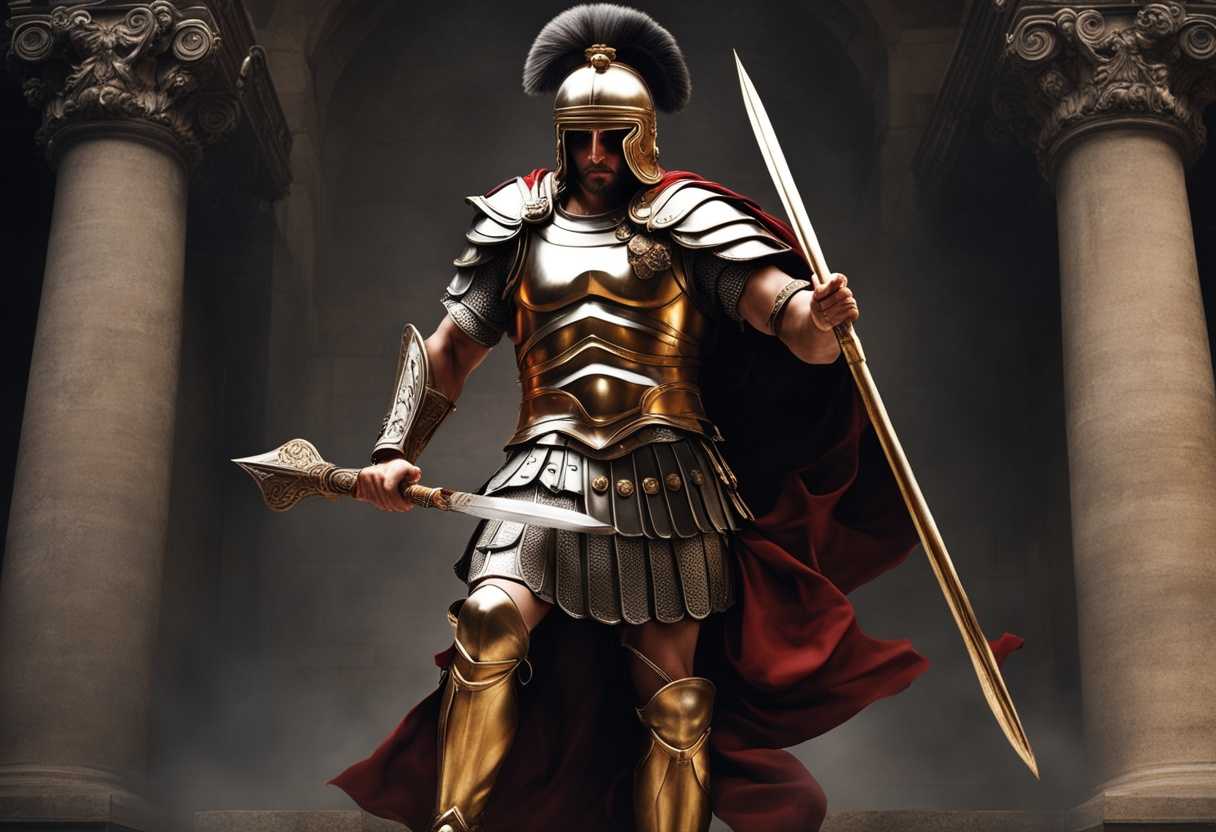
In the Bible, a lance is typically referred to as a spear, a long weapon used in battle. It symbolizes power and authority, as seen in instances like the weapon of the Roman centurion who pierced Jesus’ side (John 19:34).
Scripture
7 When Phinehas the son of Eleazar, son of Aaron the priest, saw it, he rose and left the congregation and took a spear in his hand
8 and went after the man of Israel into the chamber and pierced both of them, the man of Israel and the woman through her belly. So the plague on the people of Israel was stopped.
Meaning of Lance in the Bible
In biblical literature, the idea of a lance or spear transcends its physical representation as a weapon; it embodies themes of authority, judgment, and divine intervention. The act of the Roman centurion piercing Jesus’ side with a lance, as recorded in John 19:34, serves not only to fulfill prophecy but also to illustrate the finality of Christ’s sacrifice. This moment signifies the culmination of human violence against the divine, revealing both humanity’s rejection of God and the profound love of Christ, who allows His own suffering for the sake of redemption. The spear becomes a symbol of both the brutality of sin and the grace that emerges from that ultimate sacrifice, where through His wounds, believers find healing and forgiveness (Isaiah 53:5).
Furthermore, the spear is also symbolic of God’s judgment and the power wielded by those who are appointed by Him, as noted in passages that describe military leaders and kings. For instance, in 1 Samuel 18:10-11, King Saul tries to use a spear to kill David, showcasing the volatile grasp of power, and hinting at the divine protection over David, who is destined to be the next king. In these contexts, the lance represents not only the might of earthly rulers but also divine sovereignty as it reflects God’s ultimate control over the events of history, suggesting that while human beings exert power, it is God who ordains the outcome according to His divine plan. Thus, the lance or spear within the biblical narrative can be seen as a multifaceted symbol encapsulating judgment, power, suffering, and the promise of salvation.
In addition to its representation as a physical weapon, the lance or spear in the Bible can also symbolize the tension between divine will and human action. The book of Numbers recounts an incident during the time of Moses when a destructive plague afflicted the Israelites due to their unfaithfulness. In response to the rebellion, Phinehas, the grandson of Aaron, takes up a spear and acts decisively to mete out judgment on an offending couple who openly defy God’s commandments. This dramatic act of zeal not only halts the plague but also brings recognition and a covenant of peace from God to Phinehas, illustrating how the proper use of force in alignment with divine will can yield preservation and redemption for the community (Numbers 25:7-13).
Moreover, the imagery of the spear is intertwined with spiritual warfare, as highlighted in Ephesians 6, where Paul describes the armor of God. Here, the spear transcends the physical realm, representing the believer’s engagement in spiritual battles against evil forces. The lance serves as an illustration of striking against temptation, sin, and spiritual darkness. The metaphorical use of weaponry underscores that the fight is not against flesh and blood, but against powers and principalities—reminding believers that their strength lies not in human might, but in divine empowerment. The various representations of the lance throughout scripture reinforce its dual nature as a tool for judgment and protection while serving as an emblematic reminder of the spiritual vigilance required in the faith journey.
Symbol of Authority and Power
In biblical contexts, a lance often symbolizes authority and power, particularly in the hands of a warrior or leader. It represents the ability to defend one’s people and territory, serving as a tool of both protection and aggression. The lance, as a weapon, signifies the strength and might of those who wield it, reflecting the divine right to govern and protect.
Instrument of Judgment and Sacrifice
The lance can also be interpreted as an instrument of judgment and sacrifice. In various narratives, the act of piercing with a lance can symbolize the execution of divine judgment or the fulfillment of prophetic words. This duality highlights the themes of sacrifice and atonement, where the lance serves as a reminder of the cost of sin and the necessity of redemption.
Representation of Conflict and Struggle
Additionally, the lance embodies the themes of conflict and struggle within the biblical narrative. It is often associated with battles, both physical and spiritual, representing the ongoing fight between good and evil. The lance serves as a metaphor for the challenges faced by individuals and communities, emphasizing the need for faith and perseverance in the face of adversity.
How to Embrace Suffering for Spiritual Growth in Christ
Embracing suffering as a pathway to spiritual growth in Christ can be one of the most transformative experiences in our faith journey. It’s important to remember that suffering is not a sign of God’s absence but rather an opportunity for deeper connection with Him. When we face trials, we can lean into prayer, seeking God’s presence and guidance, and allowing our struggles to draw us closer to His heart. Reflecting on passages like Romans 5:3-5, which tells us that suffering produces perseverance, character, and hope, can help us reframe our pain as a catalyst for growth. Instead of shying away from discomfort, we can invite God into our suffering, asking Him to reveal His purpose and to strengthen our faith. By sharing our burdens with fellow believers and finding community in our struggles, we not only grow individually but also encourage others in their journeys. Remember, it’s in the depths of our trials that we often discover the richness of God’s grace and the profound truth of His love.
Bible References to the Meaning of Lance:
1 Samuel 17:45-47: 45 Then David said to the Philistine, “You come to me with a sword and with a spear and with a javelin, but I come to you in the name of the Lord of hosts, the God of the armies of Israel, whom you have defied.
46 This day the Lord will deliver you into my hand, and I will strike you down and cut off your head.
47 And that all this assembly may know that the Lord saves not with sword and spear. For the battle is the Lord’s, and he will give you into our hand.
2 Samuel 2:23: 23 But he refused to turn aside. Therefore Abner struck him in the stomach with the butt of the spear, so that the spear came out at his back. And he fell there and died where he was. And all who came to the place where Asahel had fallen and died, stood still.
2 Samuel 23:18-21: 18 Now Abishai, the brother of Joab, the son of Zeruiah, was chief of the thirty. And he wielded his spear against three hundred men and killed them and won a name beside the three.
19 Was he not the most honored of the thirty and did he not become their commander? And he was with David at Pas-dammim when the Philistines were gathered there for battle.
20 And Benaiah the son of Jehoiada was a valiant man of Kabzeel, a doer of great deeds. He struck down two ariels of Moab. He also went down and struck down a lion in a pit on a day when snow had fallen.
21 And he struck down an Egyptian, a handsome man. The Egyptian had a spear in his hand, but Benaiah went down to him with a staff and snatched the spear out of the Egyptian’s hand and killed him with his own spear.
1 Chronicles 11:11-14: 11 This is an account of David’s mighty men: Jashobeam, a Hachmonite, was chief of the three. He wielded his spear against 300 whom he killed at one time.
12 And next to him was Eleazar the son of Dodo, the Ahohite, who was one of the three mighty men.
13 He was with David at Pas-dammim when the Philistines were gathered there for battle. There was a plot of ground full of barley, and the men fled from the Philistines.
14 And they took their stand in the midst of that plot and defended it and struck down the Philistines, and the Lord saved them by a great victory.
1 Chronicles 12:8-14: 8 From the Gadites there went over to David at the stronghold in the wilderness mighty and experienced warriors, expert with shield and spear, whose faces were like the faces of lions and who were swift as gazelles upon the mountains.
9 Ezer the chief, Obadiah second, Eliab third,
10 they were bowmen and could shoot arrows and sling stones with either the right or the left hand; they were Benjaminites, Saul’s kinsmen.
11 They were Benjaminites, Saul’s kinsmen, and their chief was Ahiezer the son of Shemaah, of Gibeah.
12 Of the Gadites there went over to David at the stronghold in the wilderness mighty and experienced warriors, expert with shield and spear, whose faces were like the faces of lions and who were swift as gazelles upon the mountains.
13 Jeremiah the tenth, Machbannai the eleventh.
14 These Gadites were officers of the army; the least was a match for a hundred men and the greatest for a thousand.
Job 41:26-29: 26 “Though the sword reaches him, it does not avail, nor the spear, the dart, or the javelin.”
27 “He counts iron as straw,
and bronze as rotten wood.
28 The arrow cannot make him flee; for him, sling stones are turned to stubble.
29 Clubs are counted as stubble; he laughs at the rattle of javelins.
Jeremiah 50:42-43: 42 They lay hold of bow and spear;
they are cruel and have no mercy.
43 The king of Babylon heard the report of them, and his hands fell helpless; anguish seized him, pain as of a woman in labor.
Joel 3:9-10: 9 Proclaim this among the nations: Consecrate for war; stir up the mighty men. Let all the men of war draw near; let them come up.
Beat your plowshares into swords,
and your pruning hooks into spears;
let the weak say, “I am a warrior.”
John 19:34-37: 34 But one of the soldiers pierced his side with a spear, and at once there came out blood and water.
35 He who saw it has borne witness—his testimony is true, and he knows that he is telling the truth—that you also may believe.
36 For these things took place that the Scripture might be fulfilled: “Not one of his bones will be broken.”
37 And again another Scripture says, “They will look on him whom they have pierced.”

Reverend Ogunlade is a seasoned Church Minister with over three decades of experience in guiding and nurturing congregations. With profound wisdom and a serene approach, Reverend Ogunlade has carried out various pastoral duties, including delivering uplifting sermons, conducting religious ceremonies, and offering sage counsel to individuals seeking spiritual guidance. Their commitment to fostering harmony and righteousness within their community is exemplified through their compassionate nature, making them a beloved and trusted figure among the congregation.