
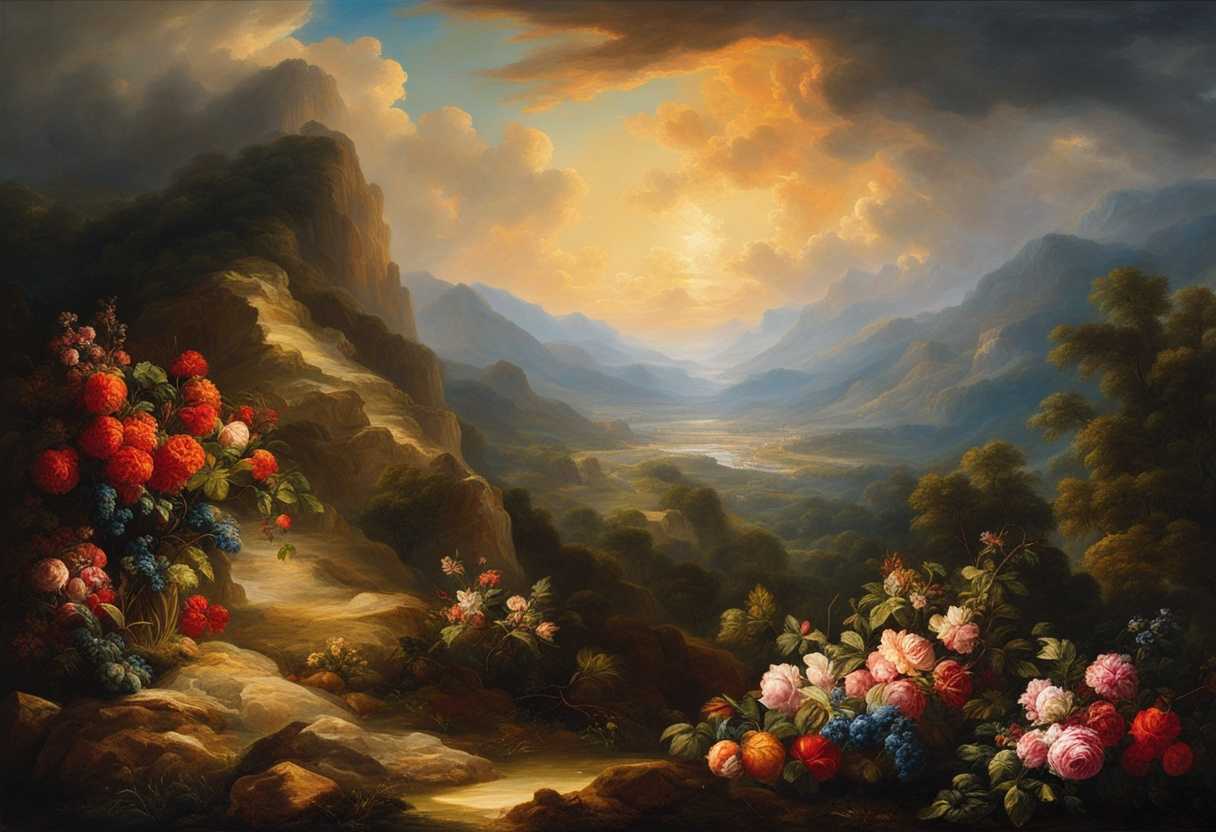
In the Bible, Carmel refers to both a geographic region known for its fertility and beauty, specifically a mountain range in northern Israel, and symbolizes abundance and God’s blessings. It is also associated with the prophet Elijah’s confrontation with the prophets of Baal in 1 Kings 18, showcasing the power of the Lord.
Scripture
16 So Obadiah went to meet Ahab, and told him. And Ahab went to meet Elijah.
17 When Ahab saw Elijah, Ahab said to him, “Is it you, you troubler of Israel?”
18 And he answered, “I have not troubled Israel, but you have, and your father’s house, because you have abandoned the commandments of the Lord and followed the Baals.
19 Now therefore send and gather all Israel to me at Mount Carmel, and the 450 prophets of Baal and the 400 prophets of Asherah, who eat at Jezebel’s table.”
20 So Ahab sent to all the people of Israel and gathered the prophets together at Mount Carmel.
21 And Elijah came near to all the people and said, “How long will you go limping between two different opinions? If the Lord is God, follow him; but if Baal, then follow him.” And the people did not answer him a word.
22 Then Elijah said to the people, “I, even I only, am left a prophet of the Lord, but Baal’s prophets are 450 men.
23 Let two bulls be given to us, and let them choose one bull for themselves and cut it in pieces and lay it on the wood, but put no fire to it. And I will prepare the other bull and lay it on the wood and put no fire to it.
24 And you call upon the name of your god, and I will call upon the name of the Lord, and the God who answers by fire, he is God.” And all the people answered, “It is well spoken.”
25 Then Elijah said to the prophets of Baal, “Choose for yourselves one bull and prepare it first, for you are many, and call upon the name of your god, but put no fire to it.”
26 And they took the bull that was given them, and they prepared it and called upon the name of Baal from morning until noon, saying, “O Baal, answer us!” But there was no voice, and no one answered. And they limped around the altar that they had made.
27 And at noon Elijah mocked them, saying, “Cry aloud, for he is a god. Either he is musing, or he is relieving himself, or he is on a journey, or perhaps he is asleep and must be awakened.”
28 And they cried aloud and cut themselves after their custom with swords and lances, until the blood gushed out upon them.
29 And as midday passed, they raved on until the time of the offering of the oblation, but there was no voice. No one answered; no one paid attention.
30 Then Elijah said to all the people, “Come near to me.” And all the people came near to him. And he repaired the altar of the Lord that had been thrown down.
31 Elijah took twelve stones, according to the number of the tribes of the sons of Jacob, to whom the word of the Lord came, saying, “Israel shall be your name,”
32 And with the stones he built an altar in the name of the Lord.
33 And he put the wood in order and cut the bull in pieces and laid it on the wood. And he said, “Fill four jars with water and pour it on the burnt offering and on the wood.”
34 And he said, “Fill four jars with water and pour it on the burnt offering and on the wood.”
35 And the water ran around the altar and filled the trench also with water.
36 And at the time of the offering of the oblation, Elijah the prophet came near and said, “O Lord, God of Abraham, Isaac, and Israel, let it be known this day that you are God in Israel, and that I am your servant, and that I have done all these things at your word.
37 Answer me, O Lord, answer me, that this people may know that you, O Lord, are God, and that you have turned their hearts back.”
38 Then the fire of the Lord fell and consumed the burnt offering and the wood and the stones and the dust, and licked up the water that was in the trench.
39 And when all the people saw it, they fell on their faces and said, “The Lord, he is God; the Lord, he is God.”
40 And Elijah said to them, “Seize the prophets of Baal; let not one of them escape.” And they seized them. And Elijah brought them down to the brook Kishon and slaughtered them there.
41 And Elijah said to Ahab, “Go up, eat and drink, for there is a sound of the rushing of rain.”
42 So Ahab went up to eat and to drink. And Elijah went up to the top of Mount Carmel. And he bowed himself down on the earth and put his face between his knees.
43 And he said to his servant, “Go up now, look toward the sea.” And he went up and looked and said, “There is nothing.” And he said, “Go again,” seven times.
44 And at the seventh time he said, “Behold, a little cloud like a man’s hand is rising from the sea.” And he said, “Go up, say to Ahab, ‘Prepare your chariot and go down, lest the rain stop you.’”
45 And in a little while the heavens grew black with clouds and wind, and there was a great rain. And Ahab rode and went to Jezreel.
46 And the hand of the Lord was on Elijah, and he gathered up his garment and ran before Ahab to the entrance of Jezreel.
Meaning of Carmel in the Bible
The term “Carmel” in the Bible evokes more than just a physical location; it symbolizes God’s provision, abundance, and the contrast between true divinity and idolatry. Specifically, Mount Carmel, situated in northern Israel, is renowned for its fertile lands and lush landscapes, as reflected in passages like 1 Kings 18:19, which underscores its rich agricultural significance. The very name “Carmel” translates to “vineyard of God” or “field of God’s abundance,” emphasizing not just the bounty of the land but also a spiritual abundance provided by a faithful God. This portrayal enriches our understanding of divine blessing, as seen in the imagery within Isaiah 35:2, where it mentions that the glory of Lebanon will be given to it, portraying a beautiful scene of flourishing nature that mirrors the flourishing of God’s people when they align with His will.
Moreover, the confrontation between the prophet Elijah and the prophets of Baal at Mount Carmel (1 Kings 18) serves as a pivotal moment in the biblical narrative, illustrating the supremacy of Yahweh over false gods. In this dramatic showdown, Elijah calls down fire from heaven, proving God’s power and sovereignty to the people of Israel, who had turned away from Him. The outcome reaffirms the theme of covenant faithfulness and reinforces the call to return to the Lord. This event is integral to understanding how the physical landscape of Carmel transcends its geographical identity to become a symbol of divine revelation and the reaffirmation of faith in a time of spiritual crisis, highlighted in 1 Kings 18:39 when the people affirm, “The Lord, he is God!” Thus, Carmel stands as a microcosm of God’s enduring relationship with His chosen people, showcasing the harmony between His creation and His divine authority.
In addition to its agricultural connotations, Carmel is frequently associated with a place of refuge and divine favor in various biblical texts. For instance, in the song of Solomon, Carmel is likened to images of beauty and longing, symbolizing the lush landscape that evokes love and intimacy in the context of divine communion. The romantic imagery draws on the notion of the inherent beauty of God’s creation, suggesting a deep spiritual connection that mirrors the lushness of the land itself, reminiscent of the overwhelming love God has for His people. The comparisons made in the Song of Solomon emphasize not just geography, but the intimacy found in recognizing God’s presence within the beauty of His creation, positioning Carmel as a sanctuary where one can encounter the divine.
Furthermore, the prophetic literature often alludes to Carmel to signify hope and restoration. In the aftermath of judgment, the comparison of Anthony’s corresponding environment reminds the faithful of God’s merciful intentions. For example, in Jeremiah, the image of Carmel can be seen as a metaphor for regeneration and renewal—indicating not only physical provision but also spiritual revival. The lush plant life and striking imagery serve as a reminder of Israel’s ultimate restoration and the blessings that await those who turn back to God. Thus, Carmel emerges as a multifaceted representation of God’s providence, love, and the promise of redemption, embodying both the beauty of creation and the hope of restoration in the lives of His people.
Symbol of Abundance and Fertility
Carmel, often associated with lush landscapes and fertile grounds, represents abundance in biblical texts. The name itself means “vineyard” or “orchard,” which signifies a place of growth and prosperity. This imagery is frequently used to illustrate God’s blessings and the richness of His creation, highlighting the importance of spiritual nourishment and the flourishing of faith.
Spiritual Significance and Divine Encounter
Carmel is also a site of significant spiritual encounters in the Bible. It serves as a backdrop for moments of divine revelation and confrontation, particularly in the context of the prophet Elijah. The mountain symbolizes a place where humanity meets the divine, emphasizing the themes of faith, obedience, and the power of God. This connection illustrates the importance of seeking God in places that are set apart for spiritual reflection and revelation.
Contrast Between Wilderness and Abundance
In biblical narratives, Carmel often stands in stark contrast to the surrounding wilderness. This juxtaposition highlights the transformative power of God, who can turn desolation into abundance. The imagery of Carmel serves as a reminder of hope and renewal, suggesting that even in the midst of trials and challenges, God can bring forth beauty and life. This theme encourages believers to trust in God’s ability to provide and restore, regardless of their circumstances.
How to Embrace Holiness and Live a Fruitful Life
Embracing holiness is a beautiful journey that invites us to align our lives more closely with God’s will, and it begins with a sincere heart. To live a fruitful life, we must cultivate a deep relationship with God through prayer, scripture reading, and community fellowship. This means not just attending church but actively engaging with others, sharing our struggles and victories, and encouraging one another in faith. Holiness isn’t about perfection; it’s about progress and a willingness to let God transform us from the inside out. As we seek to embody the fruits of the Spirit—love, joy, peace, patience, kindness, goodness, faithfulness, gentleness, and self-control—we’ll find that our lives naturally become a reflection of Christ’s love. Remember, it’s in the small, daily choices to live out our faith that we truly embrace holiness and bear fruit that glorifies God. So, let’s take each step with intention, trusting that He is at work in us, shaping us into vessels of His grace.
Bible References to the Meaning of Carmel:
1 Samuel 25:2-42: 2 And there was a man in Maon whose business was in Carmel. The man was very rich; he had three thousand sheep and a thousand goats.
3 Now the name of the man was Nabal, and the name of his wife Abigail. The woman was discerning and beautiful, but the man was harsh and badly behaved; he was a Calebite.
4 David heard in the wilderness that Nabal was shearing his sheep.
5 So David sent ten young men. And David said to the young men, “Go up to Carmel, and go to Nabal and greet him in my name.
6 And thus you shall greet him: ‘Peace be to you, and peace be to your house, and peace be to all that you have.
7 I hear that you have shearers. Now your shepherds have been with us, and we did them no harm, and they missed nothing all the time they were in Carmel.
8 Ask your young men, and they will tell you. Therefore let my young men find favor in your eyes, for we come on a feast day. Please give whatever you have at hand to your servants and to your son David.
9 When David’s young men came, they said all this to Nabal in the name of David, and then they waited.
10 And Nabal answered David’s servants, “Who is David? Who is the son of Jesse? There are many servants these days who are breaking away from their masters.
11 Shall I take my bread and my water and my meat that I have killed for my shearers and give it to men who come from I do not know where?”
12 So David’s young men turned away and came back and told him all this.
13 And David said to his men, “Every man strap on his sword!” And every man of them strapped on his sword. David also strapped on his sword.
14 But one of the young men told Abigail, Nabal’s wife, “Behold, David sent messengers out of the wilderness to greet our master, and he railed at them.
15 Yet the men were very good to us, and we suffered no harm, and we did not miss anything when we were in the fields, as long as we went with them.
16 They were a wall to us both by night and by day, all the while we were with them keeping the sheep.
17 Now therefore know this and consider what you should do, for harm is determined against our master and against all his house, and he is such a worthless man that one cannot speak to him.”
18 Then Abigail made haste and took two hundred loaves and two skins of wine and five sheep already prepared and five seahs of parched grain and a hundred clusters of raisins and two hundred cakes of figs, and laid them on donkeys.
19 And she said to her young men, “Go on before me; behold, I come after you.” But she did not tell her husband Nabal.
20 And as she rode on the donkey and came down under cover of the mountain, behold, David and his men came down toward her, and she met them.
21 Now David had said, “Surely in vain have I guarded all that this fellow has in the wilderness, so that nothing was missed of all that belonged to him, and he has returned me evil for good.
22 God do so to the enemies of David and more also, if by morning I leave so much as one male of all who belong to him.”
23 When Abigail saw David, she hurried and got down from the donkey and fell before David on her face and bowed to the ground.
24 She fell at his feet and said, “On me alone, my lord, be the guilt. Please let your servant speak in your ears, and hear the words of your servant.
25 Please let not my lord regard this worthless fellow, Nabal, for as his name is, so is he. Nabal is his name, and folly is with him. But I your servant did not see the young men of my lord, whom you sent.
26 Now then, my lord, as the Lord lives, and as your soul lives, because the Lord has restrained you from bloodguilt and from saving with your own hand, now then let your enemies and those who seek to do evil to my lord be as Nabal.
27 And now this present that your servant has brought to my lord, let it be given to the young men who follow my lord.
28 Please forgive the trespass of your servant.
29 If men rise up to pursue you and to seek your life, the life of my lord shall be bound in the bundle of the living in the care of the Lord your God. And the lives of your enemies he shall sling out as from the hollow of a sling.
30 And when the Lord has done to my lord according to all the good that he has spoken concerning you and has appointed you prince over Israel,
31 that this shall be no grief to you or pangs of heart to my lord, either that you have shed blood without cause or that my lord has avenged himself. And when the Lord has dealt well with my lord, then remember your servant.”
32 And David said to Abigail, “Blessed be the Lord, the God of Israel, who sent you this day to meet me!
33 Blessed be your discretion, and blessed be you, who have kept me this day from bloodguilt and from working salvation with my own hand.
34 Nevertheless, as your soul lives, the Lord, the God of Israel, who has restrained me from hurting you, unless you had hurried and come to meet me, truly by morning there had not been left to Nabal so much as one male.”
35 So David received from her hand what she had brought him and said to her, “Go up in peace to your house. See, I have obeyed your voice and granted your petition.”
36 And Abigail came to Nabal, and behold, he was holding a feast in his house, like the feast of a king. And Nabal’s heart was merry within him, for he was very drunk. So she told him nothing at all until the morning light.
37 In the morning, when the wine had gone out of Nabal, his wife told him these things, and his heart died within him, and he became as a stone.
38 And about ten days later the Lord struck Nabal, and he died.
39 When David heard that Nabal was dead, he said, “Blessed be the Lord who has avenged the insult I received at the hand of Nabal, and has kept back his servant from wrongdoing. The Lord has returned the evil of Nabal on his own head.” Then David sent and spoke to Abigail, to take her as his wife.
40 When the servants of David came to Abigail at Carmel, they said to her, “David has sent us to you to take you to him as his wife.”
41 And she rose and bowed with her face to the ground and said, “Behold, your handmaid is a servant to wash the feet of the servants of my lord.”
42 And Abigail hurried and rose and mounted a donkey, and her five young women attended her. She followed the messengers of David and became his wife.
2 Kings 2:25-3:27: 25 He went up from there to Bethel, and while he was going up on the way, some small boys came out of the city and jeered at him, saying, “Go up, you baldhead! Go up, you baldhead!”
3 Now Jehoram the son of Ahab became king over Israel in Samaria in the eighteenth year of Jehoshaphat king of Judah, and reigned twelve years.
2 He did what was evil in the sight of the Lord, though not like his father and mother, for he put away the pillar of Baal that his father had made.
3 Nevertheless, he clung to the sins of Jeroboam the son of Nebat, which he made Israel to sin; he did not depart from them.
4 Now Mesha king of Moab was a sheep breeder, and he had to deliver to the king of Israel 100,000 lambs and the wool of 100,000 rams.
5 But when Ahab died, the king of Moab rebelled against the king of Israel.
6 And King Jehoram marched out of Samaria at that time and mustered all Israel.
7 And he went and sent word to Jehoshaphat king of Judah: “The king of Moab has rebelled against me. Will you go with me to battle against Moab?” And he said, “I will go. I am as you are, my people as your people, my horses as your horses.”
8 And he said, “By which way shall we march?” Jesus answered, “By the way of the wilderness of Edom.”
9 So the king of Israel went with the king of Judah and the king of Edom. And when they had made a circuitous march of seven days, there was no water for the army or for the animals that followed them.
10 And the king of Israel said, “Alas! The Lord has called these three kings to give them into the hand of Moab.”
11 But Jehoshaphat said, “Is there no prophet of the Lord here, through whom we may inquire of the Lord?” Then one of the king of Israel’s servants answered, “Elisha the son of Shaphat is here, who poured water on the hands of Elijah.”
12 And Jehoshaphat said, “The word of the Lord is with him.” So the king of Israel and Jehoshaphat and the king of Edom went down to him.
13 And Elisha said to the king of Israel, “What have I to do with you? Go to the prophets of your father and to the prophets of your mother.” But the king of Israel said to him, “No; it is the Lord who has called these three kings to give them into the hand of Moab.”
14 And Elisha said, “As the Lord of hosts lives, before whom I stand, were it not that I have regard for Jehoshaphat the king of Judah, I would neither look at you nor see you.
15 But now bring me a musician.” And when the musician played, the hand of the Lord came upon him.
16 And he said, “Thus says the Lord, ‘Make this valley full of trenches.’
17 For thus says the Lord, ‘You shall not see wind or rain, but that streambed shall be filled with water, so that you shall drink, you, your livestock, and your animals.’
18 This is a light thing in the sight of the Lord. He will also give the Moabites into your hand,
19 And you shall attack every fortified city and every choice city, and shall fell every good tree and stop up all springs of water and ruin every good piece of land with stones.”
20 The next morning, about the time of offering the sacrifice, behold, water came from the direction of Edom, till the country was filled with water.
21 And when all the Moabites heard that the kings had come up to fight against them, all who were able to put on armor, from the youngest to the oldest, were called out and were drawn up at the border.
22 And they rose early in the morning, and the sun shone upon the water, and the Moabites saw the water opposite them as red as blood.
23 And they said, “This is blood; the kings have surely fought together and struck one another down. Now then, Moab, to the spoil!”
24 But when they came to the camp of Israel, the Israelites rose and struck the Moabites, until they fled before them. And they went forward, striking the Moabites as they went.
25 And they overthrew the cities, and on every good piece of land every man threw a stone until it was covered. They stopped every spring of water and felled all the good trees, till only its stones were left in Kir-hareseth, and the slingers surrounded and attacked it.
26 When the king of Moab saw that the battle was too fierce for him, he took with him 700 swordsmen to break through, opposite the king of Edom, but they could not.
27 Then he took his oldest son who was to reign in his place and offered him for a burnt offering on the wall. And there came great wrath against Israel. And they withdrew from him and returned to their own land.
2 Kings 4:25-37: 25 So she set out and came to the man of God at Mount Carmel.
26 Run at once to meet her and say to her, ‘Is all well with you? Is all well with your husband? Is all well with the child?’ And she answered, ‘All is well.’
27 And when she came to the mountain to the man of God, she caught hold of his feet. And Gehazi came to push her away. But the man of God said, “Leave her alone, for she is in bitter distress, and the Lord has hidden it from me and has not told me.”
28 Then she said, “Did I ask my lord for a son? Did I not say, ‘Do not deceive me’?”
29 He said to Gehazi, “Tie up your garment and take my staff in your hand and go. If you meet anyone, do not greet him, and if anyone greets you, do not reply. And lay my staff on the face of the child.”
30 Then the mother of the child said, “As the Lord lives and as you yourself live, I will not leave you.” So he arose and followed her.
31 Gehazi went on ahead and laid the staff on the face of the child, but there was no sound or sign of life. So he returned to meet him and told him, “The child has not awakened.”
32 When Elisha came into the house, he saw the child lying dead on his bed.
33 So he went in and shut the door behind the two of them and prayed to the Lord.
34 Then he went up and lay on the child, putting his mouth on his mouth, his eyes on his eyes, and his hands on his hands. And as he stretched himself upon him, the flesh of the child became warm.
35 Then he got up again and walked once back and forth in the house, and went up and stretched himself upon him. The child sneezed seven times, and the child opened his eyes.
36 Then he summoned Gehazi and said, “Call this Shunammite.” So he called her. And when she came to him, he said, “Pick up your son.”
37 Then she went in and fell at his feet and bowed to the ground. Then she took up her son and went out.
Isaiah 35:1-10: 1 The wilderness and the dry land shall be glad;
the desert shall rejoice and blossom like the crocus;
2 It shall blossom abundantly and rejoice with joy and singing. The glory of Lebanon shall be given to it, the majesty of Carmel and Sharon. They shall see the glory of the Lord, the majesty of our God.
3 Strengthen the weak hands,
and make firm the feeble knees.
4 Say to those who have an anxious heart, “Be strong; fear not! Behold, your God will come with vengeance, with the recompense of God. He will come and save you.”
5 Then the eyes of the blind shall be opened, and the ears of the deaf unstopped;
6 Then shall the lame man leap like a deer, and the tongue of the mute sing for joy. For waters break forth in the wilderness, and streams in the desert.
7 And the burning sand shall become a pool, and the thirsty ground springs of water; in the haunt of jackals, where they lie down, the grass shall become reeds and rushes.
8 And a highway shall be there,
and it shall be called the Way of Holiness;
the unclean shall not pass over it.
It shall belong to those who walk on the way;
even if they are fools, they shall not go astray.
9 No lion shall be there, nor shall any ravenous beast come up on it; they shall not be found there, but the redeemed shall walk there.
10 And the ransomed of the Lord shall return and come to Zion with singing; everlasting joy shall be upon their heads; they shall obtain gladness and joy, and sorrow and sighing shall flee away.
Song of Solomon 7:5-9: 5 Your stature is like a palm tree, and your breasts are like its clusters.
6 How beautiful and pleasant you are, O loved one, with all your delights!
7 Your stature is like a palm tree, and your breasts are like its clusters.
8 I say, “I will climb the palm tree and lay hold of its fruit.” Oh, may your breasts be like clusters of the vine, and the scent of your breath like apples.
9 And the roof of your mouth like the best wine for my beloved, flowing gently over lips and teeth.
Amos 1:1-2: 1 The words of Amos, who was among the shepherds of Tekoa, which he saw concerning Israel in the days of Uzziah king of Judah and in the days of Jeroboam the son of Joash, king of Israel, two years before the earthquake.
2 And he said: “The Lord roars from Zion and utters his voice from Jerusalem; the pastures of the shepherds mourn, and the top of Carmel withers.”
Jeremiah 46:18-28: 18 As I live, declares the King, whose name is the Lord of hosts, like Tabor among the mountains and like Carmel by the sea, shall one come.
19 Prepare yourselves baggage for exile, O inhabitants of Egypt! For Memphis shall become a waste, a ruin, without inhabitant.
20 “A beautiful heifer is Egypt,
but a biting fly from the north has come upon her.
21 Even her hired soldiers in her midst are like fattened calves; yes, they have turned and fled together; they did not stand, for the day of their calamity has come upon them, the time of their punishment.
22 The noise of battle is in the land, and great destruction!
23 They shall cut down her forest, declares the Lord,
though it is impenetrable,
because they are more numerous than locusts;
they are without number.
24 “The daughter of Egypt shall be put to shame; she shall be delivered into the hand of a people from the north.”
25 The Lord of hosts, the God of Israel, said: “Behold, I am bringing punishment upon Amon of Thebes, and Pharaoh, and Egypt and her gods and her kings, upon Pharaoh and those who trust in him.
26 I will deliver them into the hand of those who seek their life, into the hand of Nebuchadnezzar king of Babylon and his officers. Afterward Egypt shall be inhabited as in the days of old, declares the Lord.
27 “But fear not, O Jacob my servant, nor be dismayed, O Israel, for behold, I will save you from far away, and your offspring from the land of their captivity. Jacob shall return and have quiet and ease, and none shall make him afraid.”
28 Fear not, O Jacob my servant, declares the Lord, for I am with you. I will make a full end of all the nations to which I have driven you, but of you I will not make a full end. I will discipline you in just measure, and I will by no means leave you unpunished.
Micah 7:14-20: 14 Shepherd your people with your staff,
the flock of your inheritance,
who dwell alone in a forest
in the midst of a garden land;
let them graze in Bashan and Gilead
as in the days of old.
15 As in the days when you came out of the land of Egypt, I will show them marvelous things.
16 The nations shall see and be ashamed of all their might;
they shall lay their hands on their mouths;
their ears shall be deaf;
17 they shall lick the dust like a serpent,
like the crawling things of the earth;
they shall come trembling out of their strongholds;
they shall turn in dread to the Lord our God,
and they shall be in fear of you.
18 Who is a God like you, pardoning iniquity and passing over transgression for the remnant of his inheritance?
19 He will again have compassion on us;
he will tread our iniquities underfoot.
You will cast all our sins
into the depths of the sea.
20 You will show faithfulness to Jacob
and steadfast love to Abraham,
as you have sworn to our fathers
from the days of old.

Reverend Michael Johnson is an experienced Church Minister with a profound expertise in spirituality and guidance. With a serene presence and a compassionate heart, he has faithfully served his congregation for over 20 years, leading them on a spiritual journey towards inner peace and enlightenment. Reverend Johnson’s extensive knowledge of religious philosophies and profound understanding of human nature have made him a trusted confidant and mentor to many, as he seamlessly weaves his profound wisdom into life teachings. Reverend Johnson’s calming demeanor and empathetic nature continue to uplift and heal souls, nurturing a sense of unity and tranquility within his community.