
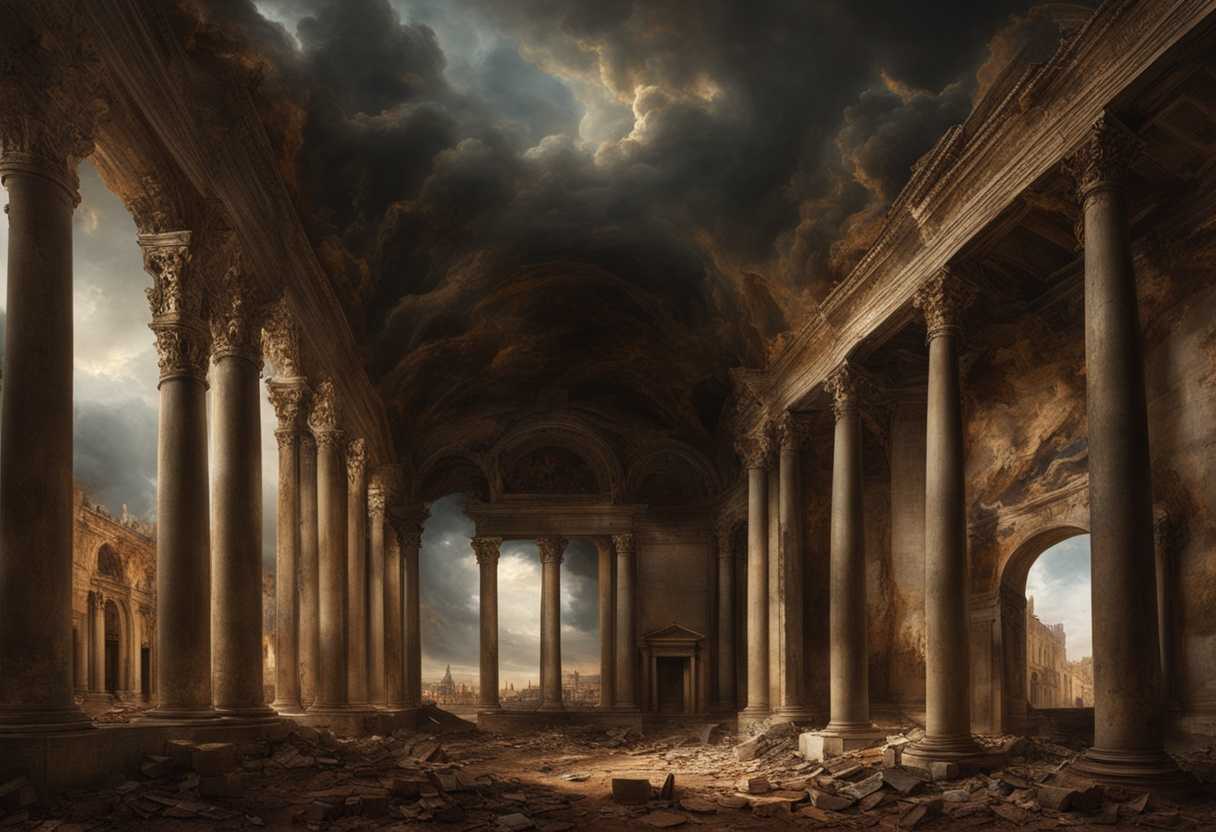
Sodom is a city in the Bible, known for its wickedness and immorality, often mentioned alongside Gomorrah. It is famously destroyed by divine judgment in the Book of Genesis (Genesis 19) due to the sinful behavior of its inhabitants.
Scripture
10 And Lot lifted up his eyes and saw that the Jordan Valley was well watered everywhere like the garden of the Lord, like the land of Egypt, in the direction of Zoar. (This was before the Lord destroyed Sodom and Gomorrah.)
11 So Lot chose for himself all the Jordan Valley, and Lot journeyed east. Thus they separated from each other.
12 Abram settled in the land of Canaan, while Lot settled among the cities of the valley and moved his tent as far as Sodom.
13 Now the men of Sodom were wicked, great sinners against the Lord.
Biblical Definition of Sodom
Sodom, alongside Gomorrah, serves as a powerful symbol of the consequences of widespread immorality and divine judgment in the biblical narrative. In Genesis 19, we see the culmination of God’s displeasure, as the cities are destroyed by fire and brimstone for their depravity, particularly their engagement in sexual immorality and lack of hospitality—a significant cultural value in the ancient Near East. The narrative of Sodom is not just an account of physical destruction but also a profound commentary on the moral state of societies. As referenced in Ezekiel 16:49-50, the sins of Sodom are elucidated further, highlighting pride, excess, and neglect of the poor and needy, suggesting that the sinfulness of Sodom extended beyond sexual immorality to encompass broader social injustices.
The broader meaning of Sodom also embodies a theological warning about the nature of sin and its repercussions. In the New Testament, references to Sodom are utilized to emphasize judgment and accountability, as seen in Matthew 10:15, where the fate of unrepentant cities is likened to that of Sodom. The depiction of Sodom serves as a stark reminder that divine justice operates within the framework of moral responsibility, and it challenges believers to reflect on their values and actions. The imagery of Sodom has thus transcended its historical context, becoming a metaphorical reference for moral degradation and the urgent need for repentance and righteousness, highlighting the relevance of its lessons throughout biblical and contemporary discourse.
In addition to its portrayal in Genesis, Sodom is referenced in various other contexts throughout Scripture, illustrating its enduring significance as a symbol of wickedness. The prophetic literature frequently invokes Sodom to underscore themes of judgment and divine retribution. For instance, in the book of Isaiah, Sodom is mentioned in a context that critiques the moral failings of Jerusalem, suggesting that even a city with a covenantal relationship with God can fall into ruin if it becomes similarly corrupt. This parallel serves to remind the faithful that proximity to divine favor does not eliminate the peril of moral decay, underscoring the idea that accountability extends beyond mere association with righteousness.
The concept of Sodom also emerges in the context of eschatological warnings in the New Testament. The apostle Peter speaks of the destruction of Sodom as an example of God’s judgment against the ungodly, highlighting how divine justice serves a purpose beyond mere punishment—it acts as a somber reminder for those living in defiance of divine law. In his epistles, Jude explicitly mentions the fate of Sodom in conjunction with the behaviors that led to its downfall, linking this historical incident to ongoing moral and spiritual challenges faced by believers. Collectively, these scriptural references amplify the theme of Sodom as a dire cautionary tale that urges vigilance against moral complacency and emphasizes the need for steadfast adherence to God’s standards amidst a world often indifferent to righteousness.
Symbol of Immorality and Wickedness
Sodom is often viewed as a symbol of extreme immorality and wickedness in biblical literature. The city is frequently associated with sinful behaviors, particularly sexual immorality, and serves as a cautionary tale about the consequences of turning away from divine commandments. The narrative surrounding Sodom illustrates the idea that unchecked sin can lead to divine judgment and destruction.
Representation of Divine Judgment
Sodom also represents the theme of divine judgment in the Bible. The destruction of Sodom and its neighboring city, Gomorrah, is depicted as a direct response to the pervasive sinfulness of its inhabitants. This narrative emphasizes the belief that God holds individuals and communities accountable for their actions, reinforcing the notion that divine justice will ultimately prevail against unrighteousness.
Warning Against Complacency
Furthermore, Sodom serves as a warning against complacency and moral decay within society. The story encourages readers to remain vigilant and to uphold ethical standards, as the gradual acceptance of immoral behavior can lead to societal downfall. The fate of Sodom acts as a reminder of the importance of maintaining righteousness and the potential consequences of ignoring moral responsibilities.
How to Embrace Forgiveness and Growth in Faith
Embracing forgiveness and growth in faith is a transformative journey that begins with a humble heart. As we navigate our daily lives, it’s essential to remember that forgiveness is not just a one-time act but a continuous process that reflects God’s grace in our own lives. When we choose to forgive others, we release ourselves from the burdens of resentment and anger, allowing room for healing and spiritual growth. Take a moment to reflect on the teachings of Jesus, who exemplified unconditional love and forgiveness, even in the face of betrayal. By actively seeking to forgive those who have wronged us, we not only align ourselves with Christ’s example but also open our hearts to deeper connections with others and with God. As you cultivate this practice, you may find that your faith flourishes, leading you to a more profound understanding of compassion, empathy, and the boundless love that God has for each of us. Remember, growth in faith is a journey, and every step taken in forgiveness brings you closer to the heart of God.
Bible References to Sodom’s Definition:
Genesis 18:20-33: 20 Then the Lord said, “Because the outcry against Sodom and Gomorrah is great and their sin is very grave,
21 I will go down to see whether they have done altogether according to the outcry that has come to me.
22 So the men turned from there and went toward Sodom, but Abraham still stood before the Lord.
23 Then Abraham drew near and said, “Will you indeed sweep away the righteous with the wicked?
24 Suppose there are fifty righteous within the city. Will you then sweep away the place and not spare it for the fifty righteous who are in it?
25 Far be it from you to do such a thing, to put the righteous to death with the wicked, so that the righteous fare as the wicked! Far be that from you! Shall not the Judge of all the earth do what is just?”
26 And the Lord said, “If I find at Sodom fifty righteous in the city, I will spare the whole place for their sake.”
27 Abraham answered and said, “Behold, I have undertaken to speak to the Lord, I who am but dust and ashes.
28 Suppose five of the fifty righteous are lacking. Will you destroy the whole city for lack of five?” And he said, “I will not destroy it if I find forty-five there.”
29 He said to him, “Oh let not the Lord be angry, and I will speak. Suppose thirty are found there.”
30 Then he said, “Oh let not the Lord be angry, and I will speak. Suppose thirty are found there.” He answered, “I will not do it, if I find thirty there.”
31 He said, “Behold, I have undertaken to speak to the Lord. Suppose twenty are found there.” He answered, “For the sake of twenty I will not destroy it.”
32 Then he said, “Oh let not the Lord be angry, and I will speak again but this once. Suppose ten are found there.” He answered, “For the sake of ten I will not destroy it.”
33 And the Lord went his way, when he had finished speaking to Abraham, and Abraham returned to his place.
Genesis 19:1-29: 1 The two angels came to Sodom in the evening, and Lot was sitting in the gate of Sodom. When Lot saw them, he rose to meet them and bowed himself with his face to the earth.
2 and said, “My lords, please turn aside to your servant’s house and spend the night and wash your feet. Then you may rise up early and go on your way.” They said, “No; we will spend the night in the town square.”
3 But he pressed them strongly; so they turned aside to him and entered his house.
4 But before they lay down, the men of the city, the men of Sodom, both young and old, all the people to the last man, surrounded the house.
5 And they called to Lot, “Where are the men who came to you tonight? Bring them out to us, that we may know them.”
6 Lot went out to the men at the entrance, shut the door after him,
7 And said, “Please, my brothers, do not act so wickedly.
8 Behold, I have two daughters who have not known any man. Let me bring them out to you, and do to them as you please.
9 But they said, “Stand back!” And they said, “This fellow came to sojourn, and he has become the judge! Now we will deal worse with you than with them.” Then they pressed hard against the man Lot, and drew near to break the door down.
10 But the men reached out their hands and brought Lot into the house with them and shut the door.
11 And they struck with blindness the men who were at the entrance of the house, both small and great, so that they wore themselves out groping for the door.
12 Then the men said to Lot, “Have you anyone else here? Sons-in-law, sons, daughters, or anyone you have in the city, bring them out of the place.
13 For we are about to destroy this place, because the outcry against its people has become great before the Lord, and the Lord has sent us to destroy it.
14 So Lot went out and said to his sons-in-law, who were to marry his daughters, “Up! Get out of this place, for the Lord is about to destroy the city.” But he seemed to his sons-in-law to be jesting.
15 As morning dawned, the angels urged Lot, saying, “Up! Take your wife and your two daughters who are here, lest you be swept away in the punishment of the city.”
16 But he lingered. So the men seized him and his wife and his two daughters by the hand, the Lord being merciful to him, and they brought him out and set him outside the city.
17 And as they brought them out, one said, “Escape for your life. Do not look back or stop anywhere in the valley. Escape to the hills, lest you be swept away.”
18 And Lot said to them, “Oh, no, my lords.
19 Behold, your servant has found favor in your sight, and you have shown me great kindness in saving my life.
20 Behold, this city is near enough to flee to, and it is a little one. Let me escape there—is it not a little one?—and my life will be saved!”
21 He said to him, “Behold, I grant you this favor also, that I will not overthrow the city of which you have spoken.
22 Escape there quickly, for I can do nothing till you arrive there.” Therefore the name of the city was called Zoar.
23 The sun had risen on the earth when Lot came to Zoar.
24 Then the Lord rained on Sodom and Gomorrah sulfur and fire from the Lord out of heaven.
25 And he overthrew those cities, and all the valley, and all the inhabitants of the cities, and what grew on the ground.
26 But Lot’s wife, behind him, looked back, and she became a pillar of salt.
27 And Abraham went early in the morning to the place where he had stood before the Lord.
28 And he looked down toward Sodom and Gomorrah and toward all the land of the valley, and he looked and, behold, the smoke of the land went up like the smoke of a furnace.
29 So it was that, when God destroyed the cities of the valley, God remembered Abraham and sent Lot out of the midst of the overthrow when he overthrew the cities in which Lot had lived.
Deuteronomy 29:22-23: 22 And the next generation, your children who rise up after you, and the foreigner who comes from a far land, will say, when they see the afflictions of that land and the sicknesses with which the Lord has made it sick—
23 the whole land burned out with brimstone and salt, nothing sown and nothing growing, where no plant can sprout, an overthrow like that of Sodom and Gomorrah, Admah, and Zeboiim, which the Lord overthrew in his anger and wrath—
Isaiah 1:9-10: 9 If the Lord of hosts had not left us a few survivors,
we should have been like Sodom,
and become like Gomorrah.
10 Hear the word of the Lord, you rulers of Sodom! Give ear to the teaching of our God, you people of Gomorrah!
Isaiah 3:8-9: 8 For Jerusalem has stumbled, and Judah has fallen, because their speech and their deeds are against the Lord, defying his glorious presence.
9 For the look on their faces bears witness against them;
they proclaim their sin like Sodom;
they do not hide it.
Woe to them!
For they have brought evil on themselves.
Jeremiah 23:14: 14 But in the prophets of Jerusalem I have seen a horrible thing: they commit adultery and walk in lies; they strengthen the hands of evildoers, so that no one turns from his evil; all of them have become like Sodom to me, and its inhabitants like Gomorrah.”
Jeremiah 49:17-18: 17 “Edom shall become a horror. Everyone who passes by it will be horrified and will hiss because of all its disasters.
18 As when Sodom and Gomorrah and their neighboring cities were overthrown, says the Lord, no man shall dwell there, no man shall sojourn in her.
Ezekiel 16:49-50: 49 Behold, this was the guilt of your sister Sodom: she and her daughters had pride, excess of food, and prosperous ease, but did not aid the poor and needy.
50 They were haughty and did an abomination before me. So I removed them, when I saw it.
Amos 4:11: 11 “I overthrew some of you, as when God overthrew Sodom and Gomorrah, and you were as a brand plucked out of the burning; yet you did not return to me,” declares the Lord.
Zephaniah 2:9: 9 Therefore, as I live,” declares the Lord of hosts, the God of Israel, “Moab shall become like Sodom, and the Ammonites like Gomorrah, a land possessed by nettles and salt pits, and a waste forever. The remnant of my people shall plunder them, and the survivors of my nation shall possess them.”
Matthew 10:14-15: 14 And if anyone will not receive you or listen to your words, shake off the dust from your feet when you leave that house or town.
15 Truly, I say to you, it will be more bearable on the day of judgment for the land of Sodom and Gomorrah than for that town.
Matthew 11:23-24: 23 And you, Capernaum, will you be exalted to heaven? You will be brought down to Hades. For if the mighty works done in you had been done in Sodom, it would have remained until this day.
24 But I tell you that it will be more tolerable on the day of judgment for the land of Sodom than for you.”
Luke 10:10-12: 10 But whenever you enter a town and they do not receive you, go into its streets and say,
11 ‘Even the dust of your town that clings to our feet we wipe off against you. Nevertheless know this, that the kingdom of God has come near.’
12 I tell you, it will be more bearable on that day for Sodom than for that town.
Luke 17:28-30: 28 Likewise, just as it was in the days of Lot—they were eating and drinking, buying and selling, planting and building,
29 but on the day when Lot went out from Sodom, fire and sulfur rained from heaven and destroyed them all—
30 so will it be on the day when the Son of Man is revealed.
2 Peter 2:6-8: 6 if by turning the cities of Sodom and Gomorrah to ashes he condemned them to extinction, making them an example of what is going to happen to the ungodly;
7 and if he rescued righteous Lot, greatly distressed by the sensual conduct of the wicked
8 (for as that righteous man lived among them day after day, he was tormenting his righteous soul over their lawless deeds that he saw and heard);
Jude 1:7: 7 just as Sodom and Gomorrah and the surrounding cities, which likewise indulged in sexual immorality and pursued unnatural desire, serve as an example by undergoing a punishment of eternal fire.
Revelation 11:8: 8 and their dead bodies will lie in the street of the great city that symbolically is called Sodom and Egypt, where their Lord was crucified.

Reverend Michael Johnson is an experienced Church Minister with a profound expertise in spirituality and guidance. With a serene presence and a compassionate heart, he has faithfully served his congregation for over 20 years, leading them on a spiritual journey towards inner peace and enlightenment. Reverend Johnson’s extensive knowledge of religious philosophies and profound understanding of human nature have made him a trusted confidant and mentor to many, as he seamlessly weaves his profound wisdom into life teachings. Reverend Johnson’s calming demeanor and empathetic nature continue to uplift and heal souls, nurturing a sense of unity and tranquility within his community.