
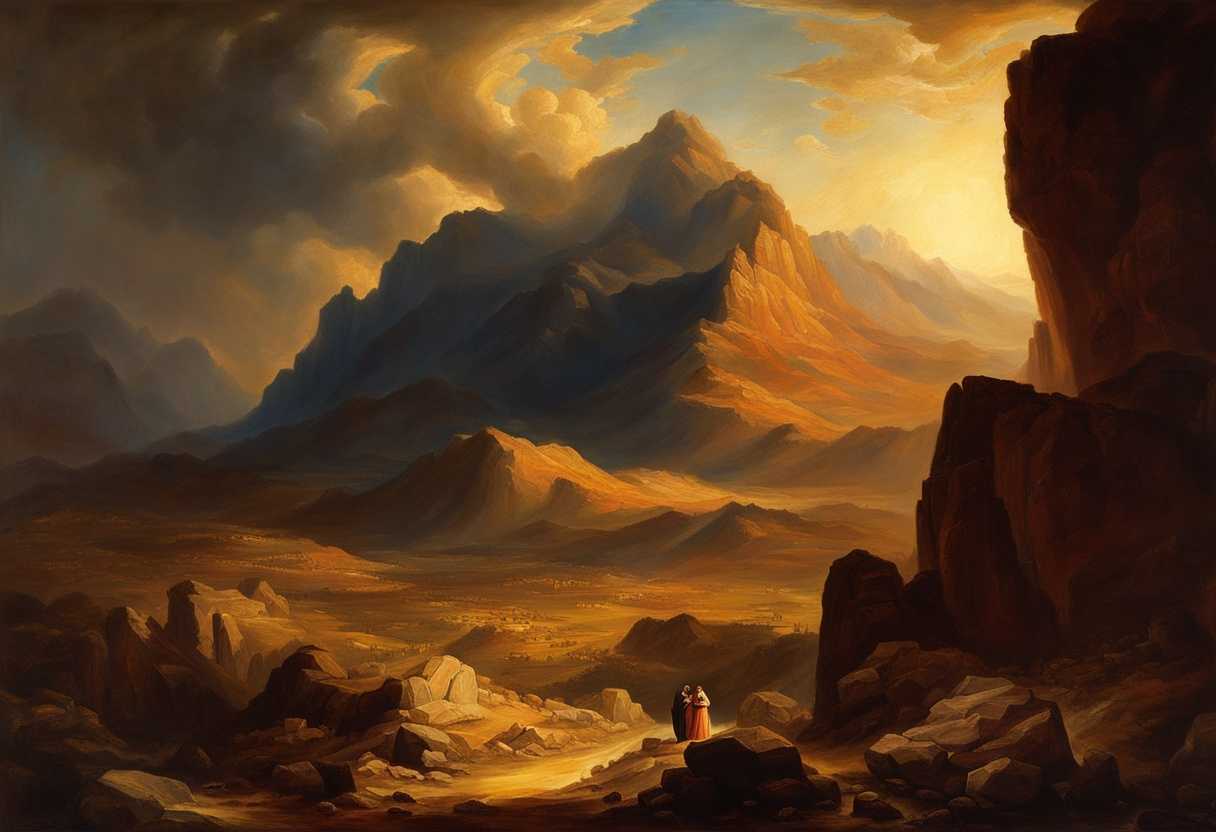
Mount Sinai is the biblical mountain where Moses received the Ten Commandments from God, symbolizing the covenant between God and the Israelites. It represents a place of divine revelation and guidance in the Hebrew Bible, particularly in the Book of Exodus.
Scripture
1 On the third new moon after the people of Israel had gone out of the land of Egypt, on that day they came into the wilderness of Sinai.
2 They set out from Rephidim and came into the wilderness of Sinai, and they encamped in the wilderness. There Israel encamped before the mountain,
3 while Moses went up to God. The Lord called to him out of the mountain, saying, “Thus you shall say to the house of Jacob, and tell the people of Israel:
4 You yourselves have seen what I did to the Egyptians, and how I bore you on eagles’ wings and brought you to myself.
5 Now therefore, if you will indeed obey my voice and keep my covenant, you shall be my treasured possession among all peoples, for all the earth is mine.
6 and you shall be to me a kingdom of priests and a holy nation. These are the words that you shall speak to the people of Israel.”
7 So Moses came and called the elders of the people and set before them all these words that the Lord had commanded him.
8 All the people answered together and said, “All that the Lord has spoken we will do.” And Moses reported the words of the people to the Lord.
9 And the Lord said to Moses, “Behold, I am coming to you in a thick cloud, that the people may hear when I speak with you, and may also believe you forever.”
10 the Lord said to Moses, “Go to the people and consecrate them today and tomorrow, and let them wash their garments.
11 and be ready for the third day. For on the third day the Lord will come down on Mount Sinai in the sight of all the people.
12 And you shall set limits for the people all around, saying, ‘Take care not to go up into the mountain or touch the edge of it. Whoever touches the mountain shall be put to death.
13 No hand shall touch him, but he shall be stoned or shot; whether beast or man, he shall not live.’ When the trumpet sounds a long blast, they shall come up to the mountain.”
14 So Moses went down from the mountain to the people and consecrated the people, and they washed their garments.
15 And he said to the people, “Be ready for the third day; do not go near a woman.”
16 On the morning of the third day there were thunders and lightnings and a thick cloud on the mountain and a very loud trumpet blast, so that all the people in the camp trembled.
17 Then Moses brought the people out of the camp to meet God, and they took their stand at the foot of the mountain.
18 Now Mount Sinai was wrapped in smoke because the Lord had descended on it in fire. The smoke of it went up like the smoke of a kiln, and the whole mountain trembled greatly.
19 As the sound of the trumpet grew louder and louder, Moses spoke, and God answered him in thunder.
20 The Lord came down on Mount Sinai, to the top of the mountain.
21 And the Lord said to Moses, “Go down and warn the people, lest they break through to the Lord to look and many of them perish.
22 Also let the priests who come near to the Lord consecrate themselves, lest the Lord break out against them.”
23 Then Moses said to the Lord, “The people cannot come up to Mount Sinai, for you yourself warned us, saying, ‘Set limits around the mountain and consecrate it.’”
24 And the Lord said to him, “Go down, and come up bringing Aaron with you. But do not let the priests and the people break through to come up to the Lord, lest he break out against them.”
25 So Moses went down to the people and told them.
Meaning of Mount Sinai in the Bible
Mount Sinai holds profound significance in the Bible as the locus of divine revelation, where God established a covenant with the Israelites. In Exodus 19, the mountain is depicted as a sacred and fearsome place, enveloped in smoke and thunder, emphasizing God’s holiness and the gravity of the moment (Exodus 19:18-19). This encounter not only served as the foundational event for the Israelites’ identity as God’s chosen people but also set the moral and ethical framework for their community through the giving of the Ten Commandments (Exodus 20:1-17). The commandments represent more than mere rules; they embody the principles of justice, mercy, and holiness that guide both individual and collective conduct.
Moreover, the meaning of Mount Sinai extends beyond its historical context; it symbolizes the broader themes of revelation, relationship, and responsibility in the biblical narrative. Hebrews 12:18-24 contrasts Mount Sinai with Mount Zion, highlighting a transition from the old covenant of law to the new covenant of grace through Christ. This juxtaposition reflects the evolving relationship between God and humanity, suggesting that while Sinai represents the law and the boundaries set by God, it also foreshadows the coming of Christ, who fulfills the law and invites believers into a deeper, spiritual relationship with God. Thus, Mount Sinai serves as a pivotal point not only in Israel’s history but also in the unfolding story of redemption that echoes through the scriptures.
In addition to its representation as a site of covenant and encounter, Mount Sinai signifies the themes of obedience and communal identity. Throughout the Old Testament, the mountain serves as a constant reminder for the Israelites of their commitment to God’s commandments. The gatherings at Sinai instilled a sense of unity among the tribes, fostering a collective consciousness rooted in the divine laws they agreed to uphold. The Israelites’ worship and rituals during their time at Sinai, including offerings and the establishment of the priesthood, further embed the mountain’s significance within their social and religious life, as it underscores their distinct identity as a community set apart by God.
The echoes of Mount Sinai can also be traced into later biblical texts, where it is referenced to evoke themes of divine instruction and moral guidance. The prophetic literature frequently recalls the Sinai event to reinforce calls for faithfulness and repentance, urging the people to return to the covenant promises that were made atop the mountain. As seen in the writings of the prophets, Sinai serves not merely as a geographical location but as a spiritual benchmark, representing both the blessings of obedience and the consequences of turning away from God’s laws. This continued reference emphasizes that the lessons and commitments forged at Sinai remain vital for understanding God’s expectations of His people throughout history, thus embedding its meaning deeply within the theological framework of the Bible.
Theophany and Divine Encounter
Mount Sinai represents a significant location for theophany, where God reveals Himself to humanity. It is a place of profound divine encounter, where the presence of God is manifested in a tangible way. This mountain serves as a reminder of the holiness of God and the awe-inspiring nature of His presence, emphasizing the need for reverence and respect in approaching the divine.
Covenant and Law
Mount Sinai is also symbolic of the establishment of the covenant between God and His people. It is here that the Israelites received the Law, which serves as a foundational element of their identity and relationship with God. This covenant signifies not only the legal and moral guidelines for living but also the commitment of God to His people, highlighting themes of obedience, faithfulness, and the consequences of breaking the covenant.
Transformation and Identity
The experience at Mount Sinai marks a transformative moment for the Israelites, shaping their identity as a nation chosen by God. The events that transpire on this mountain signify a transition from slavery in Egypt to a new life of freedom under God’s guidance. This transformation underscores the importance of spiritual renewal and the journey toward becoming a people set apart for divine purposes, reflecting the broader theme of redemption throughout the biblical narrative.
How to Embrace God’s Covenantal Promise in Faith
Embracing God’s covenantal promise in faith is a transformative journey that invites us to deepen our relationship with Him. It begins with understanding that God’s promises are not just ancient words but living truths that speak to our hearts today. As you read Scripture, let the stories of God’s faithfulness resonate within you—like the covenant with Abraham, which reminds us that God is always faithful, even when we falter. Take time in prayer to reflect on how these promises apply to your life; ask God to reveal His plans for you and to strengthen your faith. Surround yourself with a community of believers who can encourage you and share their own experiences of God’s faithfulness. Remember, faith is not a one-time decision but a daily choice to trust in God’s goodness, even when circumstances seem uncertain. By actively engaging with His promises, you will find a deeper sense of peace and purpose, knowing that you are part of a divine narrative that spans generations.
Bible References to Mount Sinai’s Significance:
Exodus 20:1-21: 1 And God spoke all these words, saying,
2 “I am the Lord your God, who brought you out of the land of Egypt, out of the house of slavery.
3 “You shall have no other gods before me.
4 “You shall not make for yourself a carved image, or any likeness of anything that is in heaven above, or that is in the earth beneath, or that is in the water under the earth.
5 You shall not bow down to them or serve them, for I the Lord your God am a jealous God, visiting the iniquity of the fathers on the children to the third and the fourth generation of those who hate me,
6 but showing steadfast love to thousands of those who love me and keep my commandments.
7 You shall not take the name of the Lord your God in vain, for the Lord will not hold him guiltless who takes his name in vain.
8 “Remember the Sabbath day, to keep it holy.
9 Six days you shall labor, and do all your work,
10 but the seventh day is a Sabbath to the Lord your God. On it you shall not do any work, you, or your son, or your daughter, your male servant, or your female servant, or your livestock, or the sojourner who is within your gates.
11 For in six days the Lord made heaven and earth, the sea, and all that is in them, and rested on the seventh day. Therefore the Lord blessed the Sabbath day and made it holy.
12 “Honor your father and your mother, that your days may be long in the land that the Lord your God is giving you.
13 “You shall not murder.”
14 “You shall not commit adultery.”
15 “You shall not steal.”
16 “You shall not bear false witness against your neighbor.”
17 “You shall not covet your neighbor’s house; you shall not covet your neighbor’s wife, or his male servant, or his female servant, or his ox, or his donkey, or anything that is your neighbor’s.”
18 Now when all the people saw the thunder and the flashes of lightning and the sound of the trumpet and the mountain smoking, the people were afraid and trembled, and they stood far off.
19 and said to Moses, “You speak to us, and we will listen; but do not let God speak to us, lest we die.”
20 Moses said to the people, “Do not fear, for God has come to test you, that the fear of him may be before you, that you may not sin.”
21 The people stood far off, while Moses drew near to the thick darkness where God was.
Exodus 24:12-18: 12 The Lord said to Moses, “Come up to me on the mountain and wait there, that I may give you the tablets of stone, with the law and the commandment, which I have written for their instruction.”
13 Then Moses set out with Joshua his assistant, and Moses went up into the mountain of God.
14 He said to the elders, “Wait here for us until we return to you. And behold, Aaron and Hur are with you. Whoever has a dispute, let him go to them.”
15 Then Moses went up on the mountain, and the cloud covered the mountain.
16 The glory of the Lord dwelt on Mount Sinai, and the cloud covered it six days. And on the seventh day he called to Moses out of the midst of the cloud.
17 Now the appearance of the glory of the Lord was like a devouring fire on the top of the mountain in the sight of the people of Israel.
18 Moses entered the cloud and went up on the mountain. And Moses was on the mountain forty days and forty nights.
Exodus 31:18: 18 And he gave to Moses, when he had finished speaking with him on Mount Sinai, the two tablets of the testimony, tablets of stone, written with the finger of God.
Exodus 32:1-35: 1 When the people saw that Moses delayed to come down from the mountain, the people gathered themselves together to Aaron and said to him, “Up, make us gods who shall go before us. As for this Moses, the man who brought us up out of the land of Egypt, we do not know what has become of him.”
2 So Aaron said to them, “Take off the rings of gold that are in the ears of your wives, your sons, and your daughters, and bring them to me.”
3 So all the people took off the rings of gold that were in their ears and brought them to Aaron.
4 And he received the gold from their hand and fashioned it with a graving tool and made a golden calf. And they said, “These are your gods, O Israel, who brought you up out of the land of Egypt!”
5 When Aaron saw this, he built an altar before it. And Aaron made a proclamation and said, “Tomorrow shall be a feast to the Lord.”
6 And they rose up early the next day and offered burnt offerings and brought peace offerings. And the people sat down to eat and drink and rose up to play.
7 And the Lord said to Moses, “Go down, for your people, whom you brought up out of the land of Egypt, have corrupted themselves.
8 They have turned aside quickly out of the way that I commanded them.
9 And the Lord said to Moses, “I have seen this people, and behold, it is a stiff-necked people.
10 Now therefore let me alone, that my wrath may burn hot against them and I may consume them, in order that I may make a great nation of you.
11 But Moses implored the Lord his God and said, “O Lord, why does your wrath burn hot against your people, whom you have brought out of the land of Egypt with great power and with a mighty hand?
12 Why should the Egyptians say, ‘With evil intent did he bring them out, to kill them in the mountains and to consume them from the face of the earth’? Turn from your burning anger and relent from this disaster against your people.
13 Remember Abraham, Isaac, and Israel, your servants, to whom you swore by your own self, and said to them, ‘I will multiply your offspring as the stars of heaven, and all this land that I have promised I will give to your offspring, and they shall inherit it forever.’”
14 And the Lord relented from the disaster that he had spoken of bringing on his people.
15 Then Moses turned and went down from the mountain with the two tablets of the testimony in his hand, tablets that were written on both sides; on the front and on the back they were written.
16 The tablets were the work of God, and the writing was the writing of God, engraved on the tablets.
17 Now when Joshua heard the noise of the people as they shouted, he said to Moses, “There is a noise of war in the camp.”
18 But he said, “It is not the sound of shouting for victory, or the sound of the cry of defeat, but the sound of singing that I hear.”
19 And as soon as he came near the camp and saw the calf and the dancing, Moses’ anger burned hot, and he threw the tablets out of his hands and broke them at the foot of the mountain.
20 He took the calf that they had made and burned it with fire and ground it to powder and scattered it on the water and made the people of Israel drink it.
21 And Moses said to Aaron, “What did this people do to you that you have brought such a great sin upon them?”
22 And Aaron said, “Let not the anger of my lord burn hot. You know the people, that they are set on evil.
23 For they said to me, ‘Make us gods who shall go before us. As for this Moses, the man who brought us up out of the land of Egypt, we do not know what has become of him.’
24 So I said to them, ‘Let any who have gold take it off.’ So they gave it to me, and I threw it into the fire, and out came this calf.”
25 And when Moses saw that the people had broken loose (for Aaron had let them break loose, to the derision of their enemies),
26 then Moses stood in the gate of the camp and said, “Who is on the Lord’s side? Come to me.” And all the sons of Levi gathered around him.
27 And he said to them, “Thus says the Lord God of Israel, ‘Put your sword on your side each of you, and go to and fro from gate to gate throughout the camp, and each of you kill his brother and his companion and his neighbor.’”
28 And the sons of Levi did according to the word of Moses. And that day about three thousand men of the people fell.
29 And Moses said, “Today you have been ordained for the service of the Lord, each one at the cost of his son and of his brother, so that he might bestow a blessing upon you this day.”
30 The next day Moses said to the people, “You have sinned a great sin. And now I will go up to the Lord; perhaps I can make atonement for your sin.”
32 Then Moses returned to the Lord, and said, “Alas, this people has sinned a great sin. They have made for themselves gods of gold.
32 But now, if you will forgive their sin—but if not, please blot me out of your book that you have written.”
33 But the Lord said to Moses, “Whoever has sinned against me, I will blot out of my book.
34 But now go, lead the people to the place about which I have spoken to you; behold, my angel shall go before you. But on the day when I visit, I will visit their sin upon them.”
35 Then the Lord sent a plague on the people, because they made the calf, the one that Aaron made.
Exodus 34:1-35: 1 The Lord said to Moses, “Cut for yourself two tablets of stone like the first, and I will write on the tablets the words that were on the first tablets, which you broke.
2 Be ready by the morning, and come up in the morning to Mount Sinai, and present yourself there to me on the top of the mountain.
3 No one shall come up with you, and let no one be seen throughout all the mountain. Let no flocks or herds graze opposite that mountain.”
4 So Moses cut two tablets of stone like the first. And he rose early in the morning and went up on Mount Sinai, as the Lord had commanded him, and took in his hand two tablets of stone.
5 The Lord descended in the cloud and stood with him there, and proclaimed the name of the Lord.
6 The Lord passed before him and proclaimed, “The Lord, the Lord, a God merciful and gracious, slow to anger, and abounding in steadfast love and faithfulness,
7 keeping steadfast love for thousands, forgiving iniquity and transgression and sin, but who will by no means clear the guilty, visiting the iniquity of the fathers on the children and the children’s children, to the third and the fourth generation.
8 And Moses quickly bowed his head toward the earth and worshiped.
9 And he said, “If now I have found favor in your sight, O Lord, please let the Lord go in the midst of us, for it is a stiff-necked people, and pardon our iniquity and our sin, and take us for your inheritance.”
10 And he said, “Behold, I am making a covenant. Before all your people I will do marvels, such as have not been created in all the earth or in any nation. And all the people among whom you are shall see the work of the Lord, for it is an awesome thing that I will do with you.
11 Observe what I command you this day. Behold, I will drive out before you the Amorites, the Canaanites, the Hittites, the Perizzites, the Hivites, and the Jebusites.
12 Take care, lest you make a covenant with the inhabitants of the land to which you go, lest it become a snare in your midst.
13 You shall tear down their altars and break their pillars and cut down their Asherim
14 (for you shall worship no other god, for the Lord, whose name is Jealous, is a jealous God),
15 lest you make a covenant with the inhabitants of the land, and when they whore after their gods and sacrifice to their gods and you are invited, you eat of his sacrifice,
16 and you take of their daughters for your sons, and their daughters whore after their gods and make your sons whore after their gods.
17 You shall not make for yourself any gods of cast metal.
18 “You shall keep the Feast of Unleavened Bread. Seven days you shall eat unleavened bread, as I commanded you, at the time appointed in the month Abib, for in the month Abib you came out from Egypt.
19 “All that open the womb are mine, all your male livestock, the firstborn of cow and sheep.”
20 The firstborn of a donkey you shall redeem with a lamb, or if you will not redeem it you shall break its neck.
21 “Six days you shall work, but on the seventh day you shall rest. In plowing time and in harvest you shall rest.”
22 You shall observe the Feast of Weeks, the firstfruits of wheat harvest, and the Feast of Ingathering at the year’s end.
23 Three times in the year shall all your males appear before the Lord God, the God of Israel.
24 For I will cast out nations before you and enlarge your borders; no one shall covet your land, when you go up to appear before the Lord your God three times in the year.
25 “You shall not offer the blood of my sacrifice with anything leavened, or let the sacrifice of the Feast of the Passover remain until the morning.”
26 The best of the firstfruits of your ground you shall bring to the house of the Lord your God.
27 And the Lord said to Moses, “Write these words, for in accordance with these words I have made a covenant with you and with Israel.”
28 So he was there with the Lord forty days and forty nights. He neither ate bread nor drank water. And he wrote on the tablets the words of the covenant, the Ten Commandments.
29 When Moses came down from Mount Sinai, with the two tablets of the testimony in his hand as he came down from the mountain, Moses did not know that the skin of his face shone because he had been talking with God.
30 Aaron and all the people of Israel saw Moses, and behold, the skin of his face shone, and they were afraid to come near him.
31 And Moses called to them, and Aaron and all the leaders of the congregation returned to him, and Moses talked with them.
32 Afterward all the people of Israel came near, and he commanded them all that the Lord had spoken with him in Mount Sinai.
33 And when Moses had finished speaking with them, he put a veil over his face.
34 Whenever Moses went in before the Lord to speak with him, he would remove the veil, until he came out. And when he came out and told the people of Israel what he was commanded,
35 the people of Israel would see the face of Moses, that the skin of Moses’ face was shining. And Moses would put the veil over his face again, until he went in to speak with him.
Leviticus 7:37-38: 37 This is the law of the burnt offering, of the grain offering, of the sin offering, of the guilt offering, of the ordination offering, and of the peace offering,
38 which the Lord commanded Moses on Mount Sinai, on the day that he commanded the people of Israel to bring their offerings to the Lord, in the wilderness of Sinai.
Leviticus 25:1-7: 8 “You shall count seven weeks of years, seven times seven years, so that the time of the seven weeks of years shall give you forty-nine years.
2 “Speak to the people of Israel and say to them, When you come into the land that I give you, the land shall keep a Sabbath to the Lord.
3 For six years you shall sow your field, and for six years you shall prune your vineyard and gather in its fruits,
4 but in the seventh year there shall be a Sabbath of solemn rest for the land, a Sabbath to the Lord.
5 You shall not reap what grows of itself in your harvest, or gather the grapes of your undressed vine. It shall be a year of solemn rest for the land.
6 The Sabbath of the land shall provide food for you, for yourself and for your male and female slaves and for your hired worker and the sojourner who lives with you,
7 And for your livestock also, and for the wild animals in your land, all its yield shall be for food.
Leviticus 26:46: 46 These are the statutes and rules and laws that the Lord made between himself and the people of Israel through Moses on Mount Sinai.
Leviticus 27:34: 34 These are the commandments that the Lord commanded Moses for the people of Israel on Mount Sinai.
Numbers 3:1-4: 1 These are the generations of Aaron and Moses at the time when the Lord spoke with Moses on Mount Sinai.
2 These are the names of the sons of Aaron: Nadab the firstborn, and Abihu, Eleazar, and Ithamar.
3 These are the names of the sons of Aaron, the anointed priests, whom he ordained to serve as priests.
4 But Nadab and Abihu died before the Lord when they offered unauthorized fire before the Lord in the wilderness of Sinai, and they had no children. So Eleazar and Ithamar served as priests in the lifetime of Aaron their father.
Numbers 9:1-5: 1 And the Lord spoke to Moses in the wilderness of Sinai, in the first month of the second year after they had come out of the land of Egypt, saying:
2 “Let the people of Israel keep the Passover at its appointed time.
3 On the fourteenth day of this month, at twilight, you shall keep it at its appointed time; according to all its statutes and all its rules you shall keep it.
4 So Moses told the people of Israel that they should keep the Passover.
5 And they kept the Passover in the first month, on the fourteenth day of the month, at twilight, in the wilderness of Sinai; according to all that the Lord commanded Moses, so the people of Israel did.
Numbers 10:11-12: 11 In the second year, in the second month, on the twentieth day of the month, the cloud lifted from over the tabernacle of the testimony,
12 And the people of Israel set out by stages from the wilderness of Sinai. And the cloud settled down in the wilderness of Paran.
Deuteronomy 1:6-8: 6 “The Lord our God said to us in Horeb, ‘You have stayed long enough at this mountain.
7 Turn and take your journey, and go to the hill country of the Amorites and to all their neighbors in the Arabah, in the hill country and in the lowland and in the Negeb and by the seacoast, the land of the Canaanites, and Lebanon, as far as the great river, the river Euphrates.
8 See, I have set the land before you. Go in and take possession of the land that the Lord swore to your fathers, to Abraham, to Isaac, and to Jacob, to give to them and to their offspring after them.
Deuteronomy 4:10-14: 10 how on the day that you stood before the Lord your God at Horeb, the Lord said to me, ‘Gather the people to me, that I may let them hear my words, so that they may learn to fear me all the days that they live on the earth, and that they may teach their children so.’
11 And you came near and stood at the foot of the mountain, while the mountain burned with fire to the heart of heaven, wrapped in darkness, cloud, and gloom.
12 Then the Lord spoke to you out of the midst of the fire. You heard the sound of words, but saw no form; there was only a voice.
13 And he declared to you his covenant, which he commanded you to perform, that is, the Ten Commandments, and he wrote them on two tablets of stone.
14 And the Lord commanded me at that time to teach you statutes and rules, that you might do them in the land that you are going over to possess.
Deuteronomy 5:1-5: 5 And Moses summoned all Israel and said to them, Hear, O Israel, the statutes and the rules that I speak in your hearing today, and you shall learn them and be careful to do them.
2 The Lord our God made a covenant with us at Horeb.
3 The Lord did not make this covenant with our fathers, but with us, who are all of us here alive today.
4 The Lord spoke with you face to face at the mountain, out of the midst of the fire,
5 while I stood between the Lord and you at that time, to declare to you the word of the Lord. For you were afraid because of the fire, and you did not go up into the mountain.
Deuteronomy 9:8-21: 8 Even at Horeb you provoked the Lord to wrath, and the Lord was so angry with you that he was ready to destroy you.
9 When I went up the mountain to receive the tablets of stone, the tablets of the covenant that the Lord made with you, I remained on the mountain forty days and forty nights. I neither ate bread nor drank water.
10 And the Lord gave me the two tablets of stone written with the finger of God, and on them were all the words that the Lord had spoken with you on the mountain out of the midst of the fire on the day of the assembly.
11 And at the end of forty days and forty nights the Lord gave me the two tablets of stone, the tablets of the covenant.
12 Then the Lord said to me, ‘Arise, go down quickly from here, for your people whom you have brought from Egypt have acted corruptly. They have turned aside quickly out of the way that I commanded them; they have made themselves a metal image.’
13 “Furthermore, the Lord said to me, ‘I have seen this people, and behold, it is a stubborn people.”
14 Let me alone, that I may destroy them and blot out their name from under heaven. And I will make of you a nation mightier and greater than they.’
15 “So I turned and came down from the mountain, and the mountain was burning with fire. And the two tablets of the covenant were in my two hands.”
16 And I looked, and behold, you had sinned against the Lord your God. You had made yourselves a golden calf.
17 And I took hold of the two tablets and threw them out of my two hands and broke them before your eyes.
18 Then I lay prostrate before the Lord as before, forty days and forty nights.
19 For I was afraid of the anger and hot displeasure that the Lord bore against you, so that he was ready to destroy you. But the Lord listened to me that time also.
20 And the Lord was so angry with Aaron that he was ready to destroy him. And I prayed for Aaron also at the same time.
21 And I took the sinful thing, the calf that you had made, and burned it with fire and crushed it, grinding it very small, until it was as fine as dust. And I threw the dust of it into the brook that ran down from the mountain.
Deuteronomy 18:15-19: 15 “The Lord your God will raise up for you a prophet like me from among you, from your brothers—it is to him you shall listen—”
16 just as you desired of the Lord your God at Horeb on the day of the assembly, when you said, ‘Let me not hear again the voice of the Lord my God or see this great fire any more, lest I die.’
17 And the Lord said to me, ‘They are right in what they have spoken.
18 I will raise up for them a prophet like you from among their brothers. And I will put my words in his mouth, and he shall speak to them all that I command him.
19 And whoever will not listen to my words that he shall speak in my name, I myself will require it of him.
Nehemiah 9:13-14: 13 You came down on Mount Sinai and spoke with them from heaven and gave them right rules and true laws, good statutes and commandments.
14 and made known to them your holy Sabbath and commanded them commandments and statutes and a law by Moses your servant.
Psalm 68:7-8: 7 O God, when you went out before your people, when you marched through the wilderness, Selah.
8 The earth quaked; the heavens poured down rain before God, the One of Sinai, before God, the God of Israel.
Acts 7:30-38: 30 “Now when forty years had passed, an angel appeared to him in the wilderness of Mount Sinai, in a flame of fire in a bush.”
31 When Moses saw it, he marveled at the sight, and as he drew near to look, there came the voice of the Lord:
32 ‘I am the God of your fathers, the God of Abraham and of Isaac and of Jacob.’ And Moses trembled and did not dare to look.
33 Then the Lord said to him, ‘Take off the sandals from your feet, for the place where you are standing is holy ground.
34 I have surely seen the affliction of my people who are in Egypt, and have heard their groaning, and I have come down to deliver them. And now come, I will send you to Egypt.’”
35 “This Moses, whom they rejected, saying, ‘Who made you a ruler and a judge?’—this man God sent as both ruler and redeemer by the hand of the angel who appeared to him in the bush.
36 This man led them out, performing wonders and signs in Egypt and at the Red Sea and in the wilderness for forty years.
37 This is the Moses who said to the Israelites, ‘God will raise up for you a prophet like me from your brothers.’
38 This is the one who was in the congregation in the wilderness with the angel who spoke to him at Mount Sinai, and with our fathers. He received living oracles to give to us.
Galatians 4:24-26: 24 Now this may be interpreted allegorically: these women are two covenants. One is from Mount Sinai, bearing children for slavery; she is Hagar.
25 Now Hagar is Mount Sinai in Arabia; she corresponds to the present Jerusalem, for she is in slavery with her children.
26 But the Jerusalem above is free, and she is our mother.
Hebrews 12:18-21: 18 For you have not come to what may be touched, a blazing fire and darkness and gloom and a tempest.
19 and the sound of a trumpet and a voice whose words made the hearers beg that no further messages be spoken to them.
20 For they could not endure the order that was given, “If even a beast touches the mountain, it shall be stoned.”
21 Indeed, so terrifying was the sight that Moses said, “I tremble with fear.”

Rev. François Dupont is a dedicated church minister with a wealth of experience in serving spiritual communities. With a calm and serene demeanor, he has been devoted to sharing the message of love, compassion, and tolerance for over two decades. Through his thoughtful sermons, compassionate counseling, and unwavering support, Rev. Dupont has touched the lives of countless individuals, allowing them to find solace and strength during difficult times. His serene presence and deep understanding of the human condition make him a trusted guide for those seeking spiritual nourishment and guidance.