
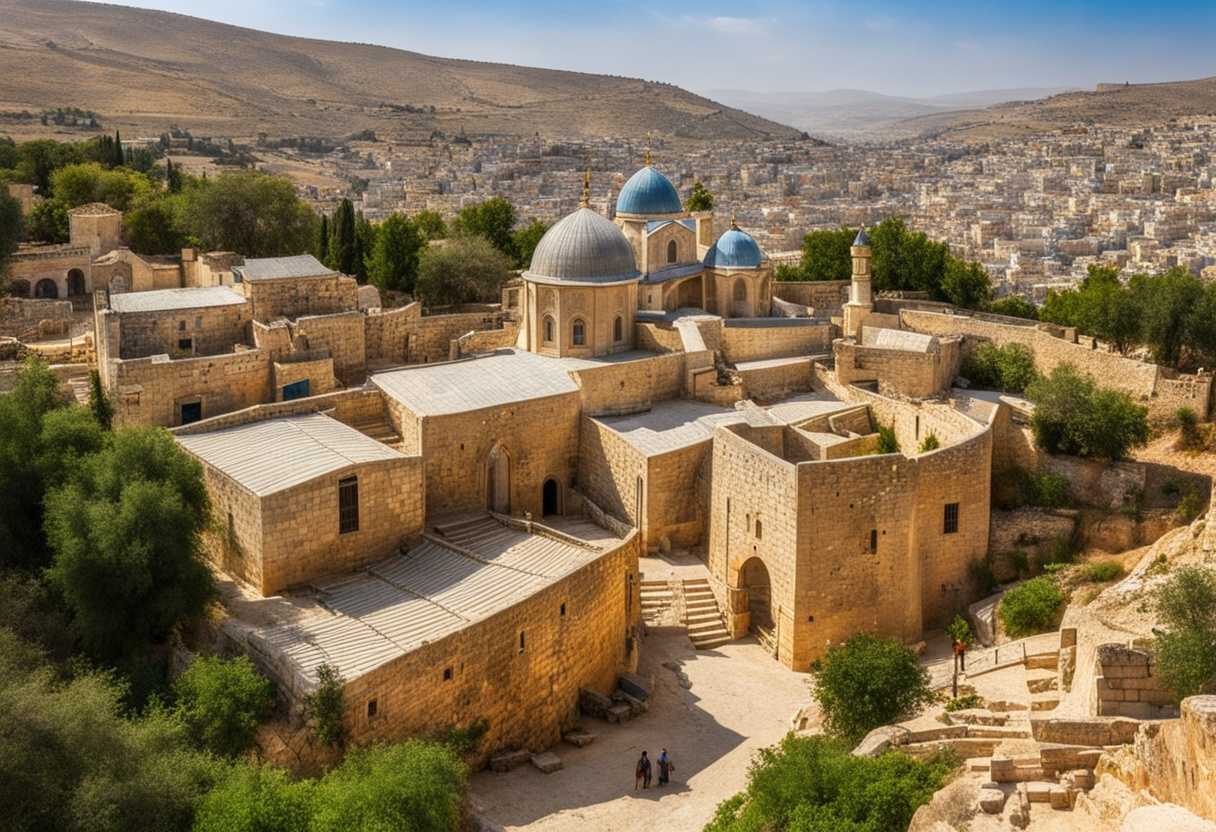
Hebron, in the Bible, is a significant ancient city located in the southern part of Canaan, known as the burial place of the patriarch Abraham and his family. It symbolizes a place of ancestry, covenant, and the fulfillment of God’s promises to the descendants of Abraham.
Scripture
18 So Abram moved his tent and came and settled by the oaks of Mamre, which are at Hebron, and there he built an altar to the Lord.
19 And the Lord said, “Lift up your eyes, and look from the place where you are, northward and southward and eastward and westward,
20 And it was in the plain of Mamre, which is in Hebron, and there Abram built an altar to the Lord and called upon the name of the Lord.
Meaning of Hebron in the Bible
Hebron holds profound significance in the biblical narrative, serving as a pivotal geographical and theological location that encapsulates themes of ancestry, covenant, and divine promise. As noted in Genesis 23:2, it is where Abraham mourned the loss of Sarah and purchased the Cave of Machpelah, establishing it as a family burial site. This act not only signifies the establishment of a permanent heritage in the land promised to Abraham (Genesis 17:8) but also underscores the beginning of a covenantal relationship between God and His chosen people, symbolized by Abraham’s descendants. Thus, Hebron becomes a tangible reminder of God’s promises, intimately connected with the identity and destiny of the Israelite people.
Moreover, Hebron’s role extends beyond the patriarchs to later biblical figures, such as David, who made it his first capital when he was anointed king over Judah (2 Samuel 2:1-4). This transition from a burial site to a political stronghold illustrates the city’s embodiment of divine favor and the unfolding narrative of God’s plan for His people. In addition, Hebron is often associated with themes of faith and trust in God’s promises, resonating with the life of Abraham, who traveled to the land of Canaan relying on God’s word (Hebrews 11:8-10). Overall, Hebron signifies not just a historic and geographic landmark, but also a profound symbol of the covenant community’s journey in faith and the realization of God’s intentions throughout biblical history.
Hebron is consistently portrayed in the Bible as a nexus of familial ties and divine promise, emphasizing its importance in establishing the heritage of the Israelite people. It was in this city that Caleb, one of the original scouts sent into Canaan, famously claimed his inheritance at the age of 85, which reflects both his unwavering faith and the fulfillment of God’s promise to the Israelites concerning the land (Joshua 14:6-14). This act encapsulates the spirit of perseverance and loyalty to God’s word that defined many of the ancient figures, showing how Hebron became a site where faith and inheritance converged, thereby cementing its role in the narrative of the Promised Land.
Moreover, the city of Hebron also serves as a significant backdrop for the complex stories surrounding the nation of Israel. It is mentioned in the context of King Solomon’s reign, where the region continued to be of great importance politically and religiously (1 Kings 9:26-28). The presence of the Tabernacle in Gilgal, nearby Hebron, during the early years of Israel’s conquest emphasizes Hebron’s role in worship practice and communal identity. This notion perpetuates the theme of continuity in God’s relationship with His people, with Hebron acting as a touchpoint between the past and the future. Consequently, the city is not just a geographic location but embodies the spiritual journey of the Israelites as they navigated their covenant with God, marking the dynamic interplay between land, promise, and the community’s evolving identity.
A Place of Covenant and Promise
Hebron is often associated with the covenant that God made with Abraham, symbolizing the promise of land and descendants. This connection highlights the significance of faith and divine assurance in the lives of the patriarchs. The city serves as a reminder of God’s faithfulness to His promises, illustrating the importance of trust in divine plans.
A Center of Leadership and Transition
Hebron also represents a pivotal location in the transition of leadership within Israel. It was here that David was anointed king over Judah, marking a significant shift in the nation’s history. This aspect of Hebron emphasizes themes of authority, governance, and the establishment of a united kingdom, showcasing the importance of leadership in fulfilling God’s purposes.
A Symbol of Heritage and Legacy
Hebron is deeply rooted in the heritage of the Israelites, being the burial site of the patriarchs and matriarchs. This connection to ancestry underscores the importance of legacy and the continuity of faith through generations. It serves as a reminder of the foundational figures of the faith and the enduring impact of their lives on future generations.
How to Cultivate Meaningful Christian Relationships and Fellowship
Cultivating meaningful Christian relationships and fellowship is a beautiful journey that requires intentionality and openness. Start by being present in your community—attend church services, join small groups, or participate in volunteer activities where you can meet like-minded believers. Remember, it’s not just about being in the same space; it’s about engaging with others on a deeper level. Share your joys and struggles, and be willing to listen and support others in theirs. Make it a habit to pray for one another, as prayer can forge powerful bonds. Don’t shy away from vulnerability; it’s often in our shared experiences of faith that we find true connection. Lastly, be patient and persistent; building meaningful relationships takes time, but the rewards of fellowship—love, encouragement, and accountability—are invaluable in your walk with Christ.
Bible References to the Meaning of Hebron:
Genesis 23:1-20: 1 Sarah lived 127 years; these were the years of the life of Sarah.
2 And Sarah died at Kiriath-arba (that is, Hebron) in the land of Canaan, and Abraham went in to mourn for Sarah and to weep for her.
3 And Abraham rose up from before his dead and said to the Hittites,
4 “I am a sojourner and foreigner among you; give me property among you for a burying place, that I may bury my dead out of my sight.”
5 “And the Hittites answered Abraham,”
6 “Hear us, my lord; you are a prince of God among us. Bury your dead in the choicest of our tombs. None of us will withhold from you his tomb to hinder you from burying your dead.”
7 Abraham rose and bowed to the Hittites, the people of the land.
8 “He said to them, ‘If you are willing that I should bury my dead out of my sight, hear me and entreat for me Ephron the son of Zohar,’”
9 that he may give me the cave of Machpelah, which he owns; it is at the end of his field. For the full price let him give it to me in your presence as property for a burying place.”
10 Now Ephron was sitting among the Hittites, and Ephron the Hittite answered Abraham in the hearing of the Hittites, of all who went in at the gate of his city.
11 “No, my lord, hear me: I give you the field, and I give you the cave that is in it. In the sight of the sons of my people I give it to you. Bury your dead.”
12 And Abraham bowed before the people of the land.
13 and he said to Ephron in the hearing of the people of the land, “But if you will, hear me: I give the price of the field. Accept it from me, that I may bury my dead there.”
14 Ephron answered Abraham, “My lord, listen to me: a piece of land worth four hundred shekels of silver, what is that between you and me? Bury your dead.”
15 “My lord, listen to me; a piece of land worth four hundred shekels of silver, what is that between you and me? Bury your dead.”
16 Abraham listened to Ephron, and Abraham weighed out for Ephron the silver that he had named in the hearing of the Hittites, four hundred shekels of silver, according to the weights current among the merchants.
17 So the field of Ephron in Machpelah, which was to the east of Mamre, the field with the cave that was in it and all the trees that were in the field, throughout its whole area, was made over
18 to Abraham as a possession in the presence of the Hittites, before all who went in at the gate of his city.
19 After this, Abraham buried Sarah his wife in the cave of the field of Machpelah east of Mamre (that is, Hebron) in the land of Canaan.
20 the field and the cave that is in it were made over to Abraham as property for a burying place by the Hittites.
Genesis 35:27-29: 27 And Jacob came to his father Isaac at Mamre, or Kiriath-arba (that is, Hebron), where Abraham and Isaac had sojourned.
28 And the days of Isaac were a hundred and eighty years.
29 And Isaac breathed his last, and he died and was gathered to his people, old and full of days. And his sons Esau and Jacob buried him.
Numbers 13:21-24: 21 So they went up and spied out the land from the wilderness of Zin to Rehob, near Lebo-hamath.
22 They went up into the Negeb and came to Hebron.
23 And they came to the Valley of Eshcol and cut down from there a branch with a single cluster of grapes, and they carried it on a pole between two of them; they also brought some pomegranates and figs.
24 That place was called the Valley of Eshcol, because of the cluster that the people of Israel cut down from there.
Joshua 10:36-37: 36 Then Joshua and all Israel with him went up from Eglon to Hebron. And they fought against it
37 And they took it and struck it with the edge of the sword, and its king and its towns they devoted to destruction.
Joshua 14:13-15: 13 Then Joshua blessed him, and he gave Hebron to Caleb the son of Jephunneh for an inheritance.
14 Therefore Hebron became the inheritance of Caleb the son of Jephunneh the Kenizzite to this day, because he wholly followed the Lord, the God of Israel.
15 Now the name of Hebron formerly was Kiriath-arba. (Arba was the greatest man among the Anakim.) And the land had rest from war.
Joshua 15:13-14: 13 According to the commandment of the Lord to Joshua, he gave to Caleb the son of Jephunneh a portion among the people of Judah, Kiriath-arba, that is, Hebron (Arba was the father of Anak).
14 And Caleb drove out from there the three sons of Anak: Sheshai, Ahiman, and Talmai, the descendants of Anak.
2 Samuel 2:1-4: 1 After this David inquired of the Lord, “Shall I go up into any of the cities of Judah?” And the Lord said to him, “Go up.” David said, “To which shall I go up?” And he said, “To Hebron.”
2 So David went up there, and his two wives also, Ahinoam of Jezreel and Abigail the widow of Nabal of Carmel.
3 And David brought up his men who were with him, everyone with his household, and they lived in the towns of Hebron.
4 And the men of Judah came, and there they anointed David king over the house of Judah.
2 Samuel 5:1-5: 1 Then all the tribes of Israel came to David at Hebron and said, “Behold, we are your bone and flesh.
2 In times past, when Saul was king over us, it was you who led out and brought in Israel. And the Lord said to you, ‘You shall be shepherd of my people Israel, and you shall be prince over Israel.’”
3 So all the elders of Israel came to the king at Hebron, and King David made a covenant with them at Hebron before the Lord, and they anointed David king over Israel.
4 David was thirty years old when he began to reign, and he reigned forty years.
5 And David sent and gathered together the elders of Israel and the priests and the Levites.
1 Chronicles 6:54-57: 54 These are the dwelling places according to their settlements within their borders for the sons of Aaron of the families of the Kohathites, for theirs was the first lot.
55 till he came to the hill country of Ephraim, and found a place for themselves to live in.
56 but the fields of the city and its villages they gave to Caleb the son of Jephunneh.
57 To the sons of Aaron they gave the cities of refuge: Hebron, Libnah with its pasturelands, Jattir, Eshtemoa with its pasturelands,
1 Chronicles 11:1-3: 1 Then all Israel gathered together to David at Hebron and said, “Behold, we are your bone and flesh.
2 In times past, even when Saul was king, it was you who led out and brought in Israel. And the Lord your God said to you, ‘You shall be shepherd of my people Israel, and you shall be prince over my people Israel.’”
3 Therefore all the elders of Israel came to the king at Hebron, and David made a covenant with them at Hebron before the Lord, and they anointed David king over Israel, according to the word of the Lord by Samuel.
1 Chronicles 12:23-28: 23 These are the numbers of the divisions of the armed troops who came to David in Hebron to turn the kingdom of Saul over to him, according to the word of the Lord.
24 The men of Judah bearing shield and spear were 6,800 armed troops.
25 From Simeon, mighty men of valor for war, 7,100.
26 Of the Simeonites, mighty men of valor for war, 26,000.
27 Jehoiada, the leader of the house of Aaron, and with him 3,700,
28 and Zadok, a young man mighty in valor, and twenty-two commanders from his own fathers’ house.
1 Chronicles 29:26-28: 26 And David the son of Jesse reigned over all Israel.
27 And the time that he reigned over Israel was forty years.
28 Then he died in a good old age, full of days, riches, and honor. And Solomon his son reigned in his place.

Rev. François Dupont is a dedicated church minister with a wealth of experience in serving spiritual communities. With a calm and serene demeanor, he has been devoted to sharing the message of love, compassion, and tolerance for over two decades. Through his thoughtful sermons, compassionate counseling, and unwavering support, Rev. Dupont has touched the lives of countless individuals, allowing them to find solace and strength during difficult times. His serene presence and deep understanding of the human condition make him a trusted guide for those seeking spiritual nourishment and guidance.