
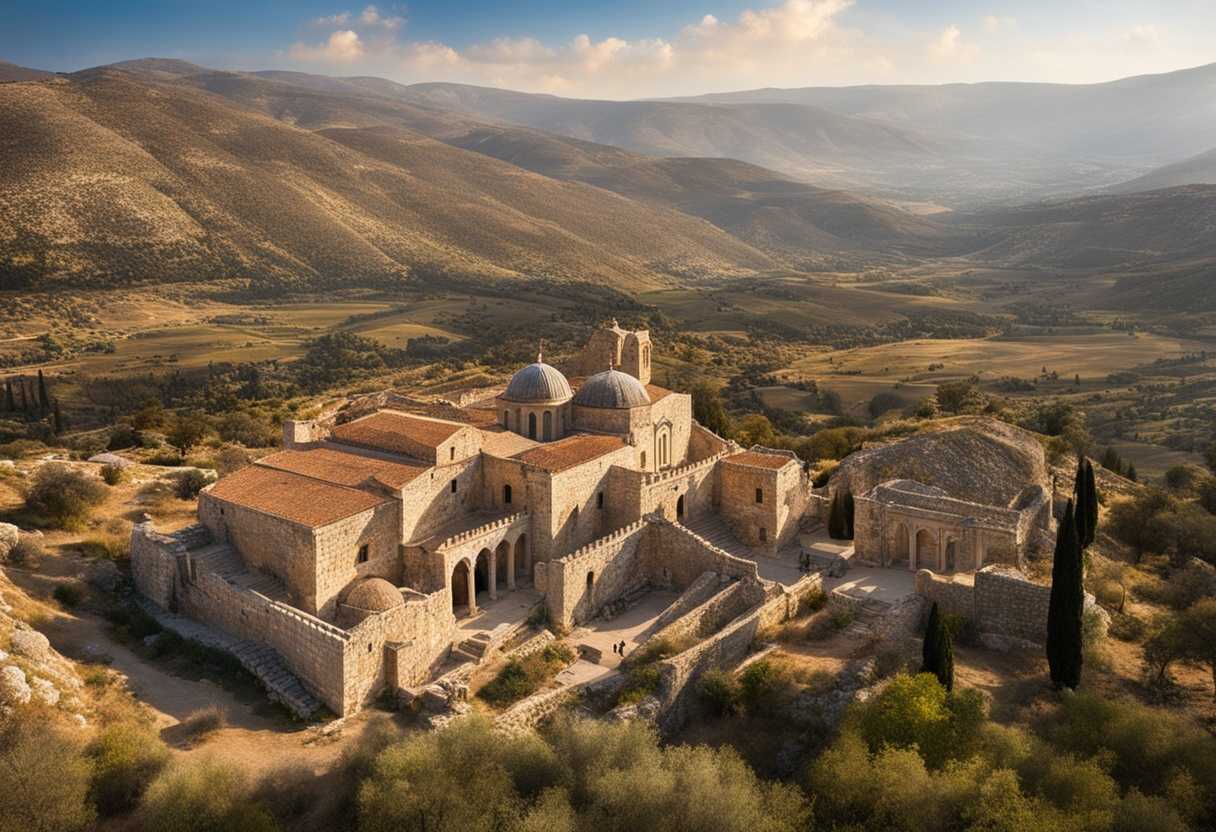
In the Bible, Samaria refers to both a region and its capital city in ancient Israel, known for its significant role in the history of the northern kingdom. It symbolizes division and conflict, especially between the Israelites and the Samaritans, as well as the site of idol worship and foreign influences that often led the people away from Yahweh.
Scripture
5 Then the king of Assyria invaded all the land and came to Samaria, and for three years he besieged it.
6 In the ninth year of Hoshea, the king of Assyria captured Samaria, and he carried the Israelites away to Assyria and placed them in Halah, and on the Habor, the river of Gozan, and in the cities of the Medes.
7 And this occurred because the people of Israel had sinned against the Lord their God, who had brought them up out of the land of Egypt from under the hand of Pharaoh king of Egypt, and had feared other gods.
8 and walked in the customs of the nations whom the Lord drove out before the people of Israel, and in the customs that the kings of Israel had practiced.
9 And the people of Israel did secretly against the Lord their God things that were not right. They built for themselves high places in all their towns, from watchtower to fortified city.
10 They set up for themselves pillars and Asherim on every high hill and under every green tree,
11 and there they made offerings on all the high places, as the nations did whom the Lord carried away before them. And they did wicked things, provoking the Lord to anger,
12 they served idols, of which the Lord had said to them, “You shall not do this.”
13 Yet the Lord warned Israel and Judah by every prophet and every seer, saying, “Turn from your evil ways and keep my commandments and my statutes, in accordance with all the Law that I commanded your fathers, and that I sent to you by my servants the prophets.”
14 But they would not listen, but were stubborn, as their fathers had been, who did not believe in the Lord their God.
15 They despised his statutes and his covenant that he made with their fathers and the warnings that he gave them. They went after false idols and became false, and they followed the nations that were around them, concerning whom the Lord had commanded them that they should not do like them.
16 And they abandoned all the commandments of the Lord their God and made for themselves metal images of two calves; and they made an Asherah and worshiped all the host of heaven and served Baal.
17 And they burned their sons and their daughters as offerings and used divination and omens and sold themselves to do evil in the sight of the Lord, provoking him to anger.
18 Therefore the Lord was very angry with Israel and removed them out of his sight. None was left but the tribe of Judah only.
19 Judah also did not keep the commandments of the Lord their God, but walked in the customs that Israel had introduced.
20 And the Lord rejected all the descendants of Israel and afflicted them and gave them into the hand of plunderers, until he had cast them out of his sight.
21 When he had torn Israel from the house of David, they made Jeroboam the son of Nebat king. And Jeroboam drove Israel from following the Lord and made them commit great sin.
22 For the people of Israel walked in all the sins that Jeroboam did. They did not depart from them,
23 until the Lord removed Israel out of his sight, as he had spoken by all his servants the prophets. So Israel was exiled from their own land to Assyria until this day.
Meaning of Samaria in the Bible
Samaria, both as a region and its capital, is a multifaceted symbol in the biblical narrative, representing not just geographical significance but also the profound divisions and spiritual conflicts that permeated the history of Israel. The northern kingdom, with Samaria as its capital, deviated from the worship of Yahweh, leading to the establishment of idolatrous practices. This is notably chronicled in 1 Kings 12:25-30, where Jeroboam sets up two golden calves in Bethel and Dan, thus drawing the people away from Jerusalem and inciting both religious and political fragmentation. As a result, Samaria becomes synonymous with a straying from true faith, serving as a powerful reminder of the consequences of departing from God’s commandments.
The New Testament further illustrates the import of Samaria through the dynamics between Jews and Samaritans, most famously depicted in the parable of the Good Samaritan (Luke 10:25-37). Here, Samaria embodies both social conflict and the broader theme of mercy that transcends ethnic and religious boundaries. The use of the Samaritan in this narrative signifies a radical call to love beyond prejudice and established enmities, inviting readers to reflect on their own biases and the inclusive nature of God’s love. Thus, Samaria in the biblical context represents not only a historical site of division and idolatry but also a profound theological text urging unity and compassion in the face of division.
In the prophetic literature, Samaria frequently serves as a focal point for divine judgment and admonishment. Prophets such as Amos and Hosea deliver scathing critiques against the corruption and social injustice prevalent in the region. Amos, in particular, emphasizes the disparity between the lavish lifestyles of the elites in Samaria and the suffering of the marginalized, illustrating a societal moral decay that deeply angers God. This serves to highlight that Samaria is not merely a location but a representation of spiritual failings and a community engulfed in ethical and spiritual crisis. The portrayal of Samaria in these texts underscores the prophetic call for repentance and a return to justice and righteousness, making it a symbol of both warning and hope.
Additionally, Samaria’s significance is magnified in the context of the early church and the expansion of the Gospel. In Acts 8, the evangelist Philip preaches in Samaria, resulting in a significant response from the Samaritans who embrace the message of Christ. This moment signifies a radical shift, where the region, previously characterized by animosity and exclusion, becomes a recipient of the Good News. The conversion of Samaritans not only serves as a testament to the transformative power of the Gospel but also exemplifies the breaking down of barriers that once divided Jews and Samaritans. Thus, Samaria transitions from a symbol of disunity and idolatry to one of inclusiveness and new life in Christ, reinforcing the biblical theme of redemption and the universality of God’s plan for salvation.
Symbol of Division and Conflict
Samaria represents the division between the northern and southern kingdoms of Israel. After the reign of King Solomon, the kingdom split into Israel (the north) and Judah (the south). Samaria, as the capital of the northern kingdom, became a symbol of political and religious conflict, illustrating the struggles and tensions that arose from this division. The city often embodied the consequences of idolatry and disobedience to God, leading to its eventual downfall and conquest.
Representation of Redemption and Hope
Despite its negative connotations, Samaria also serves as a backdrop for themes of redemption and hope in the biblical narrative. The New Testament highlights the significance of Samaria through the ministry of Jesus and the early church, where Samaritans are portrayed as recipients of God’s grace. This shift emphasizes the inclusivity of the Gospel and the breaking down of barriers, showcasing that redemption is available to all, regardless of their past or cultural background.
Metaphor for Spiritual Condition
In a broader spiritual context, Samaria can be seen as a metaphor for the human heart’s condition. The city’s history of idolatry and moral decay reflects the struggles individuals face in their spiritual lives. Just as Samaria needed restoration and renewal, so too do individuals require transformation and healing through faith. This metaphor encourages believers to seek a deeper relationship with God, moving away from spiritual complacency and towards a life of obedience and devotion.
How to Foster Unity and Faith in Christ
Fostering unity and faith in Christ is a beautiful journey that begins in our hearts and extends to our communities. As we strive to embody the love of Christ, it’s essential to cultivate an attitude of humility and openness, recognizing that we are all part of the same body of believers, each with unique gifts and perspectives. Engage in regular prayer, not just for your own needs but for the unity of the church and the world around you. Make it a point to listen actively to others, valuing their experiences and insights, which can deepen your understanding of God’s diverse creation. Participate in fellowship activities, whether through small groups, service projects, or church events, where you can build relationships and share your faith journey. Remember, unity doesn’t mean uniformity; it’s about celebrating our differences while focusing on our shared love for Christ. As you grow in faith, let your actions reflect the grace and compassion of Jesus, drawing others into a community that mirrors His love.
Bible References to the Meaning of Samaria:
1 Kings 16:23-28: 23 In the thirty-first year of Asa king of Judah, Omri began to reign over Israel, and he reigned for twelve years. Six years he reigned in Tirzah.
24 He bought the hill of Samaria from Shemer for two talents of silver, and he fortified the hill and called the name of the city that he built Samaria, after the name of Shemer, the owner of the hill.
25 Omri did what was evil in the sight of the Lord, and did more evil than all who were before him.
26 For he walked in all the way of Jeroboam the son of Nebat, and in the sins that he made Israel to sin, provoking the Lord, the God of Israel, to anger by their idols.
27 Now the rest of the acts of Omri that he did, and the might that he showed, are they not written in the Book of the Chronicles of the Kings of Israel?
28 So Omri slept with his fathers and was buried in Samaria, and Ahab his son reigned in his place.
2 Kings 18:9-12: 9 In the fourth year of King Hezekiah, which was the seventh year of Hoshea son of Elah, king of Israel, Shalmaneser king of Assyria came up against Samaria and besieged it.
10 And at the end of three years they captured it.
11 The king of Assyria carried the Israelites away to Assyria and put them in Halah, and on the Habor, the river of Gozan, and in the cities of the Medes,
12 because they did not obey the voice of the Lord their God but transgressed his covenant, even all that Moses the servant of the Lord commanded. They neither listened nor obeyed.
2 Kings 17:24-41: 24 And the king of Assyria brought people from Babylon, Cuthah, Avva, Hamath, and Sepharvaim, and placed them in the cities of Samaria instead of the people of Israel. They took possession of Samaria and lived in its cities.
25 And at the beginning of their dwelling there, they did not fear the Lord. Therefore the Lord sent lions among them, which killed some of them.
26 So they spoke to the king of Assyria, saying, “The nations that you have carried away and placed in the cities of Samaria do not know the law of the god of the land. Therefore he has sent lions among them, and behold, they are killing them, because they do not know the law of the god of the land.”
27 Then the king of Assyria commanded, “Send there one of the priests whom you carried away from there, and let him go and dwell there and teach them the law of the god of the land.”
28 So one of the priests whom they had carried away from Samaria came and lived in Bethel and taught them how they should fear the Lord.
29 But every nation still made gods of its own and put them in the shrines of the high places that the Samaritans had made, every nation in the cities in which they lived.
30 The men of Babylon made Succoth-benoth, the men of Cuth made Nergal, the men of Hamath made Ashima,
31 the Avvites made Nibhaz and Tartak; and the Sepharvites burned their children in the fire to Adrammelech and Anammelech, the gods of Sepharvaim.
32 They also feared the Lord and appointed from among themselves all sorts of people as priests of the high places, who sacrificed for them in the shrines of the high places.
33 They feared the Lord but also served their own gods, after the manner of the nations from among whom they had been carried away.
34 To this day they do according to their former manner. They do not fear the Lord, and they do not follow the statutes or the rules or the law or the commandment that the Lord commanded the children of Jacob, whom he named Israel.
35 The Lord made a covenant with them and commanded them, “You shall not fear other gods or bow yourselves to them or serve them or sacrifice to them,
36 but you shall fear the Lord, who brought you out of the land of Egypt with great power and with an outstretched arm. You shall bow yourselves to him, and to him you shall sacrifice.
37 And the statutes and the rules and the law and the commandment that he wrote for you, you shall always be careful to do. You shall not fear other gods.
38 And the covenant that I have made with you, you shall not forget, and you shall not fear other gods.
39 but you shall fear the Lord your God, and he will deliver you out of the hand of all your enemies.
40 but they would not listen, but were stubborn, as their fathers had been, who did not believe in the Lord their God.
41 So these nations feared the Lord and also served their carved images. Their children did likewise, and their children’s children—as their fathers did, so they do to this day.
John 4:1-42: 4 Now when Jesus learned that the Pharisees had heard that Jesus was making and baptizing more disciples than John
2 (though Jesus himself did not baptize, but only his disciples),
3 he left Judea and departed again for Galilee.
4 And he had to pass through Samaria.
5 So he came to a town of Samaria called Sychar, near the field that Jacob had given to his son Joseph.
6 Jacob’s well was there; so Jesus, wearied as he was from his journey, was sitting beside the well. It was about the sixth hour.
7 A woman from Samaria came to draw water. Jesus said to her, “Give me a drink.”
8 For his disciples had gone away into the city to buy food.
9 The Samaritan woman said to him, “How is it that you, a Jew, ask for a drink from me, a woman of Samaria?” (For Jews have no dealings with Samaritans.)
10 Jesus answered her, “If you knew the gift of God, and who it is that is saying to you, ‘Give me a drink,’ you would have asked him, and he would have given you living water.”
11 The woman said to him, “Sir, you have nothing to draw water with, and the well is deep. Where do you get that living water?
12 Are you greater than our father Jacob? He gave us the well and drank from it himself, as did his sons and his livestock.
13 Jesus said to her, “Everyone who drinks of this water will be thirsty again,
14 but whoever drinks of the water that I will give him will never be thirsty again. The water that I will give him will become in him a spring of water welling up to eternal life.”
15 The woman said to him, “Sir, give me this water, so that I will not be thirsty or have to come here to draw water.”
16 So Jesus said to her, “Go, call your husband, and come here.”
17 The woman answered him, “I have no husband.” Jesus said to her, “You are right in saying, ‘I have no husband’;
18 There is no fear in love, but perfect love casts out fear. For fear has to do with punishment, and whoever fears has not been perfected in love.
19 The woman said to him, “Sir, I perceive that you are a prophet.
20 Our fathers worshiped on this mountain, but you say that in Jerusalem is the place where people ought to worship.”
21 Jesus said to her, “Woman, believe me, the hour is coming when neither on this mountain nor in Jerusalem will you worship the Father.”
22 You worship what you do not know; we worship what we know, for salvation is from the Jews.
23 But the hour is coming, and is now here, when the true worshipers will worship the Father in spirit and truth, for the Father is seeking such people to worship him.
24 God is spirit, and those who worship him must worship in spirit and truth.
25 The woman said to him, “I know that Messiah is coming (he who is called Christ). When he comes, he will tell us all things.”
26 Jesus said to her, “I who speak to you am he.”
27 Just then his disciples came back. They marveled that he was talking with a woman, but no one said, “What do you seek?” or, “Why are you talking with her?”
28 So the woman left her water jar and went away into town and said to the people,
29 “Come, see a man who told me all that I ever did. Can this be the Christ?”
30 They went out of the town and were coming to him.
31 Meanwhile the disciples were urging him, saying, “Rabbi, eat.”
32 But he said to them, “I have food to eat that you do not know about.”
33 So the disciples said to one another, “Has anyone brought him something to eat?”
34 Jesus said to them, “My food is to do the will of him who sent me and to accomplish his work.”
35 Do you not say, ‘There are yet four months, then comes the harvest’? Look, I tell you, lift up your eyes, and see that the fields are white for harvest.
36 Already the one who reaps is receiving wages and gathering fruit for eternal life, so that sower and reaper may rejoice together.
37 For here the saying holds true, ‘One sows and another reaps.’
38 I sent you to reap that for which you did not labor. Others have labored, and you have entered into their labor.
39 Many Samaritans from that town believed in him because of the woman’s testimony, “He told me all that I ever did.”
40 So when the Samaritans came to him, they asked him to stay with them, and he stayed there two days.
41 And many more believed because of his word.
42 They said to the woman, “It is no longer because of what you said that we believe, for we have heard for ourselves, and we know that this is indeed the Savior of the world.”
Luke 9:51-56: 51 When the days drew near for him to be taken up, he set his face to go to Jerusalem.
52 And he sent messengers ahead of him, who went and entered a village of the Samaritans, to make preparations for him.
53 But the people did not receive him, because his face was set toward Jerusalem.
54 And when his disciples James and John saw it, they said, “Lord, do you want us to tell fire to come down from heaven and consume them?”
55 But he turned and rebuked them.
56 For the Son of Man did not come to destroy men’s lives but to save them.” And they went on to another village.
Acts 8:4-25: 4 Now those who were scattered went about preaching the word.
5 Philip went down to the city of Samaria and proclaimed to them the Christ.
6 And the crowds with one accord paid attention to what was being said by Philip when they heard him and saw the signs that he did.
7 For unclean spirits, crying out with a loud voice, came out of many who had them, and many who were paralyzed or lame were healed.
8 So there was much joy in that city.
9 But there was a man named Simon, who had previously practiced magic in the city and amazed the people of Samaria, saying that he himself was somebody great.
10 They all paid attention to him, from the least to the greatest, saying, “This man is the power of God that is called Great.”
11 And they paid attention to him because for a long time he had amazed them with his magic.
12 But when they believed Philip as he preached good news about the kingdom of God and the name of Jesus Christ, they were baptized, both men and women.
13 Even Simon himself believed, and after being baptized he continued with Philip. And seeing signs and great miracles performed, he was amazed.
14 Now when the apostles at Jerusalem heard that Samaria had received the word of God, they sent to them Peter and John,
15 who came down and prayed for them that they might receive the Holy Spirit,
16 for he had not yet fallen on any of them, but they had only been baptized in the name of the Lord Jesus.
17 Then they laid their hands on them and they received the Holy Spirit.
18 Now when Simon saw that the Spirit was given through the laying on of the apostles’ hands, he offered them money,
19 saying, “Give me this power also, so that anyone on whom I lay my hands may receive the Holy Spirit.”
20 But Peter said to him, “May your silver perish with you, because you thought you could obtain the gift of God with money!
21 You have neither part nor lot in this matter, for your heart is not right before God.
22 Repent, therefore, of this wickedness of yours, and pray to the Lord that, if possible, the intent of your heart may be forgiven you.
23 For I see that you are in the gall of bitterness and in the bond of iniquity.”
24 And Simon answered, “Pray for me to the Lord, that nothing of what you have said may come upon me.”
25 Now when they had testified and spoken the word of the Lord, they returned to Jerusalem, preaching the gospel to many villages of the Samaritans.
Hosea 8:5-7: 5 He has rejected your calf, O Samaria. My anger burns against them. How long will they be incapable of innocence?
6 For it is from Israel; a craftsman made it; it is not God. The calf of Samaria shall be broken to pieces.
7 For they sow the wind, and they shall reap the whirlwind.
Amos 4:1-3: 1 “Hear this word, you cows of Bashan, who are on the mountain of Samaria, who oppress the poor, who crush the needy, who say to your husbands, ‘Bring, that we may drink!’”
2 The Lord God has sworn by his holiness
that, behold, the days are coming upon you
when they shall take you away with hooks,
even the last of you with fishhooks.
3 “And you shall go out through the breaches, each one straight ahead; and you shall be cast out into Harmon,” declares the Lord.
Micah 1:1-7: 1 The word of the Lord that came to Micah of Moresheth in the days of Jotham, Ahaz, and Hezekiah, kings of Judah, which he saw concerning Samaria and Jerusalem.
2 Hear, you peoples, all of you; pay attention, O earth, and all that is in it, and let the Lord God be a witness against you, the Lord from his holy temple.
3 For behold, the Lord is coming out of his place, and will come down and tread upon the high places of the earth.
4 And the mountains will melt under him, and the valleys will split open, like wax before the fire, like waters poured down a steep place.
5 All this is for the transgression of Jacob and for the sins of the house of Israel. What is the transgression of Jacob? Is it not Samaria? And what is the high place of Judah? Is it not Jerusalem?
6 Therefore I will make Samaria a heap in the open country, a place for planting vineyards, and I will pour down her stones into the valley and uncover her foundations.
7 All her carved images shall be beaten to pieces, all her wages shall be burned with fire, and all her idols I will lay waste, for from the fee of a prostitute she gathered them, and to the fee of a prostitute they shall return.

Reverend Ogunlade is a seasoned Church Minister with over three decades of experience in guiding and nurturing congregations. With profound wisdom and a serene approach, Reverend Ogunlade has carried out various pastoral duties, including delivering uplifting sermons, conducting religious ceremonies, and offering sage counsel to individuals seeking spiritual guidance. Their commitment to fostering harmony and righteousness within their community is exemplified through their compassionate nature, making them a beloved and trusted figure among the congregation.