
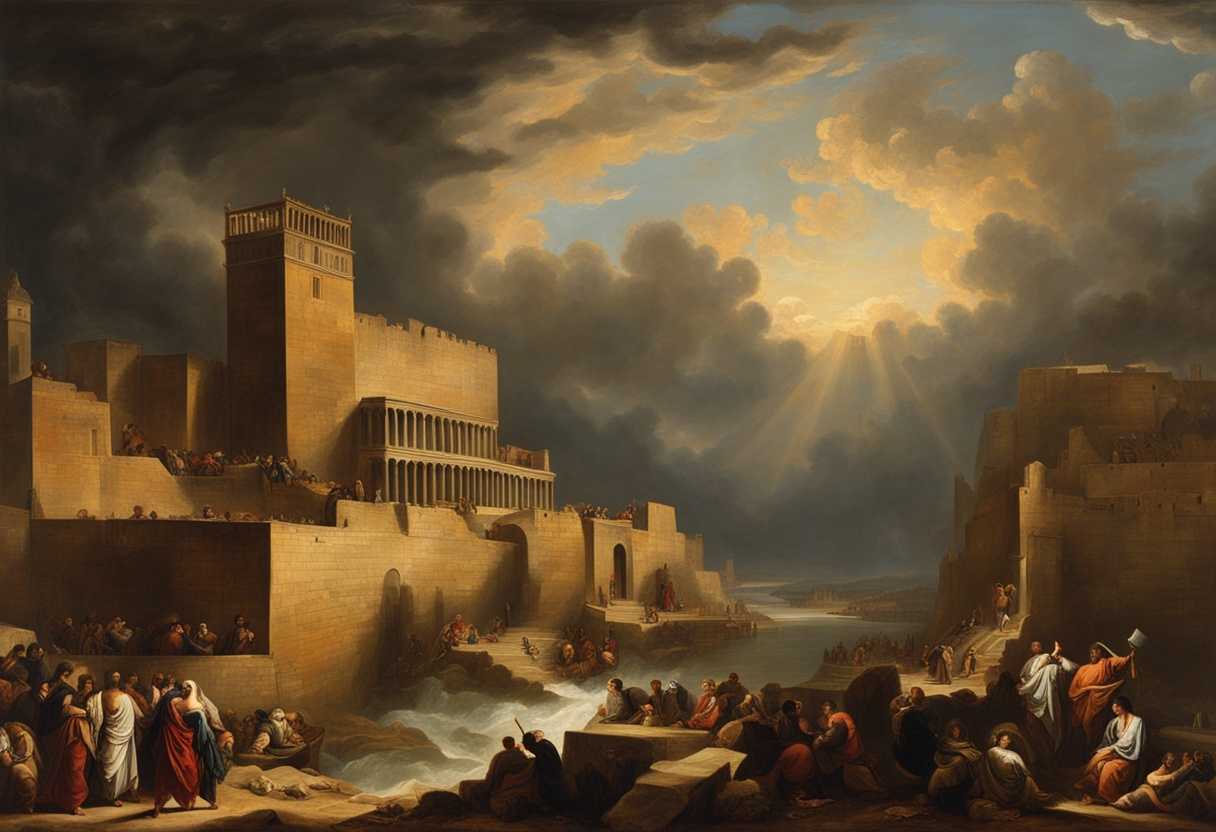
In the Bible, Nineveh is the capital city of the ancient Assyrian empire, known for its wickedness and rebellion against God. It is famously featured in the Book of Jonah, where God commands the prophet to preach repentance to its inhabitants.
Scripture
8 Cush fathered Nimrod; he was the first on earth to be a mighty man.
9 He was a mighty hunter before the Lord. So it is said, “Like Nimrod a mighty hunter before the Lord.”
10 The beginning of his kingdom was Babel, Erech, Accad, and Calneh, in the land of Shinar.
11 From that land he went into Assyria and built Nineveh, Rehoboth-Ir, Calah,
12 and Resen between Nineveh and Calah; that is the great city.
Meaning of Nineveh in the Bible
Nineveh holds significant symbolic meaning in the Bible, particularly as a representation of human sinfulness and the potential for redemption. Its notoriety as a city steeped in wickedness and rebellion against God is evident in Jonah 1:2, where God commands the prophet Jonah to go and call out against the city due to its evil ways. This call to repentance highlights God’s desire for mercy even towards those who have strayed far from righteousness. Despite Jonah’s initial reluctance and attempt to flee, he ultimately fulfills God’s command, leading to an astonishing response from the Ninevites, who repent in mass, donning sackcloth and fasting (Jonah 3:5-10). This narrative underscores the theme of God’s unrelenting grace, illustrating that no matter how far one has wandered, the opportunity for redemption remains accessible.
The broader implications of Nineveh extend beyond its historical context to reflect on the nature of God’s relationship with humanity. The story exemplifies divine compassion and the transformative power of repentance. Even the Assyrians, enemies of Israel renowned for their cruelty (Nahum 3:1-4), receive God’s message with humility, prompting Him to relent from impending judgment. This theme emphasizes that God’s mercy is not limited to Israel but is available to all people, urging believers to consider the depth of God’s love for the world (John 3:16). Nineveh’s eventual destruction in Nahum serves as a sobering reminder of the consequences of continued rebellion against divine authority, thus highlighting both the hope of repentance and the seriousness of turning away from sin. As a result, Nineveh serves as a profound lesson in biblical teachings on mercy, judgment, and the vast scope of God’s call to all humankind for acknowledgment of sin and the embrace of repentance.
Nineveh’s role in the biblical narrative not only showcases individual transformation through repentance but also marks a pivotal intersection for divine interaction with nations regarded as adversaries. Throughout scripture, the city’s prominence as an emblem of grace amid sin reflects God’s continued outreach to those perceived as outsiders to His covenant. This is particularly relevant in the context of the ancient Assyrian Empire, which represented the height of human arrogance and hostility towards God’s people. Nineveh stands as a testament to the potential for societal change when even the most depraved achieve humility before God, suggesting that the reach of divine mercy is far broader than one might assume.
Moreover, the Prophet Micah draws attention to the significance of Nineveh by contrasting its fate with that of Israel. In proclaiming a vision of hope for the returning exiles, Micah often underscores the importance of justice, mercy, and walking humbly with God. By contrasting Nineveh’s repentance with Israel’s repeated disobedience, the narrative prompts an introspective examination of a nation’s relationship with God. This brings forth a multifaceted theological message: it is not merely personal repentance that is vital, but also communal acknowledgment of sin and a concerted return to righteousness. Nineveh thus remains emblematic of the broader biblical call for all peoples to recognize their need for God and to seek His grace, reminding us that transformation is possible irrespective of one’s past, as long as there is a willingness to turn toward divine mercy.
Symbol of Repentance and Mercy
Nineveh serves as a powerful symbol of repentance and divine mercy in the biblical narrative. The city’s response to Jonah’s warning illustrates the potential for transformation and redemption, highlighting that even the most wicked can turn from their ways and seek forgiveness. This theme emphasizes the boundless nature of God’s mercy, suggesting that no one is beyond the reach of divine grace if they genuinely repent.
Representation of Judgment and Consequences
Nineveh also represents the consequences of sin and the impending judgment that follows unrepentant behavior. The prophetic messages concerning Nineveh underscore the idea that nations and individuals alike are accountable for their actions. The eventual downfall of Nineveh serves as a cautionary tale about the seriousness of moral decay and the inevitable repercussions that arise from turning away from righteousness.
Contrast Between Human and Divine Perspectives
The story of Nineveh highlights the contrast between human understanding and divine perspective. While humans may view a city or nation as irredeemable, God’s vision encompasses the potential for change and restoration. This dichotomy invites reflection on how people perceive others and challenges them to adopt a more compassionate and hopeful outlook, recognizing that transformation is always possible through divine intervention.
How to Embrace Repentance for a Faithful Life
Embracing repentance is a transformative journey that can deepen your faith and strengthen your relationship with God. It begins with a sincere acknowledgment of our shortcomings and a heartfelt desire to turn away from sin. Remember, repentance isn’t just about feeling guilty; it’s about recognizing the love and grace that God offers us through Jesus Christ. Take time in prayer to reflect on your actions and ask for forgiveness, not only from God but also from those you may have wronged. This act of humility opens the door to healing and renewal. As you cultivate a repentant heart, you’ll find that it leads to a more faithful life, filled with grace, compassion, and a deeper understanding of God’s mercy. Embrace this process as a daily practice, allowing it to guide your choices and interactions, and watch how it transforms your life and the lives of those around you.
Bible References to the Meaning of Nineveh:
Jonah 1:1-3: 1 Now the word of the Lord came to Jonah the son of Amittai, saying,
2 “Arise, go to Nineveh, that great city, and call out against it, for their evil has come up before me.”
3 But Jonah rose to flee to Tarshish from the presence of the Lord. He went down to Joppa and found a ship going to Tarshish. So he paid the fare and went down into it, to go with them to Tarshish, away from the presence of the Lord.
Jonah 3:1-10: 1 Then the word of the Lord came to Jonah the second time, saying,
2 “Arise, go to Nineveh, that great city, and call out against it the message that I tell you.”
3 So Jonah arose and went to Nineveh, according to the word of the Lord. Now Nineveh was an exceedingly great city, three days’ journey in breadth.
4 Jonah began to go into the city, going a day’s journey. And he called out, “Yet forty days, and Nineveh shall be overthrown!”
5 And the people of Nineveh believed God. They called for a fast and put on sackcloth, from the greatest of them to the least of them.
6 The word reached the king of Nineveh, and he arose from his throne, removed his robe, covered himself with sackcloth, and sat in ashes.
7 And he issued a proclamation and published through Nineveh, “By the decree of the king and his nobles: Let neither man nor beast, herd nor flock, taste anything. Let them not feed or drink water,
8 but let man and beast be covered with sackcloth, and let them call out mightily to God. Let everyone turn from his evil way and from the violence that is in his hands.
9 Who knows? God may turn and relent and turn from his fierce anger, so that we may not perish.”
10 When God saw what they did, how they turned from their evil way, God relented of the disaster that he had said he would do to them, and he did not do it.
Jonah 4:1-11: 1 But it displeased Jonah exceedingly, and he was angry.
2 And he prayed to the Lord and said, “O Lord, is not this what I said when I was yet in my country? That is why I made haste to flee to Tarshish; for I knew that you are a gracious God and merciful, slow to anger and abounding in steadfast love, and relenting from disaster.
3 Therefore now, O Lord, please take my life from me, for it is better for me to die than to live.”
4 And the Lord said, “Do you do well to be angry?”
5 Jonah went out of the city and sat to the east of the city and made a booth for himself there. He sat under it in the shade, till he should see what would become of the city.
6 Now the Lord God appointed a plant and made it come up over Jonah, that it might be a shade over his head, to save him from his discomfort. So Jonah was exceedingly glad because of the plant.
7 But when dawn came up the next day, God appointed a worm that attacked the plant, so that it withered.
8 When the sun rose, God appointed a scorching east wind, and the sun beat down on the head of Jonah so that he was faint. And he asked that he might die and said, “It is better for me to die than to live.”
9 But God said to Jonah, “Do you do well to be angry for the plant?” And he said, “Yes, I do well to be angry, angry enough to die.”
10 And the Lord said, “You pity the plant, for which you did not labor, nor did you make it grow, which came into being in a night and perished in a night.
11 And should not I pity Nineveh, that great city, in which there are more than 120,000 persons who do not know their right hand from their left, and also much cattle?”
Nahum 1:1-15: 1 The oracle of Nineveh. The book of the vision of Nahum of Elkosh.
2 The Lord is a jealous and avenging God;
the Lord is avenging and wrathful;
the Lord takes vengeance on his adversaries
and keeps wrath for his enemies.
3 The Lord is slow to anger and great in power,
and the Lord will by no means clear the guilty.
4 He rebukes the sea and makes it dry; he dries up all the rivers; Bashan and Carmel wither; the bloom of Lebanon withers.
5 The mountains quake before him; the hills melt; the earth heaves before him, the world and all who dwell in it.
6 Who can stand before his indignation?
7 The Lord is good, a stronghold in the day of trouble; he knows those who take refuge in him.
8 But with an overflowing flood he will make a complete end of the adversaries, and will pursue his enemies into darkness.
9 What do you plot against the Lord? He will make a complete end; trouble will not rise up a second time.
10 For they are like entangled thorns, like drunkards as they drink; they are consumed like stubble fully dried.
11 From you came one who plotted evil against the Lord, a worthless counselor.
12 Thus says the Lord: “Though they are at full strength and many, they will be cut down and pass away. Though I have afflicted you, I will afflict you no more.
13 And now I will break his yoke from off you and will burst your bonds apart.”
14 And the Lord has given commandment about you: “No more shall your name be perpetuated; from the house of your gods I will cut off the carved image and the metal image. I will make your grave, for you are vile.”
15 Behold, upon the mountains, the feet of him who brings good news, who publishes peace! Keep your feasts, O Judah; fulfill your vows, for never again shall the worthless pass through you; he is utterly cut off.
Nahum 2:1-13: 1 The scatterer has come up against you. Man the ramparts; watch the road; dress for battle; collect all your strength.
2 For the Lord is restoring the majesty of Jacob as the majesty of Israel, for plunderers have plundered them and ruined their branches.
3 The shield of his mighty men is red; his soldiers are clothed in scarlet. The chariots come with flashing metal on the day he musters them; the cypress spears are brandished.
4 The chariots race madly through the streets; they rush to and fro through the squares; they gleam like torches; they dart like lightning.
5 He remembers his officers; they stumble as they go, they hasten to the wall; the siege tower is set up.
6 The river gates are opened;
the palace melts;
7 The LORD is good, a stronghold in the day of trouble; he knows those who take refuge in him.
2 The chariots race madly through the streets; they rush to and fro through the squares; they gleam like torches; they dart like lightning.
9 Plunder the silver, plunder the gold! There is no end of the treasure or wealth of all precious things.
10 She is empty, void, and waste; the heart melts, and the knees tremble; anguish is in all loins; all faces grow pale!
11 The queen is stripped; she is carried off, her slave girls lamenting, moaning like doves and beating their breasts.
12 The lion tore enough for his cubs
and strangled prey for his lionesses;
he filled his caves with prey
and his dens with torn flesh.
13 Behold, I am against you, declares the Lord of hosts, and I will burn your chariots in smoke, and the sword shall devour your young lions. I will cut off your prey from the earth, and the voice of your messengers shall no longer be heard.
Nahum 3:1-19: 1 Woe to the bloody city, all full of lies and plunder— no end to the prey!
2 The crack of the whip, and rumble of the wheel, galloping horse and bounding chariot!
3 Horsemen charging,
flashing sword and glittering spear,
hosts of slain,
heaps of corpses,
dead bodies without end—
they stumble over the bodies!
4 all because of the multitude of the whoredom of the prostitute, graceful and of deadly charms, who betrays nations with her whoredom, and peoples with her charms.
5 Behold, I am against you, declares the Lord of hosts, and will lift up your skirts over your face; and I will make nations look at your nakedness and kingdoms at your shame.
6 I will throw filth at you and treat you with contempt and make you a spectacle.
7 And all who look at you will shrink from you and say, “Wasted is Nineveh; who will grieve for her?” Where shall I seek comforters for you?
8 Are you better than Thebes that sat by the Nile,
with water around her,
her rampart a sea,
and water her wall?
9 Cush and Egypt were her boundless strength;
Put and Libya were her helpers.
10 Yet she became an exile; she went into captivity; her infants were dashed in pieces at the head of every street; for her honored men lots were cast, and all her great men were bound in chains.
11 You also will be drunken; you will go into hiding; you will seek a refuge from the enemy.
12 All your fortresses are like fig trees
with first-ripe figs—
if shaken they fall
into the mouth of the eater.
13 Behold, your troops are women in your midst. The gates of your land are wide open to your enemies; fire has devoured your bars.
14 Draw water for the siege; strengthen your forts; go into the clay; tread the mortar; take hold of the brick mold!
15 There will the fire devour you; the sword will cut you off. It will devour you like the locust. Multiply yourselves like the locust; multiply like the grasshopper!
16 You increased your merchants more than the stars of the heavens.
17 Your princes are like grasshoppers,
your scribes like clouds of locusts
settling on the fences
in a day of cold—
when the sun rises, they fly away;
no one knows where they are.
18 Your shepherds are asleep, O king of Assyria; your nobles slumber. Your people are scattered on the mountains with none to gather them.
19 There is no easing your hurt; your wound is grievous. All who hear the news about you clap their hands over you. For upon whom has not come your unceasing evil?
Zephaniah 2:13-15: 13 And he will stretch out his hand against the north and destroy Assyria,
and he will make Nineveh a desolation,
a dry waste like the desert.
14 Herds shall lie down in her midst,
all kinds of beasts;
even the owl and the hedgehog
shall lodge in her capitals;
a voice shall hoot in the window;
devastation will be on the threshold;
for her cedar work will be laid bare.
15 This is the exultant city that lived securely, that said in her heart, “I am, and there is no one else.” What a desolation she has become, a lair for wild beasts! Everyone who passes by her hisses and shakes his fist.
2 Kings 19:36-37: 36 And Sennacherib the king of Assyria departed and went home and lived at Nineveh.
37 And as he was worshiping in the house of Nisroch his god, Adrammelech and Sharezer, his sons, struck him down with the sword. And after they escaped into the land of Ararat, Esarhaddon his son reigned in his place.
Isaiah 37:37-38: 37 So Sennacherib king of Assyria departed and returned home and lived at Nineveh.
38 And as he was worshiping in the house of Nisroch his god, Adrammelech and Sharezer, his sons, struck him down with the sword. And after they escaped into the land of Ararat, Esarhaddon his son reigned in his place.

Rev. François Dupont is a dedicated church minister with a wealth of experience in serving spiritual communities. With a calm and serene demeanor, he has been devoted to sharing the message of love, compassion, and tolerance for over two decades. Through his thoughtful sermons, compassionate counseling, and unwavering support, Rev. Dupont has touched the lives of countless individuals, allowing them to find solace and strength during difficult times. His serene presence and deep understanding of the human condition make him a trusted guide for those seeking spiritual nourishment and guidance.