
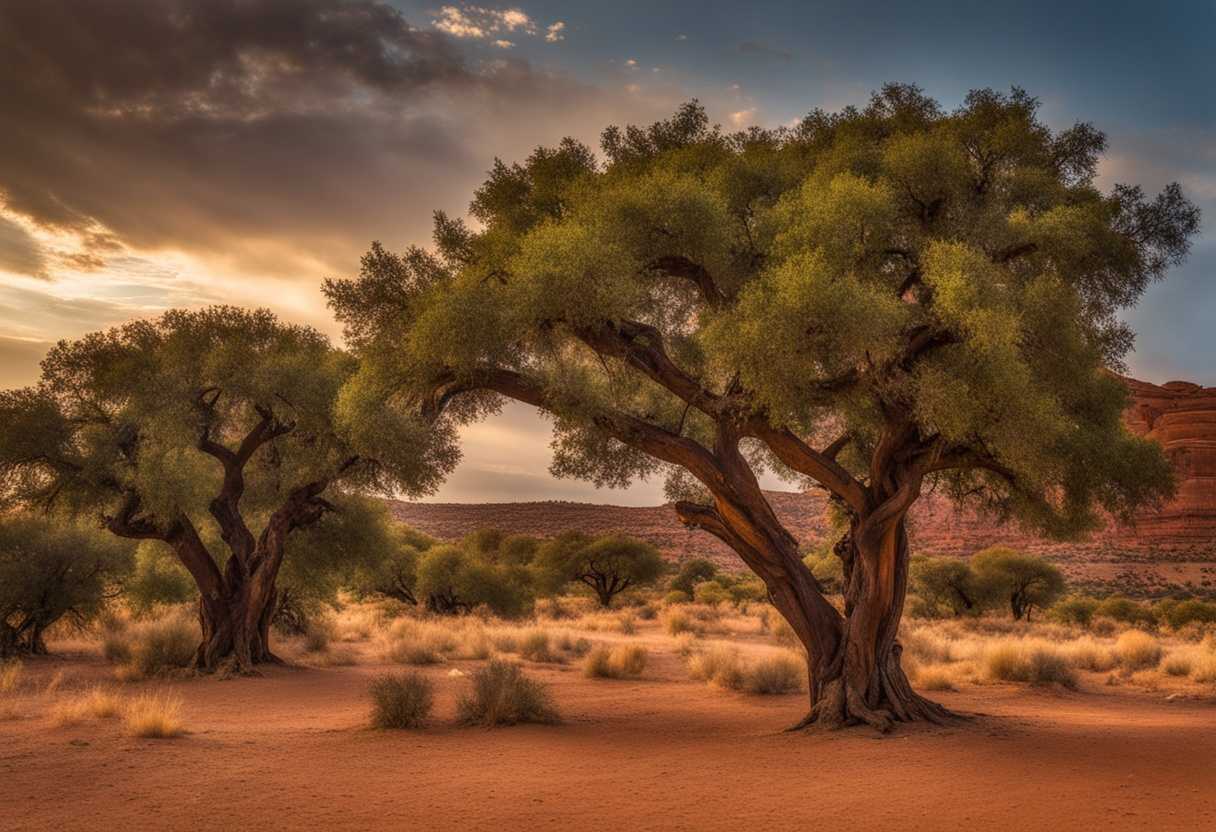
In the Bible, the Shittim tree, specifically referenced in the Old Testament, is often identified with acacia trees and is significant as the material from which the Ark of the Covenant and other tabernacle furnishings were made (Exodus 25:10). Shittim is also mentioned as a location in the plains of Moab, associated with the Israelites before entering the Promised Land (Numbers 25:1).
Scripture
10 “They shall make an ark of acacia wood. Two cubits and a half shall be its length, a cubit and a half its breadth, and a cubit and a half its height.”
11 You shall overlay it with pure gold, inside and outside shall you overlay it, and you shall make on it a molding of gold around it.
12 And cast four rings of gold for it and put them on its four feet, two rings on the one side of it, and two rings on the other side of it.
13 You shall make poles of acacia wood and overlay them with gold.
14 And you shall put the poles into the rings on the sides of the ark to carry the ark by them.
15 The poles shall remain in the rings of the ark; they shall not be taken from it.
16 And you shall put into the ark the testimony that I shall give you.
17 You shall make a mercy seat of pure gold.
18 And you shall make two cherubim of gold; of hammered work shall you make them, on the two ends of the mercy seat.
19 And make one cherub on the one end, and one cherub on the other end. Of one piece with the mercy seat shall you make the cherubim on its two ends.
20 The cherubim shall spread out their wings above, overshadowing the mercy seat with their wings, their faces one to another; toward the mercy seat shall the faces of the cherubim be.
21 And you shall put the mercy seat on the top of the ark, and in the ark you shall put the testimony that I shall give you.
22 There I will meet with you, and from above the mercy seat, from between the two cherubim that are on the ark of the testimony, I will speak with you about all that I will give you in commandment for the people of Israel.
Meaning of the Shittim Tree in the Bible
The Shittim tree, or acacia, holds both practical and symbolic significance within the biblical narrative. As detailed in Exodus 25:10, the use of Shittim wood in the construction of the Ark of the Covenant emphasizes its durability and sanctity, suggesting that spiritual truths can emerge from seemingly humble beginnings. The Ark served as a tangible manifestation of God’s presence among His people, highlighting the importance of holiness and divine fellowship. This duality of the Shittim tree—being both a common resource and a vessel for the sacred—embodies a broader biblical theme: God’s ability to use ordinary elements of life to accomplish extraordinary purposes.
Additionally, the Shittim location in Numbers 25:1 is significant as it marks a pivotal moment for the Israelites, presenting themes of temptation and faithfulness. In the plains of Moab, the Israelites faced moral challenges and idolatry, which ultimately led to divine judgment. This narrative serves as a reminder of the critical juncture between entering the Promised Land and succumbing to spiritual compromise. The Shittim tree thus encapsulates the tension between the sacred and the secular, symbolizing both the material aspect of worship and the spiritual battle faced by God’s people. This theme is echoed throughout Scripture, where the faithful must navigate their physical surroundings while remaining true to their covenant with God, as shown in verses like James 1:12, which encourages believers to persevere under trial.
Further exploration of the Shittim tree reveals its role in biblical geography and symbolism beyond its physical attributes. In Joshua 2, the spies sent to Jericho lodged with Rahab, who lived in a house built into the city wall. Jewish traditions often associate such structures with dwellings made from Shittim wood, linking the material to themes of refuge and protection during times of turmoil. Rahab’s story, highlighting her faith and boldness, reflects that the Shittim tree—a structure reflecting both strength and vulnerability—serves as a backdrop for the unfolding theme of redemption and inclusion within God’s plan. It shows that even in the seemingly mundane, one can find avenues for divine grace and purpose.
Moreover, the Shittim tree appears in prophetic literature and psalms, reinforcing its symbolism. In Isaiah 41:19, acacia trees are mentioned in the context of wilderness restoration, where God promises to bring forth life and fruitfulness in desolate places. This reflects the broader biblical concept of hope and renewal, suggesting that the Shittim, often found in barren landscapes, represents spiritual revival. Through the imagery of growth and the transformation of lifelessness into vibrancy, the Shittim tree becomes a powerful symbol of God’s ability to bring forth beauty from ashes. Taken together, these references allow for a deeper appreciation of the Shittim tree as not merely a botanical entity but as an emblem of God’s overarching narrative of provision, redemption, and resilience amidst life’s trials.
Symbol of Endurance and Resilience
The Shittim tree, often identified with the acacia tree, symbolizes endurance and resilience in the face of adversity. Its ability to thrive in harsh environments reflects the strength of the Israelites during their journey through the wilderness. This tree serves as a reminder of the importance of perseverance and faith, even when circumstances are challenging.
Representation of Divine Provision
The Shittim tree is also significant as a representation of divine provision. The wood from this tree was used in the construction of sacred items, including the Ark of the Covenant. This highlights the idea that God provides the necessary resources for His people to fulfill their divine purpose, emphasizing the connection between the material and the spiritual.
Connection to Holiness and Separation
In biblical narratives, the Shittim tree is associated with themes of holiness and separation. The Israelites were instructed to maintain their distinct identity and avoid the practices of surrounding nations. The use of Shittim wood in sacred objects underscores the call to holiness and the importance of remaining set apart for God’s purposes, reinforcing the idea of living a life dedicated to spiritual integrity.
How to Embrace Change and Grow in Faith
Embracing change can often feel daunting, but it’s essential for our growth as Christians. Remember that change is a part of God’s divine plan, and it often leads us to deeper faith and understanding. When faced with new challenges or transitions, take a moment to pray and seek God’s guidance—He is always there, ready to lead you through the unknown. Reflect on the stories of biblical figures like Abraham, who stepped into the unknown with faith, or the disciples, who left everything behind to follow Jesus. These examples remind us that change can be a catalyst for spiritual growth. Surround yourself with a supportive community, engage in scripture, and be open to the lessons that come with each new season. Trust that God is shaping you through every twist and turn, and allow His love to transform your heart as you navigate the journey of faith.
Bible References to the Shittim Tree:
Exodus 26:15-30: 15 You shall make upright frames for the tabernacle of acacia wood.
16 Ten cubits shall be the length of a board, and a cubit and a half shall be the breadth of each board.
17 There shall be two tenons in each board, fitted to one another. So shall he make for all the boards of the tabernacle.
18 And you shall make fifty clasps of bronze, and put the clasps into the loops, and couple the tent together that it may be a single whole.
19 And you shall make forty bases of silver under the twenty frames, two bases under one frame for its two tenons, and two bases under the next frame for its two tenons.
20 And you shall make forty bases of silver under the twenty frames, two bases under one frame for its two tenons, and two bases under the next frame for its two tenons.
21 In the first row there shall be a curtain of blue and purple and scarlet yarns and fine twined linen, with cherubim skillfully worked into it.
22 There shall be two tenons for each board, fitted to one another; so shall you do for all the boards of the tabernacle.
23 There shall be two tenons in one board, set in order, that one may be joined to the other.
24 And they shall be double at the two corners of the house.
25 And there shall be eight frames with their bases of silver, sixteen bases; two bases under one frame, and two bases under another frame.
26 And you shall make bars of acacia wood, five for the frames of the one side of the tabernacle,
27 And five bars for the frames of the one side of the tabernacle, and five bars for the frames of the other side of the tabernacle, and five bars for the frames of the side of the tabernacle at the rear westward.
28 and the middle bar in the center of the frames shall pass through from end to end.
29 And you shall overlay the frames with gold and shall make their rings of gold for holders for the bars, and you shall overlay the bars with gold.
30 Then you shall erect the tabernacle according to the plan for it that you were shown on the mountain.
Exodus 27:1-8: 1 “You shall make the altar of acacia wood, five cubits long and five cubits broad. The altar shall be square, and its height shall be three cubits.
2 And you shall make horns for it on its four corners; its horns shall be of one piece with it, and you shall overlay it with bronze.
3 Five cubits shall be the length of the one curtain, and five cubits the breadth of the one curtain for the first set of curtains, and five cubits the length of the one curtain, and five cubits the breadth of the one curtain for the second set of curtains.
4 You shall make for it a grating of network of bronze, and on the net you shall make four bronze rings at its four corners.
5 You shall put it under the ledge of the altar so that the net shall extend halfway down the altar.
6 You shall make poles for the altar, a net of bronze network, to be set halfway up the altar.
7 And you shall put it under the ledge of the altar so that the net shall extend halfway down the altar.
8 It shall be made with cherubim skillfully worked into it.
Exodus 30:1-10: 1 “You shall make an altar on which to burn incense; you shall make it of acacia wood.
2 A cubit shall be its length, and a cubit its breadth. It shall be square, and two cubits shall be its height. Its horns shall be of one piece with it.
3 You shall overlay it with pure gold, its top and around its sides and its horns. And you shall make a molding of gold around it.
4 A golden altar, a holy anointing oil, and a fragrant incense.
5 And you shall make the poles of acacia wood and overlay them with gold.
6 And you shall put it in front of the veil that is above the ark of the testimony, in front of the mercy seat that is above the testimony, where I will meet with you.
7 And Aaron shall burn fragrant incense on it. Every morning when he dresses the lamps he shall burn it,
8 And when Aaron sets up the lamps at twilight, he shall burn it, a regular incense offering before the Lord throughout your generations.
9 You shall not offer unauthorized incense on it, or a burnt offering, or a grain offering, and you shall not pour a drink offering on it.
10 Aaron shall make atonement on its horns once a year. With the blood of the sin offering of atonement, he shall make atonement for it once in the year throughout your generations. It is most holy to the Lord.”
Exodus 36:20-34: 20 He made the upright frames for the tabernacle of acacia wood.
21 These are the records of the tabernacle, the tabernacle of the testimony, as they were recorded at the commandment of Moses, the responsibility of the Levites under the direction of Ithamar the son of Aaron the priest.
22 Each board had two tenons for fitting together. He did this for all the boards of the tabernacle.
23 With it he made the bases for the entrance of the tent of meeting, the bronze altar and the bronze grating for it and all the utensils of the altar,
24 And with it he made the bases for the entrance of the tent of meeting, the bronze altar and the bronze grating for it, and all the utensils of the altar,
25 And for the other side of the tabernacle, on the north side, he made twenty frames
26 And he made for the tent a covering of tanned rams’ skins and goatskins.
27 And for the corners of the court on the west you shall make six frames.
28 He also made bars of acacia wood, five for the boards of the one side of the tabernacle,
29 And they made the connecting rods of acacia wood to hold the veil in place.
30 And there were eight frames with their bases of silver: sixteen bases, under every frame two bases.
31 And he made bars of acacia wood, five for the frames of the one side of the tabernacle,
32 And five bars for the frames of the other side of the tabernacle, and five bars for the frames of the side of the tabernacle at the rear westward.
33 And he made the middle bar to run from end to end halfway up the frames.
34 He overlaid the frames with gold and made their rings of gold for holders for the bars, and overlaid the bars with gold.
Exodus 37:1-9: 1 He made the ark of acacia wood. Two cubits and a half was its length, a cubit and a half its breadth, and a cubit and a half its height.
2 He overlaid it with pure gold inside and outside, and made a molding of gold around it.
3 He cast four rings of gold for its four feet, two rings on its one side and two rings on its other side.
4 He made poles of acacia wood and overlaid them with gold.
5 And he put the poles into the rings on the sides of the ark to carry the ark.
6 He made the mercy seat of pure gold. Two cubits and a half was its length, and a cubit and a half its breadth.
7 And he made two cherubim of gold. He made them of hammered work on the two ends of the mercy seat,
8 He made the basin of bronze and its stand of bronze, from the mirrors of the ministering women who ministered in the entrance of the tent of meeting.
9 The cherubim spread out their wings above, overshadowing the mercy seat with their wings, with their faces one to another; toward the mercy seat were the faces of the cherubim.
Exodus 38:1-7: 1 He made the altar of burnt offering of acacia wood.
2 And he made horns for it on its four corners. Its horns were of one piece with it, and he overlaid it with bronze.
3 And he made all the utensils of the altar, the pots, the shovels, the basins, the forks, and the fire pans. He made all its utensils of bronze.
4 He made for the altar a grating, a network of bronze, under its ledge, extending halfway down.
5 They made the altar of acacia wood. It was square, five cubits long, five cubits wide, and three cubits high.
6 He made the poles of acacia wood and overlaid them with bronze.
7 And he put the poles through the rings on the sides of the altar to carry it with them. He made it hollow, with boards.
Deuteronomy 10:1-5: 2 And I will write on the tablets the words that were on the first tablets that you broke, and you shall put them in the ark.”
2 And I will write on the tablets the words that were on the first tablets that you broke, and you shall put them in the ark.”
3 So I made an ark of acacia wood, and cut two tablets of stone like the first, and went up the mountain with the two tablets in my hand.
4 And he wrote on the tablets, in the same writing as before, the Ten Commandments that the Lord had spoken to you on the mountain out of the midst of the fire on the day of the assembly.
5 Then I turned and came down from the mountain and put the tablets in the ark that I had made. And there they are, as the Lord commanded me.”
Isaiah 41:17-20: 17 When the poor and needy seek water, and there is none, and their tongue is parched with thirst, I the Lord will answer them; I the God of Israel will not forsake them.
18 I will open rivers on the bare heights, and fountains in the midst of the valleys. I will make the wilderness a pool of water, and the dry land springs of water.
19 I will put in the wilderness the cedar, the acacia, the myrtle, and the olive. I will set in the desert the cypress, the plane and the pine together,
20 that they may see and know,
may consider and understand together,
that the hand of the Lord has done this,
the Holy One of Israel has created it.
Joel 3:18-21: 18 “And in that day the mountains shall drip sweet wine, and the hills shall flow with milk, and all the streambeds of Judah shall flow with water; and a fountain shall come forth from the house of the Lord and water the Valley of Shittim.”
19 Egypt shall become a desolation and Edom a desolate wilderness, because of the violence done to the people of Judah, in whose land they have shed innocent blood.
20 But Judah shall be inhabited forever, and Jerusalem to all generations.
21 I will avenge their blood, blood I have not avenged, for the Lord dwells in Zion.

Rev. François Dupont is a dedicated church minister with a wealth of experience in serving spiritual communities. With a calm and serene demeanor, he has been devoted to sharing the message of love, compassion, and tolerance for over two decades. Through his thoughtful sermons, compassionate counseling, and unwavering support, Rev. Dupont has touched the lives of countless individuals, allowing them to find solace and strength during difficult times. His serene presence and deep understanding of the human condition make him a trusted guide for those seeking spiritual nourishment and guidance.