
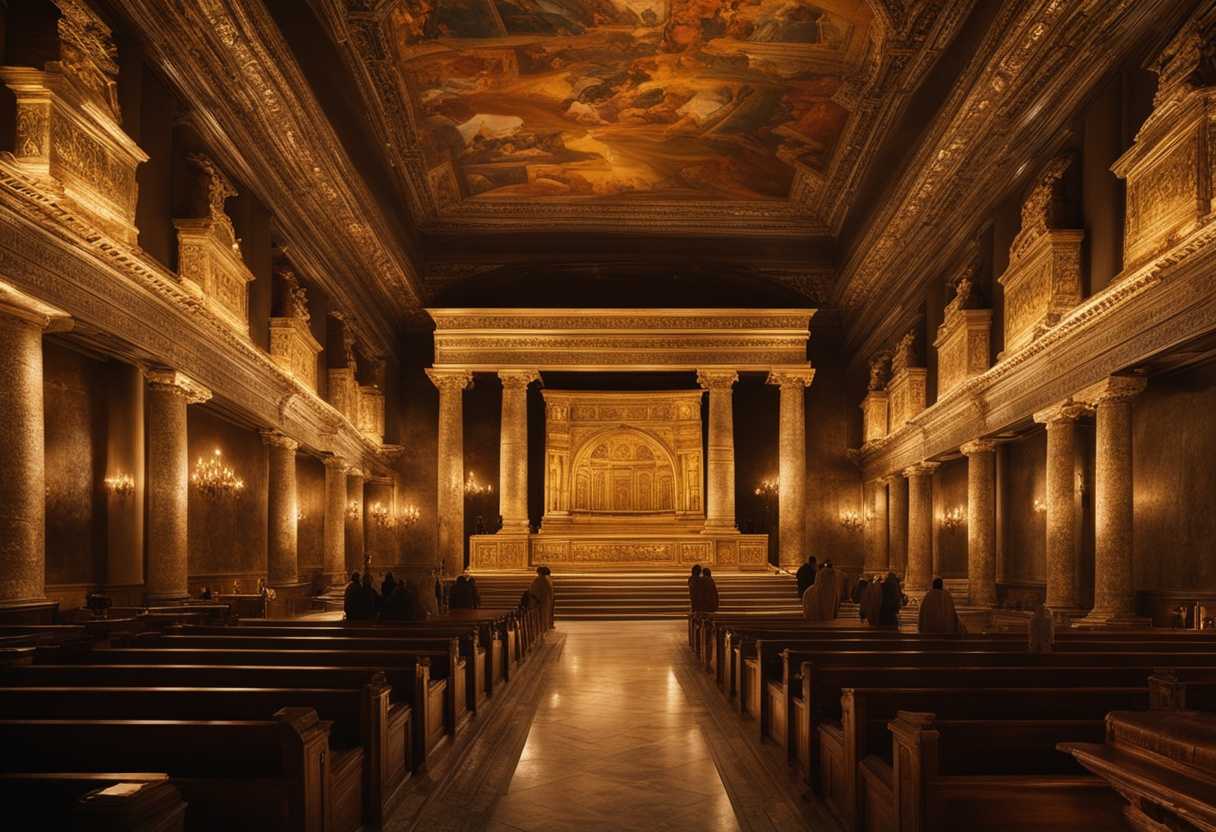
In the Bible, “Silo” generally refers to a location associated with the city of Shiloh, which was an important religious center for the Israelites before the construction of the Temple in Jerusalem. It is mentioned as the place where the Ark of the Covenant was kept and where the Israelites gathered for worship and sacrifice (1 Samuel 1:3).
Scripture
8 “Judah, your brothers shall praise you;
your hand shall be on the neck of your enemies;
your father’s sons shall bow down before you.
9 Judah is a lion’s cub; from the prey, my son, you have gone up. He stooped down; he crouched as a lion and as a lioness; who dares rouse him?
10 The scepter shall not depart from Judah, nor the ruler’s staff from between his feet, until tribute comes to him; and to him shall be the obedience of the peoples.
11 Binding his foal to the vine
and his donkey’s colt to the choice vine,
he has washed his garments in wine
and his vesture in the blood of grapes.
12 His eyes are darker than wine,
and his teeth whiter than milk.
Biblical Significance of Silo
The term “Silo,” often seen in connection with “Shiloh,” signifies more than just a geographical location; it embodies a pivotal spiritual and communal hub for the Israelites in their early history. As noted in 1 Samuel 1:3, Shiloh served as a sacred space where the Ark of the Covenant, the symbol of God’s presence among His people, was housed. This underscores not only the importance of the Ark but illustrates Shiloh’s role as a focal point for worship, sacrifices, and spiritual gatherings. The significance of Shiloh was emphasized during the period of the judges, as it was a place where religious leaders, such as Eli and Samuel, played crucial roles in guiding the people of Israel.
Moreover, the broader implications of Shiloh extend to themes of God’s presence, covenant, and eventual judgment. Jeremiah 7:12-14 highlights how Shiloh became a symbol of impending judgment against disobedience. The reference to Shiloh reflects the consequences of forsaking one’s covenant with God, as the once-sacred space fell into irrelevance and warning often served as a reminder of the critical importance of fidelity in the relationship between God and His people. Thus, “Silo” or “Shiloh” serves not only as a historical reference but also as a theological reminder of the profound connection between place, worship, and the covenantal relationship that defines Israel’s identity throughout biblical history.
In addition to its religious and historical significance, Shiloh represents a powerful symbol of hope and restoration in the context of the Israelite narrative. As a site where the Tabernacle was located, it became a beacon of divine guidance and instruction during tumultuous times. The prophetic messages associated with Shiloh underscore its role in connecting the Israelites to their covenantal obligations, drawing them back to the values of repentance and renewal. The expectations of the Deuteronomic covenant resonate throughout the texts, illustrating that Shiloh represents not only a promise of God’s dwelling among His people but also the expectation of their faithfulness in return.
Furthermore, Shiloh’s significance transcends the historical narrative; it resonates within the messianic expectations found in later scriptures. The mention of Shiloh is often interpreted as alluding to the future hope of a ruler from the tribe of Judah, a connection that has been pivotal in understanding messianic prophecy. Genesis 49:10 speaks to the arrival of a ruler who will bring peace and fulfill the promises made to Israel, echoing back to the ideals embodied in Shiloh. Thus, Shiloh encapsulates a dual function: as a current site of worship and communal identity, and as a prophetic symbol forecasting a future reconciliation and restoration under a promised leader, illustrating the depths of Israel’s spiritual and communal journey.
Historical Significance of Shiloh
Shiloh, often referred to as Silo, holds a prominent place in biblical history as a religious center for the Israelites. It was the site where the Tabernacle was located after the Israelites entered the Promised Land. This makes Shiloh a symbol of God’s presence among His people and a focal point for worship and sacrifice. The establishment of Shiloh as a religious hub signifies the importance of community and collective worship in the life of the Israelites, reflecting their covenant relationship with God.
Symbol of Divine Judgment
In the biblical narrative, Shiloh also serves as a symbol of divine judgment and the consequences of disobedience. The eventual destruction of Shiloh, as a result of the Israelites’ unfaithfulness, illustrates the seriousness of turning away from God. This transformation from a place of worship to a site of desolation serves as a warning to future generations about the importance of fidelity to God’s commandments and the repercussions of neglecting one’s spiritual responsibilities.
Representation of Hope and Restoration
Despite its association with judgment, Shiloh also embodies themes of hope and restoration. The prophetic messages concerning Shiloh suggest that even in times of despair, there is the possibility of renewal and redemption. This duality reflects the broader biblical narrative of God’s unwavering love and the promise of restoration for His people, emphasizing that even after failure, there is always a path back to grace and reconciliation with God.
How to Embrace Abundance Through Faith and Gratitude
Embracing abundance through faith and gratitude is a transformative journey that can deeply enrich your Christian walk. Start by recognizing that abundance is not merely about material wealth but encompasses the richness of love, joy, and peace that God offers us daily. Cultivating a heart of gratitude is essential; take time each day to reflect on the blessings in your life, no matter how small they may seem. This practice shifts your focus from what you lack to the abundance that already surrounds you. As you deepen your faith, trust that God has a plan for you, and believe that He provides for your needs in ways you may not yet understand. Remember, in Philippians 4:19, we are reminded that “God will meet all your needs according to the riches of his glory in Christ Jesus.” By intertwining faith with gratitude, you open yourself to experiencing the fullness of life that God desires for you, allowing His abundance to flow through you and touch the lives of others.
Bible References to the Meaning of Silo:
Joshua 18:1-10: 1 Then the whole congregation of the people of Israel assembled at Shiloh and set up the tent of meeting there. The land lay subdued before them.
2 There remained among the people of Israel seven tribes whose inheritance had not yet been apportioned.
3 So Joshua said to the people of Israel, “How long will you put off going in to take possession of the land, which the Lord, the God of your fathers, has given you?
4 Appoint three men from each tribe, and I will send them out that they may set out and go up and down the land. They shall write a description of it with a view to their inheritances, and then come to me.
5 And they shall divide it into seven portions. Judah shall continue in his territory on the south, and the house of Joseph shall continue in their territory on the north.
6 You shall describe the land in seven divisions and bring the description here to me. And I will cast lots for you here before the Lord our God.
7 The Levites have no portion among you, for the priesthood of the Lord is their heritage. And Gad and Reuben and half the tribe of Manasseh have received their inheritance beyond the Jordan eastward, which Moses the servant of the Lord gave them.”
8 So the men arose and went, and Joshua charged those who went to write the description of the land, saying, “Go up and down in the land and write a description and return to me. And I will cast lots for you here before the Lord in Shiloh.”
9 The men went and passed up and down in the land and set in writing a description of it in seven divisions. Then they came to Joshua to the camp at Shiloh.
10 Joshua cast lots for them in Shiloh before the Lord. So there Joshua apportioned the land to the people of Israel, to each his portion.
Judges 21:19-21: 19 So they said, “Behold, there is the yearly feast of the Lord at Shiloh, which is north of Bethel, on the east of the highway that goes up from Bethel to Shechem, and south of Lebonah.”
20 So they commanded the people of Benjamin, saying, “Go and lie in ambush in the vineyards,
21 And watch. If the daughters of Shiloh come out to dance in the dances, then come out of the vineyards and snatch each man his wife from the daughters of Shiloh, and go to the land of Benjamin.
1 Samuel 1:3-20: 3 Now this man used to go up year by year from his city to worship and to sacrifice to the Lord of hosts at Shiloh, where the two sons of Eli, Hophni and Phinehas, were priests of the Lord.
4 On the day when Elkanah sacrificed, he would give portions to Peninnah his wife and to all her sons and daughters.
5 But to Hannah he gave a double portion, because he loved her, though the Lord had closed her womb.
6 And her rival used to provoke her grievously to irritate her, because the Lord had closed her womb.
7 So it went on year by year. As often as she went up to the house of the Lord, she used to provoke her. Therefore Hannah wept and would not eat.
8 And Elkanah, her husband, said to her, “Hannah, why do you weep? And why do you not eat? And why is your heart sad? Am I not more to you than ten sons?”
9 After they had eaten and drunk in Shiloh, Hannah rose. Now Eli the priest was sitting on the seat beside the doorpost of the temple of the Lord.
10 She was deeply distressed and prayed to the Lord and wept bitterly.
11 And she vowed a vow and said, “O Lord of hosts, if you will indeed look on the affliction of your servant and remember me and not forget your servant, but will give to your servant a son, then I will give him to the Lord all the days of his life, and no razor shall touch his head.”
12 As she continued praying before the Lord, Eli observed her mouth.
13 Hannah was speaking in her heart; only her lips moved, and her voice was not heard. Therefore Eli took her to be a drunken woman.
14 And Eli said to her, “How long will you go on being drunk? Put your wine away from you.”
15 But Hannah answered, “No, my lord, I am a woman troubled in spirit. I have drunk neither wine nor strong drink, but I have been pouring out my soul before the Lord.
16 Do not regard your servant as a worthless woman, for all along I have been speaking out of my great anxiety and vexation.”
17 Then Eli answered, “Go in peace, and the God of Israel grant your petition that you have made to him.”
18 And she said, “Let your servant find favor in your eyes.” Then the woman went her way and ate, and her face was no longer sad.
19 They rose early in the morning and worshiped before the Lord; then they went back to their house at Ramah. And Elkanah knew Hannah his wife, and the Lord remembered her.
20 And in due time Hannah conceived and bore a son, and she called his name Samuel, for she said, “I have asked for him from the Lord.”
1 Samuel 3:1-21: 3 Now the boy Samuel was ministering to the Lord in the presence of Eli. And the word of the Lord was rare in those days; there was no frequent vision.
2 At that time Eli, whose eyesight had begun to grow dim so that he could not see, was lying down in his own place.
3 The lamp of God had not yet gone out, and Samuel was lying down in the temple of the Lord, where the ark of God was.
4 Then the Lord called Samuel, and he said, “Here I am!”
5 and he ran to Eli and said, “Here I am, for you called me.” But he said, “I did not call; lie down again.” So he went and lay down.
6 And the Lord called again, “Samuel!” and Samuel arose and went to Eli and said, “Here I am, for you called me.” But he said, “I did not call, my son; lie down again.”
7 Now Samuel did not yet know the Lord, and the word of the Lord had not yet been revealed to him.
8 And the Lord called Samuel again the third time. And he arose and went to Eli and said, “Here I am, for you called me.” Then Eli perceived that the Lord was calling the boy.
9 Therefore Eli said to Samuel, “Go, lie down, and if he calls you, you shall say, ‘Speak, Lord, for your servant hears.’” So Samuel went and lay down in his place.
10 And the Lord came and stood, calling as at other times, “Samuel! Samuel!” And Samuel said, “Speak, for your servant hears.”
11 Then the Lord said to Samuel, “Behold, I am about to do a thing in Israel at which the two ears of everyone who hears it will tingle.
12 On that day I will fulfill against Eli all that I have spoken concerning his house, from beginning to end.
13 And I declare to him that I am about to punish his house forever, for the iniquity that he knew, because his sons were blaspheming God, and he did not restrain them.
14 Therefore I swear to the house of Eli that the iniquity of Eli’s house shall not be atoned for by sacrifice or offering forever.”
15 And Samuel lay until the morning; then he opened the doors of the house of the Lord. Samuel was afraid to tell the vision to Eli.
16 Then Eli called Samuel and said, “Samuel, my son.” And he said, “Here I am.”
17 And he said, “What is the word that the Lord spoke to you? Please do not hide it from me. May God do so to you and more also if you hide anything from me of all that he told you.”
18 So Samuel told him everything and hid nothing from him. And he said, “It is the Lord. Let him do what seems good to him.”
19 And Samuel grew, and the Lord was with him and let none of his words fall to the ground.
20 And all Israel from Dan to Beersheba knew that Samuel was established as a prophet of the Lord.
21 And the Lord appeared again at Shiloh, for the Lord revealed himself to Samuel at Shiloh by the word of the Lord.
1 Kings 2:27-28: 27 So Solomon expelled Abiathar from being priest to the Lord, thus fulfilling the word of the Lord that he had spoken concerning the house of Eli in Shiloh.
28 When the news came to Joab—for Joab had supported Adonijah although he had not supported Absalom—Joab fled to the tent of the Lord and caught hold of the horns of the altar.
Jeremiah 7:12-15: 12 Go now to my place that was in Shiloh, where I made my name dwell at first, and see what I did to it because of the evil of my people Israel.
13 And now, because you have done all these things, declares the Lord, and when I spoke to you persistently you did not listen, and when I called you, you did not answer,
14 Therefore, I will do to the house that is called by my name, and in which you trust, and to the place that I gave to you and to your fathers, as I did to Shiloh.
15 And I will cast you out of my sight, as I cast out all your kinsmen, all the offspring of Ephraim.
Jeremiah 26:6-9: 6 then I will make this house like Shiloh, and I will make this city a curse for all the nations of the earth.”
7 The priests and the prophets and all the people heard Jeremiah speaking these words in the house of the Lord.
8 And when Jeremiah had finished speaking all that the Lord had commanded him to speak to all the people, then the priests and the prophets and all the people laid hold of him, saying, “You shall die.
9 Why have you prophesied in the name of the Lord, saying, ‘This house shall be like Shiloh, and this city shall be desolate, without inhabitant’?” And all the people gathered around Jeremiah in the house of the Lord.
Psalm 78:56-64: 56 Yet they tested and rebelled against the Most High God and did not keep his testimonies.
57 But they were unfaithful and acted treacherously like their fathers; they twisted like a deceitful bow.
58 For they provoked him to anger with their high places; they moved him to jealousy with their idols.
59 When God heard, he was full of wrath, and he utterly rejected Israel.
60 He forsook his dwelling at Shiloh, the tent where he dwelt among mankind,
61 And delivered his power to captivity, his glory to the hand of the foe.
62 He gave his people over to the sword and vented his wrath on his heritage.
63 Fire devoured their young men, and their young women had no marriage song.
64 Their priests fell by the sword, and their widows made no lamentation.
1 Kings 14:1-18: 1 At that time Abijah the son of Jeroboam fell sick.
2 And Jeroboam said to his wife, “Arise, and disguise yourself, that it not be known that you are the wife of Jeroboam, and go to Shiloh. Behold, Ahijah the prophet is there, who said of me that I should be king over this people.
3 And take with you ten loaves, some cakes, and a jar of honey, and go to him. He will tell you what shall happen to the child.”
4 And Jeroboam’s wife did so. She arose and went to Shiloh and came to the house of Ahijah. Now Ahijah could not see, for his eyes were dim because of his age.
5 Now the Lord had said to Ahijah, “Behold, the wife of Jeroboam is coming to inquire of you concerning her son, for he is sick. Thus and thus shall you say to her.”
6 And when Ahijah heard the sound of her feet as she came in at the door, he said, “Come in, wife of Jeroboam. Why do you pretend to be another? For I am charged with unbearable news for you.
7 Go, tell Jeroboam, ‘Thus says the Lord, the God of Israel: “Because I exalted you from among the people and made you leader over my people Israel,
8 and tore the kingdom away from the house of David and gave it to you, and yet you have not been like my servant David, who kept my commandments and followed me with all his heart, doing only that which was right in my eyes,
9 but you have done evil above all who were before you and have gone and made for yourself other gods and metal images, provoking me to anger, and have cast me behind your back,
10 therefore behold, I will bring harm upon the house of Jeroboam and will cut off from Jeroboam every male, both bond and free in Israel, and will burn up the house of Jeroboam, as a man burns up dung until it is all gone.
11 Anyone belonging to Jeroboam who dies in the city the dogs shall eat, and anyone who dies in the open country the birds of the heavens shall eat, for the Lord has spoken it.
12 Arise therefore, go to your house. When your feet enter the city, the child shall die.
13 And all Israel shall mourn for him and bury him, for he only of Jeroboam shall come to the grave, because in him there is found something pleasing to the Lord, the God of Israel, in the house of Jeroboam.
14 Moreover, the Lord will raise up for himself a king over Israel who shall cut off the house of Jeroboam today.
15 And the Lord will strike Israel as a reed is shaken in the water, and root up Israel out of this good land that he gave to their fathers and scatter them beyond the Euphrates, because they have made their Asherim, provoking the Lord to anger.
16 And he will give Israel up because of the sins of Jeroboam, which he sinned and made Israel to sin.
17 Then Jeroboam’s wife arose and departed and came to Tirzah. When she came to the threshold of the house, the child died.
18 And they buried him, and all Israel mourned for him, according to the word of the Lord, which he spoke by his servant Ahijah the prophet.

Rev. François Dupont is a dedicated church minister with a wealth of experience in serving spiritual communities. With a calm and serene demeanor, he has been devoted to sharing the message of love, compassion, and tolerance for over two decades. Through his thoughtful sermons, compassionate counseling, and unwavering support, Rev. Dupont has touched the lives of countless individuals, allowing them to find solace and strength during difficult times. His serene presence and deep understanding of the human condition make him a trusted guide for those seeking spiritual nourishment and guidance.