
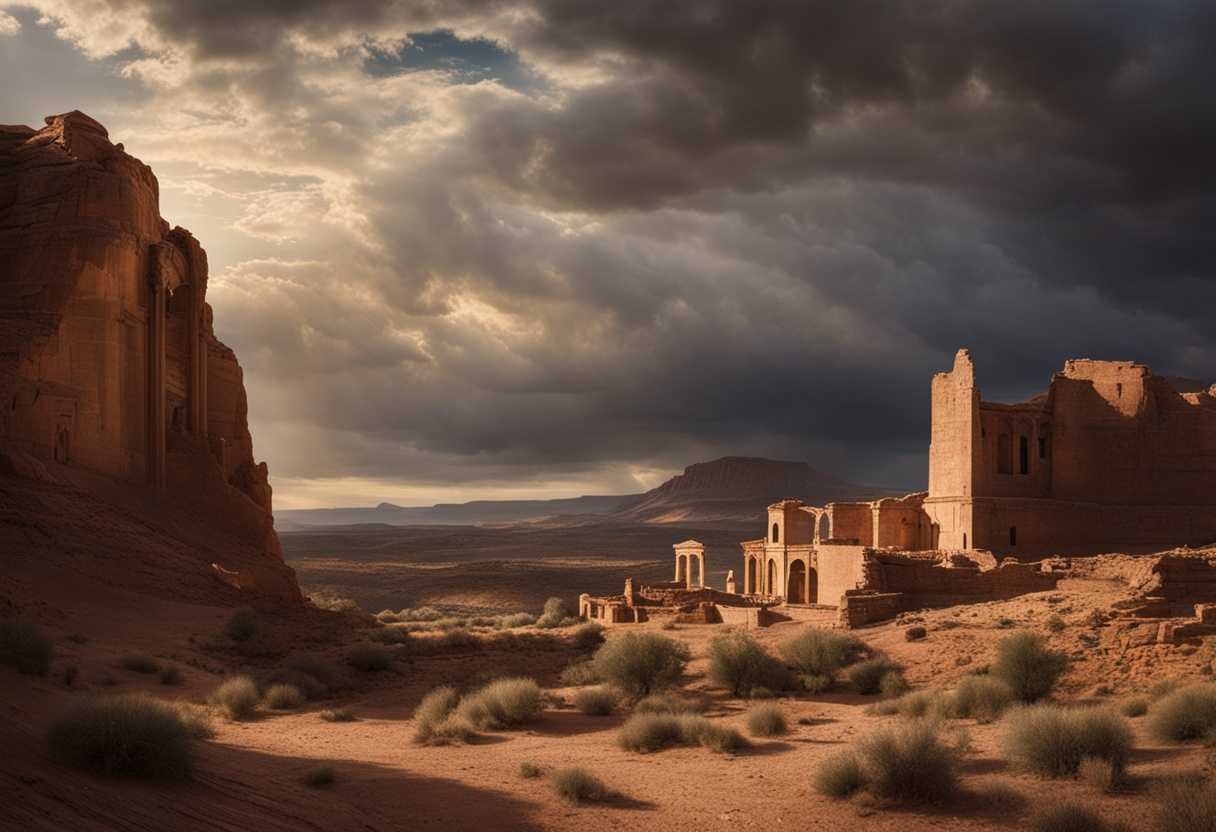
In the Bible, the Land of Moab refers to a region situated east of the Dead Sea, known for its rugged terrain and as the ancestral home of the Moabites, a people descended from Lot. It is significant in biblical narratives, particularly in the story of Ruth and the Israelites’ interaction with the Moabites, symbolizing both a place of refuge and tension in the history of Israel.
Scripture
30 Now Lot went up out of Zoar and lived in the hills with his two daughters, for he was afraid to live in Zoar. So he lived in a cave with his two daughters.
31 And the firstborn said to the younger, “Our father is old, and there is not a man on earth to come in to us after the manner of all the earth.
32 Come, let us make our father drink wine, and we will lie with him, that we may preserve offspring from our father.”
33 So they made their father drink wine that night. And the firstborn went in and lay with her father. He did not know when she lay down or when she arose.
34 The next day, the firstborn said to the younger, “Behold, I lay last night with my father. Let us make him drink wine tonight also. Then you go in and lie with him, that we may preserve offspring from our father.”
35 So they made their father drink wine that night. And the firstborn went in and lay with her father. He did not know when she lay down or when she arose.
36 Thus both the daughters of Lot became pregnant by their father.
37 The firstborn bore a son and called his name Moab. He is the father of the Moabites to this day.
38 The younger also bore a son and called his name Ben-ammi. He is the father of the Ammonites to this day.
Meaning of Moab in the Bible
The Land of Moab holds a complex and multifaceted significance in the Bible, primarily as a region that both nurtures and presents challenges to the Israelites. As descendants of Lot, the Moabites were seen as kin to the Israelites, creating a relationship fraught with both familiarity and tension (Genesis 19:37). Moab is often depicted as a place where the boundaries of Israelite identity were tested, particularly in their encounters marked by conflict, such as in the accounts found in Numbers 22-24, where Balak, the king of Moab, hired Balaam to curse the Israelites. This illustrates the struggle between neighboring nations and the challenge of maintaining covenant faithfulness amidst external pressures.
Conversely, Moab is also depicted as a land associated with redemption and inclusion within the biblical narrative. The story of Ruth, a Moabite woman who becomes a key figure in the lineage of King David, offers a poignant example of how borders can be transcended through loyalty and love (Ruth 1:16). Her declaration of commitment to Naomi and her embrace of Yahweh as her God highlights Moab’s role as a place of divine providence, where God’s plans extend beyond ethnic boundaries. Thus, the Land of Moab symbolizes a duality of refuge and adversity while inviting reflection on the broader themes of belonging, redemption, and the dynamic relationship between Israel and its neighbors.
Beyond the narratives of conflict and redemption, the Land of Moab also serves as a geographical and theological backdrop for key moments in the Israelite journey. In Deuteronomy, the plains of Moab are significant as the site where Moses delivers his final speeches to the Israelites before they enter the Promised Land. Here, he reiterates the importance of obedience to God’s laws and the covenant, underscoring Moab’s role as a transitional space between the wilderness experiences and the fulfillment of God’s promises. This setting encapsulates both a sense of urgency and solemnity, inviting the Israelites to reflect on their past struggles as they prepare to embrace their future.
Moreover, the relationship between Israel and Moab highlights larger themes of divine justice and mercy woven throughout Scripture. In Jeremiah 48, the prophecies concerning Moab reveal a dire fate for the nation due to its pride and idolatrous practices. Yet, this prophetic discourse also serves as a reminder of God’s broader concern for all nations, displaying how the dynamics of power, sin, and redemption are not confined to Israel alone. The interactions with Moab invite readers to ponder the complexities of divine judgment and mercy while reinforcing the notion that God’s covenantal love extends to all peoples. Such portrayals encourage a contemplation of the divine plan that includes both warning and hope, as the narrative of Moab weaves intricate connections within the story of salvation history.
Symbol of Separation and Otherness
The Land of Moab often represents a place of separation from the Israelite community. It is depicted as a foreign land, inhabited by people who worship different gods and have distinct cultural practices. This separation serves as a reminder of the boundaries between the Israelites and other nations, emphasizing the importance of maintaining their identity and faith in the face of external influences.
A Place of Redemption and Transformation
Despite its associations with otherness, Moab also serves as a backdrop for stories of redemption and transformation. The narrative of Ruth, a Moabite woman who becomes an ancestor of King David, illustrates how individuals from outside the Israelite community can play significant roles in God’s plan. This highlights the theme of inclusivity and the potential for transformation, suggesting that God’s grace can extend beyond traditional boundaries.
A Landscape of Trials and Tribulations
Moab is often depicted as a land of challenges and trials for the Israelites. It is a place where they faced opposition and conflict, reflecting the broader struggles of faith and perseverance. The experiences in Moab serve as a metaphor for the trials believers encounter in their spiritual journeys, emphasizing the need for reliance on God amidst adversity and the importance of faithfulness in difficult circumstances.
How to Embrace Peace Amidst Exile and Conflict
Embracing peace amidst exile and conflict can feel like an insurmountable challenge, yet it is a deeply spiritual journey that can transform our hearts and minds. In times of turmoil, I find solace in the words of Philippians 4:6-7, which remind us to present our worries to God through prayer, allowing His peace to guard our hearts. It’s essential to cultivate a practice of gratitude, even in the smallest of things, as this shifts our focus from what we lack to the abundance of God’s grace surrounding us. Engaging in community, whether through church or fellowship groups, can also provide a sense of belonging and support, reminding us that we are not alone in our struggles. Finally, let us remember the example of Jesus, who, even in the face of conflict, chose love and forgiveness. By embodying these principles, we can find a profound sense of peace that transcends our circumstances, allowing us to be beacons of hope for others navigating their own storms.
Bible References to the Land of Moab:
Numbers 21:10-20: 10 And the people of Israel set out and camped in Oboth.
11 And they set out from Oboth and camped at Iye-abarim, in the wilderness that is opposite Moab, toward the sunrise.
12 From there they set out and camped in the valley of Zered.
13 From there they set out and camped on the other side of the Arnon, which is in the wilderness that extends from the border of the Amorites, for the Arnon is the border of Moab, between Moab and the Amorites.
14 Therefore it is said in the Book of the Wars of the Lord, “Waheb in Suphah, and the valleys of the Arnon,
15 And the slope of the valleys that extends to the seat of Ar, and leans to the border of Moab.”
16 And from there they continued to Beer; that is the well of which the Lord said to Moses, “Gather the people together, so that I may give them water.”
17 Then Israel sang this song: “Spring up, O well!—Sing to it,
18 the well that the princes made, that the nobles of the people dug, with the scepter and with their staffs.” And from the wilderness they went on to Mattanah,
19 And from Mattanah to Nahaliel, and from Nahaliel to Bamoth,
20 and from Bamoth to the valley that is in the region of Moab, to the top of Pisgah that looks down on the desert.
Numbers 22:1-41: 1 Then the people of Israel set out and camped in the plains of Moab beyond the Jordan opposite Jericho.
2 And Balak the son of Zippor saw all that Israel had done to the Amorites.
3 So Moab was in great dread of the people, because they were many. Moab was overcome with fear of the people of Israel.
4 And Moab said to the elders of Midian, “Now this horde will lick up all that is around us, as the ox licks up the grass of the field.” So Balak the son of Zippor, who was king of Moab at that time,
5 And he sent messengers to Balaam the son of Beor at Pethor, which is near the River in the land of the people of Amaw, to call him, saying, “Behold, a people has come out of Egypt. They cover the face of the earth, and they are dwelling opposite me.
6 Come now, curse this people for me, since they are too mighty for me. Perhaps I shall be able to defeat them and drive them from the land, for I know that he whom you bless is blessed, and he whom you curse is cursed.”
7 So the elders of Moab and the elders of Midian departed with the fees for divination in their hand. And they came to Balaam and gave him Balak’s message.
8 And he said to them, “Lodge here tonight, and I will bring back word to you, as the Lord speaks to me.” So the princes of Moab stayed with Balaam.
9 And God came to Balaam and said, “Who are these men with you?”
10 And Balaam said to God, “Balak the son of Zippor, king of Moab, has sent to me, saying,
11 Behold, a people has come out of Egypt, and it covers the face of the earth. Now come, curse them for me. Perhaps I shall be able to fight against them and drive them out.
12 God said to Balaam, “You shall not go with them. You shall not curse the people, for they are blessed.”
13 And Balaam rose in the morning and said to the princes of Balak, “Go to your own land, for the Lord has refused to let me go with you.”
14 And the princes of Moab rose and went to Balak and said, “Balaam refuses to come with us.”
15 And Balaam said to God, “Balak the son of Zippor, king of Moab, has sent to me, saying,
16 And they came to Balaam and said to him, “Thus says Balak the son of Zippor: ‘Let nothing hinder you from coming to me,
17 for I will surely do you great honor, and whatever you say to me I will do. Come, curse this people for me.’”
18 But Balaam answered and said to the servants of Balak, “Though Balak were to give me his house full of silver and gold, I could not go beyond the command of the Lord my God to do less or more.
19 Now please stay here tonight also, that I may know what more the Lord will say to me.”
20 And God came to Balaam at night and said to him, “If the men have come to call you, rise, go with them; but only do what I tell you.”
21 So Balaam rose in the morning and saddled his donkey and went with the princes of Moab.
22 But God’s anger was kindled because he went, and the angel of the Lord took his stand in the way as his adversary.
23 And the donkey saw the angel of the Lord standing in the road, with a drawn sword in his hand. And the donkey turned aside out of the road and went into the field. So Balaam struck the donkey, to turn her into the road.
24 Then the angel of the Lord stood in a narrow path between the vineyards, with a wall on either side.
25 And when the donkey saw the angel of the Lord, she pushed against the wall and pressed Balaam’s foot against the wall. So he struck her again.
26 Then the angel of the Lord went ahead and stood in a narrow place, where there was no way to turn either to the right or to the left.
27 And when the donkey saw the angel of the Lord, she lay down under Balaam. And Balaam’s anger was kindled, and he struck the donkey with his staff.
28 Then the Lord opened the mouth of the donkey, and she said to Balaam, “What have I done to you, that you have struck me these three times?”
29 Balaam said to the donkey, “Because you have made a fool of me. I wish I had a sword in my hand, for then I would kill you.”
30 And the donkey said to Balaam, “Am I not your donkey, on which you have ridden all your life long to this day? Is it my habit to treat you this way?” And he said, “No.”
31 Then the Lord opened the eyes of Balaam, and he saw the angel of the Lord standing in the way, with his drawn sword in his hand. And he bowed down and fell on his face.
32 And the angel of the Lord said to him, “Why have you struck your donkey these three times? Behold, I have come out to oppose you because your way is perverse before me.
33 The donkey saw me and turned aside before me these three times. If she had not turned aside from me, surely just now I would have killed you and let her live.”
34 Balaam said to the angel of the Lord, “I have sinned, for I did not know that you stood in the road against me. Now therefore, if it is evil in your sight, I will turn back.”
35 And the angel of the Lord said to Balaam, “Go with the men, but speak only the word that I tell you.” So Balaam went on with the princes of Balak.
36 When Balak heard that Balaam had come, he went out to meet him at the city of Moab, on the border formed by the Arnon, at the extremity of the border.
37 And Balak said to Balaam, “Did I not send to you to call you? Why did you not come to me? Am I not able to honor you?”
38 And Balaam said to Balak, “Behold, I have come to you! Have I now any power of my own to speak anything? The word that God puts in my mouth, that must I speak.”
39 Then Balaam went with Balak, and they came to Kiriath-huzoth.
40 And Balak sacrificed oxen and sheep, and sent for Balaam and for the princes who were with him.
41 And in the morning Balak took Balaam and brought him up to Bamoth-Baal, and from there he saw a fraction of the people.
Deuteronomy 2:8-12: 8 So we went on, away from our brothers, the people of Esau, who live in Seir, away from the Arabah road from Elath and Ezion-geber. And we turned and went in the direction of the wilderness of Moab.
9 And the Lord said to me, ‘Do not harass Moab or contend with them in battle, for I will not give you any of their land for a possession, because I have given Ar to the people of Lot for a possession.’
10(The Emim formerly lived there, a people great and many, and tall as the Anakim.)
11 Like the Anakim they are also counted as Rephaim, but the Moabites call them Emim.
12 The Horites also lived in Seir formerly, but the people of Esau dispossessed them and destroyed them from before them and settled in their place, as Israel did to the land of their possession, which the Lord gave to them.
Deuteronomy 34:1-8: 4 And the Lord said to him, “This is the land of which I swore to Abraham, to Isaac, and to Jacob, ‘I will give it to your offspring.’ I have let you see it with your eyes, but you shall not go over there.”
2 And all Naphtali, and the land of Ephraim and Manasseh, and all the land of Judah, as far as the western sea,
3 the Negeb, and the Plain, that is, the Valley of Jericho, the city of palm trees, as far as Zoar.
4 And the Lord said to him, “This is the land of which I swore to Abraham, to Isaac, and to Jacob, ‘I will give it to your offspring.’ I have let you see it with your eyes, but you shall not go over there.”
5 So Moses the servant of the Lord died there in the land of Moab, according to the word of the Lord.
6 And he buried him in the valley in the land of Moab, opposite Beth-peor; but no one knows the place of his burial to this day.
7 Moses was 120 years old when he died. His eye was undimmed, and his vigor unabated.
8 And the people of Israel wept for Moses in the plains of Moab thirty days. So the days of weeping and mourning for Moses were ended.
Judges 3:12-30: 12 And the people of Israel again did what was evil in the sight of the Lord, and the Lord strengthened Eglon the king of Moab against Israel, because they had done what was evil in the sight of the Lord.
13 And he gathered to himself the Ammonites and the Amalekites, and went and defeated Israel. And they took possession of the city of palms.
14 And the people of Israel served Eglon the king of Moab eighteen years.
15 Then the people of Israel cried out to the Lord, and the Lord raised up for them a deliverer, Ehud, the son of Gera, the Benjaminite, a left-handed man. The people of Israel sent tribute by him to Eglon the king of Moab.
16 Ehud made for himself a sword with two edges, a cubit in length, and he bound it on his right thigh under his clothes.
17 And he presented the tribute to Eglon king of Moab. Now Eglon was a very fat man.
18 And when the children of Israel cried out to the Lord, the Lord raised up a deliverer for the children of Israel, who saved them, Othniel the son of Kenaz, Caleb’s younger brother.
19 But he himself turned back at the idols near Gilgal and said, “I have a secret message for you, O king.” And he commanded, “Silence.” And all his attendants went out from his presence.
20 And Ehud came to him as he was sitting alone in his cool roof chamber. And Ehud said, “I have a message from God for you.” And he arose from his seat.
21 But Ehud reached with his left hand, took the sword from his right thigh, and thrust it into his belly.
22 And the handle also went in after the blade, and the fat closed over the blade, for he did not pull the sword out of his belly; and the dung came out.
23 Then Ehud went out into the porch and closed the doors of the roof chamber behind him and locked them.
24 When he had gone, the servants came, and when they saw that the doors of the roof chamber were locked, they thought, “Surely he is relieving himself in the closet of the cool chamber.”
25 And they waited till they were embarrassed. But when he still did not open the doors of the roof chamber, they took the key and opened them, and there lay their lord dead on the floor.
26 Ehud escaped while they delayed, and he passed beyond the idols and escaped to Seirah.
27 When he arrived, he sounded the trumpet in the hill country of Ephraim. Then the people of Israel went down with him from the hill country, and he was their leader.
28 And he said to them, “Follow me, for the Lord has given your enemies the Moabites into your hand.” So they went down after him and seized the fords of the Jordan against the Moabites and did not allow anyone to pass over.
29 And they killed at that time about ten thousand of the Moabites, all strong, able-bodied men; not a man escaped.
30 So Moab was subdued that day under the hand of Israel. And the land had rest for eighty years.
Ruth 1:1-22: 1 In the days when the judges ruled there was a famine in the land, and a man of Bethlehem in Judah went to sojourn in the country of Moab, he and his wife and his two sons.
2 The name of the man was Elimelech and the name of his wife Naomi, and the names of his two sons were Mahlon and Chilion. They were Ephrathites from Bethlehem in Judah. They went into the country of Moab and remained there.
3 But Elimelech, the husband of Naomi, died, and she was left with her two sons.
4 They took Moabite wives, the name of the one was Orpah and the name of the other Ruth. They lived there about ten years.
5 Then both Mahlon and Chilion also died, and the woman was left without her two sons and her husband.
6 Then she arose with her daughters-in-law to return from the country of Moab, for she had heard in the fields of Moab that the Lord had visited his people and given them food.
7 So she set out from the place where she was with her two daughters-in-law, and they went on the way to return to the land of Judah.
8 But Naomi said to her two daughters-in-law, “Go, return each of you to her mother’s house. May the Lord deal kindly with you, as you have dealt with the dead and with me.
9 The Lord grant that you may find rest, each of you in the house of her husband!”
10 And they said to her, “No, we will return with you to your people.”
11 But Naomi said, “Turn back, my daughters; why will you go with me? Have I yet sons in my womb that they may become your husbands?
12 Turn back, my daughters; go your way, for I am too old to have a husband. If I should say I have hope, even if I should have a husband this night and should bear sons,
13 would you therefore wait till they were grown? Would you therefore refrain from marrying? No, my daughters, for it is exceedingly bitter to me for your sake that the hand of the Lord has gone out against me.”
14 Then they lifted up their voices and wept again. And Orpah kissed her mother-in-law, but Ruth clung to her.
15 And she said, “See, your sister-in-law has gone back to her people and to her gods; return after your sister-in-law.”
16 But Ruth said, “Do not urge me to leave you or to return from following you. For where you go I will go, and where you lodge I will lodge. Your people shall be my people, and your God my God.
17 Where you die I will die, and there will I be buried. May the Lord do so to me and more also if anything but death parts me from you.”
18 And when Naomi saw that she was determined to go with her, she said no more.
19 So the two of them went on until they came to Bethlehem. And when they came to Bethlehem, the whole town was stirred because of them. And the women said, “Is this Naomi?”
20 She said to them, “Do not call me Naomi; call me Mara, for the Almighty has dealt very bitterly with me.
21 I went away full, and the Lord has brought me back empty. Why call me Naomi, when the Lord has testified against me and the Almighty has brought calamity upon me?
22 So Naomi returned, and Ruth the Moabite her daughter-in-law with her, who returned from the country of Moab. And they came to Bethlehem at the beginning of barley harvest.
1 Samuel 12:9-11: 9 But they forgot the Lord their God. And he sold them into the hand of Sisera, commander of the army of Hazor, and into the hand of the Philistines, and into the hand of the king of Moab. And they fought against them.
10 And they cried out to the Lord and said, ‘We have sinned, because we have forsaken the Lord and have served the Baals and the Ashtaroth. But now deliver us out of the hand of our enemies, that we may serve you.’
11 And the Lord sent Jerubbaal and Barak and Jephthah and Samuel and delivered you out of the hand of your enemies on every side, and you lived in safety.
2 Kings 3:4-27: 4 Now Mesha king of Moab was a sheep breeder, and he had to deliver to the king of Israel 100,000 lambs and the wool of 100,000 rams.
5 But when Ahab died, the king of Moab rebelled against the king of Israel.
6 And King Jehoram marched out of Samaria at that time and mustered all Israel.
7 And he went and sent word to Jehoshaphat king of Judah: “The king of Moab has rebelled against me. Will you go with me to battle against Moab?” And he said, “I will go. I am as you are, my people as your people, my horses as your horses.”
8 And he said, “By which way shall we march?” Jesus answered, “By the way of the wilderness of Edom.”
9 So the king of Israel went with the king of Judah and the king of Edom. And when they had made a circuitous march of seven days, there was no water for the army or for the animals that followed them.
10 And the king of Israel said, “Alas! The Lord has called these three kings to give them into the hand of Moab.”
11 But Jehoshaphat said, “Is there no prophet of the Lord here, through whom we may inquire of the Lord?” Then one of the king of Israel’s servants answered, “Elisha the son of Shaphat is here, who poured water on the hands of Elijah.”
12 And Jehoshaphat said, “The word of the Lord is with him.” So the king of Israel and Jehoshaphat and the king of Edom went down to him.
13 And Elisha said to the king of Israel, “What have I to do with you? Go to the prophets of your father and to the prophets of your mother.” But the king of Israel said to him, “No; it is the Lord who has called these three kings to give them into the hand of Moab.”
14 And Elisha said, “As the Lord of hosts lives, before whom I stand, were it not that I have regard for Jehoshaphat the king of Judah, I would neither look at you nor see you.
15 But now bring me a musician.” And when the musician played, the hand of the Lord came upon him.
16 And he said, “Thus says the Lord, ‘Make this valley full of trenches.’
17 For thus says the Lord, ‘You shall not see wind or rain, but that streambed shall be filled with water, so that you shall drink, you, your livestock, and your animals.’
18 This is a light thing in the sight of the Lord. He will also give the Moabites into your hand,
19 And you shall attack every fortified city and every choice city, and shall fell every good tree and stop up all springs of water and ruin every good piece of land with stones.”
20 The next morning, about the time of offering the sacrifice, behold, water came from the direction of Edom, till the country was filled with water.
21 And when all the Moabites heard that the kings had come up to fight against them, all who were able to put on armor, from the youngest to the oldest, were called out and were drawn up at the border.
22 And they rose early in the morning, and the sun shone upon the water, and the Moabites saw the water opposite them as red as blood.
23 And they said, “This is blood; the kings have surely fought together and struck one another down. Now then, Moab, to the spoil!”
24 But when they came to the camp of Israel, the Israelites rose and struck the Moabites, until they fled before them. And they went forward, striking the Moabites as they went.
25 And they overthrew the cities, and on every good piece of land every man threw a stone until it was covered. They stopped every spring of water and felled all the good trees, till only its stones were left in Kir-hareseth, and the slingers surrounded and attacked it.
26 When the king of Moab saw that the battle was too fierce for him, he took with him 700 swordsmen to break through, opposite the king of Edom, but they could not.
27 Then he took his oldest son who was to reign in his place and offered him for a burnt offering on the wall. And there came great wrath against Israel. And they withdrew from him and returned to their own land.
Isaiah 15:1-9: 1 An oracle concerning Moab. Because Ar of Moab is laid waste in a night, Moab is undone; because Kir of Moab is laid waste in a night, Moab is undone.
2 He has gone up to the temple, and to Dibon, to the high places to weep; over Nebo and over Medeba Moab wails. On every head is baldness; every beard is shorn;
3 in their streets they wear sackcloth;
on the housetops and in their squares
everyone wails and melts in tears.
4 And Heshbon and Elealeh cry out; their voice is heard as far as Jahaz; therefore the armed men of Moab cry aloud; his soul trembles.
5 My heart cries out for Moab; her fugitives flee to Zoar, to Eglath-shelishiyah. In the way to Horonaim they raise a cry of destruction.
6 For the waters of Nimrim are desolate; for the grass is withered, the vegetation fails, the greenery is no more.
7 Therefore the abundance they have gained and what they have laid up they carry away over the Brook of the Willows.
8 For a cry has gone around the land of Moab; the wailing reaches to Eglaim; the wailing reaches to Beer-elim.
9 For the waters of Dimon are full of blood;
for I will bring upon Dimon even more,
a lion for those of Moab who escape,
for the remnant of the land.
Jeremiah 48:1-47: 1 Concerning Moab. Thus says the Lord of hosts, the God of Israel: “Woe to Nebo, for it is laid waste! Kiriathaim is put to shame, it is taken; the fortress is put to shame and broken down;”
2 The renown of Moab is no more. In Heshbon they planned disaster against her: ‘Come, let us cut her off from being a nation!’ You also, O Madmen, shall be brought to silence; the sword shall pursue you.
3 “The sound of a cry comes from Horonaim,
desolation and great destruction.”
4 “Moab is destroyed; her little ones have made a cry.”
5 For in the shadow of Heshbon fugitives stop without strength, for fire came out from Heshbon, flame from the house of Sihon; it has destroyed the forehead of Moab, the crown of the sons of tumult.
6 Flee, save your lives, and be like a juniper in the desert.
7 For, because you trusted in your works and your treasures, you also shall be taken; and Chemosh shall go into exile with his priests and his officials.
8 The destroyer shall come upon every city, and no city shall escape; the valley shall perish, and the plain shall be destroyed, as the Lord has spoken.
9 Give wings to Moab, for she would fly away; her cities shall become a desolation, with no inhabitant in them.
10 “Cursed is he who does the work of the Lord with slackness, and cursed is he who keeps back his sword from bloodshed.”
11 “Moab has been at ease from his youth
and has settled on his dregs;
he has not been emptied from vessel to vessel,
nor has he gone into exile;
so his taste remains in him,
and his scent is not changed.”
12 Therefore, behold, the days are coming, declares the Lord, when I will send to him pourers who will pour him, and empty his vessels and break his jars in pieces.
13 Then Moab shall be ashamed of Chemosh, as the house of Israel was ashamed of Bethel, their confidence.
14 “How do you say, ‘We are heroes and mighty men of war’?”
15 “In the shadow of Heshbon
fugitives stop without strength,
for fire came out from Heshbon,
flame from the house of Sihon;
it has destroyed the forehead of Moab,
the crown of the sons of tumult.
16 The calamity of Moab is near at hand, and his affliction hastens swiftly.
17 “How the mighty scepter is broken, the glorious staff.”
18 “Come down from your glory, and sit on the parched ground, O inhabitant of Dibon! For the destroyer of Moab has come up against you; he has destroyed your strongholds.”
19 Stand by the way and watch, O inhabitant of Aroer! Ask him who flees and her who escapes; say, ‘What has happened?’
20 “Moab is put to shame, for it is broken; wail and cry! Tell it beside the Arnon, that Moab is laid waste.”
21 “Judgment has come upon the tableland, upon Holon, and Jahzah, and Mephaath,”
22 on Dibon, Nebo, and Beth-diblathaim,
23 and Kiriathaim, and Beth-gamul, and Beth-meon,
24 and Kerioth, and Bozrah, and all the cities of the land of Moab, far and near.
25 The horn of Moab is cut off, and his arm is broken, declares the Lord.
26 “Make him drunk, because he magnified himself against the Lord, so that Moab shall wallow in his vomit, and he too shall be held in derision.
27 “For was not Israel a derision to you? Was he found among thieves, that whenever you spoke of him you wagged your head?”
28 Leave the cities, and dwell in the rock, O inhabitants of Moab! Be like the dove that nests in the sides of the mouth of a gorge.
29 We have heard of the pride of Moab—
he is very proud—
of his loftiness, his pride, and his arrogance,
and the haughtiness of his heart.
30 “I know his insolence, declares the Lord; his boasts are false, his deeds are false.”
31 Therefore I wail for Moab; I cry out for all Moab; for the men of Kir-hareseth I mourn.
32 O vine of Sibmah, I weep for you more than I weep for Jazer, your branches have gone over the sea, reached to the sea of Jazer; on your summer fruits and your grapes the destroyer has fallen.
33 Joy and gladness are taken away from the fruitful field; and in the vineyards no songs are sung, no cheers are raised; no treader treads out wine in the presses; I have put an end to the shouting.
34 From the outcry at Heshbon even to Elealeh, as far as Jahaz they utter their voice, from Zoar to Horonaim and Eglath-shelishiyah. For the waters of Nimrim also have become desolate.
35 I will bring to an end in Moab, declares the Lord, him who offers sacrifice in the high place and makes offerings to his god.
36 Therefore my heart moans for Moab like a flute, and my heart moans like a flute for the men of Kir-hareseth.
37 “For every head is shaved and every beard cut off. On all the hands are gashes, and around the waist is sackcloth.”
38 On all the housetops of Moab and in the squares there is nothing but lamentation, for I have broken Moab like a vessel for which no one cares, declares the Lord.
39 “How it is broken! How they wail! How Moab has turned his back in shame! So Moab has become a derision and a horror to all that are around him.”
40 For thus says the Lord: “Behold, one shall fly swiftly like an eagle and spread his wings against Moab;
41 The cities shall be taken
and the strongholds seized.
42 Moab shall be destroyed and be no longer a people, because he magnified himself against the Lord.
43 “Terror, pit, and snare are before you, O inhabitant of Moab! declares the Lord.”
44 “He who flees from the terror shall fall into the pit, and he who climbs out of the pit shall be caught in the snare. For I will bring these things upon Moab, the year of their punishment, declares the Lord.
45 “In the shadow of Heshbon fugitives stop without strength, for fire came out from Heshbon, flame from the midst of Sihon; it has devoured the forehead of Moab, the crown of the sons of tumult.”
46 Woe to you, O Moab! The people of Chemosh are undone, for your sons have been taken captive, and your daughters into captivity.
47 Yet I will restore the fortunes of Moab in the latter days, declares the Lord.” Thus far is the judgment on Moab.
Ezekiel 25:8-11: 8 “Thus says the Lord God: Because Moab and Seir said, ‘Behold, the house of Judah is like all the other nations,’”
9 therefore, behold, I will open the side of Moab from the cities, from its cities on its frontier, the glory of the country, Beth-jeshimoth, Baal-meon, and Kiriathaim.
10 I will give it along with the Ammonites to the people of the East as a possession, that the Ammonites may be remembered no more among the nations,
11 And I will execute vengeance in anger and fury upon them, and they shall know that I am the Lord when I lay my vengeance upon them.
Amos 2:1-3: 1 Thus says the Lord: “For three transgressions of Moab, and for four, I will not revoke the punishment, because he burned to lime the bones of the king of Edom.
2 So I will send a fire upon Moab,
and it shall devour the strongholds of Kerioth,
and Moab shall die amid uproar,
amid shouting and the sound of the trumpet;
3 And I will cut off the judge from its midst, and will kill all its officials with him,” says the Lord.
Zephaniah 2:8-11: 8 “I have heard the taunts of Moab
and the revilings of the Ammonites,
how they have taunted my people
and made boasts against their territory.
9 Therefore, as I live,” declares the Lord of hosts, the God of Israel, “Moab shall become like Sodom, and the Ammonites like Gomorrah, a land possessed by nettles and salt pits, and a waste forever. The remnant of my people shall plunder them, and the survivors of my nation shall possess them.”
10 This shall be their lot in return for their pride, because they taunted and boasted against the people of the Lord of hosts.
11 The Lord will be awesome against them; for he will famish all the gods of the earth, and to him shall bow down, each in its place, all the lands of the nations.

Reverend Michael Johnson is an experienced Church Minister with a profound expertise in spirituality and guidance. With a serene presence and a compassionate heart, he has faithfully served his congregation for over 20 years, leading them on a spiritual journey towards inner peace and enlightenment. Reverend Johnson’s extensive knowledge of religious philosophies and profound understanding of human nature have made him a trusted confidant and mentor to many, as he seamlessly weaves his profound wisdom into life teachings. Reverend Johnson’s calming demeanor and empathetic nature continue to uplift and heal souls, nurturing a sense of unity and tranquility within his community.