
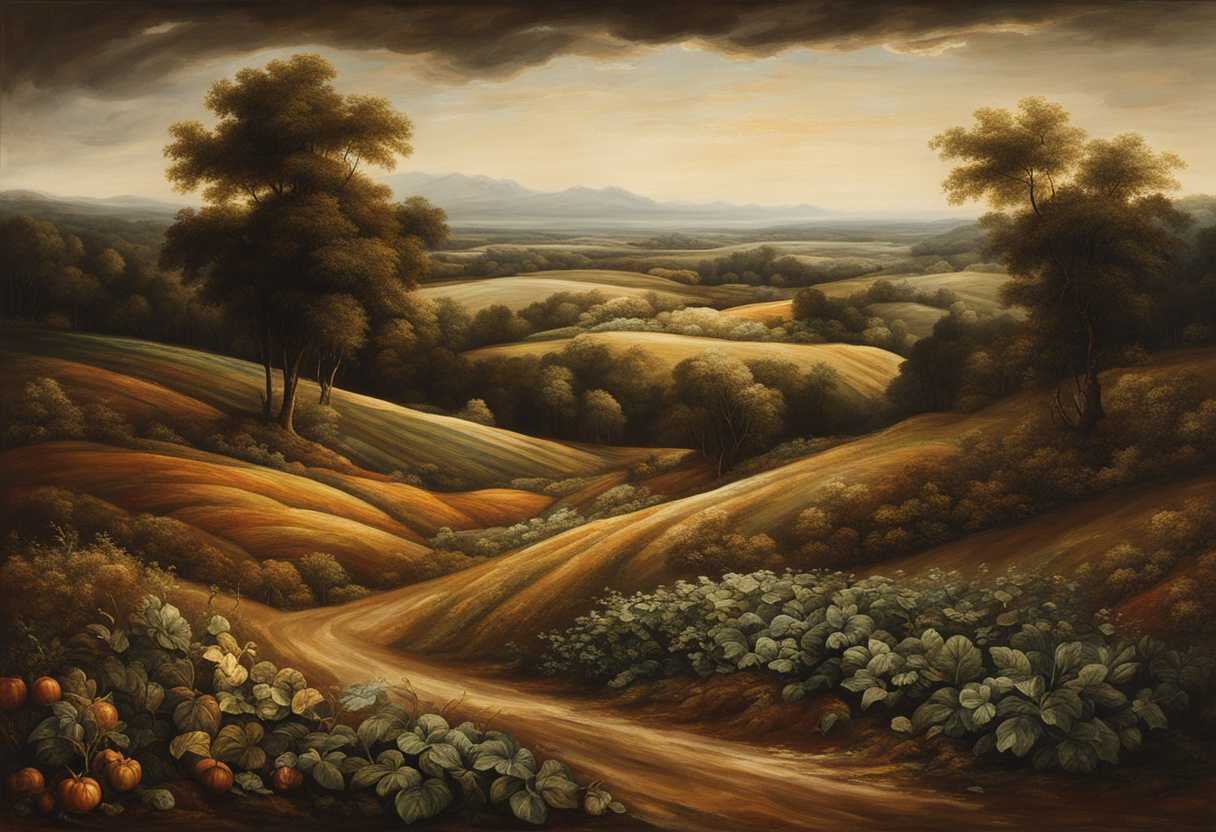
In the Bible, dirt and soil symbolize humanity’s humble origin, as humans were created from the dust of the ground (Genesis 2:7). Additionally, soil often represents fertility and growth, reflecting spiritual truths about being rooted in faith and producing good fruit (Matthew 13:8).
Scripture
7 then the Lord God formed the man of dust from the ground and breathed into his nostrils the breath of life, and the man became a living creature.
8 And the Lord God planted a garden in Eden, in the east, and there he put the man whom he had formed.
9 And out of the ground the Lord God made to spring up every tree that is pleasant to the sight and good for food. The tree of life was in the midst of the garden, and the tree of the knowledge of good and evil.
Biblical Significance of Dirt and Soil
The symbolism of dirt and soil in the Bible encapsulates a profound theological narrative about humanity’s relationship with God and the earth. In Genesis 2:7, we see God forming man from the dust of the ground, emphasizing our humble origins and the fragility of our existence. This act not only establishes a fundamental connection between human beings and creation but also serves as a reminder of our mortality; “for dust you are, and to dust you shall return” (Genesis 3:19). This inherent connection underlines themes of humility, dependence, and the need for divine sustenance.
Moreover, soil represents the potential for spiritual growth and fertility, as illustrated in parables such as the Sower in Matthew 13:8, where the seed falling on good soil yields an abundant harvest. The notion of soil as fertile ground metaphorically reflects the condition of one’s heart and the receptiveness to God’s word (Mark 4:20). Thus, dirt and soil not only highlight humanity’s origins but also echo the call to cultivate one’s spiritual life, nurturing faith to produce good works and spiritual fruitfulness. The intertwining of these ideas reveals that, from our humble beginnings, we are invited to participate in the redemptive work of God, growing in grace and reflecting His glory.
Beyond these initial reflections on dirt and soil as foundational elements of human existence and spiritual growth, the biblical narrative extends to the use of soil as an emblem of God’s covenant with His people and their responsibilities toward creation. In the context of land, soil represents not only a literal sustenance but also a metaphor for the covenant community, especially in the Promised Land. For the Israelites, the land was a gift from God, rich and fertile, symbolizing divine provision and blessings. The land’s productivity, as described in Deuteronomy, is intricately linked to the people’s obedience to God’s commandments, highlighting a reciprocal relationship. This contextualization of soil emerges as a call for stewardship, necessitating faithful cultivation in both physical and spiritual realms.
Furthermore, throughout the Scriptures, soil is often a backdrop for transformation. The imagery of rocky or thorny ground speaks to the potential obstacles and challenges faced by individuals in their spiritual journeys. Through the lens of soil quality, believers are encouraged to reflect on their inner lives—the way their spiritual health might be affected by distractions or disobedience. In Isaiah, the metaphor of sowing seeds in fertile ground resonates with the idea of divine justice and righteousness, where the earth itself rejoices in response to the faithfulness of God’s people. Hence, the biblical significance of dirt and soil extends into realms of accountability, community, and the abundant life God desires for His followers, continually inviting them to partake in the transformative power of His creation while reflecting His character in their stewardship of the earthy gifts they are entrusted with.
The Foundation of Creation
Dirt and soil in the Bible symbolize the foundational elements of creation. They represent the physical world that God formed and the material from which life is cultivated. This connection to the earth emphasizes the idea that humanity is intricately linked to the natural world, highlighting the importance of stewardship and care for creation. The soil serves as a reminder of the divine act of creation, where God shaped the earth and filled it with life, establishing a relationship between the Creator and His creation.
Symbol of Humility and Mortality
In biblical narratives, dirt and soil often symbolize humility and the transient nature of human life. The imagery of being made from dust serves as a reminder of human mortality and the need for humility before God. This theme encourages believers to recognize their dependence on God and the fleeting nature of earthly existence. It serves as a call to live with purpose and integrity, understanding that life is a gift from God and that one’s actions should reflect a commitment to spiritual values rather than earthly pursuits.
Metaphor for Spiritual Growth
Soil is frequently used as a metaphor for spiritual growth and the condition of the heart. Just as soil must be cultivated and nurtured for plants to thrive, so too must the human heart be prepared to receive spiritual truths. This metaphor emphasizes the importance of nurturing one’s faith, engaging in practices that promote spiritual growth, and being receptive to God’s word. The quality of the soil reflects the readiness of individuals to grow in their relationship with God, illustrating the transformative power of faith and the necessity of tending to one’s spiritual life.
How to Embrace Growth Through Faith and Humility
Embracing growth through faith and humility is a transformative journey that invites us to lean into our relationship with God while recognizing our own limitations. As we navigate life’s challenges, it’s essential to remember that true growth often comes from a place of surrender—acknowledging that we don’t have all the answers and that it’s okay to ask for help, both from God and from our community. Humility opens our hearts to learn from others, to listen more than we speak, and to see the divine in every person we encounter. When we approach our faith with a humble spirit, we create space for God to work in us, shaping our character and guiding our actions. So, let’s commit to daily practices of prayer, reflection, and service, allowing our faith to deepen and our hearts to expand, knowing that in our vulnerability, we find strength and purpose.
Bible References to Dirt and Soil Significance:
Genesis 3:17-19: 17 And to Adam he said, “Because you have listened to the voice of your wife and have eaten of the tree of which I commanded you, ‘You shall not eat of it,’ cursed is the ground because of you; in pain you shall eat of it all the days of your life;
18 thorns and thistles it shall bring forth for you; and you shall eat the plants of the field.
19 By the sweat of your face you shall eat bread, till you return to the ground, for out of it you were taken; for you are dust, and to dust you shall return.
Genesis 18:27-30: 27 Abraham answered and said, “Behold, I have undertaken to speak to the Lord, I who am but dust and ashes.
28 Suppose five of the fifty righteous are lacking. Will you destroy the whole city for lack of five?” And he said, “I will not destroy it if I find forty-five there.”
29 He said to him, “Oh let not the Lord be angry, and I will speak. Suppose thirty are found there.”
30 Then he said, “Oh let not the Lord be angry, and I will speak. Suppose thirty are found there.” He answered, “I will not do it, if I find thirty there.”
Exodus 8:16-17: 16 Then the Lord said to Moses, “Say to Aaron, ‘Stretch out your staff and strike the dust of the earth, so that it may become gnats in all the land of Egypt.’”
17 They did so. Aaron stretched out his hand with his staff and struck the dust of the earth, and there were gnats on man and beast. All the dust of the earth became gnats in all the land of Egypt.
Leviticus 14:33-35: 33 The Lord spoke to Moses and Aaron, saying,
34 “When you come into the land of Canaan, which I give you for a possession, and I put a case of leprous disease in a house in the land of your possession,”
35 Then he who owns the house shall come and tell the priest, ‘It seems to me there is some case of disease in my house.’
Deuteronomy 28:23-24: 23 And the heavens over your head shall be bronze, and the earth under you shall be iron.
24 The Lord will make the rain of your land powder. From heaven dust shall come down on you until you are destroyed.
2 Kings 5:10-14: 10 And Elisha sent a messenger to him, saying, “Go and wash in the Jordan seven times, and your flesh shall be restored, and you shall be clean.”
11 But Naaman was angry and went away, saying, “Behold, I thought that he would surely come out to me and stand and call upon the name of the Lord his God, and wave his hand over the place and cure the leper.
12 Are not Abana and Pharpar, the rivers of Damascus, better than all the waters of Israel? Could I not wash in them and be clean?” So he turned and went away in a rage.
13 But his servants came near and said to him, “My father, it is a great word the prophet has spoken to you; will you not do it? Has he actually said to you, ‘Wash, and be clean’?”
14 Then he went down and dipped himself seven times in the Jordan, according to the word of the man of God, and his flesh was restored like the flesh of a little child, and he was clean.
Job 10:8-9: 8 Your hands fashioned and made me,
and now you have destroyed me altogether.
9 Remember that you have made me like clay; and will you return me to the dust?
Psalm 103:13-16: 13 As a father shows compassion to his children,
so the Lord shows compassion to those who fear him.
14 For he knows our frame; he remembers that we are dust.
15 As for man, his days are like grass; he flourishes like a flower of the field;
16 For the wind passes over it, and it is gone, and its place knows it no more.
Isaiah 40:6-8: 6 A voice says, “Cry!” And I said, “What shall I cry?” All flesh is grass, and all its beauty is like the flower of the field.
7 The grass withers, the flower fades when the breath of the Lord blows on it; surely the people are grass.
8 The grass withers, the flower fades,
but the word of our God will stand forever.
Isaiah 55:10-11: 10 “For as the rain and the snow come down from heaven and do not return there but water the earth, making it bring forth and sprout, giving seed to the sower and bread to the eater,”
11 so shall my word be that goes out from my mouth; it shall not return to me empty, but it shall accomplish that which I purpose, and shall succeed in the thing for which I sent it.
Jeremiah 4:3-4: 3 For thus says the Lord to the men of Judah and Jerusalem: “Break up your fallow ground, and sow not among thorns.”
4 Circumcise yourselves to the Lord;
remove the foreskin of your hearts,
O men of Judah and inhabitants of Jerusalem;
lest my wrath go forth like fire,
and burn with none to quench it,
because of the evil of your deeds.”
Ezekiel 37:1-10: 1 The hand of the Lord was upon me, and he brought me out in the Spirit of the Lord and set me down in the middle of the valley; it was full of bones.
2 And he led me around among them, and behold, there were very many on the surface of the valley, and behold, they were very dry.
3 And he said to me, “Son of man, can these bones live?” And I answered, “O Lord God, you know.”
4 Then he said to me, “Prophesy over these bones, and say to them, O dry bones, hear the word of the Lord.”
5 Thus says the Lord God to these bones: Behold, I will cause breath to enter you, and you shall live.
6 And I will lay sinews upon you, and will cause flesh to come upon you, and cover you with skin, and put breath in you, and you shall live, and you shall know that I am the Lord.
7 So I prophesied as I was commanded. And as I prophesied, there was a sound, and behold, a rattling, and the bones came together, bone to its bone.
8 And I looked, and behold, there were sinews on them, and flesh had come upon them, and skin had covered them. But there was no breath in them.
9 Then he said to me, “Prophesy to the breath; prophesy, son of man, and say to the breath, Thus says the Lord God: Come from the four winds, O breath, and breathe on these slain, that they may live.”
10 So I prophesied as he commanded me, and the breath came into them, and they lived and stood on their feet, an exceedingly great army.
Matthew 13:3-9: 3 And he told them many things in parables, saying: “A sower went out to sow.
4 And as he sowed, some seeds fell along the path, and the birds came and devoured them.
5 Other seeds fell on rocky ground, where they did not have much soil, and immediately they sprang up, since they had no depth of soil,
6 But when the sun rose, they were scorched, and since they had no root, they withered away.
7 Other seeds fell among thorns, and the thorns grew up and choked them.
8 Other seeds fell on good soil and produced grain, some a hundredfold, some sixty, some thirty.
9 He who has ears, let him hear.
Matthew 13:18-23: 18 “Hear then the parable of the sower:
19 When anyone hears the word of the kingdom and does not understand it, the evil one comes and snatches away what has been sown in his heart. This is what was sown along the path.
20 As for what was sown on rocky ground, this is the one who hears the word and immediately receives it with joy,
21 Yet he has no root in himself, but endures for a while, and when tribulation or persecution arises on account of the word, immediately he falls away.
22 As for what was sown among thorns, this is the one who hears the word, but the cares of the world and the deceitfulness of riches choke the word, and it proves unfruitful.
23 As for what was sown on good soil, this is the one who hears the word and understands it. He indeed bears fruit and yields, in one case a hundredfold, in another sixty, and in another thirty.
Mark 4:26-29: 26 And he said, “The kingdom of God is as if a man should scatter seed on the ground.
27 He sleeps and rises night and day, and the seed sprouts and grows; he knows not how.
28 The earth produces by itself, first the blade, then the ear, then the full grain in the ear.
29 But when the grain is ripe, at once he puts in the sickle, because the harvest has come.
John 9:6-7: 6 Having said these things, he spit on the ground and made mud with the saliva. Then he anointed the man’s eyes with the mud.
7 and said to him, “Go, wash in the pool of Siloam” (which means Sent). So he went and washed and came back seeing.
Romans 9:20-21: 20 But who are you, O man, to answer back to God? Will what is molded say to its molder, “Why have you made me like this?”
21 Has the potter no right over the clay, to make out of the same lump one vessel for honorable use and another for dishonorable use?
1 Corinthians 15:47-49: 47 The first man was from the earth, a man of dust; the second man is from heaven.
48 As was the man of dust, so also are those who are of the dust, and as is the man of heaven, so also are those who are of heaven.
49 Just as we have borne the image of the man of dust, we shall also bear the image of the man of heaven.
James 1:21-22: 21 Therefore put away all filthiness and rampant wickedness and receive with meekness the implanted word, which is able to save your souls.
22 But be doers of the word, and not hearers only, deceiving yourselves.

Reverend Ogunlade is a seasoned Church Minister with over three decades of experience in guiding and nurturing congregations. With profound wisdom and a serene approach, Reverend Ogunlade has carried out various pastoral duties, including delivering uplifting sermons, conducting religious ceremonies, and offering sage counsel to individuals seeking spiritual guidance. Their commitment to fostering harmony and righteousness within their community is exemplified through their compassionate nature, making them a beloved and trusted figure among the congregation.