
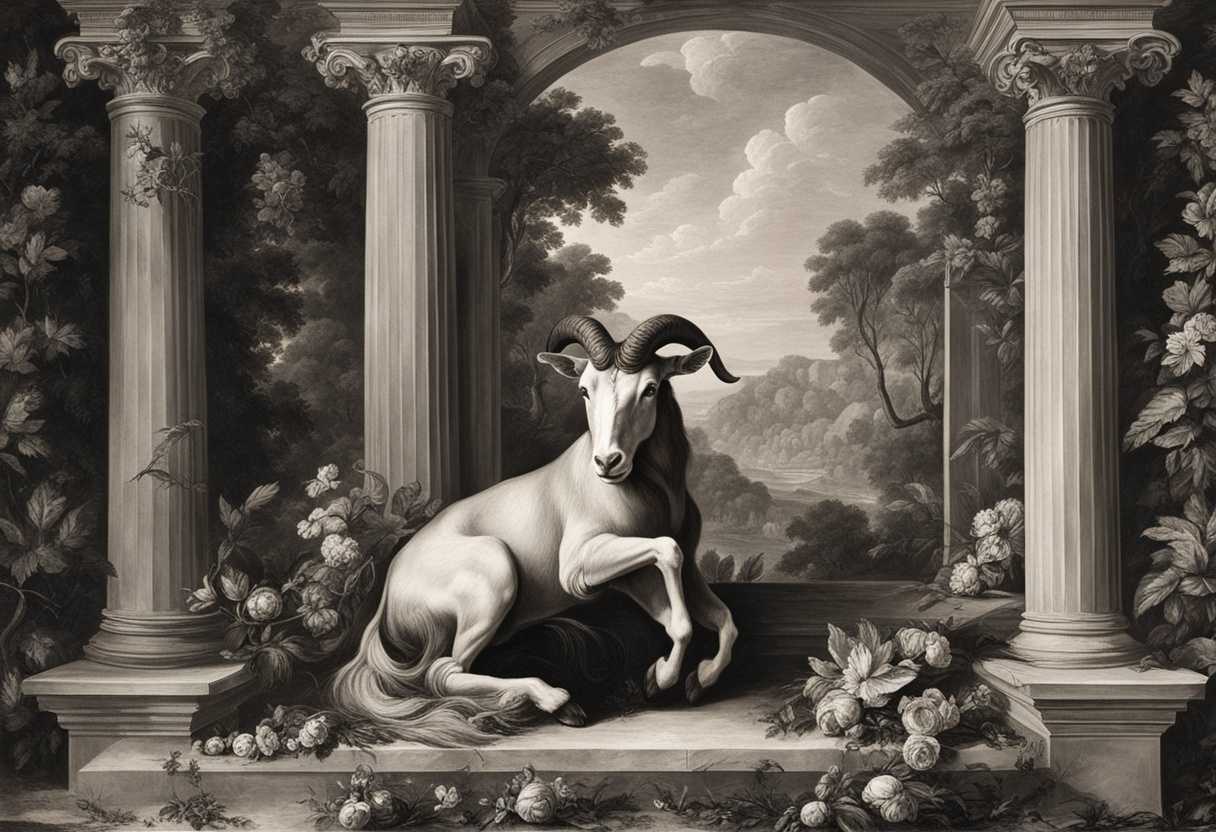
In the Bible, goats often symbolize sin and atonement, as seen in the Day of Atonement rituals where a scapegoat carried the sins of the people into the wilderness (Leviticus 16:10). Rams, on the other hand, typically represent sacrifice and covenant, exemplified by their use in offerings and their connection to God’s promises, as illustrated in the story of Abraham and Isaac (Genesis 22:13).
Scripture
5 And he shall take from the congregation of the people of Israel two male goats for a sin offering, and one ram for a burnt offering.
6 “Aaron shall offer the bull as a sin offering for himself and shall make atonement for himself and for his house.
7 Then he shall take the two goats and set them before the Lord at the entrance of the tent of meeting.
8 And Aaron shall cast lots over the two goats, one lot for the Lord and the other lot for Azazel.
9 And Aaron shall present the goat on which the lot fell for the Lord and use it as a sin offering,
10 But the goat on which the lot fell for Azazel shall be presented alive before the Lord to make atonement over it, that it may be sent away into the wilderness to Azazel.
11 “Aaron shall present the bull as a sin offering for himself, and shall make atonement for himself and for his house.
12 And he shall take a censer full of coals of fire from the altar before the Lord, and two handfuls of sweet incense beaten small, and he shall bring it inside the veil
13 and put the incense on the fire before the Lord, that the cloud of the incense may cover the mercy seat that is over the testimony, so that he does not die.
14 And he shall take some of the blood of the bull and sprinkle it with his finger on the front of the mercy seat on the east side, and in front of the mercy seat he shall sprinkle some of the blood with his finger seven times.
15 “Then he shall kill the goat of the sin offering that is for the people and bring its blood inside the veil and do with its blood as he did with the blood of the bull, sprinkling it over the mercy seat and in front of the mercy seat.”
16 Thus he shall make atonement for the Holy Place, because of the uncleannesses of the people of Israel and because of their transgressions, all their sins. And so he shall do for the tent of meeting, which dwells with them in the midst of their uncleannesses.
17 There shall be no man in the tent of meeting when he enters to make atonement in the Holy Place, until he comes out and has made atonement for himself and for his house and for all the assembly of Israel.
18 Then he shall go out to the altar that is before the Lord and make atonement for it, and shall take some of the blood of the bull and some of the blood of the goat, and put it on the horns of the altar all around.
19 He shall sprinkle some of the blood on it with his finger seven times and cleanse it and consecrate it from the uncleannesses of the people of Israel.
20 “And when he has made an end of atoning for the Holy Place and the tent of meeting and the altar, he shall present the live goat.”
21 And Aaron shall lay both his hands on the head of the live goat, and confess over it all the iniquities of the people of Israel, and all their transgressions, all their sins. And he shall put them on the head of the goat and send it away into the wilderness by the hand of a man who is in readiness.
22 And the goat shall bear all their iniquities on itself to a remote area, and he shall let the goat go free in the wilderness.
Biblical Significance of Goat and Ram
The symbolism of goats and rams in the Bible carries profound theological implications regarding sin, atonement, and divine covenant. Goats frequently depict the burden of sin and the mechanism through which atonement is achieved, particularly during the Day of Atonement, or Yom Kippur. In Leviticus 16:10, the scapegoat serves as a powerful symbol of the transference of sin from the community onto an animal, which is then driven into the wilderness, illustrating how God provides a means to cleanse the people of their iniquities. This ritual underscores the belief that sin requires a tangible means of separation and expiation, reinforcing the notion that, without atonement, the spiritual consequences of sin remain.
Conversely, rams embody themes of sacrifice and covenant faithfulness, vital to the biblical narrative of God’s relationship with His people. In Genesis 22:13, the ram provided by God to Abraham as a substitute for Isaac demonstrates both God’s provision and the principle of substitutionary atonement, foreshadowing the ultimate sacrifice of Christ in New Testament theology. Rams are also associated with various offerings in the sacrificial system (e.g., Leviticus 1:4), signifying obedience and worship. Thus, the contrasting representations of goats and rams encapsulate essential aspects of biblical theology: while goats symbolize the weight of sin and the need for atonement, rams signify the hope and promise of restoration through divine sacrifice and covenant.
Beyond their roles in atonement and sacrifice, goats and rams also extend their symbolic significance into the themes of leadership and divine authority within the biblical texts. The imagery of goats, especially in prophetic literature, often signifies the folly or rebellious nature of leaders who lead people astray. In Zechariah 10:3, for instance, God refers to leaders as “goats” who lack direction, highlighting the inherent danger of misguided leadership. This association serves to remind the faithful of the need for righteous guidance aligned with God’s will, and it draws a clear distinction between those who nurture the flock and those who exploit or neglect it.
On the other hand, rams oftentimes symbolize strength and might, representing effective leadership under God’s sovereignty. In the book of Daniel, a ram with two horns symbolizes the Medo-Persian Empire, showcasing how God uses earthly rulers as instruments of His divine plan. Additionally, rams are frequently depicted as symbols of security and protection, as seen in both biblical narratives and ancient Near Eastern cultures. The authority of the shepherd over a flock of sheep parallels the role of the ram as a protector, reinforcing the metaphor of God as a guiding force for His people. Collectively, these diverse representations weave a rich tapestry of meaning that transcends mere animal symbols, revealing deeper insights into God’s relationship with humanity and His intention for order and righteousness throughout history.
Symbol of Sacrifice and Atonement
In the Bible, both goats and rams are often associated with the themes of sacrifice and atonement. They were used in various sacrificial rituals to seek forgiveness for sins and to restore the relationship between God and His people. The act of sacrificing these animals symbolizes the cost of sin and the need for redemption, highlighting the seriousness of transgressions and the grace of God in providing a means for reconciliation.
Representation of Leadership and Authority
Rams, in particular, are frequently seen as symbols of leadership and authority. Their strong and commanding presence often represents the qualities of a good leader, such as strength, courage, and the ability to guide others. In biblical narratives, rams can also signify the role of God as the ultimate shepherd, guiding His flock and providing for their needs. This imagery reinforces the idea of divine protection and guidance in the lives of believers.
Duality of Nature: Innocence and Scapegoat
Goats embody a duality in biblical symbolism, representing both innocence and the concept of the scapegoat. While they can symbolize purity and the innocent nature of sacrifice, they are also associated with the idea of bearing the sins of the people. This duality reflects the complexity of human nature and the need for both justice and mercy in the divine plan. The goat’s role as a scapegoat illustrates the transfer of sin and guilt, emphasizing the importance of accountability and the hope for redemption.
How to Embrace Sacrifice for a Deeper Faith
Embracing sacrifice as a pathway to a deeper faith can be both challenging and transformative. It often requires us to step outside our comfort zones, whether that means giving up our time to serve others, letting go of material possessions, or even enduring personal hardships for the sake of our beliefs. I’ve found that when I intentionally choose to sacrifice something meaningful—be it my time, resources, or even my own desires—I create space for God to work in my life. This act of surrender not only deepens my reliance on Him but also fosters a profound sense of connection with Christ, who exemplified ultimate sacrifice through His love and service. Remember, it’s in these moments of giving that we often discover the richness of God’s grace and the joy of living out our faith in a way that reflects His love to the world around us. So, take that leap of faith; you might just find that what you give up leads to a greater understanding of what it means to truly follow Him.
Bible References to Goat and Ram Significance:
Numbers 28:11-15: 11 “At the beginnings of your months, you shall offer a burnt offering to the Lord: two bulls from the herd, one ram, seven male lambs a year old without blemish;”
12 And three tenths of an ephah of fine flour for a grain offering, mixed with oil, for each bull, and two tenths of fine flour for a grain offering, mixed with oil, for the one ram;
13 And a tenth of an ephah of fine flour for a grain offering, mixed with a quarter of a hin of beaten oil.
14 And their drink offerings shall be half a hin of wine for a bull, a third of a hin for a ram, and a quarter of a hin for a lamb. This is the burnt offering of each month throughout the months of the year.
15 And one male goat for a sin offering to the Lord; it shall be offered besides the regular burnt offering and its drink offering.
Genesis 22:13-14: 13 And Abraham lifted up his eyes and looked, and behold, behind him was a ram, caught in a thicket by his horns. And Abraham went and took the ram and offered it up as a burnt offering instead of his son.
14 So Abraham called the name of that place, “The Lord will provide”; as it is said to this day, “On the mount of the Lord it shall be provided.”
Exodus 12:3-6: 3 Tell all the congregation of Israel that on the tenth day of this month every man shall take a lamb according to their fathers’ houses, a lamb for a household.
4 And if the household is too small for a lamb, then he and his nearest neighbor shall take according to the number of persons; according to what each can eat you shall make your count for the lamb.
5 Your lamb shall be without blemish, a male a year old.
6 and you shall keep it until the fourteenth day of this month, when the whole assembly of the congregation of Israel shall kill their lambs at twilight.
Daniel 8:3-8: 3 Then I raised my eyes and saw, and behold, a ram standing on the bank of the canal. It had two horns, and both horns were high, but one was higher than the other, and the higher one came up last.
4 I saw the ram charging westward and northward and southward. No beast could stand before him, and there was no one who could rescue from his power. He did as he pleased and became great.
5 As I was considering, behold, a male goat came from the west across the face of the whole earth, without touching the ground. And the goat had a conspicuous horn between his eyes.
6 He came to the ram with the two horns, which I had seen standing on the bank of the canal, and he ran at him in his powerful wrath.
7 I saw him come close to the ram, and he was enraged against him and struck the ram and broke his two horns. And the ram had no power to stand before him, but he cast him down to the ground and trampled on him. And there was no one who could rescue the ram from his power.
8 Then the goat became exceedingly great, but when he was strong, the great horn was broken, and instead of it there came up four conspicuous horns toward the four winds of heaven.
2 Chronicles 29:21-24: 21 And they brought seven bulls, seven rams, seven lambs, and seven male goats for a sin offering for the kingdom and for the sanctuary and for Judah. And he commanded the priests, the sons of Aaron, to offer them on the altar of the Lord.
22 So they slaughtered the bulls, and the priests received the blood and threw it against the altar.
23 Then the goats for the sin offering were brought to the king and the assembly, and they laid their hands on them,
24 And the priests slaughtered them and made a sin offering with their blood on the altar, to make atonement for all Israel. For the king commanded that the burnt offering and the sin offering should be made for all Israel.
Leviticus 4:23-26: 23 if it is the anointed priest who sins, thus bringing guilt on the people, then he shall offer for the sin that he has committed a bull from the herd without blemish to the Lord for a sin offering.
24 And he shall lay his hand on the head of the goat and kill it in the place where they kill the burnt offering before the Lord; it is a sin offering.
25 Then the priest shall take some of the blood of the sin offering with his finger and put it on the horns of the altar of burnt offering and pour out the rest of its blood at the base of the altar of burnt offering.
26 All its fat he shall burn on the altar, like the fat of the sacrifice of peace offerings. And the priest shall make atonement for him for his sin, and he shall be forgiven.
Leviticus 9:3-4: 3 Then to the people of Israel you shall speak, saying, ‘Take a male goat for a sin offering, and a calf and a lamb, both a year old without blemish, for a burnt offering,
4 And an ox and a ram for peace offerings, to sacrifice before the Lord, and a grain offering mixed with oil, for today the Lord will appear to you.”
Numbers 7:87-88: 87 All the livestock for the burnt offering were twelve bulls, the rams twelve, the male lambs a year old twelve, with their grain offering.
88 all the bulls of the sacrifice of peace offerings were twelve rams, the rams twelve, the male lambs a year old twelve, with their grain offering.
1 Samuel 15:22-23: 22 And Samuel said, “Has the Lord as great delight in burnt offerings and sacrifices, as in obeying the voice of the Lord? Behold, to obey is better than sacrifice, and to listen than the fat of rams.
23 For rebellion is as the sin of divination, and presumption is as iniquity and idolatry. Because you have rejected the word of the Lord, he has also rejected you from being king.”
Isaiah 1:11-15: 11 “What to me is the multitude of your sacrifices? says the Lord; I have had enough of burnt offerings of rams and the fat of well-fed beasts; I do not delight in the blood of bulls, or of lambs, or of goats.”
12 “When you come to appear before me,
who has required of you
this trampling of my courts?
13 Bring no more vain offerings; incense is an abomination to me.
14 Your new moons and your appointed feasts my soul hates; they have become a burden to me; I am weary of bearing them.
15 When you spread out your hands,
I will hide my eyes from you;
even though you make many prayers,
I will not listen;
your hands are full of blood.
Ezekiel 34:17-19: 17 “As for you, my flock, thus says the Lord God: Behold, I judge between sheep and sheep, between rams and male goats.
18 Is it not enough for you to feed on the good pasture, that you must tread down with your feet the rest of your pasture; and to drink of clear water, that you must muddy the rest of the water with your feet?
19 And as for my flock, they shall eat what you have trodden with your feet, and they shall drink what you have muddied with your feet.
Hebrews 9:12-14: 12 he entered once for all into the holy places, not by means of the blood of goats and calves but by means of his own blood, thus securing an eternal redemption.
13 For if the blood of goats and bulls, and the sprinkling of defiled persons with the ashes of a heifer, sanctify for the purification of the flesh,
14 how much more will the blood of Christ, who through the eternal Spirit offered himself without blemish to God, purify our conscience from dead works to serve the living God.
Matthew 25:31-33: 31 “When the Son of Man comes in his glory, and all the angels with him, then he will sit on his glorious throne.
32 Before him will be gathered all the nations, and he will separate people one from another as a shepherd separates the sheep from the goats.
33 And he will place the sheep on his right, but the goats on the left.
Revelation 5:6-10: 6 And between the throne and the four living creatures and among the elders I saw a Lamb standing, as though it had been slain, with seven horns and with seven eyes, which are the seven spirits of God sent out into all the earth.
7 And he went and took the scroll from the right hand of him who was seated on the throne.
8 And when he had taken the scroll, the four living creatures and the twenty-four elders fell down before the Lamb, each holding a harp, and golden bowls full of incense, which are the prayers of the saints.
9 And they sang a new song, saying, “Worthy are you to take the scroll and to open its seals, for you were slain, and by your blood you ransomed people for God from every tribe and language and people and nation,
10 and you have made them a kingdom and priests to our God, and they shall reign on the earth.”

Reverend Ogunlade is a seasoned Church Minister with over three decades of experience in guiding and nurturing congregations. With profound wisdom and a serene approach, Reverend Ogunlade has carried out various pastoral duties, including delivering uplifting sermons, conducting religious ceremonies, and offering sage counsel to individuals seeking spiritual guidance. Their commitment to fostering harmony and righteousness within their community is exemplified through their compassionate nature, making them a beloved and trusted figure among the congregation.