
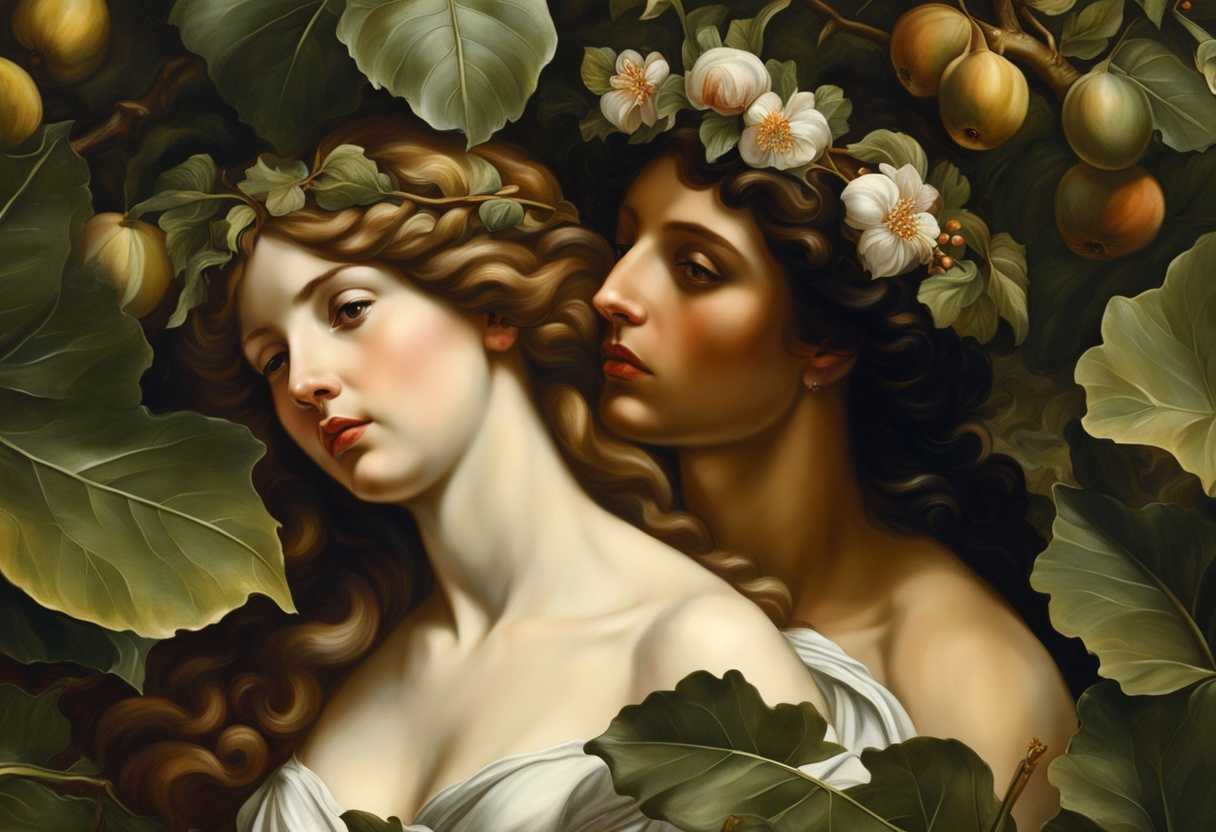
In the Bible, fig leaves symbolize the attempt to cover one’s shame and sin, as seen in Genesis 3:7 when Adam and Eve used them to hide their nakedness after disobeying God. This act represents human efforts to hide from God and the consequences of sin.
Scripture
7 Then the eyes of both were opened, and they knew that they were naked. And they sewed fig leaves together and made themselves loincloths.
8 And they heard the sound of the Lord God walking in the garden in the cool of the day, and the man and his wife hid themselves from the presence of the Lord God among the trees of the garden.
9 But the Lord God called to the man and said to him, “Where are you?”
10 And he said, “I heard the sound of you in the garden, and I was afraid, because I was naked, and I hid myself.”
Biblical Meaning of Fig Leaves
The symbolism of fig leaves in the Bible transcends the immediate narrative of Adam and Eve’s attempt to cover their nakedness in Genesis 3:7. Their use of fig leaves illustrates a broader theme of human efforts to mask vulnerability and guilt in the wake of disobedience. When they ate from the forbidden tree, they gained knowledge of good and evil, which led to their realization of nakedness—both physical and metaphorical. This moment signifies a rupture in their intimate relationship with God, prompting their instinctual response to hide through their own means. The fig leaves represent an inadequate attempt to reconcile or cover their disobedience, echoing the futility of human attempts to atone for sin without divine intervention (Romans 3:23).
Furthermore, the fig leaves also serve as a reflection of humanity’s ongoing struggle with shame and the desire for self-justification. In the New Testament, this theme continues with the teachings of Jesus, who emphasized that true spiritual restoration and acceptance come from acknowledging one’s sinfulness and seeking forgiveness rather than attempting to conceal it (Matthew 5:3-4). The use of fig leaves is ultimately a reminder that while humanity may strive to cover their shortcomings, it is through vulnerability and repentance that a bridge is built back to God, who offers grace and redemption (Psalm 32:5). This deeper understanding invites individuals to confront their nakedness—spiritually and emotionally—and to seek genuine reconciliation rather than relying on temporary measures that only serve to hide the underlying realities of sin.
The fig leaf narrative illustrates a profound insight into human nature, particularly regarding our propensity to hide our imperfections and failures. Throughout the scriptures, the act of covering oneself symbolizes an innate desire to present an acceptable facade before God and others, reflecting our fear of judgment and rejection. This theme extends to various biblical accounts and characters who, in their shortcomings, seek refuge in misplaced or superficial solutions rather than authentic repentance. The desire for human approval or self-protection often results in attempts to cover up the very issues that separate individuals from their divine creator.
In other parts of scripture, this motif of covering up one’s flaws can be linked to the prophetic calls for sincerity and true devotion to God. The prophets often chastised the people of Israel for hiding behind ritualistic practices or outward appearances while neglecting the fundamental issues of the heart, which God truly desires to transform. This underscores that fig leaves, though seemingly protective, symbolize a barrier to genuine intimacy with God. Such barriers, whether rooted in pride, fear, or denial, only serve to prolong spiritual estrangement. In contrast, the call to authenticity and openness invites a deeper relationship with God, who knows our nakedness and still extends grace and compassion, enabling a pathway toward restoration and healing.
The Symbol of Shame and Concealment
In the biblical narrative, the fig leaf represents humanity’s instinct to cover up shame and vulnerability. After the fall, Adam and Eve’s choice to use fig leaves as a covering illustrates the human tendency to hide one’s true self and shortcomings. This act of concealment signifies a deeper spiritual truth about the nature of sin and the desire to mask one’s failures rather than confront them openly.
The Illusion of Self-Righteousness
The fig leaf also serves as a metaphor for self-righteousness and the futile attempts to achieve righteousness through one’s own efforts. Just as Adam and Eve attempted to cover their nakedness with leaves, individuals often try to justify themselves through their actions or appearances. This highlights the biblical theme that true righteousness cannot be attained through human efforts but is a gift that comes from a relationship with the divine.
The Call to Authenticity and Redemption
Ultimately, the fig leaf symbolizes the need for authenticity and the journey toward redemption. The act of covering oneself with fig leaves can be seen as a barrier to genuine connection with God and others. The biblical narrative encourages believers to move beyond superficial coverings and embrace vulnerability, leading to a deeper understanding of grace and the transformative power of divine love. This call to authenticity invites individuals to shed their fig leaves and seek true healing and restoration.
How to Embrace Transparency and Foster Spiritual Growth
Embracing transparency in your spiritual journey is a powerful way to foster growth and deepen your relationship with God and others. It starts with being honest with yourself about your struggles, doubts, and joys, allowing you to bring your whole self before God in prayer. Share your experiences with trusted friends or a faith community; vulnerability can create a safe space for others to do the same, fostering a culture of support and accountability. Remember, even the most faithful among us have faced challenges—think of David’s psalms, where he laid bare his heart before God. By being open about your journey, you not only invite God’s healing into your life but also encourage others to seek authenticity in their own walks of faith. This mutual transparency can lead to profound spiritual growth, as we learn from one another and draw closer to the heart of Christ together.
Bible References to Fig Leaf Symbolism:
Genesis 3:21-24: 21 And the Lord God made for Adam and for his wife garments of skins and clothed them.
22 Then the Lord God said, “Behold, the man has become like one of us in knowing good and evil. Now, lest he reach out his hand and take also of the tree of life and eat, and live forever—”
23 therefore the Lord God sent him out from the garden of Eden to work the ground from which he was taken.
24 He drove out the man, and at the east of the garden of Eden he placed the cherubim and a flaming sword that turned every way to guard the way to the tree of life.
Matthew 21:18-22: 18 In the morning, as he was returning to the city, he became hungry.
19 And seeing a fig tree by the wayside, he went to it and found nothing on it but only leaves. And he said to it, “May no fruit ever come from you again!” And the fig tree withered at once.
20 When the disciples saw it, they marveled, saying, “How did the fig tree wither at once?”
21 And Jesus answered them, “Truly, I say to you, if you have faith and do not doubt, you will not only do what has been done to the fig tree, but even if you say to this mountain, ‘Be taken up and thrown into the sea,’ it will happen.
22 And whatever you ask in prayer, you will receive, if you have faith.
Mark 11:12-14: 12 On the following day, when they came from Bethany, he was hungry.
13 And seeing in the distance a fig tree in leaf, he went to see if he could find anything on it. When he came to it, he found nothing but leaves, for it was not the season for figs.
14 And he said to it, “May no one ever eat fruit from you again.” And his disciples heard it.
Mark 11:20-25: 20 As they passed by in the morning, they saw the fig tree withered away to its roots.
21 And Peter remembered and said to him, “Rabbi, look! The fig tree that you cursed has withered.”
22 And Jesus answered them, “Have faith in God.
23 Truly, I say to you, whoever says to this mountain, ‘Be taken up and thrown into the sea,’ and does not doubt in his heart, but believes that what he says will come to pass, it will be done for him.
24 Therefore I tell you, whatever you ask in prayer, believe that you have received it, and it will be yours.
25 And whenever you stand praying, forgive, if you have anything against anyone, so that your Father also who is in heaven may forgive you your trespasses.”
Luke 13:6-9: 6 And he told this parable: “A man had a fig tree planted in his vineyard, and he came seeking fruit on it and found none.
7 And he said to the vinedresser, ‘Look, for three years now I have come seeking fruit on this fig tree, and I find none. Cut it down. Why should it use up the ground?’
6 And he told this parable: “A man had a fig tree planted in his vineyard, and he came seeking fruit on it and found none.
9 Then if it should bear fruit next year, well and good; but if not, you can cut it down.’”
John 1:47-51: 47 Jesus saw Nathanael coming toward him and said of him, “Behold, an Israelite indeed, in whom there is no deceit!”
48 Nathanael said to him, “How do you know me?” Jesus answered him, “Before Philip called you, when you were under the fig tree, I saw you.”
49 Nathanael answered him, “Rabbi, you are the Son of God! You are the King of Israel!”
50 Jesus answered him, “Because I said to you, ‘I saw you under the fig tree,’ do you believe? You will see greater things than these.”
51 And he said to him, “Truly, truly, I say to you, you will see heaven opened, and the angels of God ascending and descending on the Son of Man.”
Romans 13:11-14: 11 Besides this you know the time, that the hour has come for you to wake from sleep. For salvation is nearer to us now than when we first believed.
12 The night is far gone; the day is at hand. So then let us cast off the works of darkness and put on the armor of light.
13 Let us walk properly as in the daytime, not in orgies and drunkenness, not in sexual immorality and sensuality, not in quarreling and jealousy.
14 But put on the Lord Jesus Christ, and make no provision for the flesh, to gratify its desires.
2 Corinthians 5:1-5: For we know that if the tent that is our earthly home is destroyed, we have a building from God, a house not made with hands, eternal in the heavens.
2 For in this tent we groan, longing to put on our heavenly dwelling,
3 if indeed by putting it on we may not be found naked.
4 For while we are still in this tent, we groan, being burdened—not that we would be unclothed, but that we would be further clothed, so that what is mortal may be swallowed up by life.
5 He who has prepared us for this very thing is God, who has given us the Spirit as a guarantee.
Revelation 6:12-17: 12 When he opened the sixth seal, I looked, and behold, there was a great earthquake, and the sun became black as sackcloth, the full moon became like blood,
13 and the stars of the sky fell to the earth as the fig tree sheds its winter fruit when shaken by a gale.
14 The sky vanished like a scroll that is being rolled up, and every mountain and island was removed from its place.
15 Then the kings of the earth and the great ones and the generals and the rich and the powerful, and everyone, slave and free, hid themselves in the caves and among the rocks of the mountains,
16 calling to the mountains and rocks, “Fall on us and hide us from the face of him who is seated on the throne, and from the wrath of the Lamb,
17 for the great day of their wrath has come, and who can stand?”

Reverend Ogunlade is a seasoned Church Minister with over three decades of experience in guiding and nurturing congregations. With profound wisdom and a serene approach, Reverend Ogunlade has carried out various pastoral duties, including delivering uplifting sermons, conducting religious ceremonies, and offering sage counsel to individuals seeking spiritual guidance. Their commitment to fostering harmony and righteousness within their community is exemplified through their compassionate nature, making them a beloved and trusted figure among the congregation.