
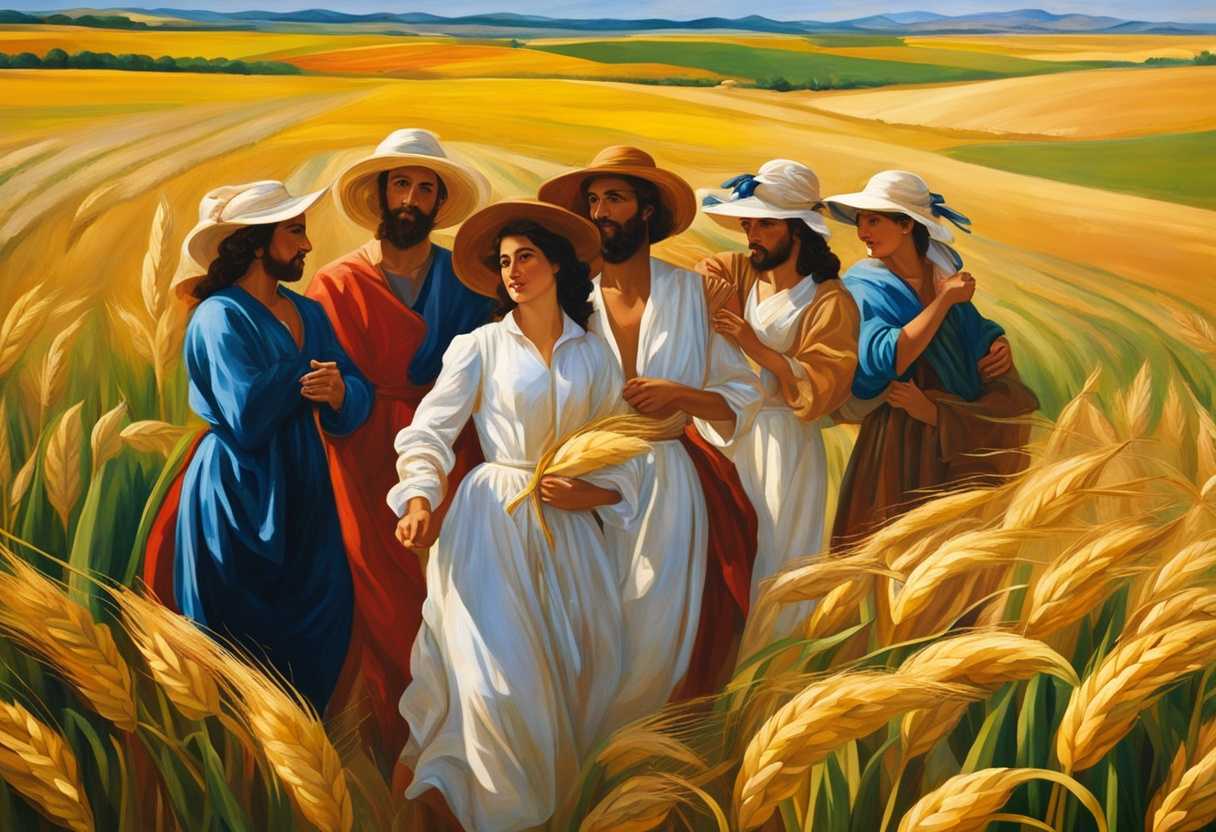
In the Bible, the month of Abib, also known as Nisan, is the first month of the ecclesiastical year for the Israelites, marking the time of the Passover and the beginning of the barley harvest (Exodus 13:4; Exodus 23:15). It signifies a period of renewal and liberation, commemorating the Israelites’ exodus from Egypt.
Scripture
1 The Lord said to Moses and Aaron in the land of Egypt,
2 “This month shall be for you the beginning of months. It shall be the first month of the year for you.
3 Tell all the congregation of Israel that on the tenth day of this month every man shall take a lamb according to their fathers’ houses, a lamb for a household.
4 And if the household is too small for a lamb, then he and his nearest neighbor shall take according to the number of persons; according to what each can eat you shall make your count for the lamb.
5 Your lamb shall be without blemish, a male a year old.
6 and you shall keep it until the fourteenth day of this month, when the whole assembly of the congregation of Israel shall kill their lambs at twilight.
7 Then they shall take some of the blood and put it on the two doorposts and the lintel of the houses in which they eat it.
8 They shall eat the flesh that night, roasted on the fire; with unleavened bread and bitter herbs they shall eat it.
9 Do not eat any of it raw or boiled in water, but roasted, its head with its legs and its inner parts.
10 And you shall let none of it remain until the morning; anything that remains until the morning you shall burn.
11 In this manner you shall eat it: with your belt fastened, your sandals on your feet, and your staff in your hand. And you shall eat it in haste. It is the Lord’s Passover.
12 For I will pass through the land of Egypt that night, and I will strike all the firstborn in the land of Egypt, both man and beast; and on all the gods of Egypt I will execute judgments: I am the Lord.
13 The blood shall be a sign for you, on the houses where you are. And when I see the blood, I will pass over you, and no plague will befall you to destroy you when I strike the land of Egypt.
14 “This day shall be for you a memorial day, and you shall keep it as a feast to the Lord; throughout your generations, as a statute forever, you shall keep it as a feast.”
15 Seven days you shall eat unleavened bread. On the first day you shall remove leaven out of your houses, for if anyone eats what is leavened, from the first day until the seventh day, that person shall be cut off from Israel.
16 On the first day you shall hold a holy assembly, and on the seventh day a holy assembly. No work shall be done on those days. But what everyone needs to eat, that alone may be prepared by you.
17 And you shall observe the Feast of Unleavened Bread, for on this very day I brought your hosts out of the land of Egypt. Therefore you shall observe this day, throughout your generations, as a statute forever.
18 In the first month, from the fourteenth day of the month at evening, you shall eat unleavened bread until the twenty-first day of the month at evening.
19 For seven days no leaven is to be found in your houses. If anyone eats what is leavened, that person will be cut off from the congregation of Israel, whether he is a sojourner or a native of the land.
20 You shall eat nothing leavened; in all your dwelling places you shall eat unleavened bread.”
21 Then Moses called all the elders of Israel and said to them, “Go and select lambs for yourselves according to your clans, and kill the Passover lamb.
22 Take a bunch of hyssop and dip it in the blood that is in the basin, and touch the lintel and the two doorposts with the blood that is in the basin. None of you shall go out of the door of his house until the morning.
23 For the Lord will pass through to strike the Egyptians, and when he sees the blood on the lintel and on the two doorposts, the Lord will pass over the door and will not allow the destroyer to enter your houses to strike you.
24 You shall observe this rite as a statute for you and for your sons forever.
25 And when you come to the land that the Lord will give you, as he has promised, you shall keep this service.
26 And when your children say to you, ‘What do you mean by this service?’
27 Then you shall say, ‘It is the sacrifice of the Lord’s Passover, for he passed over the houses of the people of Israel in Egypt, when he struck the Egyptians but spared our houses.’” And the people bowed their heads and worshiped.
28 Then the people of Israel went and did so; as the Lord had commanded Moses and Aaron, so they did.
Meaning of Abib in the Bible
The month of Abib, or Nisan, is rich in biblical significance, serving as both a marker of the agricultural cycle and a profound reminder of spiritual deliverance. As noted in Exodus 12:2, God instructs Moses that Abib is the first month of the year for the Israelites, which symbolizes a new beginning following generations of slavery in Egypt. The timing of Passover, which falls within this month, highlights themes of redemption and divine intervention. Exodus 12:13 underscores the protective power of the blood of the lamb, symbolizing how God spared the Israelites from the final plague. This foundational event not only relates to their physical liberation but also encapsulates the essence of faith and reliance on God for salvation.
In a broader theological context, Abib represents the cyclical nature of life, where physical renewal through the agricultural harvest parallels the spiritual renewal through repentance and deliverance. Leviticus 23:10-11 describes the instructions for the Feast of Firstfruits, occurring during this month, emphasizing gratitude for God’s provision and the acknowledgment of His sovereignty over creation. This month sets the stage for the unfolding of God’s covenant promises, heralding themes of hope, new life, and fulfillment that resonate throughout the rest of Scripture, culminating in the ultimate act of redemption through Christ, who, as the Passover Lamb, offers salvation to all. Thus, Abib is not only a historical marker for the Israelites but also a pivotal element in the overarching narrative of God’s desire to restore and renew His creation.
The month of Abib, as reflected in the scriptural narrative, is integral to understanding the flow of Israel’s history and God’s covenantal promises. In Deuteronomy, the significance of this month is reiterated with special emphasis on the liberation from Egypt and the importance of remembering these events. The command to celebrate the Passover during Abib serves as both a reminder of their deliverance and an intentional teaching tool for future generations. This act of remembrance signifies not only gratitude for past providence but also reinforces the identity of the Israelites as a people chosen by God and set apart for His purposes.
Moreover, the month of Abib has lasting implications as it signifies the beginning of the agricultural year in Israel. This month evokes themes of growth and sustenance as the barley harvest commences. The timing of the harvest serves as a metaphor for God’s renewal and faithfulness, as He provides for His people in tangible and meaningful ways. In the prophetic literature, references to Abib also highlight the relationship between God and Israel, often calling the people to return to Him during this time. The multifaceted nature of Abib invites reflection on not only physical sustenance but also spiritual vitality, as the historical events associated with this month continue to inform the spiritual practices and beliefs within the broader narrative of Scripture, culminating in the New Testament’s proclamation of a new creation through Christ.
The Significance of New Beginnings
The month of Abib, often associated with the spring season, symbolizes renewal and new beginnings. In the agricultural calendar, it marks the time when crops begin to sprout and flourish, reflecting the theme of rebirth and growth. This period is significant for the Israelites as it represents the transition from slavery in Egypt to freedom, emphasizing the importance of starting anew and embracing the possibilities that come with liberation.
The Call to Remember and Celebrate
Abib serves as a reminder for the Israelites to commemorate their deliverance from bondage. It is a time for reflection on their history and the faithfulness of God in guiding them through trials. The observance of festivals during this month encourages the community to come together in gratitude and worship, reinforcing their identity and shared heritage. This collective remembrance fosters a sense of unity and purpose among the people.
The Connection to Divine Timing
The month of Abib also highlights the concept of divine timing in the biblical narrative. It is during this period that significant events unfold, such as the Passover and the Exodus. This timing underscores the belief that God orchestrates events according to His divine plan, teaching the faithful to trust in His timing and providence. The month serves as a reminder that, despite challenges, there is a season for every purpose under heaven, and God’s plans will ultimately prevail.
How to Embrace Renewal and Growth in Faith
Embracing renewal and growth in your faith is a beautiful journey that requires both intention and openness. Start by carving out quiet moments in your day for prayer and reflection, allowing God to speak to your heart. Dive into Scripture with a fresh perspective, seeking not just knowledge but transformation; ask the Holy Spirit to reveal new insights that can challenge and inspire you. Surround yourself with a community of believers who encourage you and hold you accountable, as fellowship can ignite your passion for Christ. Remember, growth often comes through trials, so embrace challenges as opportunities for deeper reliance on God. Finally, be patient with yourself—spiritual growth is a lifelong process, and every step, no matter how small, is a step closer to the heart of God.
Bible References to the Month of Abib:
Exodus 13:3-10: 3 Then Moses said to the people, “Remember this day in which you came out from Egypt, out of the house of slavery, for by a strong hand the Lord brought you out from this place. No leavened bread shall be eaten.
4 Today, in the month of Abib, you are going out.
5 And when the Lord brings you into the land of the Canaanites, the Hittites, the Amorites, the Hivites, and the Jebusites, which he swore to your fathers to give you, a land flowing with milk and honey, you shall keep this service in this month.
6 Seven days you shall eat unleavened bread, and on the seventh day there shall be a feast to the Lord.
7 Unleavened bread shall be eaten for seven days; no leavened bread shall be seen with you, and no leaven shall be seen with you in all your territory.
8 You shall tell your son on that day, ‘It is because of what the Lord did for me when I came out of Egypt.’
9 And it shall be to you as a sign on your hand and as a memorial between your eyes, that the law of the Lord may be in your mouth.
10 You shall therefore keep this statute at its appointed time from year to year.
Exodus 23:14-19: 14 “Three times in the year you shall keep a feast to me.”
15 You shall keep the Feast of Unleavened Bread. As I commanded you, you shall eat unleavened bread for seven days at the appointed time in the month of Abib, for in it you came out of Egypt. None shall appear before me empty-handed.
16 You shall keep the Feast of Harvest, of the firstfruits of your labor, of what you sow in the field.
17 Three times in the year shall all your males appear before the Lord God.
18 “You shall not offer the blood of my sacrifice with anything leavened, or let the fat of my feast remain until the morning.”
19 “The best of the firstfruits of your ground you shall bring into the house of the Lord your God.
Exodus 34:18-26: 18 “You shall keep the Feast of Unleavened Bread. Seven days you shall eat unleavened bread, as I commanded you, at the time appointed in the month Abib, for in the month Abib you came out from Egypt.
19 “All that open the womb are mine, all your male livestock, the firstborn of cow and sheep.”
20 The firstborn of a donkey you shall redeem with a lamb, or if you will not redeem it you shall break its neck.
21 “Six days you shall work, but on the seventh day you shall rest. In plowing time and in harvest you shall rest.”
22 You shall observe the Feast of Weeks, the firstfruits of wheat harvest, and the Feast of Ingathering at the year’s end.
23 Three times in the year shall all your males appear before the Lord God, the God of Israel.
24 For I will cast out nations before you and enlarge your borders; no one shall covet your land, when you go up to appear before the Lord your God three times in the year.
25 “You shall not offer the blood of my sacrifice with anything leavened, or let the sacrifice of the Feast of the Passover remain until the morning.”
26 The best of the firstfruits of your ground you shall bring to the house of the Lord your God.
Deuteronomy 16:1-8: 1 “Observe the month of Abib and keep the Passover to the Lord your God, for in the month of Abib the Lord your God brought you out of Egypt by night.
2 You shall offer the Passover sacrifice to the Lord your God, from the flock or the herd, at the place that the Lord will choose, to make his name dwell there.
3 You shall eat no leavened bread with it. Seven days you shall eat it with unleavened bread, the bread of affliction—for you came out of the land of Egypt in haste—that all the days of your life you may remember the day when you came out of the land of Egypt.
4 And no leaven shall be seen with you in all your territory for seven days, and none of the flesh that you sacrifice on the evening of the first day shall remain all night until morning.
5 You may not offer the Passover sacrifice within any of your towns that the Lord your God is giving you,
6 but at the place that the Lord your God will choose, to make his name dwell in it, there you shall offer the Passover sacrifice, in the evening at sunset, at the time you came out of Egypt.
7 You shall cook it and eat it at the place that the Lord your God will choose. And in the morning you shall turn and go to your tents.
8 Six days you shall eat unleavened bread, and on the seventh day there shall be a solemn assembly to the Lord your God. You shall do no work on it.

Rev. François Dupont is a dedicated church minister with a wealth of experience in serving spiritual communities. With a calm and serene demeanor, he has been devoted to sharing the message of love, compassion, and tolerance for over two decades. Through his thoughtful sermons, compassionate counseling, and unwavering support, Rev. Dupont has touched the lives of countless individuals, allowing them to find solace and strength during difficult times. His serene presence and deep understanding of the human condition make him a trusted guide for those seeking spiritual nourishment and guidance.